Posts Tagged ‘Bank of England’
“Two possibilities exist: Either we are alone in the Universe or we are not. Both are equally terrifying.”*…
Happy Charles Dodgson’s (Lewis Carroll’s) Birthday!
Just when we thought that there was nothing else about which to worry, a different kind of “alien” concern: Helen McCaw, and economist and former senior analyst at the Bank of England, has written to her former employer with a warning…
The UK must plan for a financial crisis that would be triggered if the US government announces that aliens exist, a former Bank of England expert has said.
Helen McCaw, who served as a senior analyst in financial security at the UK’s central bank, has written to Andrew Bailey, the Bank of England’s governor, urging him to set out contingencies in case the White House ever confirms the existence of alien life, according to The Times.
Ms McCaw, who worked for the Bank of England for 10 years until 2012, said politicians and bankers can no longer afford to dismiss talk of alien life, and warned a declaration of this nature could trigger bank collapses…
Read on: “Bank of England must plan for a financial crisis triggered by aliens, says former policy expert,” from @the-independent.com.
* often attributed to Arthur C. Clarke (but likely from Stanley Kubrick, quoting Carl Sagan [who was riffing on a Walt Kelly Pogo quote])
###
As we acclimate to chaos, we might recall that it was on this date in 2021 that Resident Alien debuted (on Syfy).
Resident Alien is based on a comic book of the same name [by Peter Hogan and Steve Parkhouse]. Created by Chris Sheridan, Alan Tudyk plays an alien who crash-lands in Patience, Colorado and immediately goes on a killing spree including the town’s doctor, Harry Vanderspeigle.
Taking on the form of Harry, the alien continued killing thinking that by doing so, it would be good for planet Earth. But then, he was overcome with human emotions and started questioning the morality of it all…
– source

“But I don’t want to go among mad people,” Alice remarked.
“Oh, you can’t help that,” said the Cat: “we’re all mad here. I’m mad. You’re mad.”
“How do you know I’m mad?” said Alice.
“You must be,” said the Cat, “or you wouldn’t have come here.”
– Lewis Carroll
“Like everything metaphysical, the harmony between thought and reality is to be found in the grammar of the language”*…

Hunter Dukes in Public Domain Review, on how scholars and pedagogues in the U.S. began to illustrate the principles of grammar, more specifically, how they began to diagram sentences…
“Once you really know how to diagram a sentence, really know it, you know practically all you have to know about English grammar”, Gertrude Stein once claimed. “I really do not know that anything has ever been more exciting than diagramming sentences. . . I like the feeling the everlasting feeling of sentences as they diagram themselves.” While one student’s lexical excitement is surely another’s slow death by gerund, Stein cuts to the heart of the grammatical pull. Is grammar prescriptive and conventional, something one learns to impose on language through trial and error? Or do sentences, in a sense, diagram themselves, revealing an innate logic and latent structure in language and the mind? More than a century before Noam Chomsky popularized the idea of a universal grammar, linguists in the United States began diagramming sentences in an attempt to visualize the complex structure — of seemingly divine origins — at their mother tongue’s core.
The history of diagramming sentences in the United States begins with James Brown’s American Grammar (1831). “Language is an emanation from God”, he writes. “As a gift, it claims our servitude; as a science, it demands our highest attention.” Accordingly, the student of grammar can lift himself up (educationally, devotionally) by knuckling down. “The mind becomes a passenger; the body his chariot; ideas his baggage; the earth his inn; hope his food; and another world his destination.” It was in American Grammar that Brown debuted construing as a method for parsing sentences using a system of square and round brackets to isolate major and minor sections. Major sections are “mechanically independent”; minor sections are “mechanically dependent”. Brown called this form of analysis close reading, but construing was only one half of the system. “As construing is a critical examination of the constructive relation between the sections of a sentence, so scanning is a critical investigation of the constructive relation between the words of a section.” Scanning involves ranking minor sections in ascending numerical order based on their relational distance from the major section. Playing a kind of grammarian god, Brown uses John 1 to demonstrate how his system can cleave sentential flesh. (In the beginning) [was the word] (and the word was) (with God) (and the word was God)…

Dukes goes on to trace, with wonderful examples, those who followed Brown into the syntactical thicket; for example…


More mesmerizing examples at “American Grammar: Diagraming Sentences in the 19th Century,” from @hunterdukes in @PublicDomainRev, with links to the original texts at the invaluable Internet Archive (@internetarchive).
* Ludwig Wittgenstein
###
As we parse, we might spare a thought for a man whose sentences were eminently diagrammable, Kenneth Grahame; he died on this date in 1932. A career officer at the Bank of England–he retired as its Secretary– he is better remembered as the author of tales he created to delight his son Alastair, The Wind in the Willows and The Reluctant Dragon (both of which were made into films by Disney: The Adventures of Ichabod and Mr. Toad and The Reluctant Dragon).

“As long as the world is turning and spinning, we’re gonna be dizzy and we’re gonna make mistakes”*…

Observant fans of HG Wells have questioned how a new coin from the Royal Mint commemorating The War of the Worlds author could be released with multiple errors, including giving his “monstrous tripod” four legs.
The £2 coin is intended to mark 75 years since the death of Wells, and includes imagery inspired by The War of the Worlds and The Invisible Man.
Unfortunately, it strays from Wells’s vision of his creations. “As someone who particularly likes one of his very famous stories, can I just note that the big walking machine on the coin has four legs? Four legs. The man famous for creating the Martian TRIpod,” wrote artist Holly Humphries. “How many people did this have to go through? Did they know how to count?”
Science fiction novelist and professor of 19th-century literature Adam Roberts, who is author of a biography of Wells and vice president of the HG Wells Society, also criticised the depiction of the Invisible Man, shown in a top hat; in the book he arrives at Iping under a “wide-brimmed hat”.
“It’s nice to see Wells memorialised, but it would have been nicer for them to get things right,” Roberts said. “A tripod with four legs is hard to comprehend (tri: the clue is in the name), and Wells’s (distinctly ungentlemanly) invisible man, Griffin, never wore a top hat … I’d say Wells would be annoyed by this carelessness: he took immense pains to get things right in his own work – inviting translators of his book to stay with him to help the process and minimise errors and so on.”…
The Wells slip-up is not the first mistake immortalised in legal tender. In 2013, Ireland’s Central Bank misquoted James Joyce on a commemorative coin intended to honour the author. While Joyce wrote in Ulysses: “Ineluctable modality of the visible: at least that if no more, thought through my eyes. Signatures of all things I am here to read …”, the Central Bank included an extra “that” in the final sentence, with its coin reading: “Signatures of all things that I am here to read.” The bank later claimed the coin was intended to be “an artistic representation of the author and text and not intended as a literal representation”.
Later that year, a new £10 note featured Jane Austen with the quote “I declare after all there is no enjoyment like reading!” However, the line is spoken by Caroline Bingley, described by academic John Mullan as “a woman who has no interest in books at all”. “You can imagine being the Bank of England employee given the task of finding the telling Austen quotation. Something about reading, perhaps? A quick text search in Pride and Prejudice turns up just the thing,” wrote Mullan at the time…
Memorializing mistakes in metal: “HG Wells fans spot numerous errors on Royal Mint’s new £2 coin.“
* Mel Brooks
###
As we cast with care, we might recall that it was on this date in 1493 that Christopher Columbus, having sailed from Spain six months earlier and arrived in the Caribbean, off the shores of (what we now know as) the Dominican Republic, saw three “mermaids,” described in his diary as “not half as beautiful as they are painted.” Mermaids, mythical half-female, half-fish creatures, had persistently been reported in seafaring cultures at least since the time of the ancient Greeks. Mermaid sightings by sailors, when they weren’t made up, were most likely manatees (sea cows), dugongs or Steller’s sea cows (which became extinct by the 1760s due to over-hunting).

Book ’em, Danno…

Bulgarian designer Mladen Penev reminds us that books engage us in uniquely powerful ways. See the photo essay in full at Toxel.com.
As we renew our library cards, we might recall that it was on this date in 1694 that a Royal Charter was granted to The Governor and Company of the Bank of England– known today simply as “the Bank of England.” Scotsman William Paterson syndicated a £1.2 million loan to the then pecuniarily-challenged British government, in return for which he and his shareholders received the Charter, extending (among other privileges) the right to issue bank notes. Within a century, the Bank of England had become manager of the National Debt, “the banks of banks” in England– and the model on which most large central banks have been based.
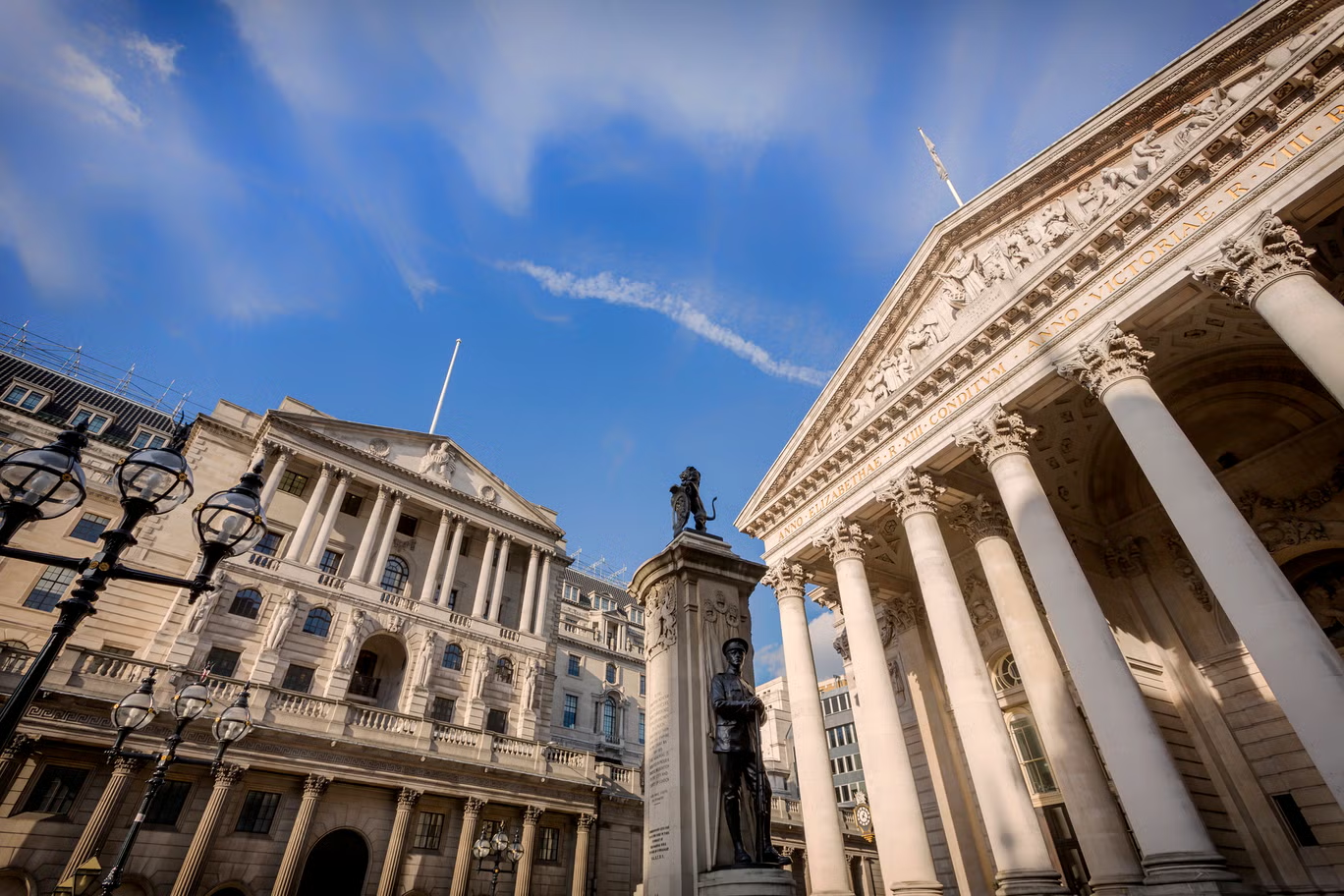
 B of E’s Threadneedle Street headquarters
![Reblog this post [with Zemanta]](https://i0.wp.com/img.zemanta.com/reblog_e.png?w=700)
You must be logged in to post a comment.