Posts Tagged ‘England’
“Whosoever is delighted in solitude is either a wild beast or a god”*…
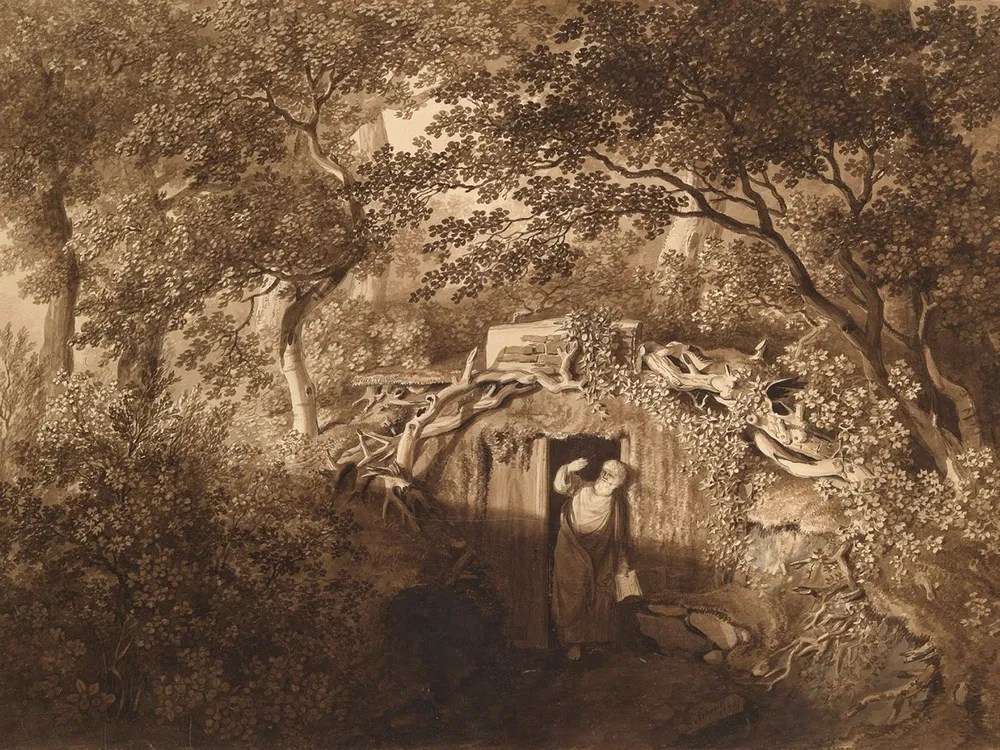
… and, whichever, rich 18th century British landowners wanted one. As Shoshi Parks explains, they hired men who agreed to live in isolation on their estates for as long as seven years…
The Honorable Charles Hamilton, an 18th-century British aristocrat and member of Parliament, was explicit in his advertisement. The ornamental hermit he was recruiting to live in the sprawling gardens at his Painshill estate in Cobham, England, must be silent, never speaking to the servants who brought him his daily meals. He must wear a goat’s hair robe and never cut his hair, nails or beard. Shoes were out of the question.
If and only if the hermit fulfilled the terms of his contract, living in solitary contemplation without stepping foot outside of the estate for seven years, he would be rewarded with £500 to £700 (around $95,000 to $130,000 today). Mr. Remington (first name unknown), the man hired to fill the role, lasted just a fraction of that time. Three weeks after arriving, he was discovered drinking at a local pub—or so the legend goes.
Remington was one of a handful of men to cash in on—or, in his case, fail to cash in on—England’s 18th-century ornamental hermit craze. The short-lived trend, which peaked between roughly 1727 and 1830, was one of the most memorable to come out of the era’s shift from perfectly pruned, geometrically aligned gardens to wild, untamed ones in which “the irregularities and asymmetry of nature were charmingly inspirational,” says Todd Longstaffe-Gowan, a landscape architect and the author of English Garden Eccentrics: Three Hundred Years of Extraordinary Groves, Burrowings, Mountains and Menageries.
Aristocrats outfitted their new landscape gardens with unexpected, whimsical elements like caves, mountains, aviaries and menageries. But the hermitage, a secluded retreat for a real or imagined hermit that could look like anything from a grotto to a treehouse, eclipsed them all. “By 1750, if you only put in one structure in your garden, it would have been a hermitage,” says Edward S. Harwood, an art historian at Bates College in Lewiston, Maine.
Hermits, or individuals who withdraw from society to focus on spiritual, philosophical or intellectual pursuits, have served as a source of mystical power and curiosity for much of human history. Paul of Thebes and Anthony of Egypt, both saints born in the third century, are widely considered the first Christian hermits. Some early hermits lived in complete seclusion, while others were regarded as oracles whose access to the divine could provide ordinary Christians with insight, prophecies and medical cures, says Robin Darling Young, a historian at the Catholic University of America in Washington, D.C.
By the Middle Ages, “hermits were thick on the ground,” says Harwood. Famous medieval figures who lived at least part of their lives in isolated introspection include Pope Celestine V, who resided in a cave before assuming leadership of the church in 1294, and the 14th-century anchoress Julian of Norwich, who wrote the oldest surviving English language text known to be authored by a woman. But the one-two punch of the 16th-century Protestant Reformation, which delegitimized the monastic and ascetic traditions to which many hermits belonged, and the 17th- and 18th-century Age of Enlightenment, which favored scientific reason over spiritual learning, “largely eliminated” the practice as a form of religious devotion, says Darling Young.
During England’s Georgian period, which spanned 1714 to 1830, a new form of hermeticism took shape. Combining Enlightenment ideals with more traditional elements of a reclusive lifestyle, the ornamental hermit “became a representation of the aspiration to the simple life, the life of rural retirement characterized by philosophical and scientific curiosity,” writes historian Gordon Campbell in The Hermit in the Garden: From Imperial Rome to Ornamental Gnome. These individuals—whether real or imagined—resided in garden hermitages, structures “predominantly used as architectural feature[s] to draw the eye in the landscape,” notes the United Kingdom’s National Trust…
More on the remarkable practice of using real people as garden decorations: “Ornamental Hermits Were 18th-Century England’s Must-Have Garden Accessory,” from @smithsonian.
* Aristotle
###
As we get away from it all, we might recall that it was on this date in 1975 that labor leader James “Jimmy” Hoffa disappeared from the parking lot of the Machus Red Fox restaurant in Bloomfield Hills, Michigan, a suburb of Detroit, at about 2:30 p.m. He was never seen nor heard from again (and was declared dead on July 30, 1982). While it is generally believed that he was murdered by the Mafia, with whom he worked closely as leader of the Teamsters Union, his legacy and the circumstances of his disappearance continue to stir debate.

“Her Majesty’s government should do nothing to place in peril our opium revenues. As for preventing the manufacturing of opium, and the sale of it in China, that is far beyond your power.”*

An excerpt from Linda Jaivin‘s The Shortest History of China…
European traders had been trying to get a foothold in China for centuries. As eager as the Europeans were for Chinese tea, silk, and porcelain, the Chinese remained indifferent to European goods. The Qing restricted access to ports, confining foreign merchants to Guangzhou (Canton), from October to March. Foreign traders resented this, as well as having to work with licensed Chinese intermediaries and abide by local law. In 1793, the British sent an experienced diplomat, Lord George Macartney, to Qianlong’s court carrying a letter arguing for greater access to the empire’s markets, including a reduction in tariffs, the ability of merchants to live in China year-round, and the stationing of an ambassador in Beijing.
The eighty-year-old Qianlong agreed to receive the Englishman at his imperial hunting lodge at Chéngdé, northeast of Beijing. The protocol of an imperial audience demanded a kowtow. Macartney refused, instead bowing on one knee before Qianlong, just as he did with his own sovereign, King George III. Qianlong received him courteously anyway, but once Macartney left and his letter was translated, Qianlong instructed his ministers to bolster the Qing’s coastal defenses, predicting that England, ‘fiercer and stronger than other countries in the Western Ocean,’ might ‘stir up trouble.’ To Macartney he prefaced his reply by saying that the Qing had everything it needed in abundance: ‘I set no value on objects strange or ingenious, and have no use for your country’s manufactures.’
The British East India Company, which enjoyed a British monopoly on East Asian trade, had something for which at least some Chinese had use: opium, grown in British-controlled India. Opium was already cultivated in China, but in small quantities — soldiers and manual laborers relied on it for pain relief, and some of the idle rich smoked it for pleasure. In 1729, the British sold two hundred chests of opium into China, each containing almost sixty kilograms of the drug. In 1790, three years before Macartney’s visit, they sold 4,054 chests. That number increased steadily.
Qianlong retired in 1796 in a gesture of filial piety, not wanting his reign to outlast that of his revered grandfather, Kangxi. This left the problem of opium to his successor, Jiāqìng (r. 1796-1820).
In 1815, the British sent another envoy, Lord Amherst, to Beijing. Jiāqìng expelled him after another tussle over the kowtow.
Opium addiction began to damage the fabric of Chinese society. The illegal trade fostered corruption, and silver drained from the imperial coffers. Debate raged in the court of Jiāqìng and his successor, Dàoguāng (r. 1821-1850), over whether to legalize opium — encouraging domestic production and limiting trade-related corruption — or ban it. In 1838, Daoguang decided on prohibition. In March 1839, the emperor sent the official Lín Zéxú (1785-1850) to Guangzhou, the hub of the opium trade, to implement the ban. By July, Lin had arrested thousands of addicts and confiscated almost twenty-three thousand kilos of opium, as well as seventy thousand pipes.
Lín Zéxú demanded that the 350 or so foreign traders in Guangzhou surrender their opium. As tensions rose, he locked them in their warehouses. Chinese soldiers blew horns and banged gongs to increase the pressure on them. It took six weeks, but the foreigners handed over twenty thousand chests. Now in possession of almost 1.4 million kilos of opium, Lín Zéxú had it mixed with water, salt, and lime and flushed out to sea.
In response, British warships blockaded the entrance to Guangzhou’s harbor, smashed through Chinese defenses, and captured ports including Shanghai and Ningbo, blocking maritime traffic on the Grand Canal and lower Yangtze. This became known as the First Opium War.
Under duress, the Qing signed the Treaty of Nanjing in 1842, which granted the British access to Guangzhou, Shanghai, and three other ‘treaty ports.’ It also ceded the island of Hong Kong — ‘fragrant port,’ named for the spice trade — to the British in perpetuity. (The British foreign secretary at the time, Lord Palmerston, questioned the wisdom of acquiring ‘a barren island with hardly a House upon it’ that would never become a great ‘Mart of Trade.’) It imposed indemnities on the Qing totaling twenty-one million silver dollars. The United States, France, and other nations piled on with their own demands, including ‘extraterritoriality’ exemption from local justice for foreigners who committed crimes in China. Chinese law would not apply within ‘concessions’ those parts of the treaty ports controlled by foreign powers. These agreements were the first of what are called the Unequal Treaties, beginning a century of China’s humiliation at the hands of various imperialist powers. They heralded the beginning of the end, not just of the Qing, but of the dynastic system by which China had been ruled for thousands of years…
Via the invaluable Delancyplace (@delanceyplace): “The Opium Wars.”
* Lord Ellenborough, 1843
###
As we contemplate colonialism, we might recall that it was on this date in 1812 that President James Madison signed the declaration of war against Great Britain that formally launched the War of 1812.
Three U.S. incursions into Canada launched in 1812 and 1813 had been handily turned back by the British despite the fact that the bulk of British force was tied up in an unpleasantness with the Emperor of France and his troops. But the decline of Napoleon’s strength freed the English to devote more resources to the West… leading to the 1814 burning of the White House, the Capital, and much of the rest of official Washington by British soldiers (retaliating for the U.S. burning of some official buildings in Canada). Still, by the end of 1814 a combination of naval and ground victories by the Americans had driven the British back to Canada, and on December 14, 1814 the Treaty of Ghent, ending the war, was signed… sadly for the British, word of the accord did not reach troops on the Gulf Coast in time to head off an attack (on January 8, 1815) on New Orleans– which was turned back by American forces led by Andrew Jackson. Jackson became a national hero, who rode his fame to the (rebuilt) White House; Johnny Horton got a Number One record out of it (Billboard Hot 100, 1959)… and the English had to console themselves with their victory at Waterloo later that year– on this date in 1815…
“In a country well governed, poverty is something to be ashamed of. In a country badly governed, wealth is something to be ashamed of.”*…

The image above captures the received wisdom about extreme poverty and the way that it has declined over the last couple of centuries. But Dylan Sullivan and Jason Hickel would have us take a longer view, suggesting that the story is neither so simple nor so laudatory as we might assume…
Highlights:
• The common notion that extreme poverty is the “natural” condition of humanity and only declined with the rise of capitalism rests on income data that do not adequately capture access to essential goods.
•Data on real wages suggests that, historically, extreme poverty was uncommon and arose primarily during periods of severe social and economic dislocation, particularly under colonialism.
• The rise of capitalism from the long 16th century onward is associated with a decline in wages to below subsistence, a deterioration in human stature, and an upturn in premature mortality.
• In parts of South Asia, sub-Saharan Africa and Latin America, wages and/or height have still not recovered.
• Where progress has occurred, significant improvements in human welfare began only around the 20th century. These gains coincide with the rise of anti-colonial and socialist political movements.
“Capitalism and extreme poverty: A global analysis of real wages, human height, and mortality since the long 16th century.” By way of context, Hickel is a “degrowth” advocate. In any case, the data is arresting– and surely worth pondering.
* Confucius
###
As we dig deeper, and lest we think pre-capitalist life was Edenic, we might recall that it was on this date in 1381 that “boy-King” Richard II met with the leaders of the Peasants’ Revolt (AKA Wat Tyler‘s Rebellion or the Great Rising), which had arisen for a variety of reasons, including the socio-economic and political tensions generated by the Black Death in the 1340s and the high taxes resulting from the conflict with France during the Hundred Years’ War.
At the meeting, Richard acceded to some of their demands– most notably, the abolition of serfdom. But after he had the opportunity to gather his forces, he put the rebellion down, rounded up the leaders (some of whom were executed; others imprisoned)… and re-instituted serfdom.

“Study the past if you would define the future”*…

Six Degrees of Francis Bacon (SDFB) is a digital reconstruction of the early modern social network that scholars and students from all over the world will be able to collaboratively expand, revise, curate, and critique. Historians and literary critics have long studied the way that early modern people associated with each other and participated in various kinds of formal and informal groups. By data-mining existing scholarship that describes relationships between early modern persons, documents, and institutions, we have created a unified, systematized representation of the way people in early modern England were connected…

Follow the connections at Six Degrees of Francis Bacon.
* Confucius
###
As we marvel at the interconnectedness of it all, we might recall that it was on this date in 1606 that The Virginia Company loaded three ships with settlers, who set sail to establish Jamestown, Virginia, the first permanent English settlement in the Americas. As this was the UK’s first colony, today can be considered the birthday of the British Empire.

A rendering of the initial settlement/fort at Jamestown, c. 1607
“Eating is an agricultural act”*…

… at least in these post-hunter-gatherer days, it is… and therein lies the problem?
To science we owe dramatic changes in our smug self-image. Astronomy taught us that our earth isn’t the center of the universe but merely one of billions of heavenly bodies. From biology we learned that we weren’t specially created by God but evolved along with millions of other species. Now archaeology is demolishing another sacred belief: that human history over the past million years has been a long tale of progress. In particular, recent discoveries suggest that the adoption of agriculture, supposedly our most decisive step toward a better life, was in many ways a catastrophe from which we have never recovered. With agriculture came the gross social and sexual inequality, the disease and despotism, that curse our existence.
At first, the evidence against this revisionist interpretation will strike twentieth century Americans as irrefutable…
Read Jared Diamond’s (1987) refutation in “The Worst Mistake in the History of the Human Race.”
* Wendel Berry
###
As we hunt and gather, we might spare a celebratory thought for “the only man to enter Parliament with honest intentions”– it’s Guy Fawkes Day.
On the eve of a general parliamentary session scheduled for November 5, 1605, Sir Thomas Knyvet, a justice of the peace, found Guy Fawkes lurking in a cellar of the Parliament building, and ordered the premises thoroughly searched. Nearly two tons of gunpowder were found hidden within the cellar. The authorities determine that the suspect was a participant in an English Catholic conspiracy, largely organized by Robert Catesby, to annihilate England’s entire Protestant government including King James I. Over the next few months, English authorities killed or captured all of the conspirators in the “Gunpowder Plot,” and also arrested, tortured, or killed dozens of innocent English Catholics. Fawkes himself was executed on January 31, 1606.
The day after Fawkes arrest, November 5, 1605 Londoners were encouraged to celebrate the King’s escape from assassination by lighting bonfires, “always provided that ‘this testemonye of joy be carefull done without any danger or disorder'”; an Act of Parliament later that year designated November 5th as an official day of thanksgiving for “the joyful day of deliverance”, and remained in force until 1859.
But as historian Lewis Call has observed, Fawkes is now “a major icon in modern political culture.” The image of Fawkes’s face has become “a potentially powerful instrument for the articulation of postmodern anarchism” during the late 20th century, exemplified by the mask worn by V in the comic book series V for Vendetta, who fights against a fictional fascist English state, and by activists who were part of the Occupy Movement.

You must be logged in to post a comment.