One punctuation mark in particular is having a moment… a not-altogether-welcome one…
Of the many tips and tricks people are coming up with to determine whether a piece of writing has been written with a little help from AI, the world seems to have homed in on the use of one particular punctuation mark: the em dash.
Though some writers have rushed in to defend the dash — the overuse of which sits alongside pizza glue and bluebberrygate in the pantheon of things people laugh at AI about — perhaps a key reason the prevalence of the punctuation mark seems so bot-like to readers is that, as writers, Americans hardly use it.
Indeed, per a recent YouGov survey, dashes are some of the least used pieces of punctuation in Americans’ arsenals, ranking just ahead of colons and semicolons, per the poll.
As you might imagine, the survey revealed that American adults who describe themselves as “good” or “very good” writers are more likely to use the rarer forms of punctuation on the list. However, for the majority of Americans, marks like the semicolon and the em dash remain mostly reserved for esteemed authors and English teachers… or those who aren’t above enlisting a chatbot for a little help to jazz up their communications.
Interestingly, the vast majority of Americans said they do little writing outside of sending texts and emails, with journaling, nonfiction and fiction writing, and other forms of creative or academic writing all falling by the wayside in 2025, according to YouGov’s research…
As we muse on marks, we might that it was on this date in 1956 that Fortran was introduced to the world. A third-generation, compiled, imperative computer programming language that is especially suited to numeric computation and scientific computing. Developed by an IBM team led by John Backus, it became the go-to language for high-performance computing and is used for programs that benchmark and rank the world’s fastest supercomputers.
In a 1979 interview with Think, the IBM employee magazine, Backus explained Fortran’s origin: “Much of my work has come from being lazy. I didn’t like writing programs, and so, when I was working on the IBM 701, writing programs for computing missile trajectories, I started work on a programming system to make it easier to write programs.”
To the item at the top, it’s worth noting that Fortran is a language with four uses for the dash– subtraction operator, negative sign, line continuation symbol, and range separator (in data processing)– but no em dash.
For a piece of Fortran’s pre-history, see here; and for an important extension, see here.
Diagram from S. W. Clark, A Practical Grammar (1847)
Hunter Dukes in Public Domain Review, on how scholars and pedagogues in the U.S. began to illustrate the principles of grammar, more specifically, how they began to diagram sentences…
“Once you really know how to diagram a sentence, really know it, you know practically all you have to know about English grammar”, Gertrude Stein once claimed. “I really do not know that anything has ever been more exciting than diagramming sentences. . . I like the feeling the everlasting feeling of sentences as they diagram themselves.” While one student’s lexical excitement is surely another’s slow death by gerund, Stein cuts to the heart of the grammatical pull. Is grammar prescriptive and conventional, something one learns to impose on language through trial and error? Or do sentences, in a sense, diagram themselves, revealing an innate logic and latent structure in language and the mind? More than a century before Noam Chomsky popularized the idea of a universal grammar, linguists in the United States began diagramming sentences in an attempt to visualize the complex structure — of seemingly divine origins — at their mother tongue’s core.
The history of diagramming sentences in the United States begins with James Brown’s American Grammar (1831). “Language is an emanation from God”, he writes. “As a gift, it claims our servitude; as a science, it demands our highest attention.” Accordingly, the student of grammar can lift himself up (educationally, devotionally) by knuckling down. “The mind becomes a passenger; the body his chariot; ideas his baggage; the earth his inn; hope his food; and another world his destination.” It was in American Grammar that Brown debuted construing as a method for parsing sentences using a system of square and round brackets to isolate major and minor sections. Major sections are “mechanically independent”; minor sections are “mechanically dependent”. Brown called this form of analysis close reading, but construing was only one half of the system. “As construing is a critical examination of the constructive relation between the sections of a sentence, so scanning is a critical investigation of the constructive relation between the words of a section.” Scanning involves ranking minor sections in ascending numerical order based on their relational distance from the major section. Playing a kind of grammarian god, Brown uses John 1 to demonstrate how his system can cleave sentential flesh. (In the beginning) [was the word] (and the word was) (with God) (and the word was God)…
A different Biblical example from James Brown, The American Grammar (1831)
Dukes goes on to trace, with wonderful examples, those who followed Brown into the syntactical thicket; for example…
Diagram from S. W. Clark, A Practical Grammar (1847)
Diagram from Solomon Barrett, The Principles of Grammar (1857)
As we parse, we might spare a thought for a man whose sentences were eminently diagrammable, Kenneth Grahame; he died on this date in 1932. A career officer at the Bank of England–he retired as its Secretary– he is better remembered as the author of tales he created to delight his son Alastair, The Wind in the Willows and The Reluctant Dragon (both of which were made into films by Disney: The Adventures of Ichabod and Mr. Toad and The Reluctant Dragon).
And as Gail Sherman observes, that principle operates at a pretty basic level…
There is a Royal Order of Adjectives, and you follow it without knowing what it is—a particular sequence to use when more than one adjective precedes a noun. There are exceptions, of course, because English is three languages in a trenchcoat. According to the Cambridge Dictionary, in general, the proper order is:
Opinion Size Physical quality Shape Age Color Origin Material Type Purpose
Most people couldn’t tell you this rule, but everyone follows it. If you use the wrong order, it just sounds weird. If you have a fancy new blue metal lunchbox but call it a metal new fancy blue lunchbox, people might be worried you are having a stroke…
As we parse, we might send powerfully-phrased birthday greetings to a spare but graceful user of adjectives, Seymour Wilson “Budd” Schulberg; he was born on this date in 1914. A screenwriter, television producer, novelist, and sportswriter, Schulberg is best remembered for his novels What Makes Sammy Run? (1941) and The Harder They Fall (1947), as well as his screenplays for On the Waterfront (1954, for which he received an Academy Award) and A Face in the Crowd (1957).
As a sportswriter, Schulberg was most famously chief boxing correspondent for Sports Illustrated. He wrote some well-received books on boxing, including Sparring with Hemingway and was inducted into the International Boxing Hall of Fame (in 2002).
The son of B. P. Schulberg, head of Paramount Studios in its golden age, Budd wrote Moving Pictures: Memoirs of a Hollywood Prince, an autobiography covering his youth in Hollywood, growing up in the 1920s and 1930s among the famous.
… Watson, a historian and philosopher of science and a teacher of writing and the humanities—in other words, a Renaissance woman—gives us a deceptively playful-looking book that turns out to be a scholarly treatise on a sophisticated device that has contributed eloquence and mystery to Western civilization.
The semicolon itself was a Renaissance invention. It first appeared in 1494, in a book published in Venice by Aldus Manutius. “De Aetna,” Watson explains, was “an essay, written in dialogue form,” about climbing Mt. Etna. Its author, Pietro Bembo, is best known today not for his book but for the typeface, designed by Francesco Griffo, in which the first semicolon was displayed: Bembo. The mark was a hybrid between a comma and a colon, and its purpose was to prolong a pause or create a more distinct separation between parts of a sentence. In her delightful history, Watson brings the Bembo semicolon alive, describing “its comma-half tensely coiled, tail thorn-sharp beneath the perfect orb thrown high above it.” Designers, she explains, have since given the mark a “relaxed and fuzzy” look (Poliphilus), rendered it “aggressive” (Garamond), and otherwise adapted it for the modern age: “Palatino’s is a thin flapper in a big hat slouched against the wall at a party.”
The problem with the semicolon is not how it looks but what it does and how that has changed over time. In the old days, punctuation simply indicated a pause. Comma, colon: semicolon; period. Eventually, grammarians and copy editors came along and made themselves indispensable by punctuating (“pointing”) a writer’s prose “to delineate clauses properly, such that punctuation served syntax.” That is, commas, semicolons, and colons were plugged into a sentence in order to highlight, subordinate, or otherwise conduct its elements, connecting them syntactically. One of the rules is that, unless you are composing a list, a semicolon is supposed to be followed by a complete clause, capable of standing on its own. The semicolon can take the place of a conjunction, like “and” or “but,” but it should not be used in addition to it. This is what got circled in red in my attempts at scholarly criticism in graduate school. Sentence length has something to do with it—a long, complex sentence may benefit from a clarifying semicolon—but if a sentence scans without a semicolon it’s best to leave it alone.
Watson has been keeping an eye out for effective semicolons for years. She calculates that there are four-thousand-odd semicolons in “Moby-Dick,” or “one for every 52 words.” Clumsy as nineteenth-century punctuation may seem to a modern reader, Melville’s semicolons, she writes, act like “sturdy little nails,” holding his wide-ranging narrative together….
As we punctuate punctiliously, we might recall that it was on this date in 1990 that CBS aired the final episode of Bob Newhart’s second successful sitcom series, Newhart, in which he co-starred with Mary Fran through a 184 episode run that had started in 1982. Newhart had, of course, had a huge hit with his first series, The Bob Newhart Show, in which he co-starred with Suzanne Pleshette.
Newhart‘s ending, its final scene, is often cited as the best finale in sit-com history.
At first this seems to mean “No head injury should be ignored — even if it’s trivial,” but reflection shows that it really means “All head injuries should be ignored — even trivial ones.”
“This difficulty has certain interesting properties,” write psychologists Peter Wason and Shuli Reich. “When the correct interpretation was explained it was often adamantly rejected in our informal studies, as if the informants literally could not see an alternative view.”…
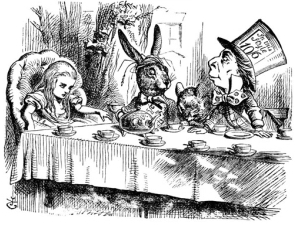
“Then you should say what you mean,” the March Hare went on.
“I do,” Alice hastily replied; “at least—at least I mean what I say—that’s the same thing, you know.”
“Not the same thing a bit!” said the Hatter…
Alice’s Adventures in Wonderland, Chapter VII [source, and of the image above]
###
As we grapple with grammar, we might send silly birthday greetings to Joseph Grimaldi; he was born on this date in 1778. The most popular English entertainer of his day, Grimaldi was an actor, comedian, and dancer who effectively invented the character of The Clown as today we know it. He became so dominant on the London comic stage that harlequinade Clowns became known as “Joey”; both that nickname and the trademark whiteface make-up that Grimaldi created were, and still are, used widely by all types of clowns. His catchphrases “Shall I?” and “Here we are again!” still get laughs in pantomimes.
Grimaldi’s memoir, edited by his fan Charles Dickens (who had, as a child, seen Grimaldi perform), was a best-seller. The annual memorial service held for him (in February at Holy Trinity Church in the London Borough of Hackney) is attended by hundreds of clown performers from all over the world– who attend in full make-up and costume.







You must be logged in to post a comment.