Posts Tagged ‘Charles Dodgson’
“Two possibilities exist: Either we are alone in the Universe or we are not. Both are equally terrifying.”*…
Happy Charles Dodgson’s (Lewis Carroll’s) Birthday!
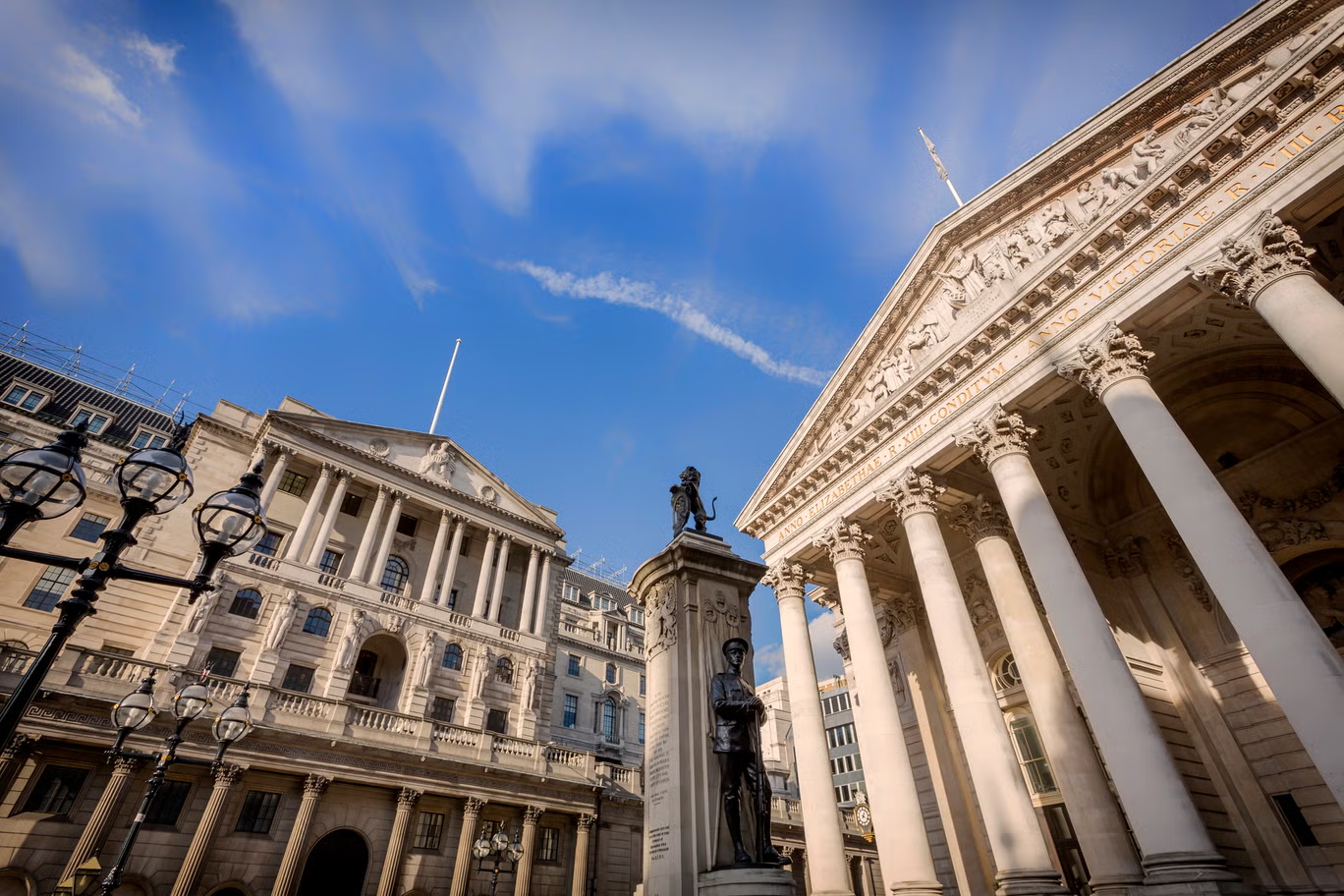
Just when we thought that there was nothing else about which to worry, a different kind of “alien” concern: Helen McCaw, and economist and former senior analyst at the Bank of England, has written to her former employer with a warning…
The UK must plan for a financial crisis that would be triggered if the US government announces that aliens exist, a former Bank of England expert has said.
Helen McCaw, who served as a senior analyst in financial security at the UK’s central bank, has written to Andrew Bailey, the Bank of England’s governor, urging him to set out contingencies in case the White House ever confirms the existence of alien life, according to The Times.
Ms McCaw, who worked for the Bank of England for 10 years until 2012, said politicians and bankers can no longer afford to dismiss talk of alien life, and warned a declaration of this nature could trigger bank collapses…
Read on: “Bank of England must plan for a financial crisis triggered by aliens, says former policy expert,” from @the-independent.com.
* often attributed to Arthur C. Clarke (but likely from Stanley Kubrick, quoting Carl Sagan [who was riffing on a Walt Kelly Pogo quote])
###
As we acclimate to chaos, we might recall that it was on this date in 2021 that Resident Alien debuted (on Syfy).
Resident Alien is based on a comic book of the same name [by Peter Hogan and Steve Parkhouse]. Created by Chris Sheridan, Alan Tudyk plays an alien who crash-lands in Patience, Colorado and immediately goes on a killing spree including the town’s doctor, Harry Vanderspeigle.
Taking on the form of Harry, the alien continued killing thinking that by doing so, it would be good for planet Earth. But then, he was overcome with human emotions and started questioning the morality of it all…
– source

“But I don’t want to go among mad people,” Alice remarked.
“Oh, you can’t help that,” said the Cat: “we’re all mad here. I’m mad. You’re mad.”
“How do you know I’m mad?” said Alice.
“You must be,” said the Cat, “or you wouldn’t have come here.”
– Lewis Carroll
“Say what you will about the ten commandments, you must always come back to the pleasant fact that there are only ten of them”*…
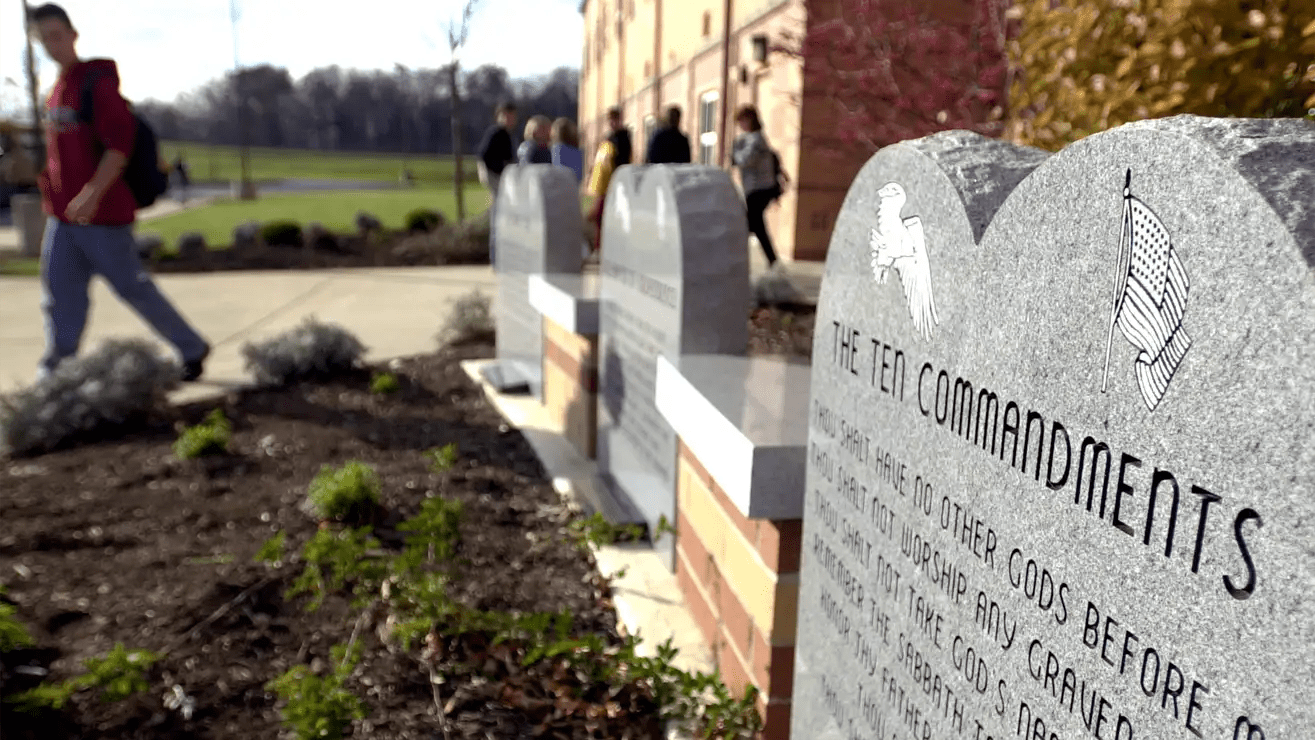
The Republican Governor of Louisiana, Jeff Landry, recently signed a law requiring state’s classrooms to display a copy of the Ten Commandments. The Onion explores the pros and cons of requiring religious doctrine in public schools…
- PRO: A good way to cover up the bullet holes.
- CON: Use of woke “Thou/Thy” pronouns.
- PRO: Great example of counting to 10 in the real world.
- CON: Just finished building golden calf.
- PRO: Least out-of-date thing in classroom.
- CON: True believers would display the entirety of the King James Bible.
- PRO: Distracts from how weird the Pledge of Allegiance is.
- CON: Not enough funding to print it out.
“Pros And Cons of Displaying The 10 Commandments in Every Classroom,” from @TheOnion.
* H. L. Mencken
###
As we ponder piety, we might recall that on this date in 1862, Charles Lutwidge Dodgson, a young Oxford mathematics don, took the daughters of the Dean of Christ Church College– Alice Liddell and her sisters– on a boating picnic on the River Thames in Oxford. To amuse the children he told them the story of a little girl, bored by a riverbank, whose adventure begins when she tumbles down a rabbit hole into a topsy-turvy world called “Wonderland.” The story so captivated the 10-year-old Alice that she begged him to write it down. The result was Alice’s Adventures in Wonderland, published in 1865 under the pen name “Lewis Carroll,” with illustrations by John Tenniel.

“The snake that cannot shed its skin perishes”*…

From Rebecca Saltzman…
As America’s seventh-ranked patriotic bunting company, we’re proud to fulfill all of your Fourth of July decorating needs this year. Also, due to a factory mix-up, our bunting this year is made of live snakes.
The American people rely on us for red, white, and blue fabric to hang on their porches. However, it has recently come to our attention that many customers have instead received a writhing mass of serpents. Are they at least harmless? No, they’re quite deadly. But we hope you will be reassured to know that the snakes can play “Yankee Doodle” on their rattles, which is a step up from our plastic bunting option.
How could this mistake happen? Our bunting factory operates under lax, or one might say non-existent, quality control standards. We also built our factory on top of a known snake nesting habitat. Our entire factory is infested with snakes.
To determine whether you’ve received bunting or snakes, we have put together the following helpful guidance…
Read on: “We Apologize That Instead of July Fourth Bunting, We Accidentally Shipped You a Box Full of Snakes,” from @beccasaltz in @mcsweeneys.
* Friedrich Nietzsche
###
As we parse patriotism, we might recall that on this date in 1862 (88 years after the Declaration of Independence was adopted by the Second Continental Congress on this same date), Charles Lutwidge Dodgson, a young Oxford mathematics don, took the daughters of the Dean of Christ Church College– Alice Liddell and her sisters– on a boating picnic on the River Thames in Oxford. To amuse the children he told them the story of a little girl, bored by a riverbank, whose adventure begins when she tumbles down a rabbit hole into a topsy-turvy world called “Wonderland.” The story so captivated the 10-year-old Alice that she begged him to write it down. The result was Alice’s Adventures in Wonderland, published in 1865 under the pen name “Lewis Carroll,” with illustrations by John Tenniel.
“When somebody says it’s not about the money, it’s about the money”*…

Further to yesterday’s post (about the relevance of Edith Wharton’s observations of her Gilded Age to ours), Dorinda Evans takes a look at rough contemporary of Wharton’s, and at his (similarly relevant) work…
After supposedly stealing 500,000 francs from his bank, the mysterious Victor Dubreuil (b. 1842) turned up penniless in the United States and began to paint dazzling trompe l’oeil images of dollar bills. Once associated with counterfeiting and subject to seizures by the Treasury Department, these artworks [are nowconsidered] unique anti-capitalist visions among the most daring and socially critical of his time…

The fascinating story of Victor Dubreuil’s cryptic currencies and the questions they raise about value and values: “Illusory Wealth,” in @PublicDomainRev.
For an illuminating look at Dubreuil’s spiritual successor, see Lawrence Weschler’s wonderful Boggs: A Comedy of Values.
For a loosely analogous artist: “Nobody knows what a dollar is, what the word means, what holds the thing up, what it stands in for… what the hell are they? What do they do? How do they do it?”
And for an appreciation of trompe l’oeil (and its influence on Cubism), see “Feinting Spells.”
* H.L. Mencken
###
As we contemplate currency, we might pour a cup of birthday tea for English mathematician, logician, photographer, and Anglican cleric, Charles Lutwidge Dodgson– better known as the author Lewis Carroll– born on this date in 1832.
“There is no use in trying,” said Alice; “one can’t believe impossible things.”
“I dare say you haven’t had much practice,” said the Queen. “When I was your age, I always did it for half an hour a day. Why, sometimes I’ve believed as many as six impossible things before breakfast.”
– Alice in Wonderland (nee “Alice’s Adventures Underground,” then “Alice’s Adventures in Wonderland”)

Oh, and… Happy Mozart’s Birthday!
“I spend too much money on books, many of which I will never read. I know that already. I certainly intend to read all of them, more or less. My intentions are good. Anyway, it’s my money. And I’ll bet you do it too.”*…

‘Twas ever thus. As Denise Gigante eaplains, nineteenth-century New York City was filled with books, bibliophilia, and marginalia…
By the nineteenth century, readers were feeling lost in a sea of print, and though this feeling was not entirely new, it was exacerbated by new print technologies and cheap reprints flooding the literary marketplace….
In New York in the 1840s, books and printed matter were everywhere. Up and down Broadway, boxes of used books cluttered the sidewalks. Newsstands stocked papers, literary journals, and magazines, while street vendors hawked the latest serialized novels by Dickens: “He-e-ere’s the New World—Dick’s new work. Here’s the New World—buy Master Humphrey, sir?”
From storefront windows, new books appealed to pedestrians with siren songs of entertainment and instruction at bargain prices, while literary annuals, gift books, and illustrated editions catered to an expanding American readership. New steam-powered rotary printing technology invented in New York in the mid-1840s revolutionized the print industry, rolling out thousands of pages per hour, while other innovations, such as stereotype printing, enabled a boom in cheap reading matter…
When technologically-enhanced supply met increased demand: “Choice Reading,” from @laphamsquart.
See also: “The value of owning more books than you can read.”
* Nick Hornby
###
As we read on, we might note that it was on this date in 1865 that a notable volume joined the parade of new books described in the article linked above: Alice’s Adventures in Wonderland (and here) was written by Charles Lutwidge Dodgson– better known as Lewis Carroll– went on sale in America for the first time (a revised edition of the first British version). Copies of the first U.S. edition, with illustrations created by John Tenniel, sold out quickly; the volume has never gone out of print since.

First edition cover (source)
You must be logged in to post a comment.