Posts Tagged ‘snakes’
“Always carry a flagon of whiskey in case of snakebite and furthermore always carry a small snake.”*…

Your correspondent has to be away for a few days, so (Roughly) Daily will, for a time, be more roughly than daily… Regular service should resume on or around Thursday, August 10. Meantime, a little reminder of the extraordinary pageant that is life…
Amar Guriro on a community with a unique lifestyle…
… This is the mound of snake charmers, Jogi Daro, which was once situated about one-and-a-half kilometres away from Umerkot city [in Pakistan]. With Umerkot’s population swelling and new housing schemes having popped up to meet demand, Jogi Daro now finds itself part of the city proper.
Each house owns at least one black Indian cobra, but most actually own several snakes, including cobras, kraits and vipers, locally known as Lundi Bala. None of the serpents are defanged but children play with them as if they were toys. [Ustad Misri, snake charmer and chieftain of his tribe] says this is because a certain contract exists between the jogis and the serpents living with them.
“A snake cannot bite a jogi child, and even if it does, it will not harm our child since we administer a drop of snake venom as suti (first food) to our newborns. This establishes immunity against snake poison for their entire life,” claims Ustad Misri.
Jogis or snake charmers are a gypsy community in Sindh. They mostly wander around the entire year from one place to another, either in search of a livelihood or a snake…
The way of the snake: “Rule of the jogi,” from @amarguriro in @Dawn_News.
See also: “How did snakes lose their limbs? Mass genome effort provides clues,” from @ScienceMagazine.
* W. C. Fields
###
As we ponder partnerships, we might recall that it was on this date in 1769 that the Portolá expedition, a group of Spanish explorers led by Gaspar de Portolá, made the first written record of the tar pits in 1769. Father Juan Crespí wrote:
While crossing the basin, the scouts reported having seen some geysers of tar issuing from the ground like springs; it boils up molten, and the water runs to one side and the tar to the other. The scouts reported that they had come across many of these springs and had seen large swamps of them, enough, they said, to caulk many vessels. We were not so lucky ourselves as to see these tar geysers, much though we wished it; as it was some distance out of the way we were to take, the Governor [Portolá] did not want us to go past them. We christened them Los Volcanes de Brea [the Tar Volcanoes].
(The English name of the site is redundant, as “La Brea” comes from the Spanish word for “tar.”)
While evidence suggests that prehistoric native Americans used and traded the asphalt, the site is now noted for the fossils found there (first by Professor William Denton in 1875). Among the prehistoric Pleistocene species associated with the La Brea Tar Pits are Columbian mammoths, dire wolves, short-faced bears, American lions, ground sloths (predominantly Paramylodon harlani, with much rarer Megalonyx jeffersonii and Nothrotheriops shastensis), coyotes, ancient bison, and the state fossil of California, the saber-toothed cat (Smilodon fatalis)– largely dating from the last glacial period.

“The snake that cannot shed its skin perishes”*…

From Rebecca Saltzman…
As America’s seventh-ranked patriotic bunting company, we’re proud to fulfill all of your Fourth of July decorating needs this year. Also, due to a factory mix-up, our bunting this year is made of live snakes.
The American people rely on us for red, white, and blue fabric to hang on their porches. However, it has recently come to our attention that many customers have instead received a writhing mass of serpents. Are they at least harmless? No, they’re quite deadly. But we hope you will be reassured to know that the snakes can play “Yankee Doodle” on their rattles, which is a step up from our plastic bunting option.
How could this mistake happen? Our bunting factory operates under lax, or one might say non-existent, quality control standards. We also built our factory on top of a known snake nesting habitat. Our entire factory is infested with snakes.
To determine whether you’ve received bunting or snakes, we have put together the following helpful guidance…
Read on: “We Apologize That Instead of July Fourth Bunting, We Accidentally Shipped You a Box Full of Snakes,” from @beccasaltz in @mcsweeneys.
* Friedrich Nietzsche
###
As we parse patriotism, we might recall that on this date in 1862 (88 years after the Declaration of Independence was adopted by the Second Continental Congress on this same date), Charles Lutwidge Dodgson, a young Oxford mathematics don, took the daughters of the Dean of Christ Church College– Alice Liddell and her sisters– on a boating picnic on the River Thames in Oxford. To amuse the children he told them the story of a little girl, bored by a riverbank, whose adventure begins when she tumbles down a rabbit hole into a topsy-turvy world called “Wonderland.” The story so captivated the 10-year-old Alice that she begged him to write it down. The result was Alice’s Adventures in Wonderland, published in 1865 under the pen name “Lewis Carroll,” with illustrations by John Tenniel.

“Round and round they went with their snakes, snakily”*…
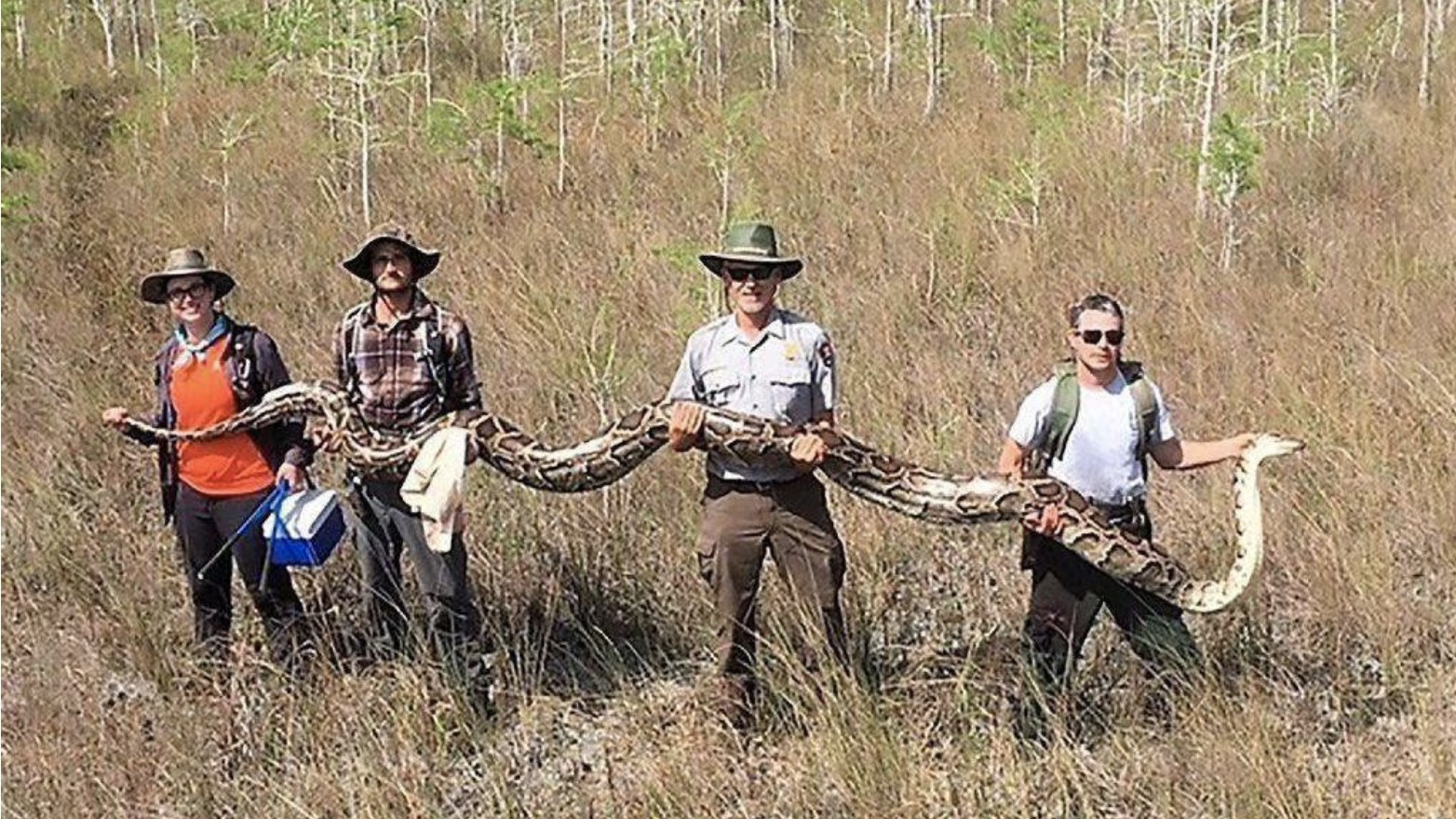
Florida…
Burmese pythons are too good at what they do — they’re nearly undetectable to both humans and their prey, they barely need to move and when they do they’re deadly. On top of that, they have lots of babies.
As a result, according to an ambitious new paper produced by the U.S. Geological Survey, their population has exploded in only 20 years from a few snakes at the southern tip of Everglades National Park to an invasion that envelops the southern third of Florida…
The success of these snakes, which are native to Southeast Asia, and came here via the exotic pet trade, has been a cataclysmic failure for South Florida ecosystems and “represent one of the most intractable invasive-species management issues across the globe,” said the paper…

When biologists open the invasive snakes up, it’s like rifling through a Florida field guide. All told, they’ve found 76 prey species inside the snakes. That includes lots of birds, such as vultures, crows, ducks, herons, roseate spoonbills and threatened wood storks; small mammals such as the endangered Key Largo woodrat and Key Largo cotton mouse, marsh rabbits, armadillos, possums, raccoons, otters and domestic cats, and larger prey including domestic goats, white-tailed deer, wild hogs and alligators….
How much damage have they done? Guzy points out that before 2000, researchers could frequently spot mammals in Everglades National Park. But from 2003 to 2011, the frequency of mammal observations [raccoons, opossums, bobcats, rabbits, gray foxes, and white-tailed deer] declined by 85% to 100%. Outside the python’s range, those species were more common.
Snakes on a plain: “Python invasion has exploded out of the Everglades and into nearly all of southern Florida,” from @SunSentinel.
* Aldous Huxley, Brave New World
###
As we tread carefully, we might recall that it was on this date in 2006 that New Line Cinema ordered five days of additional shooting on what had been a minor film in their 2006 line-up, Pacific Air Flight 121 (principal photography had wrapped in September 2005). While re-shoots normally imply problems with a film, the producers opted to add new scenes to the film to change the MPAA rating from PG-13 to R and bring it in line with growing fan expectations… expectations that had been raised when (at star Samuel L. Jackson’s insistence) the film’s title had reverted to its original working form: Snakes on a Plane.
More than 450 snakes were used for filming to represent 30 different species of snakes, including a 19-foot (5.8 m) Burmese python named Kitty.

“Round and round they went with their snakes, snakily”*…

If pythons are the snake that ate the Everglades, the apocryphal legend of their takeover begins with an appropriately cinematic opening scene. In 1992, Hurricane Andrew plowed into the state, killing 65 people and leveling thousands of homes, as well as—so the story goes—a Burmese python breeding facility.
The reality of their introduction to the area may be less exciting. “The scientific thinking, I believe, is that they were probably animals that were discarded by pet owners deep down into the Everglades,” said Steve Johnson, an associate professor of wildlife ecology and conservation at the University of Florida.
The population of Burmese pythons in the Everglades is impossible to measure with much accuracy. Since the first reported sighting of one in the wild in Florida in 1979, their numbers have exploded. Estimates from the USGS indicate there could be tens of thousands to hundreds of thousands of them in South Florida. Regardless of their actual population size, their impact is clear: pythons have decimated biodiversity in the area. The hungry snakes will consume almost any animal in their path. They seize their prey using sharp, rear-facing fangs that are long enough to pierce a hunter’s arm. Then the snake coils around its victim, constricting the animal until it’s dead. Some hunters, to protect their lower legs from bites, wear camouflage-patterned snake gaiters, light armor that’s similar to shin guards worn by soccer players. But most go without, preferring intuition and quick reflexes over adding another layer of clothing to sweat through in the muggy glades.
To stem the tide of invasive species from the exotic-pet trade, the FWC holds amnesty days that allow pet owners to surrender animals to the agency without penalty. Although most pets that get released into the glades don’t survive, some outlier species like the Burmese python become established in their new ecosystems.
In this case, “established” sounds like an understatement. Pythons have taken over. Everything else has become prey. Since 2003, rabbit populations have disappeared from USGS study areas. Foxes, raccoons, possums, bobcats, and other species are all but gone. Pythons devoured the mammals and have moved on to birds, other reptiles, and possibly fish. The snakes can bring down animals as large as deer—which can either struggle and tear themselves away or become dinner—and even alligators.
Scientists have long suspected that pythons were consuming whole populations of small mammals in the Everglades and have made efforts at estimating the impacts. But exact population counts are impossible in such a vast wilderness. In a 2015 study led by Robert McCleery at the University of Florida, researchers translocated marsh rabbits into an area of the Everglades inhabited by a large number of pythons. At first the rabbits survived. Then temperatures began to rise, and with the warming weather, pythons slithered out of hiding and began to feast. In one year, they had eaten 77 percent of the rabbits…
Pythons are devouring native animal life in the unique ecosystem of South Florida. To help solve the problem, Florida Fish and Wildlife officials have turned to amateur and professional hunters to round up the reptiles in a wild competition called the Python Bowl: “The Misunderstood Python Hunters Saving the Everglades.”
* Brave New World
###
As we ruminate on reptiles, we might recall that it was on this date in 1780 that a combination of thick smoke, fog, and heavy cloud cover caused so complete a darkness to fall on Eastern Canada and the New England area of the United States that candles were needed at noon. The drear, known as “New England’s Dark Day,” did not disburse until the following evening.

“Behold, I give unto you power to tread on serpents”*…

During St. Patrick’s Day, most revelers won’t remember the patron saint of Ireland for his role as a snake killer. But legend holds that the Christian missionary rid the slithering reptiles from Ireland‘s shores as he converted its peoples from paganism during the fifth century A.D.
St. Patrick supposedly chased the snakes into the sea after they began attacking him during a 40-day fast he undertook on top of a hill. An unlikely tale, perhaps—yet Ireland is unusual for its absence of native snakes. It’s one of only a handful of places worldwide—including New Zealand, Iceland, Greenland, and Antarctica—where Indiana Jones and other snake-averse humans can visit without fear.
But St. Patrick had nothing to do with Ireland’s snake-free status, scientists say….
Find out what actually happened to those snakes at : “Snakeless in Ireland: Blame Ice Age, Not St. Patrick.”
[image above: source]
* Luke 10:12
###
As we just say no to serpents, we might send chronically-correct birthday greetings to Georges-Louis Leclerc, Comte de Buffon; he was born on this date in 1707. A naturalist, mathematician, cosmologist, and encyclopédiste, Buffon formulated a crude theory of evolution, and was the first to suggest that the earth might be older than suggested by the Bible: in 1778 he proposed that the Earth was hot at its creation and, judging from the rate of its cooling, calculated its age to be 75,000 years, with life emerging some 40,000 years ago.
In 1739 Buffon was appointed keeper of the Jardin du Roi, a post he occupied until his death. There he worked on the comprehensive work on natural history for which he is remembered, Histoire naturelle, générale et particulière. He began in 1749, and it dominated the rest of his life. It would eventually run to 44 volumes, covering quadrupeds, birds, reptiles and minerals. As Max Ernst remarked, “truly, Buffon was the father of all thought in natural history in the second half of the 18th century.”

You must be logged in to post a comment.