Posts Tagged ‘Ten Commandments’
“Say what you will about the ten commandments, you must always come back to the pleasant fact that there are only ten of them”*…
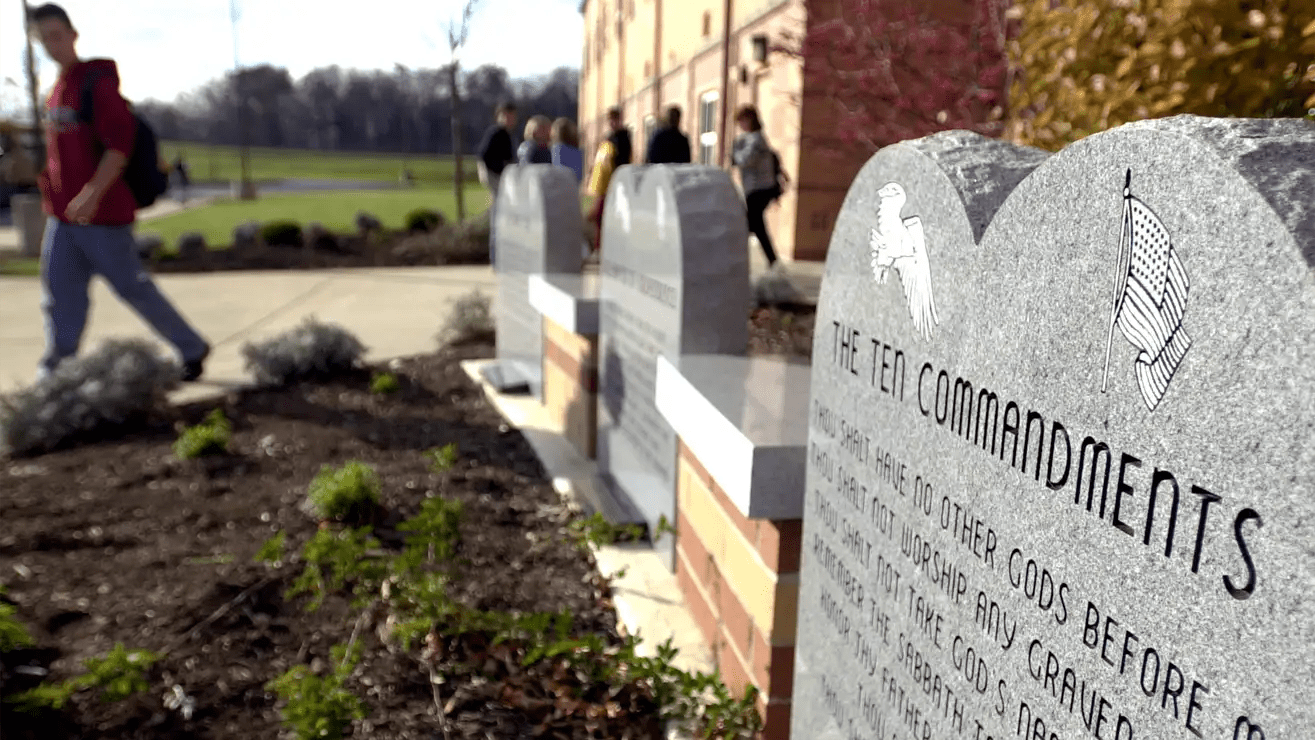
The Republican Governor of Louisiana, Jeff Landry, recently signed a law requiring state’s classrooms to display a copy of the Ten Commandments. The Onion explores the pros and cons of requiring religious doctrine in public schools…
- PRO: A good way to cover up the bullet holes.
- CON: Use of woke “Thou/Thy” pronouns.
- PRO: Great example of counting to 10 in the real world.
- CON: Just finished building golden calf.
- PRO: Least out-of-date thing in classroom.
- CON: True believers would display the entirety of the King James Bible.
- PRO: Distracts from how weird the Pledge of Allegiance is.
- CON: Not enough funding to print it out.
“Pros And Cons of Displaying The 10 Commandments in Every Classroom,” from @TheOnion.
* H. L. Mencken
###
As we ponder piety, we might recall that on this date in 1862, Charles Lutwidge Dodgson, a young Oxford mathematics don, took the daughters of the Dean of Christ Church College– Alice Liddell and her sisters– on a boating picnic on the River Thames in Oxford. To amuse the children he told them the story of a little girl, bored by a riverbank, whose adventure begins when she tumbles down a rabbit hole into a topsy-turvy world called “Wonderland.” The story so captivated the 10-year-old Alice that she begged him to write it down. The result was Alice’s Adventures in Wonderland, published in 1865 under the pen name “Lewis Carroll,” with illustrations by John Tenniel.

“… a waste of desert sand; A shape with lion body and the head of a man”*…

The sphinx before excavation
Thirty-three years ago, Peter Brosnan heard a story that seemed too crazy to be true: buried somewhere along California’s rugged Central Coast, beneath acres of sand dunes, lay the remains of a lost city. According to his friend at New York University’s film school, the remains of a massive Egyptian temple, a dozen plaster sphinxes, eight mammoth lions, and four 40-ton statues of Ramses II were all supposedly entombed in the sands 150 some-odd miles north of Los Angeles.
“It was an absolutely cockamamie story,” Brosnan says. “I thought he was nuts.” The ruins weren’t authentic Egyptian ones, of course. They were the 60-year-old remains of a massive Hollywood set—the biggest, most expensive one ever built at the time. The faux Egyptian scenery had played the role of the City of the Pharaoh in one of Hollywood’s first true epics, Cecil B DeMille’s 1923 film The Ten Commandments. The set had required more than 1,500 carpenters to build and used over 25,000 pounds of nails. The production nearly ruined DeMille and his studio. When the shoot wrapped, the tempestuous director supposedly strapped dynamite to the structures and razed the whole set, burying it in the sands near Guadalupe, California, to ensure no rival director could benefit from his vision.
Bullshit, Brosnan thought. But then his buddy pointed him to a line in DeMille’s posthumously published autobiography. “If 1,000 years from now archaeologists happen to dig beneath the sands of Guadalupe,” the director teased, “I hope they will not rush into print with the amazing news that Egyptian civilization…extended all the way to the Pacific Coast.”…

The City of the Pharaoh during filming
The extraordinary story of “The Cursed, Buried City That May Never See The Light of Day.”
* W.B. Yeats, “The Second Coming”
###
As we resolve to look more deeply, we might recall that it was on his date in 2001 that Harry Potter and the Sorcerer’s Stone was released in theaters in the U.S. It went on to gross nearly $1 billion worldwide, and to launch seven more films based on J.K. Rowling’s novels over the next decade.

At the premiere: stars Daniel Radcliffe (age 12), Rupert Grint (13), and Emma Watson (11)
You must be logged in to post a comment.