Posts Tagged ‘schools’
“Say what you will about the ten commandments, you must always come back to the pleasant fact that there are only ten of them”*…

The Republican Governor of Louisiana, Jeff Landry, recently signed a law requiring state’s classrooms to display a copy of the Ten Commandments. The Onion explores the pros and cons of requiring religious doctrine in public schools…
- PRO: A good way to cover up the bullet holes.
- CON: Use of woke “Thou/Thy” pronouns.
- PRO: Great example of counting to 10 in the real world.
- CON: Just finished building golden calf.
- PRO: Least out-of-date thing in classroom.
- CON: True believers would display the entirety of the King James Bible.
- PRO: Distracts from how weird the Pledge of Allegiance is.
- CON: Not enough funding to print it out.
“Pros And Cons of Displaying The 10 Commandments in Every Classroom,” from @TheOnion.
* H. L. Mencken
###
As we ponder piety, we might recall that on this date in 1862, Charles Lutwidge Dodgson, a young Oxford mathematics don, took the daughters of the Dean of Christ Church College– Alice Liddell and her sisters– on a boating picnic on the River Thames in Oxford. To amuse the children he told them the story of a little girl, bored by a riverbank, whose adventure begins when she tumbles down a rabbit hole into a topsy-turvy world called “Wonderland.” The story so captivated the 10-year-old Alice that she begged him to write it down. The result was Alice’s Adventures in Wonderland, published in 1865 under the pen name “Lewis Carroll,” with illustrations by John Tenniel.

“All reality is a game”*…
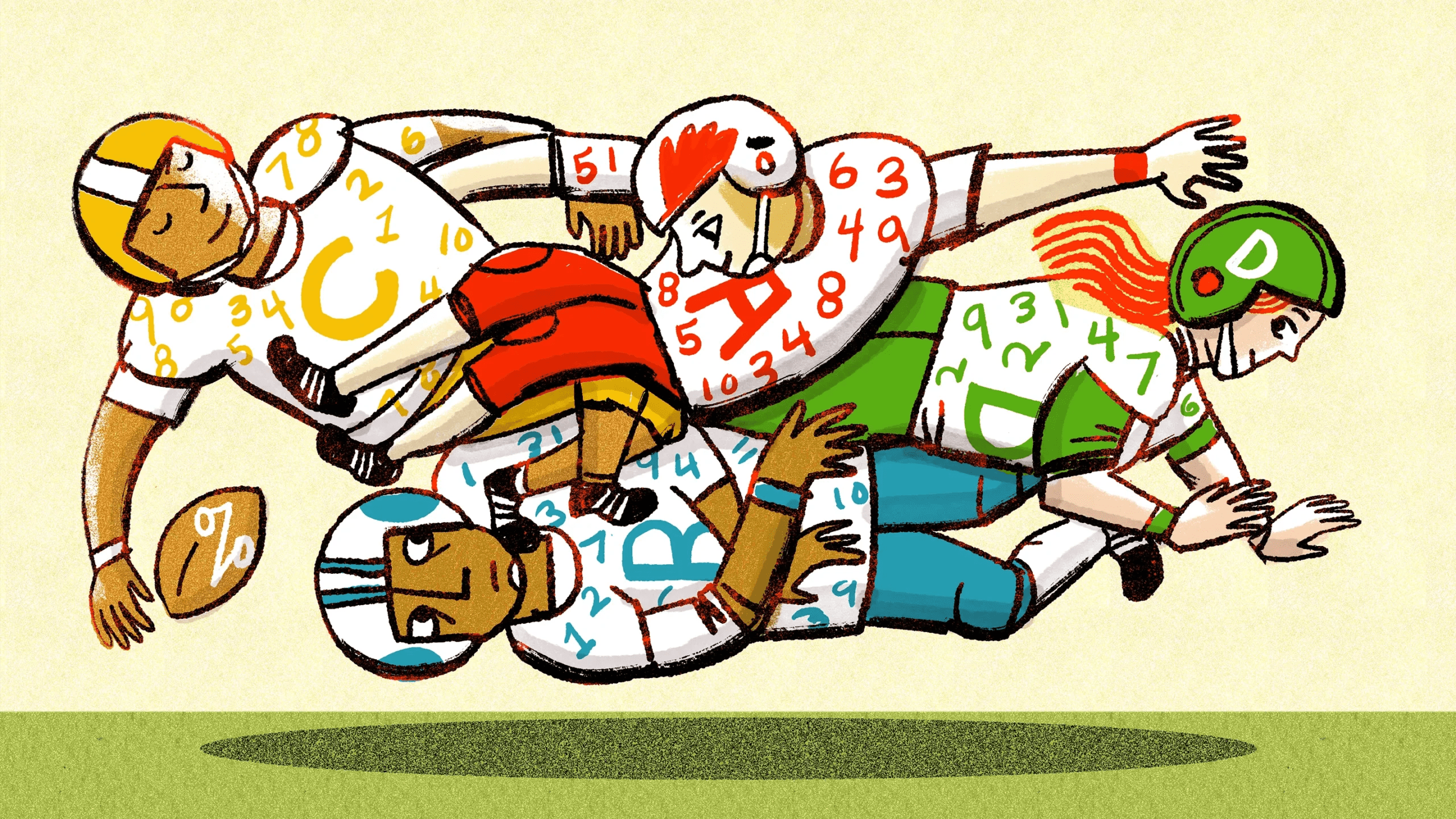
If Anna beats Benji in a game and Benji beats Carl, will Anna beat Carl? Patrick Honner unpacks the principle of transitivity…
It’s the championship game of the Imaginary Math League, where the Atlanta Algebras will face the Carolina Cross Products. The two teams haven’t played each other this season, but earlier in the year Atlanta defeated the Brooklyn Bisectors by a score of 10 to 5, and Brooklyn defeated Carolina by a score of 7 to 3. Does that give us any insight into who will take the title?
Well, here’s one line of thought. If Atlanta beat Brooklyn, then Atlanta is better than Brooklyn, and if Brooklyn beat Carolina, then Brooklyn is better than Carolina. So, if Atlanta is better than Brooklyn and Brooklyn is better than Carolina, then Atlanta should be better than Carolina and win the championship.
If you play competitive games or sports, you know that predicting the outcome of a match is never this straightforward. But from a purely mathematical standpoint, this argument has some appeal. It uses an important idea in mathematics known as transitivity, a familiar property that allows us to construct strings of comparisons across relationships. Transitivity is one of those mathematical properties that are so foundational you may not even notice it…
Read on: “The Surprisingly Simple Math Behind Puzzling Matchups,” from @MrHonner in @QuantaMagazine.
* Iain M. Banks, The Player of Games
###
As we tackle transitivity, we might spare a thought for Charlemagne; he died on this date in 814. A ruler who united the majority of western and central Europe (first as King of the Franks, then also King of the Lombards, finally adding Emperor of the Romans), he was the first recognized emperor to rule from western Europe since the fall of the Western Roman Empire three centuries earlier; the expanded Frankish state that he founded is called the Carolingian Empire, the predecessor to the Holy Roman Empire.
Committed to educational reform and extension, he began (in 789) the establishment of schools teaching the elements of mathematics, grammar, music, and ecclesiastic subjects; every monastery and abbey in his realm was expected to have a school for the education of the boys of the surrounding villages. The tradition of learning he initiated helped fuel the expansion of medieval scholarship in the 12th-century Renaissance.
Charlemagne is considered the father of modern Europe. At the same time, in accepting Pope Leo’s investiture, he set up ages of conflict: Charlemagne’s coronation as Emperor, though intended to represent the continuation of the unbroken line of Emperors from Augustus, had the effect of creating up two separate (and often opposing) Empires– the Roman and the Byzantine– with two separate claims to imperial authority. It led to war in 802, and for centuries to come, the Emperors of both West and East would make competing claims of sovereignty over the whole.

“Don’t join the book burners… Don’t be afraid to go in your library and read every book”*…

The American Library Association’s Office for Intellectual Freedom (OIF) receives reports from libraries, schools, and the media on attempts to ban books in communities across the country, from which they compile lists of challenged books in order to inform the public about censorship efforts that affect libraries and schools.
From Persepolis and The Kite Runner to The Bluest Eye and The Perks of Being a Wallflower— the top ten most frequently challenged books of 2014.
* Dwight D. Eisenhower
###
As we celebrate Banned Book Week by taking the General’s advice, we might recall that it was on this date last year that thousands of students in Jefferson County, Colorado stayed home to protest School Board action that “edited” the District’s AP History curriculum to “promote patriotism” and not to “encourage or condone civil disorder, social strife or disregard of the law.” Two days later, the School Board backed down.

Student protestors (who will, one hopes, be catching up in spelling class on their return to school)
“The human animal differs from the lesser primates in his passion for lists”*…

Our friends at Public Domain Review have gone all Buzzfeed on us, creating a collection of lists that runs from “7 types of drunkard” through “114 proved plans to save a busy man time” and “9 types of newspaper adverts with a sexual purpose,” to “162 recorded sightings of sea serpents from 1522 – 1890.” Enjoy them all at “17 Numbered Lists from History.”
“17 numbered lists that will restore your faith in humanity, specifically in its ability to make numbered lists.”
* H. Allen Smith
###
As we enumerate, we might pause to celebrate the founding of Boston Latin School, both the first public school and oldest existing school in the United States. As the town records of Boston report:
On the 13th of the second month, 1635…At a Generall meeting upon publique notice…it was…generally agreed upon that our brother Philemon Pormort shall be intreated to become scholemaster for the teaching and nourtering of children with us
Formally opened in April of that year, the school has produced four Harvard presidents, four Massachusetts governors, and five signers of the United States Declaration of Independence. Benjamin Franklin and Louis Farrakhan are among its better-known dropouts. Current students aver that Harvard College, founded a year later in 1636, was created for Boston Latin’s first graduates.

The internship of Dr. Seuss…
Readers will know that Theodor Seuss Geisel, AKA “Dr. Seuss,” worked in other forms than the books for which he was most famous– readers will remember his (in both senses of the word) fabulous The 5,000 Fingers of Dr. T, and pre-blog readers will recall his work as an editorial cartoonist during World War II.
But readers may be surprised, as your correspondent was, to learn that, two years before he published his first book, And To Think That I Saw It on Mulberry Street!, Dr. Seuss authored a comic strip:

Hejji, which ran for under a year in 1935, told the story of a traveler who found himself in the strange land of Baako, a mountaintop country that’s equal parts Tibet, the Middle East, and Whoville… Heijji’s adventures prefigure several of the good Dr.’s classics-to-come– and delight in their own right. Explore them further in Chris Sim’s lovely tribute at ComicsAlliance.
As we rethink our position on green eggs and ham, we might recall that it was on this date in 1978 that California voters approved Proposition 13, rolling back property taxes to 1975 levels and capping increases to a 2% inflation factor. Since then California public schools, which had been ranked among the nation’s best, have declined to 48th (in surveys of student achievement).

You must be logged in to post a comment.