“All reality is a game”*…
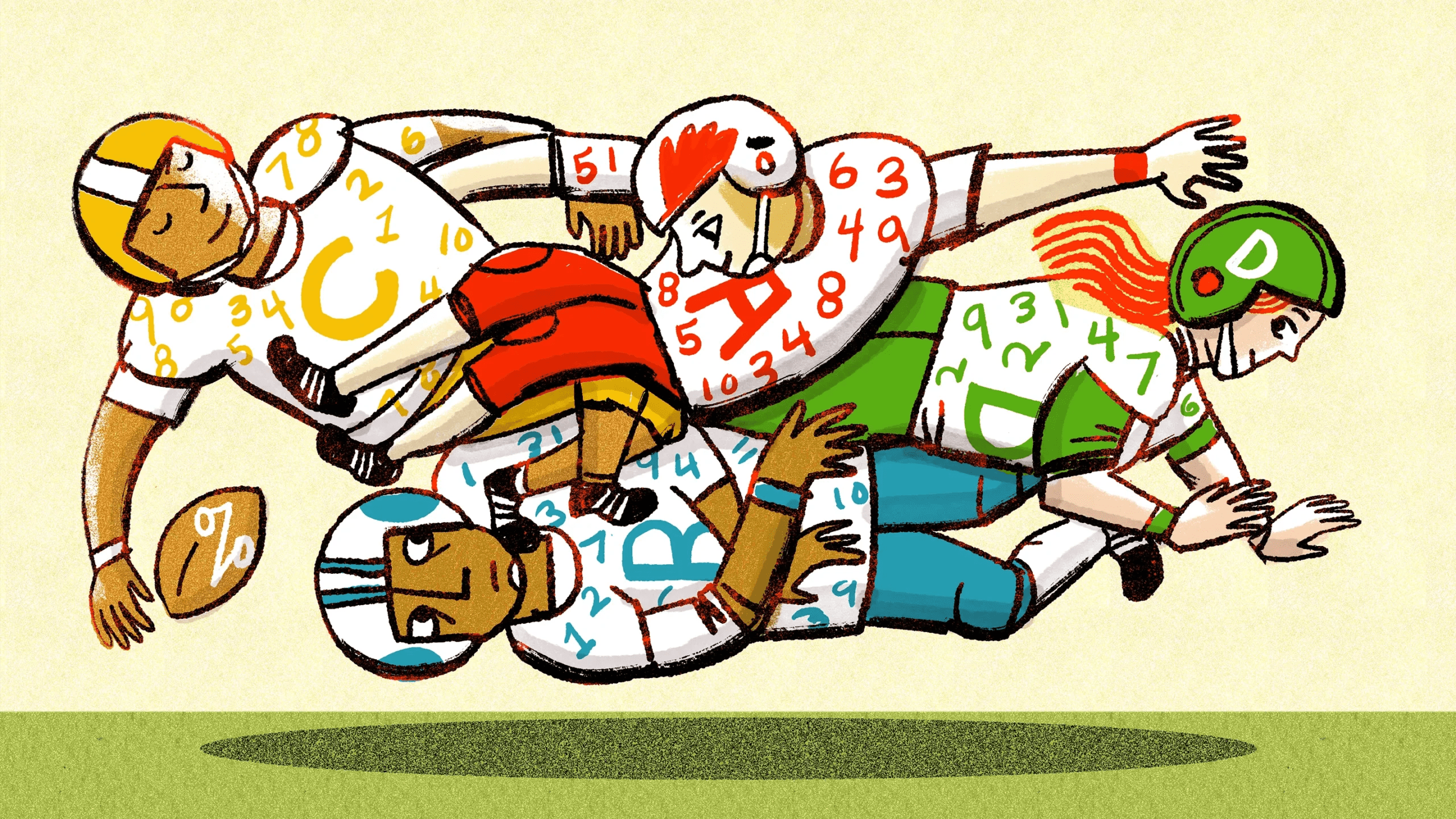
If Anna beats Benji in a game and Benji beats Carl, will Anna beat Carl? Patrick Honner unpacks the principle of transitivity…
It’s the championship game of the Imaginary Math League, where the Atlanta Algebras will face the Carolina Cross Products. The two teams haven’t played each other this season, but earlier in the year Atlanta defeated the Brooklyn Bisectors by a score of 10 to 5, and Brooklyn defeated Carolina by a score of 7 to 3. Does that give us any insight into who will take the title?
Well, here’s one line of thought. If Atlanta beat Brooklyn, then Atlanta is better than Brooklyn, and if Brooklyn beat Carolina, then Brooklyn is better than Carolina. So, if Atlanta is better than Brooklyn and Brooklyn is better than Carolina, then Atlanta should be better than Carolina and win the championship.
If you play competitive games or sports, you know that predicting the outcome of a match is never this straightforward. But from a purely mathematical standpoint, this argument has some appeal. It uses an important idea in mathematics known as transitivity, a familiar property that allows us to construct strings of comparisons across relationships. Transitivity is one of those mathematical properties that are so foundational you may not even notice it…
Read on: “The Surprisingly Simple Math Behind Puzzling Matchups,” from @MrHonner in @QuantaMagazine.
* Iain M. Banks, The Player of Games
###
As we tackle transitivity, we might spare a thought for Charlemagne; he died on this date in 814. A ruler who united the majority of western and central Europe (first as King of the Franks, then also King of the Lombards, finally adding Emperor of the Romans), he was the first recognized emperor to rule from western Europe since the fall of the Western Roman Empire three centuries earlier; the expanded Frankish state that he founded is called the Carolingian Empire, the predecessor to the Holy Roman Empire.
Committed to educational reform and extension, he began (in 789) the establishment of schools teaching the elements of mathematics, grammar, music, and ecclesiastic subjects; every monastery and abbey in his realm was expected to have a school for the education of the boys of the surrounding villages. The tradition of learning he initiated helped fuel the expansion of medieval scholarship in the 12th-century Renaissance.
Charlemagne is considered the father of modern Europe. At the same time, in accepting Pope Leo’s investiture, he set up ages of conflict: Charlemagne’s coronation as Emperor, though intended to represent the continuation of the unbroken line of Emperors from Augustus, had the effect of creating up two separate (and often opposing) Empires– the Roman and the Byzantine– with two separate claims to imperial authority. It led to war in 802, and for centuries to come, the Emperors of both West and East would make competing claims of sovereignty over the whole.

You must be logged in to post a comment.