Posts Tagged ‘Theodor Geisel’
“To a real child anything will serve as a toy”*…

The story of a toy that both confirms and contradicts that sentiment, Mr. Potato Head…
Mr. Potato Head is an American toy brand consisting of a plastic model of a potato “head” to which a variety of plastic parts can attach — typically ears, eyes, shoes, hat, nose, pants and mouth.
Mr. Potato Head was invented and manufactured by George Lerner in 1949, but was first distributed by Hasbro in 1952… In its original form, Mr. Potato Head was offered as separate plastic parts with pushpins to be affixed to a real potato or other vegetable. Due to complaints regarding rotting vegetables and new government safety regulations, Hasbro began including a plastic potato body with the toy set in 1964.
…
In the early 1940s, Brooklyn-born toy inventor George Lerner came up with the idea of inserting small, pronged body and face parts into fruits and vegetables to create a “funny face man”. Some speculate he got the idea from his wife’s nephew Aaron Bradley, who was seen placing sticks inside of potatoes in the family garden. Lerner would often take potatoes from his mother’s garden and, using various other fruits and vegetables as facial features, he would make dolls with which his younger sisters could play. The grape-eyed, carrot-nosed, potato-headed dolls became the principal idea behind the plastic toy which would later be manufactured.
Mr, Potato Head turned out to be a trailblazer– the pioneer of a new form of marketing that supercharged the toy category and paved the way for the toy-character-centered entertainment environment in which we live…
On April 30, 1952, Mr. Potato Head became the first toy advertised on television. The campaign was also the first to be aimed directly at children; before this, commercials were only targeted at adults, including toy advertisements. The commercial revolutionized marketing, and caused an industrial boom. Over one million kits were sold in the first year…
“Mr. Potato Head” from @Wikipedia.
Image above: from the collection of the Victoria and Albert Museum
* John Cowper Powys
###
As we play, we might send tasty birthday greetings to the literary genius behind green eggs and ham, Theodor Seuss Geisel, AKA “Dr. Seuss”; he was born on this date in 1904. After a fascinating series of early-career explorations, Geisel settled on a style that created what turned out to be the perfect “gateway drug” to book addiction– and a love of words– for generations of young readers.
The more that you read,
The more things you will know.
The more that you learn,
The more places you’ll go.
– I Can Read With My Eyes Shut! (1978)

“Roget’s Thesaurus is an oddball philosophy of language masquerading as a reference book”*…
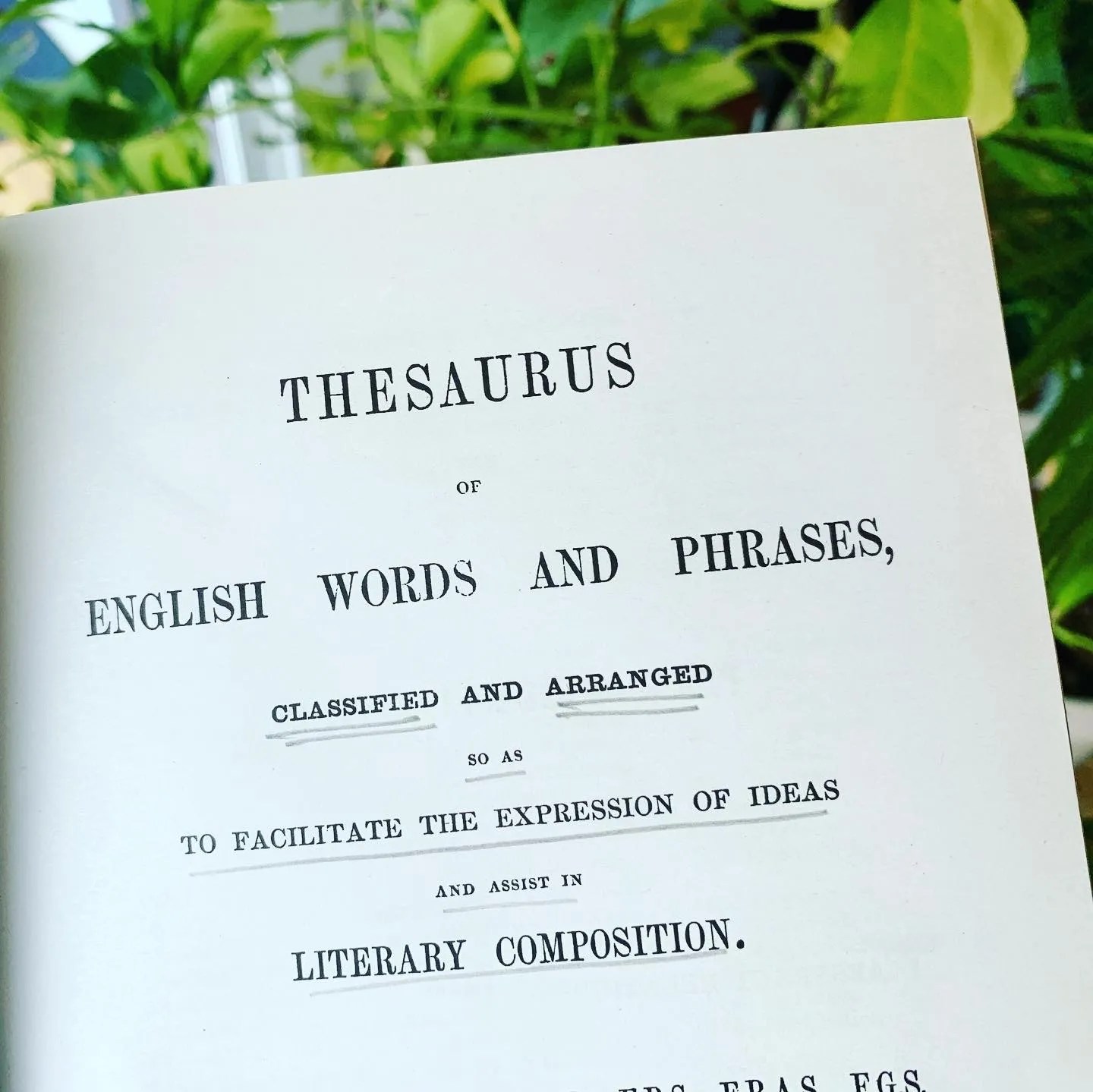
Austin Kleon on Roget’s Thesaurus…
I have always assumed — and maybe you have, too — that a thesaurus is just a synonym dictionary, the words arranged alphabetically with a list of synonyms and antonyms below. Somehow, every thesaurus I’d ever come across — even ones with “Roget” in the title! — had this alphabetic arrangement.
Because of this, it was easy for me to effectively ignore the thesaurus. If I needed a synonym or antonym, I’d just open an actual dictionary, or do a quick online search…
It turns out that Roget‘s Thesaurus is not at all what I thought it was. It is weirder and much more interesting…
… if you understand the man, you understand where his book came from. Peter Mark Roget (1779-1869) was a Victorian polymath: a doctor by trade, but he did all sorts of stuff: he was a consultant on pandemics, he wrote Encyclopedia Brittanica entries and a book about natural theology, he helped catalog several libraries, he invented the scale on the slide rule, and he may have written a paper that contributed to the birth of cinema. Oh, and he was also obsessed with chess problems.
The thing he is now most famous for — his thesaurus — was actually a side project he took up in retirement, in his seventies. His whole life he’d made lists as a way of soothing himself. He carried a notebook around with him and jotted down lists of related words and phrases to help him with his own writing and lecturing. He made his own personal thesaurus in his twenties, but in retirement he thought maybe it might be helpful to others, and after four years of work, he published the first edition of his Thesaurus (from the Greek word thēsauros, meaning “storehouse” or “treasure”) in 1852, overseeing new editions until he died in 1869. His son, John Lewis Roget, a lawyer, painter, and art critic, then took over the project.
Roget, like many Victorians, was obsessed with order and classification. His hero was Carl Linnaeus, known as the father of modern taxonomy. Roget wanted to classify and organize words in the English language. This is the best way to understand Roget’s Thesaurus: it’s not just a book of words, it’s like a library of words.
When you go to the library, the books are not arranged in alphabetical order — they’re organized topically. In order to find a book in my local library, you have to look up the book in the catalog, note the Dewey Decimal Number, then find it on the shelf. The beauty of this system, and a major argument for physical browsing collections, is that when you find the book on the shelf, it will be surrounded by books on the similar subject. You may go looking for one particular book and while browsing you might find a better book or the book you didn’t even know you were looking for. This is the way a thesaurus is supposed to work.
In the very beginning of his introduction to his book, Roget emphasizes that what makes his book unique and helpful is that the words are not arranged alphabetically, like a Dictionary, but “according to the ideas which they express.”…
The fascinating story of Roget’s Thesaurus: “A Library of Words,” from @austinkleon.
Browse the 1911 edition– still in the format Roget intended– at the Internet Archive.
###
As we look it up, we might send tasty birthday greetings to the literary genius behind green eggs and ham, Theodor Seuss Geisel, AKA “Dr. Seuss”; he was born on this date in 1904. After a fascinating series of early-career explorations, Geisel settled on a style that created what turned out to be the perfect “gateway drug” to book addiction– and a love of words– for generations of young readers.
The more that you read,
The more things you will know.
The more that you learn,
The more places you’ll go.
– I Can Read With My Eyes Shut! (1978)
Let me tell you a tale…

This map, by social realist artist William Gropper, was created to showcase the diversity of national myths and folk stories and was distributed abroad through the U.S. Department of State starting in 1946…
Gropper, born in New York City’s Lower East Side to a working-class family, deeply identified with labor movements and the Left throughout his life. He worked as a cartoonist for mainstream publications New York Tribune and Vanity Fair, as well as the leftist and radical newspapers Rebel Worker, New Masses, and Daily Worker. During the Depression, like many other out-of-work artists, Gropper designed murals for the Works Progress Administration.
The “folklore” on display in this richly illustrated map is a soup of history, music, myth, and literature. Frankie and Johnny are cheek-by-jowl with a wild-eyed John Brown; General Custer coexists with “Git Along Little Dogies.” Utah is simply host to a group of “Mormons,” in which a bearded man holds up stigmata-marked hands to a small group of wives and children, while a figure labeled “New England Witches” flies over New Hampshire, Massachusetts, and Vermont…
Click here (and again) to see the map in much larger format (or find it at the Library of Congress); read the full story at Vault.
###
As we revel in regional differences, we might recall that it was on this date in 1938 that Theodor Geisel– Dr. Seuss– published The 500 Hats of Bartholomew Cubbins. Geisel had published And To Think That I Saw It on Mulberry Street the prior year; 500 Hats was his second children’s book and the first of three (it was followed by The King’s Stilts and The Seven Lady Godivas in 1939), all of which were, atypically for him, in prose. He returned to the rhyming form for which he’s known with his fifth book, Horton Hatches the Egg.

The internship of Dr. Seuss…
Readers will know that Theodor Seuss Geisel, AKA “Dr. Seuss,” worked in other forms than the books for which he was most famous– readers will remember his (in both senses of the word) fabulous The 5,000 Fingers of Dr. T, and pre-blog readers will recall his work as an editorial cartoonist during World War II.
But readers may be surprised, as your correspondent was, to learn that, two years before he published his first book, And To Think That I Saw It on Mulberry Street!, Dr. Seuss authored a comic strip:

Hejji, which ran for under a year in 1935, told the story of a traveler who found himself in the strange land of Baako, a mountaintop country that’s equal parts Tibet, the Middle East, and Whoville… Heijji’s adventures prefigure several of the good Dr.’s classics-to-come– and delight in their own right. Explore them further in Chris Sim’s lovely tribute at ComicsAlliance.
As we rethink our position on green eggs and ham, we might recall that it was on this date in 1978 that California voters approved Proposition 13, rolling back property taxes to 1975 levels and capping increases to a 2% inflation factor. Since then California public schools, which had been ranked among the nation’s best, have declined to 48th (in surveys of student achievement).

You must be logged in to post a comment.