Posts Tagged ‘Library’
“Frederick Douglass taught that literacy is the path from slavery to freedom. There are many kinds of slavery and many kinds of freedom, but reading is still the path”*…
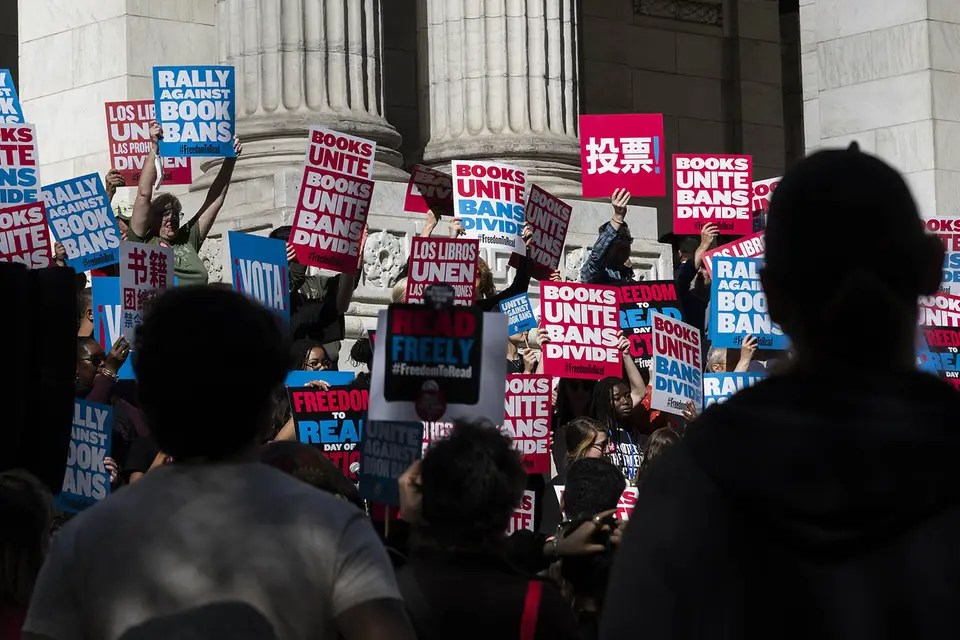
The attack on libraries, in the U.S. and beyond, has been a recurring theme here– precisely because it is so threatening. The estimable Richard Ovenden considers the titles banned, the data deleted, the nation’s librarians sacked without explanation, and explains that Donald Trump’s war on books is a threat to democracy across the world…
I am a librarian. I am fortunate enough to run one of the world’s largest and best known libraries – the Bodleian in Oxford – but my experience of libraries began as a reader. My mother took me as a child to the Deal public library in Kent, and it was there, in its modest book-filled rooms, that I discovered new worlds. My life was transformed by a public library (and its librarians) that allowed me to read freely from its well-stocked shelves. Throughout my career, I have seen at first-hand how libraries underpin the education and self-improvement of all of our citizens, rich and poor, young and old, of all creeds and colours, through providing access to a multitude of ideas and knowledge.
They celebrate the history and identity of our communities; they are stout defenders of facts and truth in an age of misinformation; and they are places where people can learn about their rights and how to protect them. This year we celebrate the 175th anniversary of the Public Libraries Act of 1850, which created our system of free public libraries – a kind of “NHS for the mind”. But what has been happening to American libraries rings a loud alarm bell for our own cherished library system.
Libraries large and small in the US are now on the frontline of the battles over knowledge that have intensified since the second presidency of Donald Trump began. The attack on libraries and librarians there is shocking and happening at a disorienting pace. Thousands of books have been banned from public and school libraries, librarians have received death threats and many have been fired. The heads of both the National Archives and the Library of Congress have been sacked on spurious grounds. Data has been deleted and funding for critical initiatives ceased.
Why is the US, the land of the free, where the realm of ideas and knowledge has been enabled by the first amendment, now turning on institutions that have been among the most trusted in society?
The first dispatches from the war on libraries began to reach me in 2022. I had recently published Burning the Books, which highlighted the role of libraries in society through a long history of attacks on the written word. Librarians began to send me messages and tagged me on social media, sharing news of assaults on public and school libraries in Florida and Texas. As one librarian put it, my book was fast beginning to look as if it would need updating. A pattern was forming: an epidemic of book banning, driven by groups from the far right of the political spectrum, empowered through social media, and funded, it seemed, by larger and darker organisations.
Throughout Joe Biden’s presidency, a coalition of extremist groups, with interests ranging from Christian nationalism to white supremacy, and anti-gay protesters were able to mobilise around common themes such as opposing sex education, LGBTQ+ issues and race equality. They began a concerted campaign to control what young people could read. Two tactics were deployed. The first was to seize control of the boards that oversee small public and school libraries. The boards then censored the books available to library users, especially young people. The second was the mobilisation of supporters using social media, manufacturing outrage through spreading lies, and encouraging challenges to libraries and attacks on librarians.
These tactics have been highly successful. The American Library Association (ALA) collects data on book bans in US libraries. Between 2001 and 2020 an average of 273 unique titles were challenged each year. In 2023, 9,021 individual titles were challenged across hundreds of libraries…
[Richard elaborates on those attacks…]
… Trump’s second presidency has heralded a more ferocious phase in the book-banning wars, moving these acts of local censorship to state and federal level. In April, I received an email letting me know that the Rutherford County’s board of education in Tennessee ordered 145 books to be removed from circulation, citing their “sexually explicit” content; they included Beloved by Toni Morrison and Forever by Judy Blume. In May, a judge ruled that users of Llano County library in Texas have no first amendment right to receive information in the form of books held by public libraries, and that the choice of books a library holds is a form of allowable “government speech” immune from constitutional scrutiny. At a stroke, in Trump’s US, public libraries are the mouthpiece of central government…
… The great civic public libraries, such as those in New York, Brooklyn, San Diego, Boston and Los Angeles, have not sat idly by as the smaller libraries drew the fire. They have digitised banned books to make them available freely online and they have helped develop toolkits to support libraries facing book banning. Despite these efforts, Friedman’s assessment of the future of the free circulation of ideas in the US is sobering: “Between Llano County and Mahmoud v Taylor, we are now seeing a radical upheaval in the legal frameworks for freedom to read,” he explained. It is hard to believe, but in Tennessee, the works of Bill Watterson, the cartoonist author of Calvin and Hobbes, are now considered a danger to young people and are banned in school libraries in many counties…
[Richard unpacks the assault on the Library of Congrees and teh national Archive, and explores the ways on which this particularly heinous form of censorship is being “exported” to other countries…]
… On 10 May 1933, in the heart of Berlin, a mass book-burning was held, where texts considered to be “un-German” – including, of course, Jewish texts, but also books from a library of human sexuality on LGBTQ+ themes – were burned on a pyre on the Unter den Linden boulevard. It is tempting to draw the analogy between this event and the mass burning of books across the US right now.
But if we do we should also remember that new libraries were founded, such as the German Freedom Library in Paris, to counteract Nazi censorship. “You may burn my books and the books of the best minds in Europe,” Helen Keller wrote in 1933, “but the ideas those books contain have passed through millions of channels and will go on.”
We should, in this anniversary year, not only defend the bold and ambitious idea of the Victorian age – that society would benefit from its citizens having access to a free library – but ensure that all people can read freely. To do so, we must empower, support and celebrate the role of libraries and librarians as defenders of an open, pluralist society – the hidden but essential infrastructure of democracy itself…
Eminently worth reading in full: “There is no political power without power over the archive,” from @richove.bsky.social in @theobserveruk.bsky.social.
We might note that, while the primary energy behind this threat is political, it is being supported by the same folks who are hollowing out journalism in the U.S. and capitalizing on the rush to incarcerate immigrants— private equity, which is supporting book banners and local defunding of libraries, then angling to take over the public libraries that they denude.
Your correspondent supports libraries and archives like Richard’s (Oxford’s Bodleian Library), the Harvard Libraries, The New York Public Library, my own local San Francisco Public Library, and the remarkable Internet Archive. You might consider contributing to your local library and to the other libraries and archives of your choice.
* Carl Sagan
###
As we opt for open, we might recall that on this date in 1951 J. D. Salinger’s The Catcher in the Rye was published by Little, Brown and Co. Almost immediately, it was the subject of bans. From 1961 to 1982 it was the most challenged book in the U.S. There was a resurgence of challenges in 2005 and 2009… and it is again the subject of broad removal efforts. In spite of (or more probably, because of) this, it keeps finding its way into adolescent hands, often as assigned reading by high school English teachers.

“The path to paradise begins in hell”*…

It’s been over 700 years since Dante Aligheri found himself, midway along the journey of his life, within a dark forest. His terza rima epic, The Divine Comedy, rivets us still…. and as Hunter Dukes recounts, raises questions…
Ever since the publication of Dante’s Divine Comedy, scholars and artists have tried to map the Inferno’s architecture, survey Purgatory, and measure their way across the spheres of Paradise. The first cosmographer of Dante’s universe was the Florentine polymath Antonio Manetti, whose unpublished research — which mathematically concluded that hell was 3246 miles wide and 408 miles deep — inspired the woodcuts used for a landmark 1506 edition of the poem. In 1588, a young Galileo weighed in, deriving Lucifer’s height and armlength (1200 and 340 meters respectively) and suggesting that the Inferno’s vaulted ceiling was supported by the same physical principles as Brunellesci’s dome. The scholarly tradition continued for centuries, culminating with the works of Michelangelo Caetani, who designed a series of maps and charts. These were published as The Divine Comedy of Dante Alighieri Described in Six Plates and appeared in two editions, an 1855 edition featuring hand-colored lithographs and an 1872 edition printed using an early form of chromolithography, deployed by an order of monks at Monte Cassino near Rome…
Learn more about Caetani and his approach, and see more of his work: “Diagramming Dante: Michelangelo Caetani’s Maps of the Divina Commedia,” from @hunterdukes in @PublicDomainRev.
* Dante Alighieri
###
As we chart cosmology, we might recall that it was on this date in 1971 that Michael Hart launched the source of the link to The Divine Comedy embedded above, Project Gutenberg, and effectively invented ebooks. It debuted on ARPANET.
An online library of free ebooks, it currently has over 70,000 items available (in plain text as well as other formats, such as HTML, PDF, EPUB, MOBI, and Plucker wherever possible).

“We are not to judge what is possible and what is not, according to what is credible and incredible to our apprehension”*…

Jason Rhode on the signature work of the Renaissance philosopher Michel de Montaigne…
… In 1571, a skeptical nobleman retires to his tower. He dictates 107 short pieces over 20 years. He calls them “essais” (“attempt,” in French). The “Essays” bear titles like “Of Drunkenness.”
They are informal, conversational. Montaigne begins on-topic, but his mind wanders. You’ll be reading an essay about rapid speech, but he’ll veer off to tell us “I am not a very collected and deliberate person” or he’ll hit you with the dankest shit ever about how to consider death.
His learning is so great, his insights so keen, that again and again he shocks us: What if the indigenous people of the Americas are superior to Europeans? What if culture’s relative; are our values real? What if we’re wrong about God? What if learning doesn’t matter that much? And over and over again, What do I know? A twist, then another. This is a mind forever in the process of finding itself…
If he had just been a clever 16th-century chronicler, that would’ve been enough. If he had merely written frankly and fearlessly, that would have been enough. If he had just invented the essay, that would have been enough.
But this book is something more: the “Essays” are the imprinting of a consciousness in a book, as no consciousness has ever been so imprinted. I’ll be plain: this work contains a mortal soul. It forever bears the real essence of its maker—like Sauron’s ring, but for a great and good man…
Eminently worth reading in full (before you turn Essays itself): “Essays, by Michel de Montaigne, (1570-1592)” from @iamthemaster.
* Michel de Montaigne
###
As we essay, we might recall that it was on this date in 1732 that the Library Company of Philadelphia signed a contract with its first librarian. Founded by Benjamin Franklin and friends in November 1731, the library enrolled members for a fee of forty shillings but had to wait for books to arrive from England before beginning full operation.
Many subscription libraries—founded to benefit academies, colleges, and other groups—were established from the late seventeenth through the nineteenth centuries. The Library Company of Philadelphia grew out of the needs of the Leather Apron Club, also known as the “Junto,” of which Franklin was a member. In addition to exchanging business information, these merchants discussed politics and natural philosophy, contributing to their requirements for books to satisfy their widespread interests. Volumes were purchased with the annual contributions of shareholders, building a more comprehensive library than any individual could afford.
Directors of the Library Company made their holdings available to the first Continental Congress when it convened in Philadelphia in September 1774. After independence, the third session of the new Federal Congress convened in Philadelphia in January 1791, and the Library Company directors again tendered use of their facility. In essence, the Library Company served as the de facto Library of Congress until 1800 when the fledgling legislature moved to its permanent Washington, D.C., location and the Library of Congress was founded.
Today, the Library Company of Philadelphia is a research center and museum.

“Google will bring you back 100,000 answers. A librarian will bring you back the right one.”*…

Stephen Akey remembers the time before online search…
How do you find the life expectancy of a California condor? Google it. Or the gross national product of Morocco? Google it. Or the final resting place of Tom Paine? Google it. There was a time, however—not all that long ago—when you couldn’t Google it or ask Siri or whatever cyber equivalent comes next. You had to do it the hard way—by consulting reference books, indexes, catalogs, almanacs, statistical abstracts, and myriad other printed sources. Or you could save yourself all that time and trouble by taking the easiest available shortcut: You could call me.
From 1984 to 1988, I worked in the Telephone Reference Division of the Brooklyn Public Library. My seven or eight colleagues and I spent the days (and nights) answering exactly such questions. Our callers were as various as New York City itself: copyeditors, fact checkers, game show aspirants, journalists, bill collectors, bet settlers, police detectives, students and teachers, the idly curious, the lonely and loquacious, the park bench crazies, the nervously apprehensive. (This last category comprised many anxious patients about to undergo surgery who called us for background checks on their doctors.) There were telephone reference divisions in libraries all over the country, but this being New York City, we were an unusually large one with an unusually heavy volume of calls. And if I may say so, we were one of the best. More than one caller told me that we were a legend in the world of New York magazine publishing.
“How do you people know all this stuff?” a caller once asked me. “What are you, some kind of scholars or wordsmiths or something?”
“No,” I replied. “Just us libarians.”
Actually, we didn’t know all that stuff; we just knew how to find it. I myself rarely remembered any of the facts I divulged to our callers, but I remembered the reference sources where I found the facts. Personal knowledge was inadmissible. I could reel off by heart the names of the four Dead Boys (Cheetah Chrome, Stiv Bators, Jimmy Zero, and Johnny Blitz—but didn’t everyone know that?), but unless I could track them down and—rule number one—cite the source (in this case, probably the Rolling Stone Encyclopedia of Rock and Roll), I had no information to impart and no answer to give to anyone who might need that information for whatever reason. But we almost always found the right source.
The progenitor and enforcer of rule number one was our department head, whose managerial style recalled that of Vince Lombardi, if Vince Lombardi had had no interest in football. I do wish Milo had been a tad less heavy-handed; he tended to reduce unsatisfactory initiates to tears before driving them from the department for keeps. Nevertheless, his grinding relentlessness, which often entailed instructions barked into one ear while one’s other ear might be dealing with a difficult and demanding caller, was in the service of professionalism and competence—necessary qualities in a small, claustrophobic office where the pressure from our backlog of callers never let up.
“Are you that nice young man who always goes out of his way to find me exactly the answers I need to the questions I ask?” a caller once asked me as a prelude to her inquiry.
“Doesn’t sound like me,” I said.
There was always psychology involved. In this case, the caller thought that by flattering me she might induce me to break or bend our rule of five minutes or three questions max, which we routinely disregarded anyway. The opposite psychological ploys—bullying, intimidating, insulting, threatening—were far more common. Contrary to the popular perception of librarianship as a serene, leisurely vocation for the bookishly inclined, the Telephone Reference Division was a high-stress environment, and most staffers, myself included, burned out within a few years. Now that reference librarianship is a shadow of its former self, psychological gamesmanship rarely takes place. You look up your information in a bland, seemingly (seemingly) trustworthy source like Wikipedia, and that’s that. Librarians have other things to do, principally programming a never-ending stream of ostentatiously unlibrary-like events, but none will ever be so interesting or so much fun as the kind of thing we did in Telephone Reference before the Internet swept it all away.
Did Charon row or pole the souls of the dead across the River Styx? Can you give me the names and addresses of manufacturers of prosthetic devices in Massachusetts? Where are the manuscripts of the composer Marc Blitzstein to be found? (The person asking that question, much to the excitement of my balletomane boss Milo, identified herself as a certain Agnes de Mille.) What was the first language ever spoken? (“Anywhere? At any time?” I asked the caller. “Yes,” she replied, before I suggested that we might try to reformulate the question.) On and on it went. Of course, what we were doing, millions of others were doing on their own without the intercession of any librarian. All of us were negotiating an informational world without algorithmic search engines. Although I hang on to some battered dictionaries and reference books, I resort to Google as readily as anyone else. Undoubtedly, much more has been gained than lost in the transformation of laborious research into something immediate, accessible, and available to everyone. Still, a world that has tossed out the scholarly, comprehensive, and authoritative print edition of the Encyclopaedia Britannica in favor of the colorless, death-by-a-thousand-edits mediocrity of Wikipedia is not necessarily a richer one.
Even without my nostalgia for certain antiquated and specialized reference books (Kane’s Famous First Facts, the Encyclopedia of Associations, Brewer’s Dictionary of Phrase and Fable), I do think certain advantages accrued to analog ways of gathering information. The many hundreds of reference sources that we were trained to use in Telephone Reference had their biases, their blind spots, their inaccuracies. In the apprenticeship each of us endured under Milo’s exhausting tutelage before getting anywhere near a telephone, we learned not merely how to find information but how to think about finding information. Don’t take anything for granted; don’t trust your memory; look for the context; put two and three and four sources together, if necessary. Sometimes it was difficult to communicate such variables to our callers, who just wanted a quick answer rather than a disquisition on the mistaken assumption that the transmission of information was a straightforward matter. How many laundromats were owned and operated by women in California and Oregon in the 1930s? To answer that question, someone would have had to gather and compile that information at the time, and there was no reason to believe that anyone would have thought to do so. Maybe some obscure state agency did tabulate all those female laundromat owners and I simply fumbled an answerable inquiry, but if so, that agency would have been thinking like a gender-conscious individual from the 1980s rather than a government bureaucracy from the 1930s.
“Think like a librarian,” Milo used to urge us, which might sound less impressive than “Think like a philosopher,” “Think like a psychologist,” or even “Think like a lawyer,” but it did make the point that information wasn’t given, that it had to be actively sought…
…
… A certain esprit de corps facilitated the work and even diffused tensions in that pressure cooker of an office. I knew a lot about rock-and-roll and spoke Spanish. Aaron had a law degree and took all the questions about legal research that stumped us. (He also dispensed free legal advice on occasion, until Milo put a stop to it.) Milo knew theater; Paul was francophone; Kathleen knew movies and pop culture. (Our preferences skewed arty left-of-center, which was inevitable in our milieu.) Sometimes we worked backward, pooling what we already knew to find the reference sources that would confirm (and occasionally contradict) the foregone conclusion. Another rule: Don’t hide your ignorance. There was no Google to cover up the gaps in our knowledge. Sally Jessy Raphael might have been the prime minister of New Zealand or she might have been an exceedingly unctuous talk show host. Unless I asked who she was (the latter, not the former), I wouldn’t know the best sources to check to find her place of birth. As expected, the caller who asked about Ms. Raphael spent a certain amount of time insulting me for my ignorance, but she got her answer.
Many of our callers were historical novelists. Some of them identified themselves as such, but it was usually obvious even when they didn’t. They tended to ask questions like “What time was low tide in Boston Harbor on May 14, 1932?”
If today I were writing a historical novel set in the 1980s, I might ask, “How did people find information in those days?” There would no longer be any telephone reference librarians to help me, so I’d have to trust to luck—and a search engine—and answer that question myself: They used logic, inference, imagination, and a tall pile of reference books…
Dispatches from the telephone reference desk: “The Department of Everything,” in @hedgehogreview.
* Neil Gaiman
###
As we stroll down memory lane, we might send thoughtfully-retrieved birthday greetings to we might send learned birthday greetings to Daniel Boorstin; he was born on this date in 1914. As a Rhodes Scholar, Boorstin took first-class honors in jurisprudence at Oxford and was admitted as a barrister to the Inner Temple in 1937. Two years later, he returned to the US to teach history, first at Harvard, then at the University of Chicago. He left Chicago in 1969 to become the director of the National Museum of American History at the Smithsonian Institution. He’s probably best-known for his three-volume history, The Americans, the third volume of which, The Americans: The Democratic Experience, won the Pulitzer Prize in 1974.
In 1975 Boorstin became the Librarian of Congress, a post he held until 1987. The de facto national library of the United States, the LoC is the oldest federal cultural institution in the U.S. It executes its primary mission of informing legislation through researching inquiries made by members of Congress via its version of (an enhanced) reference desk, the Congressional Research Service. (The library is open to the public for research, although only members of Congress, Congressional staff, and library employees may borrow books and materials for use outside of the library.)

“I have always imagined that Paradise will be a kind of a Library”*…

Digitization promised to democratize learning, and despite countervailing forces the trend is toward more open access. But is an ‘Alexandria in the cloud’ really an open sesame? The redoubtable Robert Darnton reviews the equally-estimable Peter Baldwin‘s important new book, Athena Unbound- Why and How Scholarly Knowledge Should Be Free for All…
In 1991 the World Wide Web seemed to provide a path to a dazzling future: everyone in the world would be able to communicate, at a minimal cost, with everyone else through the Internet. In 2004 Google promised to make that future even brighter. By digitizing library holdings, Google would create a modern Library of Alexandria: everyone would have free access to all the books in existence. Digitization promised to open up the world of learning to the excluded and the underprivileged, particularly in developing countries. But it touched off an equal and opposite reaction in the form of closed access, paywalls, and monopolies. The world of learning has become a battleground between the opposed forces of democratization and commercialization…
Darnton, who shares Baldwin’s goals of preservation and open access, unpacks the history of digital sharing/lending and of the forces massed to oppose it, and reviews the risks that attach, concluding in the end on a less optimistic (or at least, more complicated) note than Baldwin– a “dialogue” that’s enormously informative.
“The Dream of a Universal Library” (possible paywall; archived link here), from @RobertDarnton.
* Jorge Luis Borges
###
As we accelerate access, we might send exquisitely-curated birthday greetings to Belle da Costa Greene; she was born on this date in 1879. A librarian, she managed and developed the personal library of J. P. Morgan. After Morgan’s death in 1913, Greene continued as librarian for his son, Jack Morgan, and in 1924 was named the first director of the Pierpont Morgan Library.
Her life was a sad comment on access of another sort. Born to Black parents (her father, Richard Theodore Greener, was the first black student and first black graduate of Harvard [class of 1870], who ultimately served as dean of the Howard University School of Law), Greene passed for white. After she took the job with Morgan, she likely never spoke to her father again and listed him as deceased on passport applications throughout the 1910s, despite his being alive until 1922.

You must be logged in to post a comment.