Posts Tagged ‘synonyms’
“Roget’s Thesaurus is an oddball philosophy of language masquerading as a reference book”*…
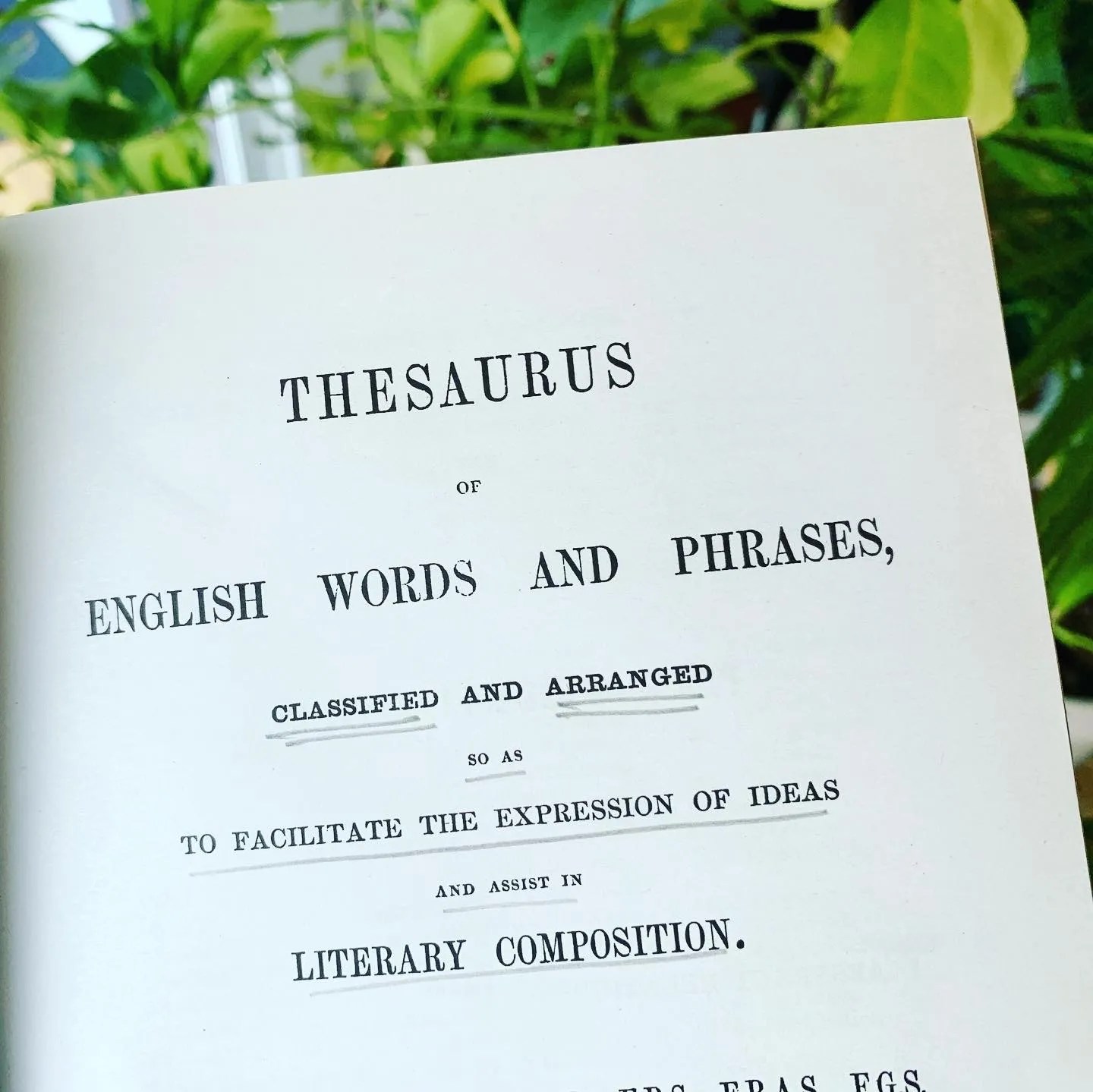
Austin Kleon on Roget’s Thesaurus…
I have always assumed — and maybe you have, too — that a thesaurus is just a synonym dictionary, the words arranged alphabetically with a list of synonyms and antonyms below. Somehow, every thesaurus I’d ever come across — even ones with “Roget” in the title! — had this alphabetic arrangement.
Because of this, it was easy for me to effectively ignore the thesaurus. If I needed a synonym or antonym, I’d just open an actual dictionary, or do a quick online search…
It turns out that Roget‘s Thesaurus is not at all what I thought it was. It is weirder and much more interesting…
… if you understand the man, you understand where his book came from. Peter Mark Roget (1779-1869) was a Victorian polymath: a doctor by trade, but he did all sorts of stuff: he was a consultant on pandemics, he wrote Encyclopedia Brittanica entries and a book about natural theology, he helped catalog several libraries, he invented the scale on the slide rule, and he may have written a paper that contributed to the birth of cinema. Oh, and he was also obsessed with chess problems.
The thing he is now most famous for — his thesaurus — was actually a side project he took up in retirement, in his seventies. His whole life he’d made lists as a way of soothing himself. He carried a notebook around with him and jotted down lists of related words and phrases to help him with his own writing and lecturing. He made his own personal thesaurus in his twenties, but in retirement he thought maybe it might be helpful to others, and after four years of work, he published the first edition of his Thesaurus (from the Greek word thēsauros, meaning “storehouse” or “treasure”) in 1852, overseeing new editions until he died in 1869. His son, John Lewis Roget, a lawyer, painter, and art critic, then took over the project.
Roget, like many Victorians, was obsessed with order and classification. His hero was Carl Linnaeus, known as the father of modern taxonomy. Roget wanted to classify and organize words in the English language. This is the best way to understand Roget’s Thesaurus: it’s not just a book of words, it’s like a library of words.
When you go to the library, the books are not arranged in alphabetical order — they’re organized topically. In order to find a book in my local library, you have to look up the book in the catalog, note the Dewey Decimal Number, then find it on the shelf. The beauty of this system, and a major argument for physical browsing collections, is that when you find the book on the shelf, it will be surrounded by books on the similar subject. You may go looking for one particular book and while browsing you might find a better book or the book you didn’t even know you were looking for. This is the way a thesaurus is supposed to work.
In the very beginning of his introduction to his book, Roget emphasizes that what makes his book unique and helpful is that the words are not arranged alphabetically, like a Dictionary, but “according to the ideas which they express.”…
The fascinating story of Roget’s Thesaurus: “A Library of Words,” from @austinkleon.
Browse the 1911 edition– still in the format Roget intended– at the Internet Archive.
###
As we look it up, we might send tasty birthday greetings to the literary genius behind green eggs and ham, Theodor Seuss Geisel, AKA “Dr. Seuss”; he was born on this date in 1904. After a fascinating series of early-career explorations, Geisel settled on a style that created what turned out to be the perfect “gateway drug” to book addiction– and a love of words– for generations of young readers.
The more that you read,
The more things you will know.
The more that you learn,
The more places you’ll go.
– I Can Read With My Eyes Shut! (1978)

“For last year’s words belong to last year’s language / And next year’s words await another voice”*…

In Words in Time and Place, David Crystal explores fifteen fascinating sets of synonyms, using the Historical Thesaurus of the Oxford English Dictionary.
We’ve turned selections from six sections of Words in Time and Place into word clouds, arranged in a shape related to the topic in question…
The first is above; see the other five– terms of endearment, dying, fools, money, and the lavatory– at Oxford Dictionaries‘ “Spiflicated, mopsy, and spondulicks: historical synonyms for everyday things.”
Special bonus: Benjamin Franklin’s personal– and voluminous– list of synonyms for “Drunk.”
* T.S. Eliot, Four Quartets
###
As we choose our words with care, we might send dangerous birthday greetings to Herbert Huncke he was born on this date in 1915. A drifter and small-time thief, Huncke became an object of respect– even affection– for William S. Burroughs, in whose autobiography (Junkie) Huncke is described:
Waves of hostility and suspicion flowed out from his large brown eyes like some sort of television broadcast. The effect was almost like a physical impact. The man was small and very thin, his neck loose in the collar of his shirt. His complexion faded from brown to a mottled yellow, and pancake make-up had been heavily applied in an attempt to conceal a skin eruption. His mouth was drawn down at the corners in a grimace of petulant annoyance…
Huncke embodied a certain honest-criminal ethic so purely that Burroughs and his friends came to love him for it. Huncke was said to have introduced Jack Kerouac to the term “beat”; in any case, Kerouac wrote adoringly of him (as Elmer Hassel) in On The Road. And Allen Ginsberg shared his New York City apartment with him, even though he realized Huncke and his junkie friends were storing stolen goods there. This phase ended in a dramatic police bust on Utopia Parkway in Bayside, Queens, during which Ginsberg frantically phoned Huncke and told him to “clean out the place” before the cops got there. Ginsberg arrived at his apartment moments ahead of the cops to find that Huncke had taken him literally. He’d tidied up and swept the floor, but left the stolen goods in an orderly stack. A forgiving Ginsberg later engaged Huncke as an instructor in the literary program he ran at Naropa Institute.

You must be logged in to post a comment.