Posts Tagged ‘Dada’
“Early modern society created – and we have inherited – that paradoxical thing: a tradition of radical innovation”*…

A University of Chicago economist with a specialty in the economics of creativity, David Galenson, with an argument that the Impressionists contributed more than their works to the story of art…
Since the 1960s the art world has become accustomed to the arrival of startling new works by contemporary artists, from Yves Klein’s anthropometries created by nude models covered with blue paint, Piero Manzoni’s canned feces, and Andy Warhol’s silkscreened portraits, through Andres Serrano’s crucifix in urine, Damien Hirst’s sectioned animals in formaldehyde, and Tracey Emin’s soiled bed, to Maurizio Cattelan’s duct-taped banana. Yet few art experts understand that these radical works are only the most recent consequences of a fundamental change in the structure of art markets that occurred more than a century ago. And the artists who initiated this change are today so venerated that few people realize how radical they were in their own time…
Art historians have long recognized that a radical change occurred in the appearance of fine art during the late 19th and early twentieth centuries, but they have failed to explain why this happened when it did. The answer lies in a change in the structure of the market for art, initiated by Claude Monet and a small group of his friends. The Impressionist group exhibitions of 1874–86 effectively ended the official Salon’s monopoly of the ability to certify artists as qualified professionals, and began a new regime in which small independent group exhibitions competed for attention. The result was a new era of artistic freedom, as painters no longer had to satisfy the conservative Salon jury, and new styles challenged for leadership of the art world. The heightened demand for originality favored conceptual artists, who could innovate conspicuously and decisively. So ironically, Monet and his fellow experimental Impressionists came under attack from the supporters of Seurat, van Gogh, Gauguin, and other young conceptual artists. The growing independence of private galleries, which further contributed to fostering competition, would allow Matisse, Picasso, and their peers to consolidate this revolution early in the next century. And the products of this perpetual revolution have included such later works as Warhol’s silkscreened portraits, Hirst’s sectioned animals, and Cattelan’s duct-taped banana. Art historians have described the transformation of modern art in great detail, but have failed to recognize the causal role of economic forces, as the shift from monopsony to a competitive market gave artists a new freedom to innovate, and made the modern era a time of continuing radical innovation…
Fascinating: “Marketing modern art: how the impressionists started a perpetual revolution,” from @jcultecon.bsky.social.
Bay Area readers can peek at the process in motion at The MFA’s Legion of Honor in the “Manet & Morisot” exhibition, up through March 1.
###
As we divvy up the difference, we might send avant-garde birthday greetings to a beneficiary of this emergent cultural mechanism, Francis Picabia; he was born on this date in 1879. A French avant-garde painter, poet, and typographist, Picabia experimented with Impressionism and Pointillism before becoming a Cubist. He then became one of the early major figures of the Dada movement in the United States and in France, and was later briefly associated with Surrealism.
See his work at the record of a major retrospective hung at the Museum of Modern Art in New York in 2017 on their web site.

“Dada was a bomb… can you imagine anyone, around half a century after a bomb explodes, wanting to collect the pieces, sticking it together and displaying it?”*…
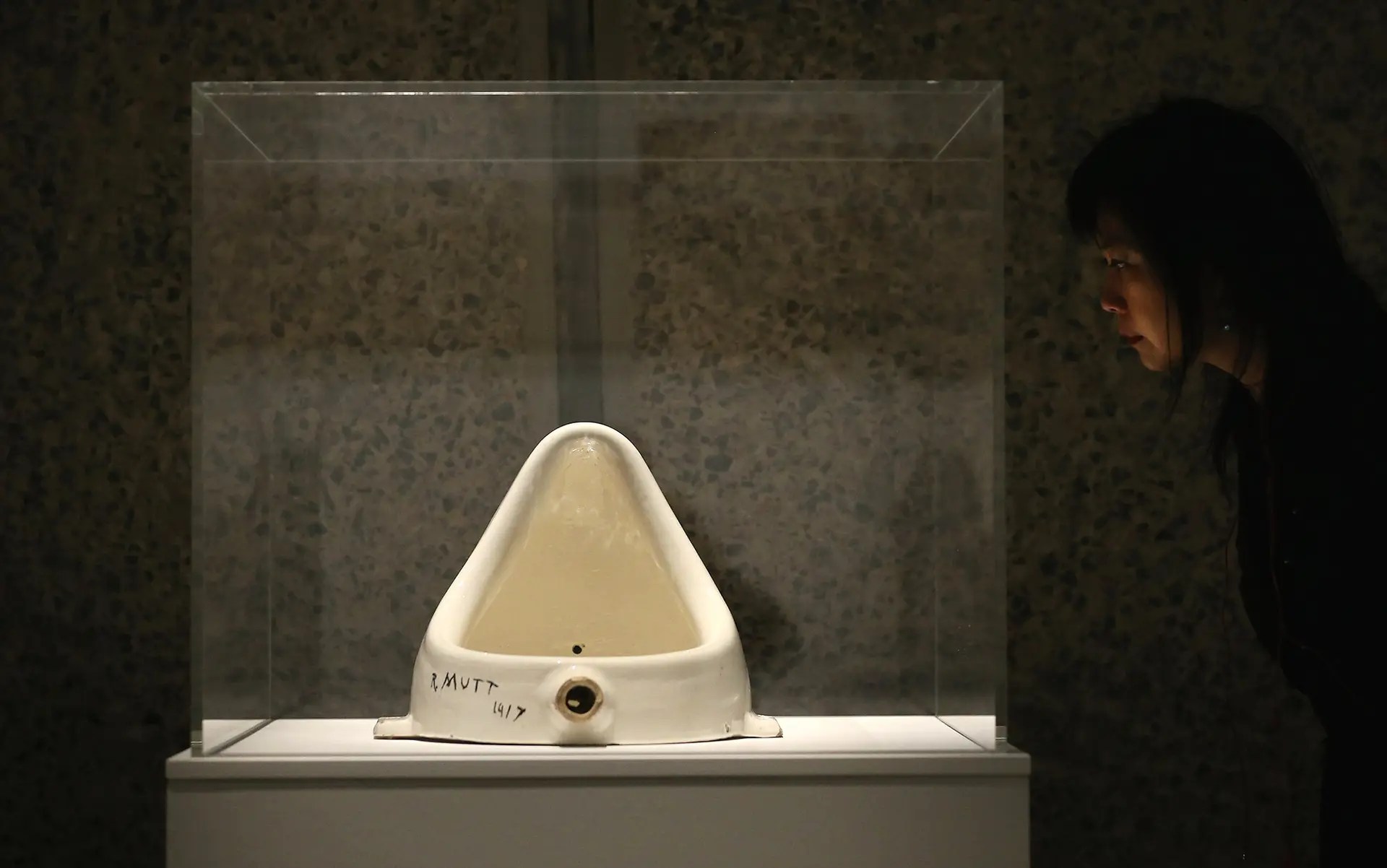
Marcel Duchamp was hugely influential in the revolutionary developments in the arts in the early 20th century. After helping establish Cubism, he turned to what he called “Readymades,” “found objects” which he selected and presented as art. By far the most famous of these was the piece he entitled “Fountain.” Damon Young and Graham Priest recount the stir that ensued… and unpack the work’s philosophical comment, making a case for why it resonates to this day…
In 1917 a pivotal event occurred for art and philosophy: Marcel Duchamp unveiled his artwork Fountain in Alfred Stieglitz’s New York studio. This was simply a porcelain urinal, signed ‘R. Mutt’.
Fountain was notorious, even for avant-garde artists. It has become one of the most discussed works of art of the 20th century. The Society of Independent Artists rejected it, though every artist who paid the exhibition fee was supposed to have their work shown. For almost a century, it has remained a difficult artwork. The philosopher John Passmore summed up Fountain as: ‘a piece of mischief at the expense of the art world’, though many have taken it very seriously.
No doubt there was some tomfoolery involved – Duchamp did not choose a urinal randomly. Yet there is more to Fountain than nose-thumbing. What makes this artwork so striking is its philosophical contribution.
Commentators often highlight the influence of Fountain on conceptual art, and this most ‘aggressive’ readymade, as Robert Hughes put it, has certainly had an enduring legacy. In 2004, it was voted the most important 20th-century work by hundreds of art experts. From Andy Warhol to Joseph Beuys to Tracey Emin, this urinal inspired artists to reconsider the traditional artwork. Instead of paintings and sculptures, art was suddenly Brillo boxes, an unmade bed, or a light-bulb plugged into a lemon: ordinary objects, some readymade, removed from their original contexts and placed on display in art galleries. The art critic Roberta Smith sums it up this way: ‘[Duchamp] reduced the creative act to a stunningly rudimentary level: to the single, intellectual, largely random decision to name this or that object or activity “art”.’ As we will see, Duchamp’s choice was not random at all, but Smith’s description points to the broader shock that Duchamp’s work prompted: if this can be art, then anything can.
Since then, scholars have discussed Fountain to demonstrate a shift away from aesthetics to thought. As the philosopher Noël Carroll notes, it’s possible to enjoy thinking about Duchamp’s work without actually looking at it, which cannot be said for Henri Matisse’s vivid paintings or Barbara Hepworth’s dignified stone sculptures.
These traditional ideas, as we will see, are all important to Fountain. But they do not go far enough. They treat Fountain as art, but of a mocking sort: a kind of intellectual heckling that nudged artists to taunt and scoff more academically at their own field. Our explanation of the artwork’s power is much more controversial: we believe that Fountain is art only insofar as it is not art. It is what it is not – and this is why it is what it is. In other words, the artwork delivers a true contradiction, what’s called a dialetheia. Fountain did not simply usher in conceptual art – it afforded us an unusual and intriguing concept to consider: a work of art that isn’t really a work of art, an everyday object that is not just an everyday object…
Marcel Duchamp’s ‘Fountain’ is not just a radical kind of art; it’s a philosophical dialetheia: a contradiction that is true: “It is and it isn’t,” from @damonyoung.com.au and Graham Priest @aeon.co. Eminently worth reading in full.
We might note that it’s not altogether clear that the dialetheia which the authors celebrate was what Duchamp had in mind. In any case (in line with the quote at the top) Duchamp, a father of Dada, was not entirely pleased with the influence that his work had:
This Neo-Dada, which they call New Realism, Pop Art, Assemblage etc. [Duchamp is referring to Andy Warhol and Roy Lichtenstein], is an easy way out and lives on what Dada did. When I discovered readymades I thought to discourage aesthetics. In Neo-Dada they have taken my readymades and found aesthetic beauty in them. I threw the bottle-rack [here] and the urinal in their faces as a challenge and now they admire them for their aesthetic beauty…
– Duchamp in a 1962 letter to Hans Richter
And as this is the centenniel of Dada’s “child,” Surrealism, we might peruse “The Small Magazines That Birthed Surrealism.”
###
As we ponder paradox, we might raise a glass in celebration of National Cartoonists Day, observed on this day each year. The date was chosen to recognize the first appearance (in color) of the mischievous cartoon character “The Yellow Kid” in the New York World newspaper (on May 5, 1895).

“Art is the lie that enables us to realize the truth”*…
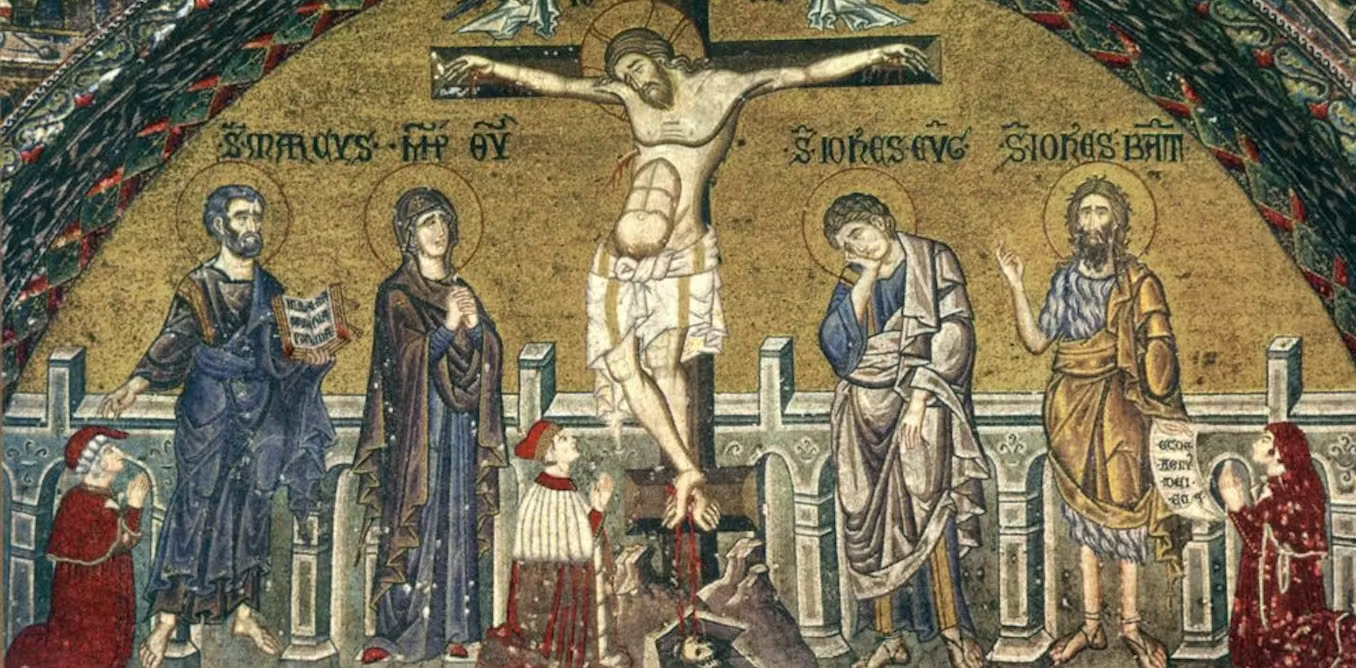
Drawing on her recent book, Facing Crisis: Art as Politics in Fourteenth-Century Venice, Stefania Gerevini on a historical reminder of the crucial role that art can play in times like these…
In an increasingly polarised world, the arts and humanities play a key role in sustaining democracy. They foster critical thinking, open dialogue, emotional intelligence and understanding across different perspectives, all of which are essential for a healthy democratic society. Also, people who participate in cultural activities are much more likely to engage in civic and democratic life.
Yet the way the arts are funded differs widely from country to country, especially in times of economic hardship or significant change. During and after the pandemic, for instance, some EU countries increased public spending on culture, while others made significant cuts.
The reasons for these contrasting attitudes are many, from local cultural values, to shifting economic priorities and politics. But at their core, different funding strategies express different attitudes towards two questions: what contribution does art make in times of crisis? And how do communities express their experiences of uncertainty?…
… the medieval city of Venice provides a remarkable historical example for addressing these questions.
Between the sixth and 12th centuries, Venice grew into an independent city-state ruled by an elected council and an elected head of state, called the doge.
Set on an island, the city lacked some of the resources necessary to its survival, so it quickly established strong maritime trade networks across the Mediterranean. It gradually developed into an international merchant empire, acquiring strategic territories along the eastern Adriatic Coast, Greece and the Aegean Sea.
By the mid-14th century, Venice was a leading global power. Yet, between 1340 and 1355, the city also faced famine, plague, a violent earthquake and fierce military conflicts with Genoa and the Ottomans.
Internally, Venice tackled dramatic political tensions (including a coup and the public execution of a doge in 1355), as non-noble citizens were gradually excluded from public office. Strikingly, it was during this period of acute crisis that the government initiated a series of ambitious artistic projects in the state church of San Marco.
A new baptistery and a chapel dedicated to Saint Isidore of Chios were lavishly decorated with mosaics. In addition, the high altar, which provided religious focus for the faithful, was revamped. This included turning its uniquely precious golden altarpiece into spectacular moving machinery that would open and close to reveal different images daily, and on feast days.
These projects, which required substantial public spending at a time of financial strain, hardly represented business as usual for Venetian policymakers. Instead, they were a central part of the government’s wider response to crisis.
On one level, these new projects revealed the range of pressing concerns that engulfed the Venetian government and people at the time. The painted altarpiece displayed on the altar of San Marco on non-festive days exhibits an emphasis on human suffering, miracles and saintly interventions that may relate the need for reassurance in uncertain times.
The bloody conflict against Genoa likely influenced the dedication of a chapel to St Isidore. The saint’s body was transported to Venice from the Greek island of Chios, a vital Genoese stronghold in the 14th century. To the people of Venice, the physical presence of St Isidore’s relics in San Marco provided reassurance and the promise of protection and victory as their state engaged in a risky conflict.
Finally, uncertainty about the nature and boundaries of citizenship and political authority – which the expansion of Venice’s overseas territories transformed into an ever more urgent problem – offer a valuable way to interpret the imagery in the baptistery. Here the apostles are rendered in mosaic as they baptise the “nations of the earth”, offering an idealised image of union in diversity.
Yet, on another level, the projects sponsored by the Venetian government during this period represented the active exercising of the political imagination. In ways that some of us may find alarmingly familiar, Venice’s ongoing instability made traditional approaches to decision-making, communication and control ineffective in dealing with the challenges it faced.
Venice’s governors responded to the crisis which threatened the very survival and stability of the city and its political foundations with a wide-ranging strategy of legal, institutional and historical revision, aimed at clarifying the nature and functions of the Venetian state.
The government reaffirmed Venice’s civic laws and reorganised its international treaties. The authority of the doge was progressively restricted, and over time, the government clarified the rules for holding public office. The first official history of Venice was completed in 1352.
In this context, the San Marco projects did not merely express the anxiety of the Venetian people, or their hopes for renewed stability. They represented the establishing of a new political landscape, which was envisioned most clearly on the east wall of the baptistery.
Three secular figures – a doge and two officers – are depicted as kneeling supplicants within a monumental mosaic of the crucifixion (see the main headline image above). Blending the sacred with the secular, this image offered an abstract “state portrait” that simultaneously expressed a political reality and suggested a new political ideal.
The mosaic now rendered Venice’s doge as a humble ruler, and it represented the business of government as a collective enterprise. In so doing, this image articulated a new vision of government as public service and shared responsibility. This idea, which developed through political reforms in Venice and from broader debates in other medieval Italian city states, has went on to influence western approaches to government and public life to this day.
Venice’s state-sponsored artistic commissions were not propaganda in the modern sense. Instead, they offered a compelling visual reflection on the nature of leadership and the necessary limits of authority. They kindled a new vision of government that enabled Venice to navigate one of the most turbulent phases of its history – reminding us, too, of the power of the arts to inspire and imagine new futures in difficult times…
Learning from history: “Medieval Venice shows us the good art can do in times of crisis,” from @theconversation.com.
* Pablo Picasso
###
As we appreciate art, we might send imaginative birthday greetings to Odilon Redon; he was born on this date in 1840. A lithographer, etcher, and painter, he was influential in the development of modern French art in two different ways. His prints explore haunted, fantastic, often macabre themes, earning him a leading place among emerging French Symbolists and foreshadowing the Surrealist and Dadaist movements. His oils and pastels, chiefly still lifes with flowers, won him the admiration of Henri Matisse and other painters as an important colorist.

“Whatever happens to musicians happens to everybody”*…

Further, In a fashion, to yesterday’s post (and for that matter, to “Nature doesn’t feel compelled to stick to a mathematically precise algorithm; in fact, nature probably can’t stick to an algorithm.”), a provocative proposal from Justin Patrick Moore…
We don’t have enough Dada in this world of too much data. Something is needed to break-through the over-curated simulacrum that is the online world in order to let in a bit of non-artificial light. One way to make a break is through the deliberate cultivation of the glitch.
The exact etymology of the word glitch is not known, though it may derive from the Yiddish “glitsh” which means a “slippery place.” In the mid-twentieth century the word first started showing up in technical texts and related to sudden surges of voltage within an electrical circuit causing it to overload. Today a glitch is any kind of malfunction in hardware or error in software.
In the 1990’s glitch music became a kind of sub-genre of electronic music found at the meeting points of the avant-garde, noise, and more popular forms. This type of music, and the methods surrounding it, including circuit-bending, can provide a window, cracked as it is, for looking out at adjacent electronic worlds, including the internet…
[Moore explains circuit-bending and it’s history…]
… Digital natives need chance like a body needs water. Algorithms have taken the fun out of what was once unplanned and unstructured; internet surfing has been made accident proof, as if it were run by insurance agents and safety specialists. Spots of possible slippage are mopped up in favor of putting forth pre-chewed opinions and junk food clickbait. A similar environment prevails for electronic musicians. The hardware and software being made more often than not makes it difficult to fail. Sound libraries, instrument and effect presets, samplers pre-loaded with perfect pulsing patterns, make it hard to even play in the wrong pitch. These fully loaded tools make it a possible to become a producer of music in a matter of minutes.
Preconfigured musical gear may make it easier to get grooving right off the bat, but the gift of instant gratification steals the sense of accomplishment and intimacy that comes from knowing every inch and crevice of an instrument. And while on first meeting, a run in with a run of the mill modular set up might cause sparks to fly, the slow burn of excitable electrons grows even further from long association. The nuance and subtlety available to those who explore in depth comes across in the very sounds. Circuit-bending is one way to go into those depths, down to the wire.
Prefab music is low risk music. Something might be made from it that could be used as a backdrop to a car commercial or fit into a DJ set at a dance club, as filler, but without investigating the underlying assumptions of a piece of gear, or software, the things that come out of it will tend to not have the rewards associated with riskier behavior. Disfigured musical gear gives the gift of decomposition and recomposition to electronic composers. With their materials mangled and mutilated, the gear becomes a mutt, with all the natural advantages over thoroughbred, store bought, off-the-shelf kit. The system may be less predictable, but that is the point…
[Moore unpacks examples, and explains how, as the solution was itself absorbed into the problem…]
Kim Cascone pointed this out in his inspired essay The Aesthetics of Failure [here] that glitch is just the latest way of investigating the creative misuse of technology. Yet as the internet grew, the process by which those techniques spread happened much faster than in previous decades. In sharing technique of glitch, some of the imaginative grain within the music was lost as it became just another commodity. With the widespread availability of digital music software, “the medium is no longer the message in glitch music: the tool has become the message.”
Failure had reached a point of failure.
If our own thinking can be glitched then perhaps it is still possible to create systems that embrace the slippage. If we don’t want the “tool to become the message” than a third element beyond the digital must be added into the mix.
The technopoly runs on data. Is there a way to make it more Dada? The artists of the Dada movement rejected many things, but logic and reason were chief among them. Where was the logic in the atrocities of World War I? The founders of the movement had lived through the war and in reaction against it, sought to elevate nonsense and the irrational above cruel, cold logic.
In our own time reason and logic have failed to deliver the utopia of technology as promised and promoted by Big Techs advertisers and PR specialists. It can seem that humanities dystopian nightmares are what are actually manifesting. Perhaps part of technologies failure is due to the fact that the digital world is built on binaries.
Logic circuits or gates are the brick and mortar of digital systems. They are electronic circuits that have one or more than one input, but only one output. Logic gates are the switches that turn ON or OFF depending on what the user does. A logic gates turn ON when a certain condition is true, and OFF when the condition is false. A logic gate is able to check whether or not the information they get follows a certain rule, and the output is thus determined.
There are several types of logic gates, but the three most common are the NOT gate, the AND gate, and the OR gate. The NOT gate is the simplest. It’s sole function is to take an input that is either ON or OFF and give it back as the opposite, what the original signal is NOT. The AND circuit requires two inputs. It can only turn on when both inputs are ON. If only one input is on it turns OFF, and when both inputs are off, it turns OFF.
The OR circuit also requires two inputs. It needs one input to be on for it be ON, and is also still ON when both inputs are ON, and it is only OFF when both inputs are OFF.
While variations from these basic circuits have been used to build complex systems, they still have at their core, the binary which undergirds the entire techonosphere. It is rather difficult for the unknown to break through when only two outcomes are possible. A third position between ON and OFF is never arrived at. This would require ternary logic, and as far as I know, a ternary computer has yet to be built.
In lieu of a ternary computer, a third element needs to be added to digital systems: that is the human component. This is also where I think modes of artistic creation in the spirit of Dada can help. By moving away from pure logic and reason, by letting a bit of nonsense or irrationality slip through, the human tendency to also think in binaries can be glitched.
So much of the creative process is automated when working with digital tools, but it has little in common with the methods of automatism that came out of the Surrealist milieu. The various methods of automatism developed by the Surrealists put a person in touch with the unknown, whether it be the unconscious or from beyond the fragile borders of this world. Bringing these techniques back into play could give back a sense of humanity to the sounds of dead electric emitted from programmed machines.
Automatism came in part from the method of automatic writing or spirit writing, when mediums and others of their psychic ilk were said to be in touch with disembodied spirits. The writing came through them from the other side. For the Surrealists tapping into these forces became a source of creativity. The results were often startling as they bypassed logic and reason.
To the point of this essay, in artistic creation, logic is rarely the principle that needs to be abided. Automation needs to be bypassed in favor of automatism. In electronic music strategies and interventions need to be used to work around and supplant the built-in binary biases of the tools, otherwise the music being made on them ends up just sounding like a commercial for the tool…
[Moore offers examples from Ben Chasney and Max Ernst…]
Whatever the source may be, if we are to glitch the circuit, we need to open ourselves up to the slippage that comes in from the unknown. Otherwise people might as well just let AIs design the music for them. And while generative music systems can be built that produce startling beauty, such as Wotja and Brian Eno’s Bloom, they leave too little for unintended influences from outside the confines of the system. For that a human really does have to put themselves into line with the flow of the circuit path.
To create something new, we need to become conduits, connect and plug into to an outside source…
Putting the Dada into data: “Glitching the Circuit,” from @igloomag.bsky.social.
* Bruce Sterling (@bruces.mastodon.social.ap.brid.gy)
###
As we explore, we might recall that it was on this date in 1977 that Iggy Pop, former frontman of The Stooges, released his debut solo album, The Idiot. It was produced by Pop’s friend David Bowie, who also wrote much of the album’s music (to which Pop added most of the lyrics). Described by Pop as “a cross between James Brown and Kraftwerk”, The Idiot marked a departure from the proto-punk of the Stooges to a more subdued, mechanical sound with electronic overtones.

“Dada is ‘nothing'”*…

Marcel Duchamp, Francis Picabia, and Beatrice Wood, 1917
Working from Marcel Duchamp’s concept of anti-art, Tristan Tzara and Hugo Ball conjured “Dada” in Europe in the early 20th century; it gestated in France, then it found it’s footing in New York in 1915, and ignited in Paris in 1920… Key figures in the movement included Duchamp, Tzara, Ball, and the likes of Jean Arp, Johannes Baader, Max Ernst, Richard Huelsenbeck, Francis Picabia, Man Ray, Hans Richter, Kurt Schwitters… and Beatrice Wood.
We need to talk about Beatrice Wood. The last surviving member of the Dada movement, the ceramicist, the artist, the writer, the actress, the lover, and let’s not leave out, the inspiration behind the headstrong character of “Rose” in the movie Titanic. Beatrice was born at the end of the 19th century, and died at the end of the 20th, and in between she lived an incredible life. The sign on her ceramics studio read “Reasonable and Unreasonable”, and was a pretty spot-on description of her life…
The remarkable story: “Meet The Mama of Dada” in @MessyNessyChic
See also: “Beatrice Wood” @Artforum
* Marcel Duchamp
###
As we appreciate art, we might send carefully-composed birthday greetings to a very different kind of artist (one against whom the Dadaists were rebelling), John Singer Sargent; he was born on this date in 1856. One of the leading portrait painters of his time, he moved in the same social circles as his subjects (Presidents [e.g., Teddy Roosevelt), nobility (e.g., Lady Agnew), tycoons and their heirs [e.g., numerous Vanderbilts, Isabella Stewart Gardner), celebrity authors (e.g, Robert Louis Stevenson, Kenneth Grahame), even other artists (e.g., Claude Monet), and so was admired in his time for his evocation of Edwardian luxury. He was prodigiously prolific: he created roughly 900 oil paintings and more than 2,000 watercolors, as well as countless sketches and charcoal drawings.

Sargent in his studio with his personal favorite of his works, Portrait of Madame X, c. 1885 (source)
You must be logged in to post a comment.