Posts Tagged ‘black holes’
“A physicist is just an atom’s way of looking at itself”*…
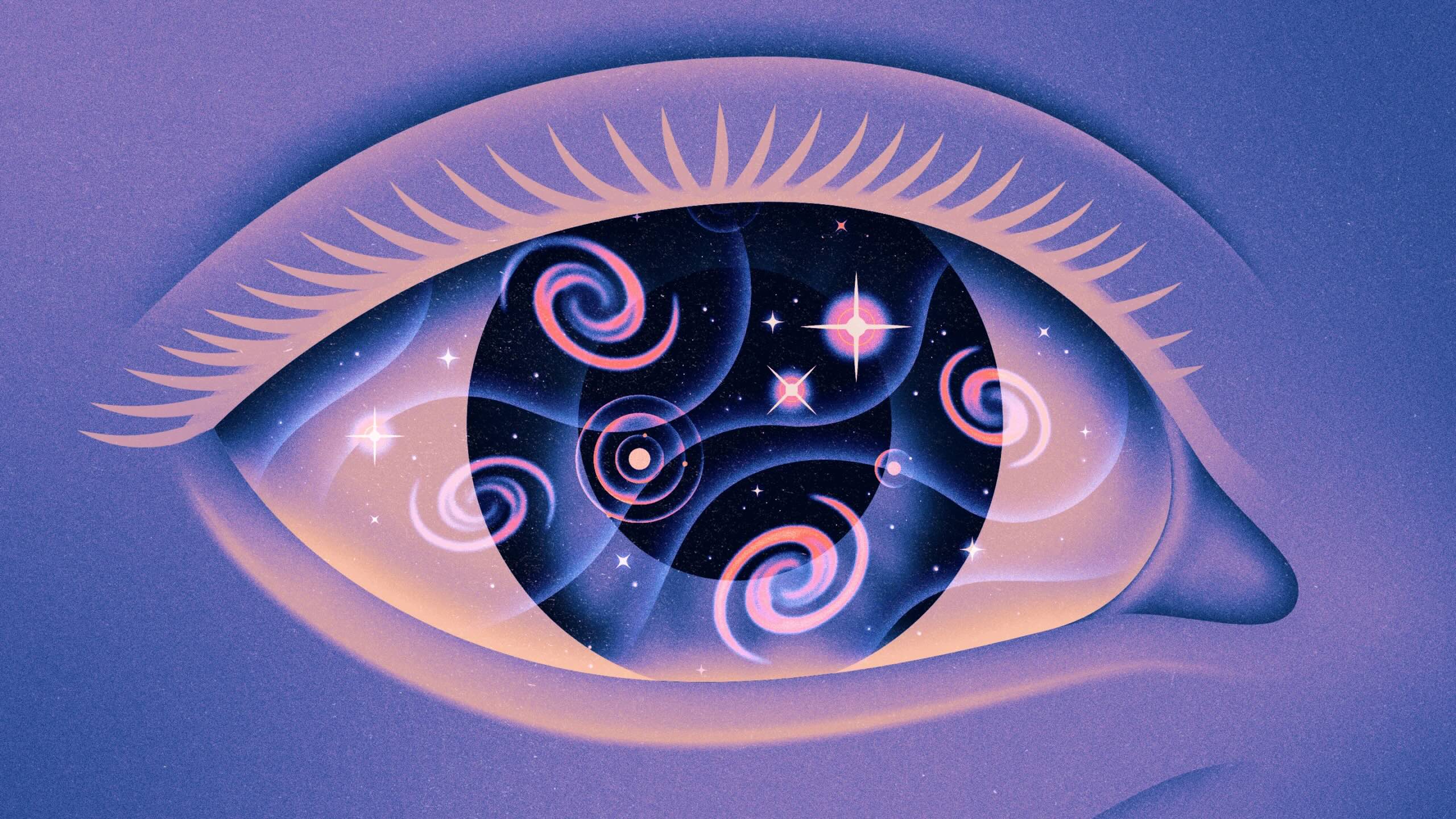
Encouraged by successes in understanding black holes, theoretical physicists are applying what they’ve learned to whole universes. As Matt von Hippel explains, what they’re finding has them questioning fundamental assumptions about how physics ought to be done…
Tinkering at their desks with the mathematics of quantum space and time, physicists have discovered a puzzling conundrum. The arcane rules of quantum theory and gravity let them imagine many different kinds of universes in precise detail, enabling powerful thought experiments that in recent years have addressed long-standing mysteries swirling around black holes.
But when a group of researchers examined a universe intriguingly like our own in 2019, they found a paradox: The theoretical universe seemed to admit only a single possible state. It appeared so simple that its contents could be described without conveying even a single bit of data, not even a choice of a zero or a one. This result clashed with the fact that this type of universe should be capable of hosting black holes, stars, planets — and people. Yet all those rich details were nowhere to be seen.
“We look around, and certainly the world seems more complex than that,” said Rob Myers, a theoretical physicist at the Perimeter Institute for Theoretical Physics in Waterloo, Canada, who has not been directly involved in this research.
Physicists have good reason to trust the calculation, which builds on fundamental physical ideas. The math implies a universe with only one state; our universe is clearly not like that. Now a team of theorists has floated a possible answer. The paradoxical result occurred when physicists sought an objective description of the state of an entire universe. But a description like that might not be possible, even in principle. It implicitly assumes a universe that exists without an observer to observe it. And perhaps without observers, the complexity of the universe loses its meaning…
[von Hippel unpacks the scientific thinking that led to this conundrum. He concludes with an account of recent work by Ying Zhao that hints at a resolution…]
… Quantum mechanics requires a distinction between an observer — such as the scientist carrying out an experiment — and the system they observe. The system tends to be something small and quantum, like an atom. The observer is big and far away, and thus well described by classical physics… Perhaps an observer could do the same to these closed, impossibly simple-seeming universes?
In 2024, Zhao moved to the Massachusetts Institute of Technology, where she began to work on the problem of how to put an observer into a closed universe. She and two colleagues —Daniel Harlow and Mykhaylo Usatyuk — thought of the observer as introducing a new kind of boundary: not the edge of the universe, but the boundary of the observer themself. When you consider a classical observer inside a closed universe, all the complexity of the world returns, Zhao and her collaborators showed.
The MIT team’s paper came out at the beginning of 2025, around the same time that another group came forward with a similar idea. Others chimed in to point out connections to earlier work.
At this stage, everyone involved emphasizes that they don’t know the full solution. The paradox itself may be a misunderstanding, one that evaporates with a new argument. But so far, adding an observer to the closed universe and trying to account for their presence may be the safest path.
“Am I really confident to say that it’s right, it’s the thing that solves the problem? I cannot say that. We try our best,” Zhao said…
“Cosmic Paradox Reveals the Awful Consequence of an Observer-Free Universe,” from @quantamagazine.org.
Apposite: “Biology Might Not Be Quantum, but Its Math Is Quantumlike“
###
As we keep an eye out, we might send cosmological birthday greetings to Enrico Fermi; he was born on this date in 1901. A physicist and Nobel Laureate (1938) for his discovery of nuclear reactions brought about by slow neutrons, he is best remembered for (literally) presiding over the birth of the Atomic Age. Fermi was perhaps especially remarkable as the last “double-threat” in his field: a genius at creating both important theories and elegant experiments. As observed before (and illustrated above :), the division of labor between theorists and experimentalists has since been pretty complete.
The novelist and historian of science C. P. Snow wrote that “if Fermi had been born a few years earlier, one could well imagine him discovering Rutherford’s atomic nucleus, and then developing Bohr’s theory of the hydrogen atom. If this sounds like hyperbole, anything about Fermi is likely to sound like hyperbole.”

“Reality is that which, when you stop believing in it, doesn’t go away”*…

Reality is tough. Everything eats and is eaten. Everything destroys and is destroyed.
In a way that challenges lots of our deeply-seated conceptions (your correspondent’s, anyway), philosopher (and self-proclaimed pessimist) Drew Dalton invokes the laws of thermodynamics to argue that it is our moral duty to strike back at the Universe…
Reality is not what you think it is. It is not the foundation of our joyful flourishing. It is not an eternally renewing resource, nor something that would, were it not for our excessive intervention and reckless consumption, continue to harmoniously expand into the future. The truth is that reality is not nearly so benevolent. Like everything else that exists – stars, microbes, oil, dolphins, shadows, dust and cities – we are nothing more than cups destined to shatter endlessly through time until there is nothing left to break. This, according to the conclusions of scientists over the past two centuries, is the quiet horror that structures existence itself.
We might think this realisation belongs to the past – a closed chapter of 19th-century science – but we are still living through the consequences of the thermodynamic revolution. Just as the full metaphysical implications of the Copernican revolution took centuries to unfold, we have yet to fully grasp the philosophical and existential consequences of entropic decay. We have yet to conceive of reality as it truly is. Instead, philosophers cling to an ancient idea of the Universe in which everything keeps growing and flourishing. According to this view, existence is good. Reality is good.
But what would our metaphysics and ethics look like if we learned that reality was against us?…
Read on for his provocative argument that philosphers must grapple with the meaning of thermodynamics: “Reality is evil,” from @dmdalton.bsky.social in @aeon.co.
Dalton further explores these ideas in his book The Matter of Evil: From Speculative Realism to Ethical Pessimism (2023)
* Philip K. Dick
###
As we wrestle with reality, we might send somewhat sunnier birthday greetings to Stephen William Hawking CH CBE FRS FRSA; he was born on this date in 1942. A theoretical physicist and cosmologist, he is probably best known in his professional circles for his work with Roger Penrose on gravitational singularity theorems in the framework of general relativity, for his theoretical prediction that black holes emit radiation (now called Hawking radiation), and for his support of the many-worlds interpretation of quantum mechanics.
But Hawking is more broadly known as a popularizer of science. His A Brief History of Time stayed on the British Sunday Times best-seller list for over four years (a record-breaking 237 weeks), and has sold over 10 million copies worldwide.
“We have this one life to appreciate the grand design of the universe, and for that, I am extremely grateful.”

“Sure, black holes can kill us, and in a variety of interesting and gruesome ways. But, all in all, we may owe our very existence to them”*…

If you want to see a black hole tonight, just look in the direction of Sagittarius, the constellation. That’s the center of the Milky Way Galaxy and there’s a raging black hole at the very center of that constellation that holds the galaxy together.
– Michio Kaku
So, which came first: the galaxies spread through the universe, of the black holes that hold them together? Ethan Siegel answers and explains.
* Philip Plait, Death from the Skies!: These Are the Ways the World Will End…
###
As we raise our eyes, we might send star-struck birthday greetings to Johann Rudolf Wolf; he was born on this date in 1816. A distinguished astronomer and mathematician, Wolf wrote on prime number theory, geometry, probability, and statistics; but he is best remembered for his work on sunspots. Working from Heinrich Schwabe’s suggestion that sunspot activity was cyclical, Wolf calculated the period of the cycle at 11.1 years; he was among the first to establish the connection of sunspot activity to geomagnetic activity on Earth; and he developed a way of quantifying sunspot activity– the Wolf number, as it is known– that remains in use.

You must be logged in to post a comment.