Posts Tagged ‘John Wheeler’
“What happens when you get to the end of things?”*…

Charlie Wood introduces a remarkable new collection in Quanta…
A couple of years ago, I was chatting about black holes with Dan Harlow of the Massachusetts Institute of Technology when he made a casual comment that left a deep impression on me. I asked if some new work he’d been doing strengthened the case that space-time was “emergent.” Without missing a beat he replied, “Sure, if it needed strengthening.”
Harlow isn’t the only physicist with serious doubts about what reality is made of. For more than a decade now, Nima Arkani-Hamed of the Institute for Advanced Study has been delivering a polished lecture arguing that space-time is “doomed.” Time and again, I’ve heard theorists in high-energy physics make similar-sounding statements, and I’ve always been struck by their confidence. We don’t have the faintest idea what the next theory of physics will look like, whether it will involve strings, loops, triangles or something entirely new that no one has thought to propose. And yet so many theorists seem rather convinced that whatever it will be, it won’t involve space or time.
Why? What does that statement mean? What would it look like to do physics without referring to space or time? I’ve spent most of this year trying to find out. The results have just been published in “The Unraveling of Space-Time,” a massive package that includes articles, videos and interactive animations from me and my colleagues Mark Belan, Emily Buder, Amanda Gefter and Joseph Howlett.
Over the course of more than 40 interviews with nearly 30 physicists, I learned that there are many ways to define emergent space-time. But at the most basic level, “emergent space-time” means that space and time are the outputs of a theory instead of the inputs. A classic analogy is heat. To explain why a teacup cools, scientists of the 1700s put heat into their theory of the world as a substance that repels itself and naturally spreads out. But this “caloric theory” was ultimately replaced by thermodynamics, a theory where a primary input is molecules that buzz around with some energy. As molecules crash into each other, their energy spreads, and we now recognize this process as the origin of heat transfer. Heat is an output — a prediction — of thermodynamics. It is an emergent phenomenon.
Space-time is the ultimate input. If physics is largely about predicting what happens where and when, you need a stage upon which things can happen. Albert Einstein became a household name for revealing that this stage acts like a fabric that bends in ways we experience as gravity. He described in spectacular detail how space-time behaves, much as 19th-century scientists described how heat behaves with caloric theory. The idea that space-time is emergent is the idea that space-time will eventually go the way of heat, water, air and so many other substances before it; we will someday understand it to be the inevitable consequence of the behavior of simpler entities. Call them the “atoms” of space-time.This week’s series explores the mind-bending notion of emergent space-time from a number of angles. There is, of course, the why of it all. This mostly boils down to the strange things that happen when Einstein’s theory of space-time collides with quantum mechanics, the theory of the subatomic world. When we combine features from both theories, we see that any experiment that tries to probe reality a little too closely will get thwarted by the appearance of a black hole, an enigma that undermines the familiar picture of space-time in its own way.
For this and other reasons, physicists are pushing to escape our familiar space-time, often referred to as the “bulk,” in search of alien environments conducive to new ways of doing physics.
Where else might one do physics, if not in the bulk? A few ideas are being developed, including one that goes by the name of holography. This is roughly the idea that any gravitational system — even the entire universe — can have an alternative description as a collection of quantum particles moving around a flat surface. From these gravity-free surfaces, a bulk world with gravity somehow pops out. It’s a remarkable theoretical claim, and over the past few years, holographers have developed a suite of tools that have helped them decode the bulk from the behavior of these surface particles.Another research program, spearheaded by Arkani-Hamed, has even more ambitious aims — getting both space-time and quantum mechanics as outputs from even more alien inputs. His group has recently developed an entirely new language for making predictions, one that makes no reference to space-time. Instead, it uses only geometric shapes and primitive counting tasks.
Is space-time, at least in its current form, definitely doomed? The idea tortured one of the pioneers of gravitational theory, John Wheeler. And today, the end of space-time is even more widely accepted. Most of the theorists I spoke with struggled to think of colleagues in the quantum gravity community who would defend space-time as a fundamental ingredient of reality. However, some researchers are pursuing alternatives. I spoke at length with Latham Boyle about patterns in particle physics that have led him and his collaborators to the more conservative notion that space-time might come in two “sheets.”
The various proposals under development are unlikely to see experimental tests this century, so a conclusive answer doesn’t seem near. But if it were someday established that space-time does break down, what would that mean for us?
On a practical level, not much. Einstein’s fabric of space-time is so sturdy that little short of a black hole would put a noticeable dent in it. But at a conceptual level, it’s hard to imagine a more dramatic rethinking of reality. When Democritus suggested that matter emerges from tiny barbed “atoms” more than 2,000 years ago, he couldn’t possibly have foreseen that parts of his proposal would ultimately be realized in the form of quantum theory — a framework asserting that reality is an ocean of overlapping waves of possibility that resolve into fixed objects only in certain situations.
If the void itself emerges from something, that something will be at least as alien. Just as individual molecules don’t themselves have a well-defined notion of heat, the base level of reality could lack marquee features of our existence that we take for granted. Places. Times. The ability to influence only nearby objects. The requirement that causes precede effects. Physicists are already finding that these notions seem unlikely to be present in a more precise accounting of the world. They seem to be the approximate outputs of something stranger.“One of the most spectacular aspects of these new findings is the emergence of causality can only happen in the approximate description,” Elliott Gesteau, a quantum gravity researcher at the California Institute of Technology, told me over Zoom earlier this year. If there is gravity, he continued, “which is what we have in our world, then this causal structure is only approximate and must break down.”…
Are we on the verge of a new physics? “Why Space-Time Looks Doomed,” from @walkingthedot in @QuantaMagazine.
The full interactive collection is here, and eminently worth reading in full.
* John Wheeler
###
As we wrestle with reality, we might spare a thought for a physicist whose work helped move the questions we face forward– Max Karl Ernst Ludwig Planck; he died on this date in 1947. A theoretical physicist, he is best remembered as the originator of quantum theory. It was his discovery of energy quanta that won him the Nobel Prize in Physics in 1918.

“The ‘paradox’ is only a conflict between reality and your feeling of what reality ‘ought to be’”*…
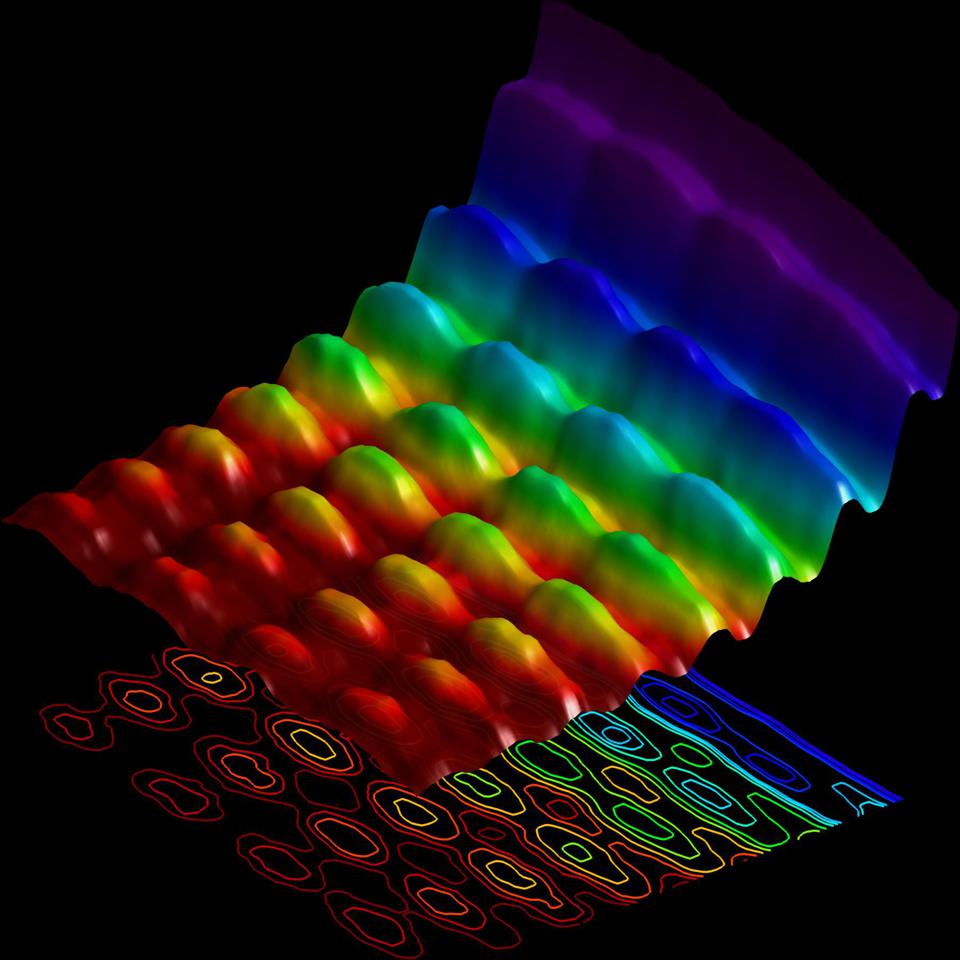
One of the most bizarre aspects of quantum physics is that the fundamental entities that make up the Universe, what we know as the indivisible quanta of reality, behave as both a wave and a particle. We can do certain experiments, like firing photons at a sheet of metal, where they act like particles, interacting with the electrons and kicking them off only if they individually have enough energy. Other experiments, like firing photons at small thin objects — whether slits, hairs, holes, spheres, or even DVDs — give patterned results that show exclusively wave-like behavior. What we observe appears to depend on which observations we make, which is frustrating, to say the least. Is there some way to tell, fundamentally, what the nature of a quanta is, and whether it’s wave-like or particle-like at its core?
That’s what Sandra Marin wants to know, asking:
“I wonder if you could help me to understand John Wheeler – the delayed choice experiment and write an article about this.”
John Wheeler was one of the most brilliant minds in physics in the 20th century, responsible for enormous advances in quantum field theory, General Relativity, black holes, and even quantum computing. Yet the idea about the delayed choice experiment hearkens all the way back to perhaps our first experience with the wave-particle duality of quantum physics: the double-slit experiment…
Although Einstein definitively wanted us to have a completely comprehensible reality, where everything that occurred obeyed our notions of cause-and-effect without any retrocausality, it was his great rival Bohr who turned out to be correct on this point. In Bohr’s own words:
“…it…can make no difference, as regards observable effects obtainable by a definite experimental arrangement, whether our plans for constructing or handling the instruments are fixed beforehand or whether we prefer to postpone the completion of our planning until a later moment when the particle is already on its way from one instrument to another.”
As far as we can tell, there is no one true objective, deterministic reality that exists independently of observers or interactions. In this Universe, you really to have to observe in order to find out what you get.
The history and the results of John Wheeler‘s famous “delayed choice” experiments: “Is Light Fundamentally A Wave Or A Particle?“
* Richard Feynman
###
As we reconsider categories, we might recall that it was on this date in 1404 that King Henry IV signed the “Act Against Multipliers,” stipulating that “None from hereafter shall use to multiply gold or silver, or use the craft of multiplication; and if any the same do, they incur the pain of felony.” Great alarm was felt at that time lest any alchemist should succeed in “transmutation” (the conversion of a base metal into gold or silver), thus undermining the sanctity of the Royal currency and/or possibly financing rebellious uprisings. Alchemy, which had flourished since the time of Bacon, effectively became illegal.
The Act was repealed in 1689, when Robert Boyle, the father of modern chemistry, and other members of the vanguard of the scientific revolution lobbied for its repeal.

You must be logged in to post a comment.