Posts Tagged ‘particle’
“How many general-relativity theorists does it take to change a light bulb?”*…

Jokes are where one finds them…
Heisenberg, Schrodinger, and Ohm are driving along the road together – Heisenberg is driving. After a time, they are stopped by a traffic cop. Heisenberg pulls over, and the cop comes up to the driver’s window.
“Sir, do you know how fast you were driving?” asks the cop.
“No” replies Heisenberg “but I know precisely where I am”
“You were doing 70.” says the cop
“Great!” says Heisenberg “Now we’re lost!”
The cop thinks this is very strange behaviour and so he decides to inspect the vehicle. After a time he comes back to the driver’s window and says
“Do you know there’s a dead cat in the trunk?”
“Well, now we do!!” yells Schrodinger.
The cop thinks this is all too weird, so he proceeds to arrest the three. Ohm resists.
source
[Image above: source]
* “How many general-relativity theorists does it take to change a light bulb? Two: one to hold the bulb and one to rotate space.” (source)
###
As we chortle, we might spare a thought for Louis de Broglie (or as he was known more officially, Louis Victor Pierre Raymond, 7th Duc de Broglie); he died on this date in 1987. An aristocrat and physicist, he made significant contributions to quantum theory. In his 1924 PhD thesis, he postulated the wave nature of electrons and suggested that all matter has wave properties— a concept known as the de Broglie hypothesis, an example of wave–particle duality— a topic that occupied both Heisenberg and Schrodinger and that forms a central part of the theory of quantum mechanics. After the wave-like behavior of matter was first experimentally demonstrated in 1927, de Broglie won the Nobel Prize for Physics (in 1929).
Louis de Broglie was the sixteenth member elected to occupy seat 1 of the Académie française in 1944, and served as Perpetual Secretary of the French Academy of Sciences. He was the first high-level scientist to call for establishment of a multi-national laboratory, a proposal that led to the establishment of the European Organization for Nuclear Research (CERN).

“The ‘paradox’ is only a conflict between reality and your feeling of what reality ‘ought to be’”*…
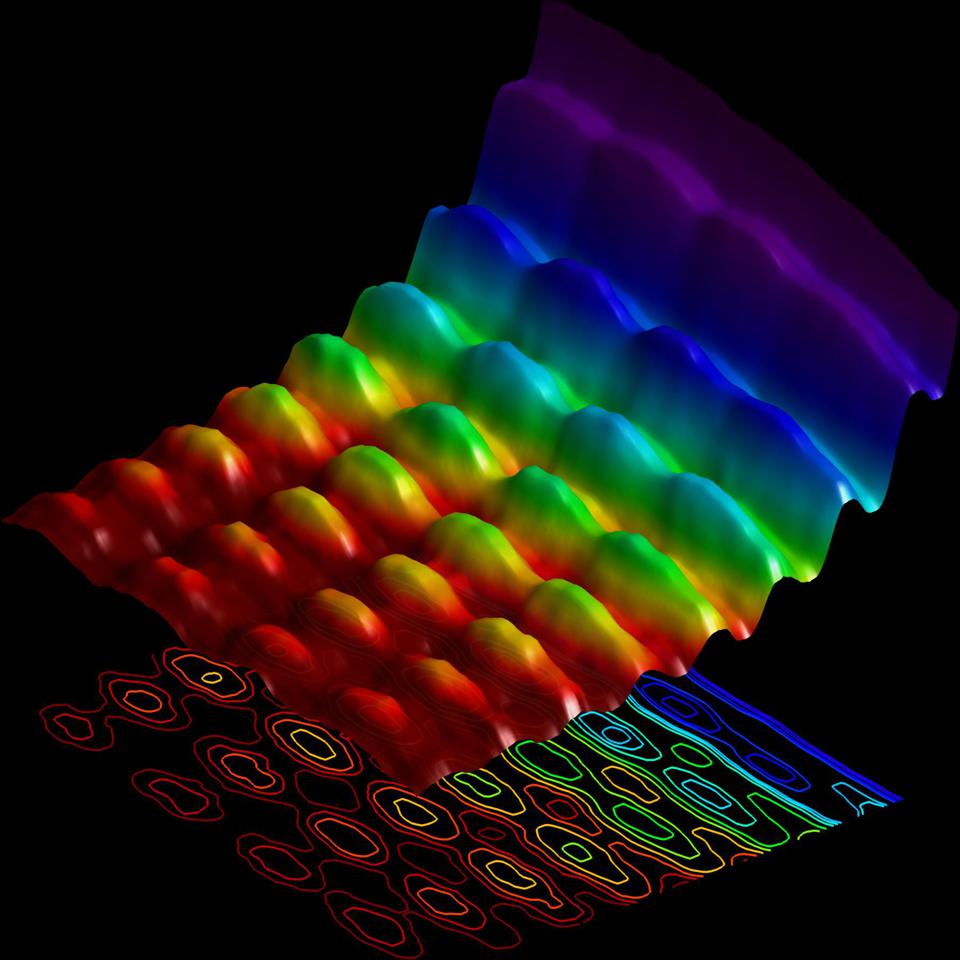
One of the most bizarre aspects of quantum physics is that the fundamental entities that make up the Universe, what we know as the indivisible quanta of reality, behave as both a wave and a particle. We can do certain experiments, like firing photons at a sheet of metal, where they act like particles, interacting with the electrons and kicking them off only if they individually have enough energy. Other experiments, like firing photons at small thin objects — whether slits, hairs, holes, spheres, or even DVDs — give patterned results that show exclusively wave-like behavior. What we observe appears to depend on which observations we make, which is frustrating, to say the least. Is there some way to tell, fundamentally, what the nature of a quanta is, and whether it’s wave-like or particle-like at its core?
That’s what Sandra Marin wants to know, asking:
“I wonder if you could help me to understand John Wheeler – the delayed choice experiment and write an article about this.”
John Wheeler was one of the most brilliant minds in physics in the 20th century, responsible for enormous advances in quantum field theory, General Relativity, black holes, and even quantum computing. Yet the idea about the delayed choice experiment hearkens all the way back to perhaps our first experience with the wave-particle duality of quantum physics: the double-slit experiment…
Although Einstein definitively wanted us to have a completely comprehensible reality, where everything that occurred obeyed our notions of cause-and-effect without any retrocausality, it was his great rival Bohr who turned out to be correct on this point. In Bohr’s own words:
“…it…can make no difference, as regards observable effects obtainable by a definite experimental arrangement, whether our plans for constructing or handling the instruments are fixed beforehand or whether we prefer to postpone the completion of our planning until a later moment when the particle is already on its way from one instrument to another.”
As far as we can tell, there is no one true objective, deterministic reality that exists independently of observers or interactions. In this Universe, you really to have to observe in order to find out what you get.
The history and the results of John Wheeler‘s famous “delayed choice” experiments: “Is Light Fundamentally A Wave Or A Particle?“
* Richard Feynman
###
As we reconsider categories, we might recall that it was on this date in 1404 that King Henry IV signed the “Act Against Multipliers,” stipulating that “None from hereafter shall use to multiply gold or silver, or use the craft of multiplication; and if any the same do, they incur the pain of felony.” Great alarm was felt at that time lest any alchemist should succeed in “transmutation” (the conversion of a base metal into gold or silver), thus undermining the sanctity of the Royal currency and/or possibly financing rebellious uprisings. Alchemy, which had flourished since the time of Bacon, effectively became illegal.
The Act was repealed in 1689, when Robert Boyle, the father of modern chemistry, and other members of the vanguard of the scientific revolution lobbied for its repeal.

You must be logged in to post a comment.