Posts Tagged ‘Patent’
“Man, sometimes it takes a long time to sound like yourself”*…
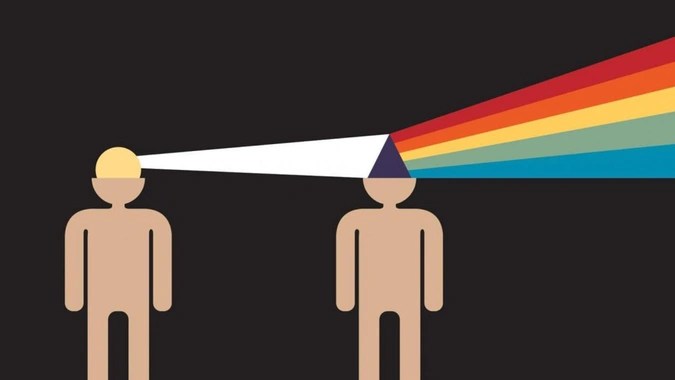
Ian Leslie on why we need to take control of our influences and what we can learn from artists about how to do so…
We live in age of social influence, and while there is no shortage of advice on how to take advantage of that – how to influence others, how to build a following, how to change minds – there is a dearth of thinking on how to be influenced. Which is odd, because that seems, to me, to be one of the key questions of the age…
Being influenced by others is inevitable and essential. But it’s also true that when we over-conform to influences, we surrender individuality. We get infected by harmful behaviours: smoking, anorexia, even suicide are all subject to social influence. We swallow conspiracy theories and false beliefs. We become mindless creatures of habit unable to imagine new possibilities. Conforming to influence can generate anxiety: we become worried that we’re not conforming well enough. There are externalities to be considered, too. Over-conformity is a kind of free-riding. The over-conformer takes from the shared pot of memes but fails to contribute to it. A society with too much imitation is liable to decay and degenerate, because it stops creating, thinking and innovating.
Each of us, then, has to try and strike a balance. Be impervious to social influence and you get closed off from the best that your fellow humans have to offer. Be defenceless against it and you become easily manipulable, boring, and unhappy.
But it’s harder than ever to strike this balance, because we live in societies where influence is everywhere, pressing upon us from all sides. We can instantly find out what strangers think, or at least what they say they’re thinking, on any given topic. We can consult with our friends every second of the day. It’s easier to outsource your opinions than ever; it feels good, it feels safe, to side with a crowd. There are higher costs to non-conformity, too: online communities assiduously police the boundaries of acceptable thought and behaviour…
… on the one hand, we have access to a broader range of information and insight than any generation in history, which ought to make us all more interesting. On the other, it’s very difficult, amidst the crossfire hurricane of influence, to think and act for yourself – to be you.
I could leave it there, with the conclusion that we’re all being influenced all the time and we’re not remotely prepared for how to manage these influences, and that maybe we should think about that a little more. But I want to add this: that there is a group of people who have a lot to teach us about how to live in the age of influence, because they have confronted this question with a special intensity for hundreds of years.
Artists (in the broad sense – painters, novelists, composers, etc) are pretty much defined by the struggle to be themselves; to absorb influences without surrendering to them; to be open to others and stubbornly individual. Consequently, artists have a different relationship to influence than the rest of us do. The core difference is this: artists do not absorb their influences passively. They choose their influences, and they choose how to be influenced by them…
Read on for sound advice: “How To Be Influenced,” from @mrianleslie via @TheBrowser.
Apposite: “The Age of Algorithmic Anxiety,” from @chaykak
* Miles Davis
###
As we steal like an artist, we might recall that it was on this date in 1790 that the first U.S. patent was issued to Samuel Hopkins for an improvement “in the making of Potash and Pearlash by a new Apparatus and Process.” It was signed by then-President George Washington.
A number of inventors had been clamoring for patents and copyrights (which were, of course, anticipated in Article I, Section 8, Clause 8 of the Constitution), but the first session of the First Congress in 1789 acted on none of the petitions. On January 8, 1790, President Washington recommended in his State of the Union address that Congress give attention to the encouragement of new and useful inventions; and within the month, the House appointed a committee to draft a patent statute. Even then the process worked slowly: Hopkins’ patent was issued over six months later.

“Why has our age surrendered so easily to the controllers, the manipulators, the conditioners of an authoritarian technics?”*…

Half a century ago, Lewis Mumford developed a concept that explains why we trade autonomy for convenience…
… Surveying the state of the high-tech life, it is tempting to ponder how it got so bad, while simultaneously forgetting what it was that initially convinced one to hastily click “I agree” on the terms of service. Before certain social media platforms became foul-smelling swamps of conspiratorial misinformation, many of us joined them for what seemed like good reasons; before sighing at the speed with which their batteries die, smartphone owners were once awed by these devices: before grumbling that there was nothing worth watching, viewers were astounded by how much streaming content was available at one’s fingertips. Overwhelmed by the way today’s tech seems to be burying us in the bad, it’s easy to forget the extent to which tech won us over by offering us a share in the good — or to be more precise, in “the goods.”
Nearly 50 years ago, long before smartphones and social media, the social critic Lewis Mumford put a name to the way that complex technological systems offer a share in their benefits in exchange for compliance. He called it a “bribe.” With this label, Mumford sought to acknowledge the genuine plentitude that technological systems make available to many people, while emphasizing that this is not an offer of a gift but of a deal. Surrender to the power of complex technological systems — allow them to oversee, track, quantify, guide, manipulate, grade, nudge, and surveil you — and the system will offer you back an appealing share in its spoils. What is good for the growth of the technological system is presented as also being good for the individual, and as proof of this, here is something new and shiny. Sure, that shiny new thing is keeping tabs on you (and feeding all of that information back to the larger technological system), but it also lets you do things you genuinely could not do before. For a bribe to be accepted it needs to promise something truly enticing, and Mumford, in his essay “Authoritarian and Democratic Technics,” acknowledged that “the bargain we are being asked to ratify takes the form of a magnificent bribe.” The danger, however, was that “once one opts for the system no further choice remains.”
For Mumford, the bribe was not primarily about getting people into the habit of buying new gadgets and machines. Rather it was about incorporating people into a world that complex technological systems were remaking in their own image. Anticipating resistance, the bribe meets people not with the boot heel, but with the gift subscription.
The bribe is a discomforting concept. It asks us to consider the ways the things we purchase wind up buying us off, it asks us to see how taking that first bribe makes it easier to take the next one, and, even as it pushes us to reflect on our own complicity, it reminds us of the ways technological systems eliminate their alternatives. Writing about the bribe decades ago, Mumford was trying to sound the alarm, as he put it: “This is not a prediction of what will happen, but a warning against what may happen.” As with all of his glum predictions, it was one that Mumford hoped to be proven wrong about. Yet as one scrolls between reviews of the latest smartphone, revelations about the latest misdeeds of some massive tech company, and commentary about the way we have become so reliant on these systems that we cannot seriously speak about simply turning them off — it seems clear that what Mumford warned “may happen” has indeed happened…
Eminently worth reading in full: “The Magnificent Bribe,” by Zachary Loeb in @_reallifemag.
As to (some of) the modern implications of that bargain, see also Shoshana Zuboff‘s: “You Are the Object of a Secret Extraction Operation.”
As we move into the third decade of the 21st century, surveillance capitalism is the dominant economic institution of our time. In the absence of countervailing law, this system successfully mediates nearly every aspect of human engagement with digital information. The promise of the surveillance dividend now draws surveillance economics into the “normal” economy, from insurance, retail, banking and finance to agriculture, automobiles, education, health care and more. Today all apps and software, no matter how benign they appear, are designed to maximize data collection.
Historically, great concentrations of corporate power were associated with economic harms. But when human data are the raw material and predictions of human behavior are the product, then the harms are social rather than economic. The difficulty is that these novel harms are typically understood as separate, even unrelated, problems, which makes them impossible to solve. Instead, each new stage of harm creates the conditions for the next stage…
And resonantly: “AI-tocracy” a working paper from NBER that links the development of artificial intelligence with the interests of autocracies: from the abstract:
Can frontier innovation be sustained under autocracy? We argue that innovation and autocracy can be mutually reinforcing when: (i) the new technology bolsters the autocrat’s power; and (ii) the autocrat’s demand for the technology stimulates further innovation in applications beyond those benefiting it directly. We test for such a mutually reinforcing relationship in the context of facial recognition AI in China. To do so, we gather comprehensive data on AI firms and government procurement contracts, as well as on social unrest across China during the last decade. We first show that autocrats benefit from AI: local unrest leads to greater government procurement of facial recognition AI, and increased AI procurement suppresses subsequent unrest. We then show that AI innovation benefits from autocrats’ suppression of unrest: the contracted AI firms innovate more both for the government and commercial markets. Taken together, these results suggest the possibility of sustained AI innovation under the Chinese regime: AI innovation entrenches the regime, and the regime’s investment in AI for political control stimulates further frontier innovation.
(And, Anne Applebaum warns, “The Bad Guys Are Winning.”)
* “Why has our age surrendered so easily to the controllers, the manipulators, the conditioners of an authoritarian technics? The answer to this question is both paradoxical and ironic. Present day technics differs from that of the overtly brutal, half-baked authoritarian systems of the past in one highly favorable particular: it has accepted the basic principle of democracy, that every member of society should have a share in its goods. By progressively fulfilling this part of the democratic promise, our system has achieved a hold over the whole community that threatens to wipe out every other vestige of democracy.
The bargain we are being asked to ratify takes the form of a magnificent bribe. Under the democratic-authoritarian social contract, each member of the community may claim every material advantage, every intellectual and emotional stimulus he may desire, in quantities hardly available hitherto even for a restricted minority: food, housing, swift transportation, instantaneous communication, medical care, entertainment, education. But on one condition: that one must not merely ask for nothing that the system does not provide, but likewise agree to take everything offered, duly processed and fabricated, homogenized and equalized, in the precise quantities that the system, rather than the person, requires. Once one opts for the system no further choice remains. In a word, if one surrenders one’s life at source, authoritarian technics will give back as much of it as can be mechanically graded, quantitatively multiplied, collectively manipulated and magnified.”
– Lewis Mumford in “Authoritarian and Democratic Technics,” via @LMSacasas
###
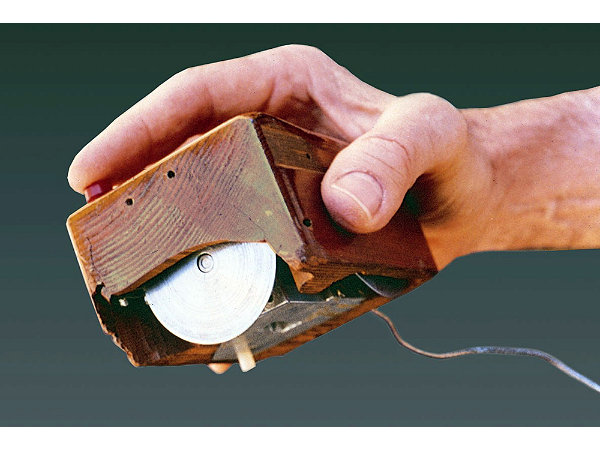
As we untangle user agreements, we might recall that it was on this date in 1970 that Douglas Engelbart (see here, here, and here) was granted a patent (US No. 3,541,541) on the “X-Y Position Indicator for a Display System,” the world’s first prototype computer mouse– a wooden block containing the tracking apparatus, with a single button attached.

“And God said, Behold, I have given you every herb bearing seed, which is upon the face of all the earth, and every tree, in the which is the fruit of a tree yielding seed”*…

The first patent on an animal was granted in the U.S. in 1988. But the first agricultural patents date back to 1930 and the Plant Patent Act (PPA). Since then, patent protection on seeds has been both broadened and lengthened; in the 1980’s, protection was extended beyond “utility” (a plant that uniquely did one thing or another) to the living thing itself. And the seed industry has consolidated…
For years Haribhai Devjibhai Patel has been growing cotton, peanuts and potatoes in the western Indian state of Gujarat. For years he and his family have used seedlings from one harvest to plant the next year’s crops on his four acre field.
Last year he planted a new potato variety known as FC5. It was a decision that ultimately landed him in court, because the US company PepsiCo had already claimed the rights to that very same potato variety. Patel claims he wasn’t aware of the potato’s name, much less PepsiCo’s claim…
According to the plaintiffs’ lawyer, Anand Yadnik, the lawsuit alleges that the FC5 potato is especially bred for PepsiCo’s subsidiary company Lays and their internationally distributed product: potato chips. PepsiCo was seeking 10 million Rupies or $140.000 (€ 126.000).
“I was completely devastated. I was afraid. Not in my lifetime would I ever have been able to pay the kind of damages that were being claimed by PepsiCo,” Patel said. The 46-year-old farmer has two children and earns around $3,500 per year.
The lawsuit was based on findings that PepsiCo gathered from Patel’s field. According to his lawyer, the company hired a private detective agency to provide the data. “They took secret video footage and collected samples from farmers fields’ sans disclosing their real intent”…
The case is another example of an ongoing global trend of companies claiming property rights for plants or genetic material of plants across the globe.
“Resources that used to be available to mankind as a community have now been confined to privatization,” Judith Düesberg from NGO Gene Ethical Network… The number of patents on plants worldwide has increased a hundredfold from just under 120 in 1990 to 12,000 today – 3500 of them are registered in Europe,according to the European initiative No-Patents-On-Seeds…
Critics argue that patents block access to genetic material for farmers and minimize biodiversity, the diversity of species and increase farmers’ dependency on seed producers.
But Bayer, Monsanto’s parent company, told DW in a written statement: “Farmers have the choice of whether and which products they buy from which supplier. [… ] Each farmer decides freely. […] Farmers will only use our products if they gain a clear advantage.”
In Europe, a case involving Monsanto and a particular breed of melon drew media attention several years ago. Monsanto had discovered that an Indian melon variety was naturally resistant to a specific virus. At the European Patent Office it then successfully applied for a patent on that trait after breeding into other melons.
From this moment on, not only did this trait belong to Monsanto, but so did every melon variety containing it, including the Indian melon from which it originated. Patent opponents call this practice biopiracy…
According to the Indian-based market research agency Mordor Intelligence, revenue in the seed sector will reach $90 billion by 2024 compared to about $60 billion in 2018. And over 50% of the worldwide market share is in the hands of Bayer-Monsanto, Du Pont and Syngenta…
The UN report “The right to food” has raised concerns about food security caused by “the oligopolistic structure of the input providers” warning that it could also cause food prices to increase and deprive the poorest of food.
A further concern is who owns the seeds and who produces the food. According to the NGO Germanwatch, most of the seed producing industry comes from the Global North, but 90% of biological resources (agricultural products, natural materials come) from the Global South.
While patenting laws remain more restrictive in the Global South, an Oxfam Study shows that big global players appear to be finding loopholes…
A few companies are angling to sew up the world’s seed supply: “Patents on plants: Is the sellout of genes a threat to farmers and global food security?“
* Genesis, 1:29 (KJV)
###
As we reap what we sow, we might send well-organized birthday greetings to Antoine Laurent de Jussieu; he was born on this date in 1748. A botanist, he is best remembered as the first to publish a natural classification of flowering plants; much of his system– which was, in part, based on unpublished work by his uncle, Bernard de Jussieu— remains in use today.

“Well, that is California all over”*…

Half of Californians live below this red line. ☝️
That may be hard to believe, but it’s more or less accurate, demographers say: Roughly 20 million people reside north of a line running through Los Angeles, and the other 20 million are squished underneath it.
n the second half of the 19th century, the majority of the state’s residents lived in Northern California, where the Gold Rush city of San Francisco hosted the largest urban population on the West Coast. So what happened?
The shift began with the oil and citrus booms of the 1890s. “Los Angeles and Southern California have one of the largest oil reserves of any region in the country. And agriculture made it an attractive place for land speculators, especially as major aqueduct projects brought water to the region,” said Justin Levitt, an adjunct political science professor at Cal State Long Beach.
Then came Hollywood’s entertainment boom in the 1920s, the WWII defense boom that sprouted industrial factories as well as a sizable military presence in San Diego, and the Southern California aerospace boom of the 1940s and ’50s. The population exploded, with Los Angeles County growing from about 170,000 in 1900 to 10 million today, a full quarter of California’s people.
The San Francisco Bay was once considered the state’s most important harbor, but Southern California stole that distinction away too. The ports at Long Beach and Los Angeles are now the busiest in the United States…
There are signs that California’s slackening growth in recent years — a consequence of curtailed immigration, housing shortages, and high cost of living — might be nudging the dividing line back north, said Dowell Myers, a demographer at USC.
At last check, about five years ago, the halfway mark was near Hollywood Burbank Airport, he said. “But since then population growth has really stalled in the state. If anything, growth is shrinking in the southern counties. This weak growth must be moving the halfway line slightly upward geographically.”
The unevenly-distributed population of the Golden State: “California’s lopsided population,” from the eminently-informative California Sun.
* Mark Twain, Roughing It
###
As we dwell on demographics, we might recall that it was on this date in 1911 that Willis S. Farnsworth– of Petaluma, in Sonoma County, California– was granted a patent for the first coin-operated locker.

“All I know about music is that not many people ever really hear it”*…

In the early 1950s, James Baldwin moved to a Swiss village in the Alps with two Bessie Smith records and a typewriter under his arm. It was there that he finished his first novel, Go Tell It on the Mountain (1953), which he largely attributes to Smith’s bluesy intonations: “It was Bessie Smith, through her tone and her cadence, who helped me to dig back to the way I myself must have spoken…and to remember the things I had heard and seen and felt. I had buried them very deep,” Baldwin wrote in an essay.
For the eminent American novelist and essayist, music was generative, unearthing inspiration that may otherwise remain concealed. Ikechúkwú Onyewuenyi, a curator at the Hammer Museum in Los Angeles, hopes to rouse a new generation of writers with “Chez Baldwin,” a 478-track, 32-hour-long Spotify playlist based on Baldwin’s vinyl record collection.
“The playlist is a balm of sorts when one is writing,” Onyewuenyi told Hyperallergic. “Baldwin referred to his office as a ‘torture chamber.’ We’ve all encountered those moments of writers’ block, where the process of putting pen to paper feels like bloodletting. That process of torture for Baldwin was negotiated with these records.”…
“Listening to the Joy in James Baldwin’s Record Collection“: “Chez Baldwin,” a 32-hour-long Spotify playlist based on Baldwin’s vinyl record collection.
* “All I know about music is that not many people ever really hear it. And even then, on the rare occasions when something opens within, and the music enters, what we mainly hear, or hear corroborated, are personal, private, vanishing evocations. But the man who creates the music is hearing something else, is dealing with the roar rising from the void and imposing order on it as it hits the air. What is evoked in him, then, is of another order, more terrible because it has no words, and triumphant, too, for that same reason. And his triumph, when he triumphs, is ours.” – James Baldwin
###
As we listen, we might recall that it was on this date in 1575 that Queen Elizabeth granted choral composer Thomas Tallis and his student William Byrd a 21-year monopoly for polyphonic music and a patent to print and publish “set songe or songes in parts,” one of the first arrangements of its kind in England. Tallis had exclusive rights to print any music in any language, and he and Byrd had sole use of the paper used in printing music.

You must be logged in to post a comment.