Posts Tagged ‘Monopoly’
“I went down the street to the 24-hour grocery. When I got there, the guy was locking the front door. I said, ‘Hey, the sign says you’re open 24 hours.’ He said, ‘Yes, but not in a row.'”*…

As Max Burns reports, a wave of corporate consolidation is reshaping the grocery industry; today, the U.S. has one-third fewer grocery stores than it did 25 years ago. The result is that just four corporations—Walmart, Kroger, Costco, and Albertsons—control more than two-thirds of the U.S. grocery market, This is squeezing workers, limiting competition, and giving this handful of retailers unprecedented control over what Americans pay for food…
If it feels to you like American consumers have fewer choices than ever before, your mind isn’t playing tricks on you. Federal regulators are approving corporate mega-mergers at the fastest rate since the 1980s. Consumers are feeling those industry-spanning consolidations everywhere, as hardly a sector of American life has escaped Wall Street’s goal of building the largest and most powerful corporate conglomerates in world history.
From power utilities and artificial intelligence to broadcast news networks and railroads, a few massive corporate players have come to dominate American commercial life in ways not seen since the Gilded Age trusts of the 19th century. Those consolidations have generated historic profits for executives and major shareholders while working families are faced with lower quality goods and services, fewer options, and a hostile labor market unfairly skewed toward the interests of the ultra-rich.
Democrats have been quick to criticize some of the nation’s biggest mergers as anti-worker and anti-consumer, but one critical sector of the U.S. economy has managed to escape widespread public criticism: grocery stores. Thanks to a record rise in special interest cash donations to both Democrats and Republicans, grocery-industry lobby groups have managed to keep prices high, wages low, and consumer choice limited while avoiding federal policymakers’ crosshairs. The result is an invisible crisis in the nation’s food industry that threatens to reshape how and what Americans eat.
In a corporate landscape defined by Republican deregulation, America’s grocery stores and food suppliers are consolidating despite active federal laws explicitly intended to prevent anticompetitive behavior. Perhaps the most important of those laws is the Robinson-Patman Act of 1936, or RPA, also known as the Anti-Price Discrimination Act. For decades, RPA ensured fair competition by banning food suppliers from charging different prices to different stores; at least it did until the Reagan-era Federal Trade Commission largely stopped enforcing it in the 1980s. Even though RPA is still the law of the land, food suppliers like Pepsi now routinely ignore the law without consequence.
“Big corporations have buying power, and they can oppress and dictate to producers what they want to pay for crops,” Rhode Island Lt. Gov. Sabina Matos told me. “A corporation can come to a farmer and say ‘we’ll pay you this price for potatoes, but you can’t give that price to anyone else,’ so they fix prices in a way that hurts independent supermarkets and independent businesses.”
Megacorporations aren’t subtle about flexing their market power to fix prices in ways that protect other megacorporations. Last year President Donald Trump’s FTC dismissed an RPA claim against PepsiCo which alleged that Pepsi illegally offered grocery chain Walmart unfair pricing discounts while charging smaller chains more for the same products. When independent grocery stores undercut Walmart by lowering the price of Pepsi products, PepsiCo allegedly responded by raising wholesale prices or refusing to do business with the smaller stores until they raised prices above those at Walmart.
As independent grocery stores struggle, they become more likely to sell out to larger national chains, leading to consolidation that makes both prices and employee wages less competitive. As president of the United Food and Commercial Workers International Union Local 3000, Faye Guenther represents over 50,000 grocery and retail workers across the Pacific Northwest. Guenther has spent years fighting the growing imbalance between rising prices and falling wages. Now, she says, things have reached a crisis point for regular Americans…
Read on for Burns’ looks at the impact on workers (TLDR: fewer jobs, lower wages), availability of stores (TDLR: or its opposite, food deserts), and food prices (TLDR: they’re rising), and for his suggested remedies.
The painful reality behind the joke “I’m getting stronger with age. I can now lift $100 worth of groceries with one hand!”: “America’s Grocery Monopoly Problem,” from @themaxburns.bsky.social in @damemagazine.bsky.social.
See also: “Grocery Retail: The Last Link in the Monopoly Chain.”
Also apposite: “Big Food Versus the People” (what court battles reveal about the ultra-processed food industry’s corporate litigation strategies). Further to which: “Is the recycling symbol free speech? A judge just ruled it could be“…
A pioneering California law meant to sharply limit use of the familiar “chasing arrows” recycling symbol has been blocked by a federal judge who said it probably violates the First Amendment.
In a preliminary injunction issued earlier this month, U.S. District Judge William Hayes halted enforcement of SB 343 after food, packaging and retail groups sued, finding that key provisions were “unconstitutionally vague” and likely infringed protected commercial speech. Enforcement of the law, passed in 2021, was expected to start this fall.
The decision is a blow to environmental advocates, who had hoped to remove the familiar symbol from a huge array of plastic products, in line with a statewide study showing that only a fraction are widely collected and actually recycled. SB 343 said only goods and packaging accepted by recycling programs serving at least 60 percent of Californians and then actually sorted for recycling — not collected and thrown away — could bear the chasing arrows.
Hayes’ constitutional reasoning surprised supporters of SB 343 because similar arguments against environmental marketing regulations have historically struggled in court….
Of course, there’s always eating out… but of course, that’s got its own issues: “The restaurant business is changing beyond recognition,” gift article from @economist.com.
Oh, and we might note that this is National Farmers Market Week.
* Steven Wright
###
As we chow down, we might recall that it was on this date in 1930 that the officially-adjudicated “first supermarket” opened: King Kullen in Queens, New York.
Grocery chains had been around since 1859, when The Great Atlantic & Pacific Tea Company (A&P) was established. But they rarely sold fresh meat or produce and relied on the old mercantile system of clerks puling items from shelves on request. As long-time readers may recall, the first self-service grocery store was the Piggly Wiggly, which shifted to self-serve in 1916.
The first modern supermarkets appeared just over twenty years later, offering a full range of food items, beverages, and household items under one self-service roof, often with an emphasis on low prices as well as convenience. There were a number of contenders for the “first supermarket” crown…
To end the debate, the Food Marketing Institute in conjunction with the Smithsonian Institution and with funding from H.J. Heinz, researched the issue. They defined the attributes of a supermarket as “self-service, separate product departments, discount pricing, marketing and volume selling.” They determined that the first true supermarket in the United States was opened by a former Kroger employee, Michael J. Cullen, on 4 August 1930, inside a 6,000-square-foot former garage in Jamaica, Queens in New York City. The store King Kullen, operated under the logic of “pile it high and sell it cheap.” The store layout was designed by Joseph Unger, who originated the concept of customers using baskets to collect groceries before checking out at a counter. Everything displayed for sale in the store “had prices clearly marked”, meaning that consumers would no longer need to haggle over prices. Cullen described his store as “the world’s greatest price wrecker.” At the time of his death in 1936, there were seventeen King Kullen stores in operation. Although Saunders had brought the world self-service, uniform stores, and nationwide marketing, Cullen built on this idea by adding separate food departments, selling large volumes of food at discount prices and adding a parking lot. Moreover, the supermarket format as pioneered by King Kullen was not only cheap, but convenient, in how it combined so many different departments under one roof which had formerly required trips to separate stores. – source

“For many Americans, the cost of one drug is the difference between life and death, dignity and dependence, hope and fear”*…

Longtime pharmaceutical executive Amal Naj laments the woeful state of the industry and calls for new leadership to win back public trust…
Some two decades ago, when I mentioned what I did for a living — manufacturing and marketing a wide range of prescription drugs — it elicited appreciative reactions from acquaintances. “I take your products every day,” a number of them would offer; others would mention how a specific medicine had made all the difference to their health and would ask whether a more advanced treatment was in the works; some simply marveled at the industry’s innovations as nothing less than miracles. Then there were some who teased: “Good business; you can charge whatever price.” I considered the quip an acknowledgment that lifesaving discoveries were worth the money. Pharma Man, they called me. It seemed to confer a certain respectability, of the sort reserved for a physician or a scientist or a teacher. There was a presumption in it, too, that I lived by certain ideals and ethics demanded of such an avocation. I was proud of being a Pharma Man.
Alas, I have now slipped precipitously in their eyes. I am seen as an avaricious man inexorably exploiting the misery of fellow human beings for profit — by inventing one new magic potion after another for which they cannot afford not to pay my price, because the only alternative would be pain and suffering, even death. My onetime champions have grudgingly tolerated this collective subjugation for years. But not anymore. Their festering anger has now broken into an open rebellion against the Pharma Man, the benevolent oppressor.
The recent murder of UnitedHealthCare CEO Brian Thompson in cold blood, a heinous and deplorable expression of this growing rebellion, cannot be condoned in any way. But the health care landscape is littered with provocations against the Pharma Man which play out daily on national television, in the newspapers, and on social media.
The Pharma Man’s reputation is only going to get worse as President-elect Donald Trump takes office and tries to fulfill his promise to bring down drug prices. And there is the specter of Robert F. Kennedy Jr. bringing his unconventional ideas to American health care in the new Trump administration; he has already publicly called for capping drug prices. Ironically, it had been the Democrats who made the industry — a financial hotbed of Republican support — a whipping boy in blaming America’s failure to deliver affordable health care to its citizens. But Mr. Trump has outshouted them all. He famously declared that pharma companies were “getting away with murder” and singled out Pfizer Inc. and publicly shamed the company and forced the CEO to roll back planned price increases.
As I watched Mr. Trump tower over the CEO at a White House appearance and later triumphantly declare the result of his disciplinary action, I was reminded of my school days when the headmaster would hoist a student by the collar to make the truant admit culpability in front of the class. It was humiliating for the Pharma Man, for I once worked at the company, proud of its pioneering history and its roster of some of the world’s most impactful medicines, a company that would go on to save millions of lives with its Covid-19 vaccine during the pandemic.
But the Pharma Man has earned this new reputation, and then some…
[Naj recounts (some of) the industry practices that have contributed to its fall from grace– familiar, but still striking…]
… It is baffling to me that we as an industry haven’t stepped out in front of the groundswell of national outrage and undertaken systemic changes to our business practices. We continue to conduct our business on the strength of our power over our customers, a power we derive from our possession of the inventions that prevent and treat and cure and which our customers cannot do without. That’s like possessing Tolkien’s One Ring, which gives the possessor unassailable power to rule over and dominate others. We set the price we want. We can cast our spell on doctors to prescribe our medicine and do our bidding. We can banish competitors who attempt to lay claim to our Ring of Power. We have institutionalized this leverage in our business, all the way from drug discovery and development to marketing and sales and distribution. This underpinning of the industry’s colossal machinery is rigged against the patient. No one in the leadership of the pharma industry has raised a voice, let alone stepped up to act, to alter this unfair state endured by their very own customers; it seems there are no hobbits in the industry ready to undertake the treacherous journey to Mount Doom in a quest to destroy the Ring.
We refuse to see how our customers see our business. In their minds, we owe our existence to their misfortunes and mishaps: the unexpected cancer, the heart that suddenly fails, the pancreas that fails to produce enough insulin. Our customers turn to us to help them deal with these events of life and living. Although they know it takes a lot of money and time to come up with a treatment, they also expect the pharma company to make it available to them at an affordable price. After all, they argue, axiomatically, the drug was specifically developed to serve their need, brought on by their unfortunate luck.
They volunteer in tens of thousands, sick and healthy, for a new drug to be tested on them so the company can prove it works and is safe; some can die from the potential side effects. They are the ones who help create the market for the drug. And to dangle it in front of them but out of their reach by charging unaffordable prices is unconscionable. It is hard to argue against that view: the symbiotic existence between our enterprise and our customers imposes a business — not to mention a moral — obligation on us to make the drug affordable to the patient who was instrumental in the development of the treatment in the first place. We also should not ignore the fact that the U.S. government helps out drug development with taxpayer dollars.
Unfortunately, our customers cannot rely on market forces for what the pharma companies won’t offer: a fair deal. Car companies, with their zillion features, battle among themselves to win over customers, and any and all of their cars, irrespective of their features, deliver the same result: transporting the buyer from one place to another. One can purchase any smartphone on the market and it will make the call, send messages, browse the web. But when it comes to drugs, the consumer doesn’t necessarily have alternative choices.
Take, for instance, the cholesterol-lowering drugs, known as statins. Among the seven or so statins developed so far, the most prescribed ones are atorvastatin (Lipitor), rosuvastatin (Crestor), and simvastatin (Zocor). Each statin has its own distinct efficacy and side effects, even though they all lower cholesterol. Physicians prescribe one statin or another based on patient condition and the desired outcome. In effect, the market of cholesterol-lowering agents gets divided into distinct segments of therapy, each offering just one single statin. Within each segment there is no competition to speak of (until the patent expires, allowing the entry of copies of the product, the so-called generics). Although the manufacturers compete with their sales and marketing campaigns to recruit patients to their respective statins, this sort of “competition” doesn’t significantly influence the price, as each product is viewed as distinct and un-substitutable, something that the manufacturers take pains to establish with their scientific papers and promotional materials.
We are known to shamelessly exploit these monopolistic powers. When we lose a patent on a drug, we pay off competitors to keep them from entering the market. (The Federal Trade Commission estimates that these anticompetitive tactics cost consumers and taxpayers $3.5 billion in higher drug costs every year.) Most commonly, we tend to extend patents with minor variations on the original drug, such as a new coating or a slight change in the formulation — this is called evergreening — which offer little or no additional benefits to the patient. (Some 78 percent of the patented drugs marketed between 2005 and 2015 are not new drugs, according to a study published in the Journal of the Law and the Biosciences in December 2018.)…
… A large truth is that our drug pricing is heavily influenced by our single-minded obsession with keeping our shareholders — not patients — happy. This is not unique to the pharma industry; delivering “shareholder value,” the appreciation of the company’s stock price, is an operational mantra of corporations across industries. Whatever earnest exercise a pharma company goes through to set drug prices based on R&D, manufacturing, marketing, and other costs, at the end of the day this is all swept aside by the pressures to achieve quarterly and annual sales and profit targets. Executives’ bonuses are tied to achieving these performance metrics, and their stock grants and options deliver additional riches when the company’s stock appreciates.
The pressures to serve the shareholder have only intensified in the past decade as the health care industry has become a sought-after vehicle for investors for the safe and steady and stellar returns it offers. Pharmaceuticals’ net profit margins are in the range of 15 to 20 percent, compared to 4 to 9 percent for large non-drug companies. A single successful drug can generate billions of dollars in sales, some as much as $15 billion or more annually. Many of our single pills, if incorporated into a company, would rank among the Fortune 500 companies.
Investors bet on our drugs long before they reach the market. They pore over scientific papers and decipher results of early-stage clinical trials of a drug with the zeal of a geologist prospecting for oil. They swarm medical and scientific conferences where the latest findings and opinions about a drug’s progress are presented. Living up to their expectations or, better yet, exceeding them becomes a high priority for companies setting their future financial performance targets. The patient is nowhere in the picture; few in executive suites agonize over whether to lower a price by 10 or 15 percent so many more patients can afford the drug.
The concept of affordability is not an operational imperative in the business, largely because top executives rarely interact with customers — the patients — to be sensitized to their needs, their plight really. In the car and smartphone industries, senior executives go around shaking hands with their customers and host regular conventions to take the pulse of their customers’ desires. In pharmaceuticals, a typical CEO’s calendar is filled with meetings with Wall Street analysts and fund managers, and the job of interacting with the customer is left to prescribing physicians, whom sales reps regularly badger with sales pitches.
But these prescribers we rely on to do our bidding with patients have lost public trust. The opioid crisis exposed a large number of doctors accepting bribes, as much as $100,000 a year, and sexual services to push sales. Although this is the most publicized example of corruption among doctors, there are many others that haven’t drawn much public attention. Nearly all Big Pharma companies have paid fines, some multiple times, to settle charges of bribing doctors. In 2013, Johnson & Johnson agreed to pay more than $2.2 billion in fines to settle charges that it had improperly promoted an antipsychotic drug; the government alleged that the company had paid “speaker fees to doctors to influence them to write prescriptions” and that its sales representatives “told these doctors that if they wanted to receive payments for speaking, they needed to increase” their prescriptions of the drug…
… n the pharmaceutical industry, influence peddling goes much deeper, to the very core of its business — the research and development — unlike in any other industry. Companies recruit leading researchers and academics to guide them during drug development, and to publicly pronounce their expert opinions in medical journals once the drug is successfully launched to the public. As critical as this alliance is to the successful development of a drug, it is now widely questioned because of these influencers’ financial ties to pharmaceutical companies.
ProPublica, a non-profit investigative journalism organization, has exposed several leading researchers and academics for accepting money from pharmaceutical companies which they didn’t disclose — or did so falsely — in connection with the scientific articles they published, some in prestigious journals like the New England Journal of Medicine and The Lancet. Among the prominent researchers ProPublica cited was the chief medical officer of Memorial Sloan Kettering Cancer Center, the nation’s leading cancer institute; he bullishly pitched to the investment community a new cancer treatment being developed by Roche without disclosing his financial ties to the company… If you want to find out if your doctor is receiving any money — how much and for what — from a company whose drug he or she is prescribing to you, you can go to the website Dollars for Docs and type in the name of the doctor. The site is the brainchild of ProPublica. It brings to mind the comparison with the U.S. Justice Department’s National Sex Offender Registry for the identity and location of known sex offenders.
In a world where doctors and researchers and medical academics all work as an army of influencers, the patient exists only as the customer to be influenced. It is a most peculiar aspect of our industry that we market our products to doctors (who help generate sales for us but don’t pay for the products) and we sell to our actual customers, the patients (who pay but have no control over the price they pay). Who decides the price? A very small group of wholesalers called pharmacy benefits managers (PBMs), owned by large insurers — CVS Health (which owns Aetna), Cigna, Humana, and UnitedHealthCare — that have been accused of padding their own profits at the cost of the patients they insure. These middlemen buy drugs on behalf of government and private employers and insurance companies. They negotiate prices with the pharma companies.
It may sound bewildering that the customers who pay for the drugs cannot negotiate directly with the manufacturers, unlike in the rest of the world. Even Medicare, the country’s largest health plan, covering 60 million Americans, can’t. In effect, the market forces of supply and demand — the backbone of all other commerce in America — are shielded from each other by the opaque wall of the middlemen. Imagine if the price of your car or a smartphone were negotiated by a handful of middlemen and you had no choice but to pay.
Today, 44 percent of Americans are either uninsured or underinsured; a 2021 national survey estimated that 46 million people couldn’t afford quality health care. Such news fails to register as profoundly worrisome in the psyches of pharmaceutical executives, largely because they are shielded from the customer by the systemic structure of the industry. Reports in the morning papers of patients unable to buy a lifesaving drug — like the news of Americans with diabetes struggling to procure high-priced insulin — might as well be the day’s weather report to them. Stories of struggles from further afield, like distant corners of Asia and Africa, where patients die because they can’t afford a blood pressure or cancer medicine, have even less of a chance of stirring the collective conscience of the industry.
I am often asked if I think drug prices are high, in the sense that they are unreasonable and exploitative. I’ve had difficulty answering the question in the past with a definitive yes or no, because many of the drugs have had such a profound impact in banishing diseases and prolonging healthy life. Their discovery didn’t come easy. I would respond that the prices reflected the cost of innovation, but that they could be lower. That conditional justification is harder to make these days.
More than 80 percent of the prescription drugs sold in the U.S. are generics, copies of patent-expired drugs. As copies, they have very low development costs. Their main costs lie in raw materials and manufacturing. And that cost is a fraction of the price the consumer currently pays for generics. I should know, because I manufacture many of them. For instance, a box of 30 five-milligram tablets of amlodipine, one of the most prescribed blood pressure medications, costs less than 30 cents to manufacture, and retails for $7 to $8.90 online and in U.S. drugstores, ostensibly discounted from $20 to $30. Simvastatin, a commonly prescribed cholesterol-lowering medication, costs less than 40 cents for a pack of 30 20-mg tablets; it sells at $7.87 to $22.28, discounted from $12 to $30. Even after adding the cost of marketing and distribution, the selling prices of these drugs are astronomical.
The consulting firm Pharmacy Benefit Consultants, which provides prescription coverage services to private and government employers, says the average wholesale prices — before the drug is sold to the patient — have been rising at “shocking rates.” Between the beginning of 2017 and March of 2018, it reports, the average wholesale prices of 450 drugs increased by between 25 and 100 percent. They included sharp increases for branded drugs that lost patents many years ago, such as 19.8 to 31 percent for Zoloft, which lost its patent in 2006, and 31.1 percent for Lipitor, which lost its patent in 2011…
… That is pathetic. Because the genesis of the modern pharma industry is anchored on the idea of delivering medicine at affordable costs. Inventors of insulin and antibiotics — the two most seminal discoveries in pharmaceuticals — refused to patent their inventions so everyone would have access to these lifesaving drugs at low costs. That mission seems not to have inspired the modern-day leaders in the slightest…
It is time for us to step up and make ourselves accountable to our customers, or else it will inevitably be done for us…
An insider calls foul: “The Pharma Man’s Negative Reputation is Fair,” from @rollingstone.com.web.brid.gy. Eminently worth reading in full.
Apposite: How the intent of a prescription drug program meant for the needy has been perverted: “How a Company Makes Millions Off a Hospital Program Meant to Help the Poor” (gift article)
###
As we heal the healers, we might send healthy birthday greetings to Charles Value Chapin; he was born on this date in 1856. A physician and epidemiologist, he was a pioneer in American public health. He co-founded in first bacteriological laboratory in the U.S. (in 1888) in Providence, were he was Superintendent of Health– a position he held for 48 years. In 1910, he established Providence City Hospital where infectious disease carriers could be isolated under aseptic nursing conditions; his success inspired similar health control measures throughout the U.S. A professor (at Brown) and prolific writer, his impact on health policy and practice was so broad that he was hailed as “the Dean of City Public Health Officials.”

“This massive ascendancy of corporate power over democratic process is probably the most ominous development since the end of World War II”*…

Food is a major topic of conversation these days. Americans feel that they’re paying more for less, with explanations ranging from rising production costs and supply chain disruptions, to concentration among suppliers leading to profit-gouging. In an excerpt from his new book, Barons: Money, Power, and the Corruption of America’s Food Industry, Austin Frerick reminds us that, while those issues are all too real, the emergence of food behemoths has brought other issues as well…
Like the broader Gilded Age economy that Walmart exemplifies and has played a role in shaping, the wealth in Bentonville obscures the hardship surrounding it. After all, the Walton family has so much money to spend on museums and bike trails because they have extracted it from the communities in which Walmart operates—from shoppers but also from the company’s employees, the towns themselves, and even from taxpayers through a series of hidden government subsidies.
For example, as Walmart expanded its traditional stores into Supercenters, it would often construct a new, larger building nearby instead of simply adding on to the existing one. Those old stores frequently sat empty or underused, just like the original Walmart in Rogers. That may be why Walmart openings have been linked to declines in nearby home values.
Walmart and other major retailers have made the situation even worse by including restrictive covenants in the deeds of old buildings, which prevent other retailers from using the space for competitive purposes. These provisions perpetuate food deserts and tie the hands of communities struggling to figure out what to do with these ghost buildings. After all, it’s not easy to find a use for an old Walmart that doesn’t involve grocery or retail. One former Walmart Supercenter in Brownsville, Texas, became the center of a national debate when it was bought by a firm detaining migrant children.
Limiting competition is apparently not enough for Walmart. The company understands what happens to communities when its stores are abandoned, and it uses this knowledge to leverage a tax break. The company often engages in what is known as the “dark stores” loophole, a tax dodge that lets it evade millions in property taxes by valuing its stores as if they were closed.
These shenanigans further tilt the scales in Walmart’s favor and deprive local communities of needed tax revenue. They are particularly egregious in light of the fact that many of their stores were built with massive taxpayer subsidies in the first place. Of course, this isn’t the only tax loophole the family has exploited. In 2013, Bloomberg reported that the family pioneered an estate tax loophole that is now widely used by American billionaires.
As bad as Walmart is for communities as a whole, it creates conditions that are particularly damaging for workers. As labor historian Nelson Lichtenstein noted, Sam Walton built a company rooted in a “southernized, deunionized post-New Deal America.” Walmart has long been defined by transnational commerce, employment insecurity, and poverty-level wages, which is an ironic geographic twist on history given that the region was at the heart of the New Deal and the antichain movement.
Walmart employs about 1.6 million people in the United States alone, making it the nation’s largest private employer. In fact, more people are on the company’s payroll than the populations of eleven states. The company’s impact on the labor market is so big that it drives down wages in the areas in which it builds Supercenters. In the words of one academic, Walmart effectively “determine[s] the real minimum wage” in the country. That’s why it’s national news when the company decides to raise wages.
From its founding, Walmart has been notorious for its poverty-level wages; in its early years, the company exploited a loophole in order to pay the mostly female store employees half of the federal minimum wage. It took a federal court battle for the workers to receive the minimum wage. In 2021, Walmart employees’ median income was about $25,000, whereas CEO Doug McMillon took home $25.7 million that year.
Given this history, it should come as no surprise that Sam Walton hated unions. “I have always believed strongly that we don’t need unions at Wal-Mart,” he stated in his memoir. Over the years, the company has aggressively fought efforts to unionize, and it seemingly closes stores whenever they gain traction. For example, after deli counter workers in a Texas Walmart Supercenter voted to unionize in 2000, the company switched to prepackaged meat and closed the department. In 2015, Walmart suddenly closed five stores to deal with what it said were extensive plumbing issues, which it said would take six months to fix. Some speculated that the real reason it closed the stores was to let the employees go as retaliation for labor activism.
And it’s not just labor laws that the company has eluded. A 2017 report based on a survey of over one thousand Walmart employees found that the company was likely violating worker protections such as the Americans with Disabilities Act and the Family and Medical Leave Act, among others. According to the New York Times, the company “routinely refuses to accept doctors’ notes, penalizes workers who need to take care of a sick family member and otherwise punishes employees for lawful absences.”
As the company’s power grew, it reshaped labor options and norms for millions of Americans. Gary Chaison, a labor expert, told the New York Times in 2015, “What you’re increasingly finding is that it’s the primary wage earners who work at Walmart, because a lot of workers have more or less given up on getting middle-class jobs.” Meanwhile, many older Americans are working at the store past the normal retirement age because of their financial insecurity, a sad reality reflected by the recent TikTok trend of elderly Walmart employees asking for donations.
This power imbalance between Walmart and its employees explains the poverty-level wages for many of Walmart’s 1.6 million workers but also for employees of its competitors. Some unionized grocery stores have even used the opening of a Supercenter as an excuse to demand cuts to their own employees’ wages and benefits.
These low wages also obscure a generous hidden subsidy that the company receives from taxpayers. Many Walmart workers depend on government public assistance programs such as Medicaid (health care), the Earned Income Tax Credit (a low-wage tax subsidy), Section 8 vouchers (housing assistance), LIHEAP (energy assistance), and SNAP (food assistance), among others. In 2013, one estimate by congressional House Democrats found that taxpayers subsidized Walmart to the tune of more than $5,000 per employee each year through all of the government assistance programs that its workers need.
In effect, instead of paying a living wage to these employees, the Walton family shifts the burden onto taxpayers. Although many people may recoil at the idea of the public filling the gap between Walmart’s pay and the income its workers need to survive, not all policymakers see an issue with this sort of billionaire welfare. Jason Furman, former chair of the Council of Economic Advisers under President Obama, wrote a paper before joining the administration titled “Wal-Mart: A Progressive Success Story” that called for even more of these subsidies to Walmart’s bottom line.
There is, of course, another way to address the issue. Walmart failed to establish dominance in Germany because of the country’s strong labor protections and antitrust guardrails. These market protections may explain why the company eventually threw in the towel and sold off its operations there.
In some instances, Walmart even receives a double subsidy. Its workers and shoppers frequently rely on SNAP, the Supplemental Nutrition Assistance Program, formerly known as “food stamps.” The program originated as part of the New Deal as a temporary measure and was made permanent by President Lyndon Johnson in a bill signed in 1964. This program and several smaller food assistance programs are now part of the Farm Bill. In fact, these food assistance programs make up more than 75 percent of the most recent Farm Bill.
SNAP is in many ways a triumph of progressive social policy, with an average of 41.2 million people participating in the program each month in 2022. The use rate is so high because, unlike many other programs, SNAP was structured by the US Congress so that anyone who qualifies is guaranteed to receive assistance. As a result, the program is a lifeline for millions of Americans who might otherwise struggle to put food on the table.
But because of Walmart’s dominance of the grocery sector, a very large portion of SNAP dollars now run through the company’s cash registers. In 2013, the company received $13 billion in sales from shoppers using SNAP. By comparison, farmers markets took in only $17.4 million of all SNAP spending that same year. The amount of SNAP money received by the company surged with the expansion of SNAP benefits in response to the COVID-19 pandemic. With some back-of-the-envelope math, I came up with a rough estimate that Walmart now receives somewhere around $26.8 billion each year from SNAP.
Unfortunately, more concrete numbers are not available because the US Supreme Court has ruled that the amount of taxpayer money that the company receives from SNAP can be kept secret. In 2019, the Court heard a case involving the USDA’s decision to deny a request by a South Dakota newspaper for this information. “Most of the time, the government tells the public which companies benefit from federal dollars earmarked for taxpayer-funded public assistance programs,” agriculture and food reporter Claire Brown noted. “We know which insurance companies make the highest profits from Medicare and Medicaid, for example, and those figures have been used to pressure them to offer better options to their clients.” But in this instance, the Court rejected this level of transparency, with Justice Elena Kagan joining the Republican-appointed members of the Court to uphold the USDA decision under the notion that it was “confidential” business information.
The program is important enough that it factors into Walmart’s operational decision-making. Many Americans enrolled in SNAP schedule their trips to the grocery store around the days when their funds get deposited. In fact, the company factors this bump into its ordering system…
Expensive food is only one of the prices we pay to “Food Barons“– @AustinFrerick in @ProMarket_org.
* “This massive ascendancy of corporate power over democratic process is probably the most ominous development since the end of World War II, and for the most part “the free world” seems to be regarding it as merely normal.” – Wendell Berry, Bringing it to the Table: On Farming and Food
###
As we ponder the point at which profit becomes predation, we might recall that it was on this date in 1950 that Hormel registered the name and trademark “Spam” for its canned meat product. It is also interesting to note that the company had marketed the product since 1937, and only felt the need to protect the name 13 years later.

“An imbalance between rich and poor is the oldest and most fatal ailment of all republics”*…

Plutarch’s warning is one to take seriously–as then, now. So, how is the American Dream doing?…
In late 20th-century music, the elusiveness of the American Dream is a recurring theme. From Stevie Wonder’s ode to a boy “born in hard time Mississippi” in 1973 to Bruce Springsteen’s anthems to the working class in factory-shuttered towns in the 1980s, frustration with people’s inability to outgrow their circumstances is rife. The timing of the peak of that genre is no coincidence: whereas nearly all American children born in 1940 could still expect to do better than their parents, only two in five could by 1984…
… A new study by Raj Chetty, of Harvard University, and colleagues provides fresh data on how America’s landscape of opportunity has shifted sharply over the past decades. Although at the national level there have been only small declines in mobility, the places and groups that have become more (or less) likely to enable children to rise up have changed a lot. The most striking finding is that, compared with the past, a child’s race is now less relevant for predicting their future and their socioeconomic class more so.
The greatest drops in mobility have been not in the places evoked in song, but on the coasts and the Great Plains, which historically provided pathways up (see maps). “Fifteen years ago, the American Dream was alive and well for white children born to low-income parents in much of the North-east and West Coast,” says Benjamin Goldman of Cornell University, one of the co-authors. “Now those areas have outcomes on par with Appalachia, the rustbelt and parts of the South-east.”
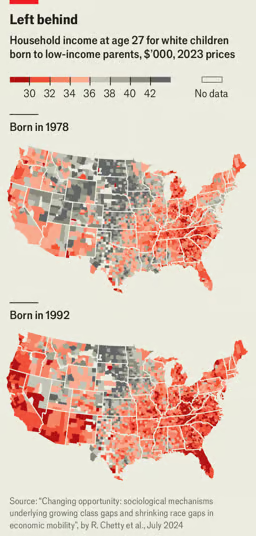
The fact that white children have become more likely to remain in poverty than before, whereas for black children the reverse is true, raises many questions. The finding comes from tracing the trajectories of 57m children born in America between 1978 and 1992 and looking at their outcomes by the age of 27. “This is really the first look with modern big data into how opportunity can change within a place over time,” says Mr Goldman. For children born into high-income families, household income increased for all races between birth cohorts. Yet among those from low-income families, earnings rose for black children and fell for white children.
A black child born to poor parents in 1992 earned $1,400 a year more than one born in 1978. A similar white child earned $2,000 less than one born in 1978. But on average, a poor white child still earned $9,500 more than a poor black child.
This pattern has played out in virtually every county, though with big regional differences. As a result, the earnings gap between rich and poor white children (the “class gap”) grew by 27%, whereas the earnings gap between poor white and poor black children (the “race gap”) fell by 28%…
… None of this means that race is no longer relevant for Americans’ chances in life. Although the reversal of the direction of travel is striking, a young black American born in 1992 to poor parents was still four percentage points more likely to remain in poverty than a poor white peer, down from a 15 percentage-point gap for those born in 1978. And while the near doubling in rates of mortality among young, lower-income white Americans is deeply alarming, mortality rates for their black counterparts have increased too, and they are still (a bit) more likely to die young…
… Convergence has not yet brought equality. Despite improvements across America for poor black children, there is still no county where their outcomes match those of poor white ones. Yet the decline of the white working class is steep, and bound to cause grief. Telling a young white man with lower life outcomes than previous generations that he is still doing better than the average black peer is about as useful as telling a young black man that he’s doing well “for a black man”.
Another possible misconception is that social mobility is a zero-sum game: that poor white children are doing worse because poor black children are doing better. The authors tackle this by showing how in places where black children have done well, white children’s outcomes have remained stable; and in places where white children have done particularly poorly, their black peers have also not thrived.
In his previous work Mr Chetty demonstrated [see here for a summary of his 2018 study] just how much a child’s chances of outperforming their parents depended on their race and where they grew up. One of the questions the authors were left with was how “sticky” these effects would be over time: could opportunities for the next cohorts of children change within these same places, or were they fixed? The new study’s most hopeful finding is that, far from being fixed, opportunities within a place can change significantly and rapidly. Neither history nor place is destiny…
… Americans love a rags-to-riches story. In his acceptance speech [at the Republican Convention], Mr Vance pledged to “make this country a place where every dream…will be possible once again”. In his bestselling book “Hillbilly Elegy” he writes that the assumption “that only a truly extraordinary person could have made it to where I am today…I think that theory is a load of bullshit.”
But the story of Mr. Vance, who grew up in a poor part of the rustbelt, rose to be a venture capitalist and now, at 39, is a potential American president, remains extraordinarily rare. While there has been a reshuffling of opportunities for Americans trying to escape the lowest rung, there has been no progress at all for routes into the upper class. For the vast majority of poor black children, who continue to have a 3% chance of rising from the bottom to the top quintile, and poor white children, whose chances have fallen from 14% to 12%, that door remains firmly shut…
“Class, race and the chances of outgrowing poverty in America,” a big-data analysis– a gift article from @TheEconomist.
* Plutarch
###
As we optimize opportunity, we might send mortgaged birthday greetings to Charles Darrow; he was born on this date in 1889. He designed (in 1933) and patented (in 1935) the board game Monopoly. He later sold his patent to Parker Brothers, which credits him as its creator.
In fact, the history of Monopoly is much longer. It can be traced back to 1903, when American anti-monopolist Lizzie Magie created a game called The Landlord’s Game that she hoped would explain the single-tax theory of Henry George. It was intended as an educational tool to illustrate the negative consequences of concentrating land in private monopolies.
After losing his job at a sales company following the Stock Market Crash of 1929, Darrow worked at various odd jobs. Seeing his neighbors and acquaintances play a board game in which the object was to buy and sell property, he decided to publish his own version of the game.
In fact, Darrow and his friends were just a few of many people in the American Midwest and East Coast who had been playing a game of buying and trading property– all based on Magie’s original… but most having morphed as warnings of that sort too often do) into the opposite of Magie’s intent– a celebration of accumulation. The game was used by college professors and their students, and another variant, called The Fascinating Game of Finance, was published in the Midwest in 1932. From there the game traveled back east, where it had remained popular in Pennsylvania, and became popular with a group of Quakers in Atlantic City. Darrow was taught to play the game by Charles Todd, who had played it in Atlantic City, where it had been customized with that city’s street and property names– to wit Monopoly‘s nomenclature.

“The malady of commercial crisis is not, in essence, a matter of the purse but of the mind”*…

Still, those crises do take tangible form…
Q3 is a traditional peak season in the world of shipping, but not this year. Global inflation, weakened consumer demand and excess cargo carrying capacity are pushing the market down…
With a gloomy economic outlook and vague alarms from central banks, it seems recession could be just around the corner.
Are there any indications from the shipping market when global recession is on its way? This is a question not only of interest to the commercial and technical players in the maritime industry, but also to financiers and policy makers.
The last recession triggered by economic factors was the Great Recession from December 2007 to June 2009. Goods loaded worldwide for seaborne trade fell by nearly five percent in 2009 compared to 2008, from about 8.23 billion tons to 7.82, according to UNCTAD’s Handbook of Statistics 2021.
Is a depressed shipping market a contributor to global recession, or does global recession lead the shipping market down? It is a chicken and egg question. But can the Great Recession’s impact to shipping market provide some useful reference to the current situation? Shipping indexes may shed some light.
…
How is the shipping market now? In May 2022, bulker earnings started to drop. Tankers were at a short break in an upward rise. Container freight rates were flat and just about to begin sliding. As of September 2022, only tankers’ earnings are still climbing.
The bulk shipping market’s underperformance will probably continue and will not turn before Christmas, unless there are significant changes – for example, if an easing of COVID restrictions in China pushes up its industrial demand (particularly for iron ore). Demand for oil and gas from the West will help send tanker rates continue soaring. Container shipping is expected to decline in the short term.
During the past months, a black cloud has appeared on the global shipping market’s horizon. The downward trend of shipping indexes brings a sense of foreboding. As to the question, “is a global recession imminent?” Most likely, say signals from these two shipping indexes…
“Do Shipping Indexes Hint at Global Recession?,” from @Mar_Ex. (TotH to friend PH.)
See also: “China lockdowns accelerate supply chain diversion and box shipping review,” and more generally, “An often-overlooked economic measure is signaling serious trouble ahead” and “Three Harbingers Point to a U.S. Recession.”
* John Stuart Mill
###
As we batten the hatches, we might we might spare a thought for Henry George; he died on this date in 1897. A writer, politician and political economist, George is best remembered for Progress and Poverty, published in 1879, which treats inequality and the cyclic nature of industrialized economies, and proposes the use of a land value tax (AKA a “single tax” on real estate) as a remedy– an economic philosophy known as Georgism, the main tenet of which is that, while individuals should own what they create, everything found in nature, most importantly the value of land, belongs equally to all mankind.
George’s ideas were widely-discussed in his time and into the early 20th century, and admired by thinkers like Alfred Russel Wallace, Jose Marti, and William Jennings Bryan; Franklin D. Roosevelt sang his praises, as did George Bernard Shaw. But with the rise of neoclassical economics, George’s star began to recede. Still, more modern thinkers like Albert Einstein and martin Luther King were fans.
In a sequence that mimicked George’s arc of influence, it was George’s work that inspired Elizabeth Magie to create The Landlord’s Game in 1904 to demonstrate his theories; ironically, it was Magie’s board game that became in the 1930s (as recently noted here and here) the basis for Monopoly.
In 1977, Joseph Stiglitz showed that under certain conditions, spending by the government on public goods will increase aggregate land rents/returns by the same amount. Stiglitz’s findings were dubbed “the Henry George Theorem,” as they illustrate a situation in which Henry George’s “single tax” is not only efficient, it is the only tax necessary to finance public expenditures.

You must be logged in to post a comment.