Posts Tagged ‘hormel’
“I thought a forest was made up entirely of trees, but now I know that the foundation lies below ground, in the fungi.”*…

As Frank Landymore explains, we’ve been underestimating fungi…
Scientists have mapped the Earth’s entire underground fungal network, showing that it’s so extensive that if it were stretched into a straight line, it would reach other star systems — and span a sizable chunk of the Milky Way galaxy, for that matter.
The groundbreaking work, published in a study in the journal Science, focused on microorganisms known as arbuscular mycorrhizal fungi. Forming the hidden backbone of our planet’s soil, they circulate water and nutrients and regulate the climate by locking away vast stores of carbon.
Altogether, the global fungal network weighs around 300 megatons, the study found, which is four to six times more than the biomass of all human beings. Around 40 percent of that fungal mass resides in high-altitude or flooded grasslands, like the Everglades in Florida.
The authors hope that their work will highlight the indispensable but overlooked role that these fungal networks play in the Earth’s ecosystems, with around 70 percent of all ground-based plant life depending on the fungi.
“People just aren’t paying attention to these ecosystems,” coauthor Toby Kiers, an evolutionary biologist at Vrije University Amsterdam and director of the Society for the Protection of Underground Networks (SPUN), told The New York Times. “What we want to do with these data is really shine a light on some of these hidden patterns underground.”
“I hope this builds into the conversation for their protection because wild grasslands are going away quite quickly,” lead author Justin Stewart, a fellow SPUN biologist, told Live Science. “These are areas that people are really ripping up because it’s much easier to rip up a grass than it is to rip up a tree.”
To unearth this subterranean network, the researchers used data from over 16,000 soil samples across 300 previous papers that calculated the local density of fungal filaments, or hyphae, across the globe. They then fed this data into a machine learning model to predict the density of these hyphal networks per square kilometer of topsoil.
The results were staggering. In all, the model found that the planet is lined with more than 110 quadrillion kilometers of hyphae, or 68 quadrillion miles, which is almost a billion times the distance between the Earth and the Sun. On a cosmic ruler, that equals nearly 12,000 light years, or about a tenth the diameter of our galaxy, which is enough to take you to the Westlund 1 super star cluster.
It’s the clearest picture yet of just how much fungal networks underpin our terrestrial ecosystems. What’s fuzzier from the model, though, is what it says about their health. The density of the fungal networks were lower in soil used for growing crops, but “we don’t know where networks are very healthy and where they’re threatened,” Kiers told the NYT…
“Earth’s Underground Fungus Network Is So Gigantic That If You Stretched It Out, It Would Reach to Other Star Systems,” from @futurism.com.
###
As we muse on the mycorrhizal, we might ponder a different kind of massive spread, as we recall that it was on this date in 1937 that Hormel introduced Spam. It was the company’s attempt to increase sales of pork shoulder, not at the time a very popular cut. While there are numerous speculations as to the “meaning of the name” (from a contraction of “spiced ham” to “Scientifically Processed Animal Matter”), its true genesis is known to only a small circle of former Hormel Foods executives.
As a result of the difficulty of delivering fresh meat to the front during World War II, Spam became a ubiquitous part of the U.S. soldier’s diet. It became variously referred to as “ham that didn’t pass its physical,” “meatloaf without basic training,” and “Special Army Meat.” Over 150 million pounds of Spam were purchased by the military before the war’s end. Indeed, Nikita Khrushchev said that without Spam, the Soviet Army would have starved. And Spam was not only eaten but was also incorporated into many other aspects of the war (e.g., grease for guns, cans for scrap metal).
During the war and the occupations that followed, Spam was introduced into Japan, Korea, Guam, Hawaii, Okinawa, the Philippines, and other islands in the Pacific. Immediately absorbed into native diets, it has become a singular part of the history and effect of U.S. influence in the Pacific region.
Today Spam is regualrly eaten in 50 countries around the world. According to the Spam website, there are 12.8 cans of Spam products consumed every second; over nine billion cans of Spam have been sold (so far). Big Ben is 1,163 Spam cans tall, and it would take 415,469,599 cans of the stuff to circle the circumference of the Earth. Need to know more? There is a museum devoted to anything and everything related to the Spam brand in Austin, MN.
Contrary to rumor, Spam is only made from six ingredients: pork with ham, salt, water, potato starch, sugar, and sodium nitrite.

“Nothing scares corporate radio like public radio”*…

These are tough times for those who love (and/or depend on) local radio. The Trump administration has eliminated the federal funding on which many local public stations have depended, and consolidation has “homogenized” local commercial radio. And this, at a time when the civic and cultural news and engagement that local radio provides has never been more important.
Still, community-rooted local radio perserveres. Consider ldial, a curated collection from Adam Scott— a list that let’s you sample some of the best independent and community radio stations in the US (and, ideally, encourages you to find your own local options).
Then, remembering that the best local radio is your local radio, consider supporting your local station(s).
* Tom Petty
###
As we tune in, we might recall that it was on this date in 1950 that Hormel registered the name and trademark “Spam” for its canned meat product. It is interesting to note that the company had marketed the product since 1937, and only felt the need to protect the name 13 years later.

“This massive ascendancy of corporate power over democratic process is probably the most ominous development since the end of World War II”*…

Food is a major topic of conversation these days. Americans feel that they’re paying more for less, with explanations ranging from rising production costs and supply chain disruptions, to concentration among suppliers leading to profit-gouging. In an excerpt from his new book, Barons: Money, Power, and the Corruption of America’s Food Industry, Austin Frerick reminds us that, while those issues are all too real, the emergence of food behemoths has brought other issues as well…
Like the broader Gilded Age economy that Walmart exemplifies and has played a role in shaping, the wealth in Bentonville obscures the hardship surrounding it. After all, the Walton family has so much money to spend on museums and bike trails because they have extracted it from the communities in which Walmart operates—from shoppers but also from the company’s employees, the towns themselves, and even from taxpayers through a series of hidden government subsidies.
For example, as Walmart expanded its traditional stores into Supercenters, it would often construct a new, larger building nearby instead of simply adding on to the existing one. Those old stores frequently sat empty or underused, just like the original Walmart in Rogers. That may be why Walmart openings have been linked to declines in nearby home values.
Walmart and other major retailers have made the situation even worse by including restrictive covenants in the deeds of old buildings, which prevent other retailers from using the space for competitive purposes. These provisions perpetuate food deserts and tie the hands of communities struggling to figure out what to do with these ghost buildings. After all, it’s not easy to find a use for an old Walmart that doesn’t involve grocery or retail. One former Walmart Supercenter in Brownsville, Texas, became the center of a national debate when it was bought by a firm detaining migrant children.
Limiting competition is apparently not enough for Walmart. The company understands what happens to communities when its stores are abandoned, and it uses this knowledge to leverage a tax break. The company often engages in what is known as the “dark stores” loophole, a tax dodge that lets it evade millions in property taxes by valuing its stores as if they were closed.
These shenanigans further tilt the scales in Walmart’s favor and deprive local communities of needed tax revenue. They are particularly egregious in light of the fact that many of their stores were built with massive taxpayer subsidies in the first place. Of course, this isn’t the only tax loophole the family has exploited. In 2013, Bloomberg reported that the family pioneered an estate tax loophole that is now widely used by American billionaires.
As bad as Walmart is for communities as a whole, it creates conditions that are particularly damaging for workers. As labor historian Nelson Lichtenstein noted, Sam Walton built a company rooted in a “southernized, deunionized post-New Deal America.” Walmart has long been defined by transnational commerce, employment insecurity, and poverty-level wages, which is an ironic geographic twist on history given that the region was at the heart of the New Deal and the antichain movement.
Walmart employs about 1.6 million people in the United States alone, making it the nation’s largest private employer. In fact, more people are on the company’s payroll than the populations of eleven states. The company’s impact on the labor market is so big that it drives down wages in the areas in which it builds Supercenters. In the words of one academic, Walmart effectively “determine[s] the real minimum wage” in the country. That’s why it’s national news when the company decides to raise wages.
From its founding, Walmart has been notorious for its poverty-level wages; in its early years, the company exploited a loophole in order to pay the mostly female store employees half of the federal minimum wage. It took a federal court battle for the workers to receive the minimum wage. In 2021, Walmart employees’ median income was about $25,000, whereas CEO Doug McMillon took home $25.7 million that year.
Given this history, it should come as no surprise that Sam Walton hated unions. “I have always believed strongly that we don’t need unions at Wal-Mart,” he stated in his memoir. Over the years, the company has aggressively fought efforts to unionize, and it seemingly closes stores whenever they gain traction. For example, after deli counter workers in a Texas Walmart Supercenter voted to unionize in 2000, the company switched to prepackaged meat and closed the department. In 2015, Walmart suddenly closed five stores to deal with what it said were extensive plumbing issues, which it said would take six months to fix. Some speculated that the real reason it closed the stores was to let the employees go as retaliation for labor activism.
And it’s not just labor laws that the company has eluded. A 2017 report based on a survey of over one thousand Walmart employees found that the company was likely violating worker protections such as the Americans with Disabilities Act and the Family and Medical Leave Act, among others. According to the New York Times, the company “routinely refuses to accept doctors’ notes, penalizes workers who need to take care of a sick family member and otherwise punishes employees for lawful absences.”
As the company’s power grew, it reshaped labor options and norms for millions of Americans. Gary Chaison, a labor expert, told the New York Times in 2015, “What you’re increasingly finding is that it’s the primary wage earners who work at Walmart, because a lot of workers have more or less given up on getting middle-class jobs.” Meanwhile, many older Americans are working at the store past the normal retirement age because of their financial insecurity, a sad reality reflected by the recent TikTok trend of elderly Walmart employees asking for donations.
This power imbalance between Walmart and its employees explains the poverty-level wages for many of Walmart’s 1.6 million workers but also for employees of its competitors. Some unionized grocery stores have even used the opening of a Supercenter as an excuse to demand cuts to their own employees’ wages and benefits.
These low wages also obscure a generous hidden subsidy that the company receives from taxpayers. Many Walmart workers depend on government public assistance programs such as Medicaid (health care), the Earned Income Tax Credit (a low-wage tax subsidy), Section 8 vouchers (housing assistance), LIHEAP (energy assistance), and SNAP (food assistance), among others. In 2013, one estimate by congressional House Democrats found that taxpayers subsidized Walmart to the tune of more than $5,000 per employee each year through all of the government assistance programs that its workers need.
In effect, instead of paying a living wage to these employees, the Walton family shifts the burden onto taxpayers. Although many people may recoil at the idea of the public filling the gap between Walmart’s pay and the income its workers need to survive, not all policymakers see an issue with this sort of billionaire welfare. Jason Furman, former chair of the Council of Economic Advisers under President Obama, wrote a paper before joining the administration titled “Wal-Mart: A Progressive Success Story” that called for even more of these subsidies to Walmart’s bottom line.
There is, of course, another way to address the issue. Walmart failed to establish dominance in Germany because of the country’s strong labor protections and antitrust guardrails. These market protections may explain why the company eventually threw in the towel and sold off its operations there.
In some instances, Walmart even receives a double subsidy. Its workers and shoppers frequently rely on SNAP, the Supplemental Nutrition Assistance Program, formerly known as “food stamps.” The program originated as part of the New Deal as a temporary measure and was made permanent by President Lyndon Johnson in a bill signed in 1964. This program and several smaller food assistance programs are now part of the Farm Bill. In fact, these food assistance programs make up more than 75 percent of the most recent Farm Bill.
SNAP is in many ways a triumph of progressive social policy, with an average of 41.2 million people participating in the program each month in 2022. The use rate is so high because, unlike many other programs, SNAP was structured by the US Congress so that anyone who qualifies is guaranteed to receive assistance. As a result, the program is a lifeline for millions of Americans who might otherwise struggle to put food on the table.
But because of Walmart’s dominance of the grocery sector, a very large portion of SNAP dollars now run through the company’s cash registers. In 2013, the company received $13 billion in sales from shoppers using SNAP. By comparison, farmers markets took in only $17.4 million of all SNAP spending that same year. The amount of SNAP money received by the company surged with the expansion of SNAP benefits in response to the COVID-19 pandemic. With some back-of-the-envelope math, I came up with a rough estimate that Walmart now receives somewhere around $26.8 billion each year from SNAP.
Unfortunately, more concrete numbers are not available because the US Supreme Court has ruled that the amount of taxpayer money that the company receives from SNAP can be kept secret. In 2019, the Court heard a case involving the USDA’s decision to deny a request by a South Dakota newspaper for this information. “Most of the time, the government tells the public which companies benefit from federal dollars earmarked for taxpayer-funded public assistance programs,” agriculture and food reporter Claire Brown noted. “We know which insurance companies make the highest profits from Medicare and Medicaid, for example, and those figures have been used to pressure them to offer better options to their clients.” But in this instance, the Court rejected this level of transparency, with Justice Elena Kagan joining the Republican-appointed members of the Court to uphold the USDA decision under the notion that it was “confidential” business information.
The program is important enough that it factors into Walmart’s operational decision-making. Many Americans enrolled in SNAP schedule their trips to the grocery store around the days when their funds get deposited. In fact, the company factors this bump into its ordering system…
Expensive food is only one of the prices we pay to “Food Barons“– @AustinFrerick in @ProMarket_org.
* “This massive ascendancy of corporate power over democratic process is probably the most ominous development since the end of World War II, and for the most part “the free world” seems to be regarding it as merely normal.” – Wendell Berry, Bringing it to the Table: On Farming and Food
###
As we ponder the point at which profit becomes predation, we might recall that it was on this date in 1950 that Hormel registered the name and trademark “Spam” for its canned meat product. It is also interesting to note that the company had marketed the product since 1937, and only felt the need to protect the name 13 years later.
“All human beings have three lives: public, private, and secret”*…

A graphic– and painful– reminder that the latter two are under constant attack…
Think about a personal and private google search and post it on this website. Something you might not have told the ones dearest to your heart. Google uses these searches to generate a data profile of you to sell on open bidding markets. This website creates a bubble for each search to remind us of all the data collected…

Every time we ask Google, we give it answers about ourselves: “Search TM.”
* Gabriel García Márquez
###
As we Duck (Duck Go), we might recall that it was on this date in 1937 that Hormel introduced Spam. It was the company’s attempt to increase sales of pork shoulder, not at the time a very popular cut. While there are numerous speculations as to the “meaning of the name” (from a contraction of “spiced ham” to “Scientifically Processed Animal Matter”), its true genesis is known to only a small circle of former Hormel Foods executives.
As a result of the difficulty of delivering fresh meat to the front during World War II, Spam became a ubiquitous part of the U.S. soldier’s diet. It became variously referred to as “ham that didn’t pass its physical,” “meatloaf without basic training,” and “Special Army Meat.” Over 150 million pounds of Spam were purchased by the military before the war’s end. During the war and the occupations that followed, Spam was introduced into Guam, Hawaii, Okinawa, the Philippines, and other islands in the Pacific. Immediately absorbed into native diets, it has become a unique part of the history and effect of U.S. influence in the Pacific islands.
“Doing research on the Web is like using a library assembled piecemeal by pack rats and vandalized nightly”*…
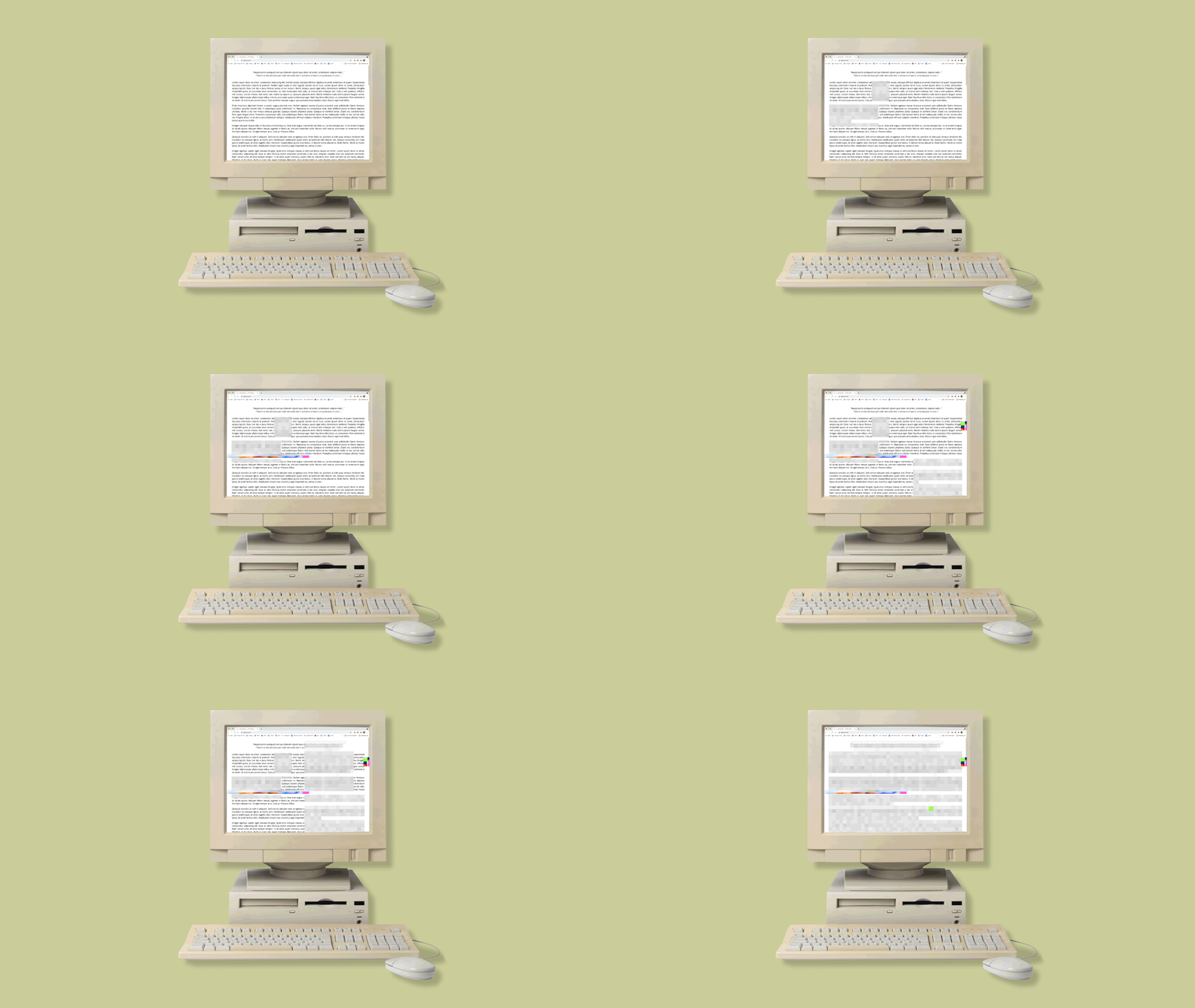
But surely, argues Jonathan Zittrain, it shouldn’t be that way…
Sixty years ago the futurist Arthur C. Clarke observed that any sufficiently advanced technology is indistinguishable from magic. The internet—how we both communicate with one another and together preserve the intellectual products of human civilization—fits Clarke’s observation well. In Steve Jobs’s words, “it just works,” as readily as clicking, tapping, or speaking. And every bit as much aligned with the vicissitudes of magic, when the internet doesn’t work, the reasons are typically so arcane that explanations for it are about as useful as trying to pick apart a failed spell.
Underpinning our vast and simple-seeming digital networks are technologies that, if they hadn’t already been invented, probably wouldn’t unfold the same way again. They are artifacts of a very particular circumstance, and it’s unlikely that in an alternate timeline they would have been designed the same way.
The internet’s distinct architecture arose from a distinct constraint and a distinct freedom: First, its academically minded designers didn’t have or expect to raise massive amounts of capital to build the network; and second, they didn’t want or expect to make money from their invention.
The internet’s framers thus had no money to simply roll out a uniform centralized network the way that, for example, FedEx metabolized a capital outlay of tens of millions of dollars to deploy liveried planes, trucks, people, and drop-off boxes, creating a single point-to-point delivery system. Instead, they settled on the equivalent of rules for how to bolt existing networks together.
Rather than a single centralized network modeled after the legacy telephone system, operated by a government or a few massive utilities, the internet was designed to allow any device anywhere to interoperate with any other device, allowing any provider able to bring whatever networking capacity it had to the growing party. And because the network’s creators did not mean to monetize, much less monopolize, any of it, the key was for desirable content to be provided naturally by the network’s users, some of whom would act as content producers or hosts, setting up watering holes for others to frequent.
Unlike the briefly ascendant proprietary networks such as CompuServe, AOL, and Prodigy, content and network would be separated. Indeed, the internet had and has no main menu, no CEO, no public stock offering, no formal organization at all. There are only engineers who meet every so often to refine its suggested communications protocols that hardware and software makers, and network builders, are then free to take up as they please.
So the internet was a recipe for mortar, with an invitation for anyone, and everyone, to bring their own bricks. Tim Berners-Lee took up the invite and invented the protocols for the World Wide Web, an application to run on the internet. If your computer spoke “web” by running a browser, then it could speak with servers that also spoke web, naturally enough known as websites. Pages on sites could contain links to all sorts of things that would, by definition, be but a click away, and might in practice be found at servers anywhere else in the world, hosted by people or organizations not only not affiliated with the linking webpage, but entirely unaware of its existence. And webpages themselves might be assembled from multiple sources before they displayed as a single unit, facilitating the rise of ad networks that could be called on by websites to insert surveillance beacons and ads on the fly, as pages were pulled together at the moment someone sought to view them.
And like the internet’s own designers, Berners-Lee gave away his protocols to the world for free—enabling a design that omitted any form of centralized management or control, since there was no usage to track by a World Wide Web, Inc., for the purposes of billing. The web, like the internet, is a collective hallucination, a set of independent efforts united by common technological protocols to appear as a seamless, magical whole.
This absence of central control, or even easy central monitoring, has long been celebrated as an instrument of grassroots democracy and freedom. It’s not trivial to censor a network as organic and decentralized as the internet. But more recently, these features have been understood to facilitate vectors for individual harassment and societal destabilization, with no easy gating points through which to remove or label malicious work not under the umbrellas of the major social-media platforms, or to quickly identify their sources. While both assessments have power to them, they each gloss over a key feature of the distributed web and internet: Their designs naturally create gaps of responsibility for maintaining valuable content that others rely on. Links work seamlessly until they don’t. And as tangible counterparts to online work fade, these gaps represent actual holes in humanity’s knowledge…
The glue that holds humanity’s knowledge together is coming undone: “The Internet Is Rotting.” @zittrain explains what we can do to heal it.
(Your correspondent seconds his call to support the critically-important work of The Internet Archive and the Harvard Library Innovation Lab, along with the other initiatives he outlines.)
* Roger Ebert
###
As we protect our past for the future, we might recall that it was on this date in 1937 that Hormel introduced Spam. It was the company’s attempt to increase sales of pork shoulder, not at the time a very popular cut. While there are numerous speculations as to the “meaning of the name” (from a contraction of “spiced ham” to “Scientifically Processed Animal Matter”), its true genesis is known to only a small circle of former Hormel Foods executives.
As a result of the difficulty of delivering fresh meat to the front during World War II, Spam became a ubiquitous part of the U.S. soldier’s diet. It became variously referred to as “ham that didn’t pass its physical,” “meatloaf without basic training,” and “Special Army Meat.” Over 150 million pounds of Spam were purchased by the military before the war’s end. During the war and the occupations that followed, Spam was introduced into Guam, Hawaii, Okinawa, the Philippines, and other islands in the Pacific. Immediately absorbed into native diets, it has become a unique part of the history and effects of U.S. influence in the Pacific islands.

You must be logged in to post a comment.