Posts Tagged ‘ocean shipping’
“The real danger is assuming that because you haven’t had a problem yet, you won’t have one soon”*…

Joan Didion once observed that “survivors look back and see omens, messages they missed.” That’s certainly true in investment arena… where stock indices have been hovering near all time highs while everyone awaits the falling of the shoe(s) from Trump’s tariffs and assorted other blows to the economy. Will we look back in the not-too-distant future to signs that it couldn’t, thus wouldn’t, continue?
Omens registered in advance are “early warning signs.” A classic on the economic front is the “cardboard box index“; the output of cardboard boxes is believed to be an indicator of future production of consumer goods, since cardboard containers are so common for packaging and shipping these goods. It’s down.
Mike Schuler, the managing editor of gCaptain weighs in with another…
The U.S. container shipping industry is heading toward what could be one of the most significant volume declines in its six-decade history, according to the latest analysis from shipping expert John McCown.
August data revealed only a slight 0.1% year-over-year increase in inbound container volume at the ten largest U.S. ports, following a temporary reprieve in July when volumes rose 3.2%. Meanwhile, outbound volume in August dropped 2.6%, continuing an erratic pattern that saw a 2.0% increase in July and a 1.7% decrease in June.
The marginal growth in August inbound volumes can be attributed to an exception for goods in transit after the August 7 implementation of revised reciprocal tariffs. “The new tariffs did not apply to containers that were loaded on vessels at their last foreign port of call before August 7 provided they entered the U.S. before October 5,” McCown explains.
This exemption artificially supported August figures, as “the large majority of boxes coming into the U.S. in August being exempt from the tariffs going into effect on August 7.” McCown adds that this mechanism may have even incentivized strategic deployment adjustments where “ships were loaded by August 7 and slow-steamed to the U.S.”
A stark contrast is emerging between U.S. container volumes and global shipping trends. “When U.S. container volume data is compared to global data and data in other major areas, there is a noticeable and widening gap as the downtrends in U.S. lanes are being significantly mitigated by increased volume in other areas,” notes McCown.
Evidence of this divergence can be seen in Far East export figures, which “set a new record and were 6.3% ahead of the same month last year” in July. McCown observes that “world container supply chains have already begun to adapt and reconfigure trading patterns. The U.S. is a less relevant player in world trade today than it was prior to these various tariff initiatives and will become more so as announced plans are implemented.”
The National Retail Federation has revised its projection for 2025, now expecting total inbound volume to decrease by 3.4%. When considering that year-to-date volume through August shows a 3.1% increase, this projection translates to “the remaining four months of 2025 being down 15.7% compared to the same four months in 2024.”
September will likely mark the beginning of more pronounced declines. In a September 17 presentation, the Port of Los Angeles director stated they expected inbound volume to drop 10% compared to the same month last year. Container bookings data supports this outlook, with bookings from China to the U.S. down 26% in the first week of September compared to the same period last year.
The situation could worsen if currently paused reciprocal tariffs on Chinese imports are implemented in mid-November. “If and when those tariffs are implemented, it is highly likely that they would lead to broader declines related to inbound containers to the U.S. from China,” McCown warns.
Adding another layer of complexity is the upcoming USTR ship fee plan targeting ships built in China or operated by Chinese carriers, set to take effect in mid-October. McCown describes this as “moving container volume related to trade lanes involving the U.S. into unchartered waters.” As these lanes account for more than a quarter of global container miles, “there will be a ripple effect that will be felt globally.”
The projected decline represents an unprecedented shift for an industry that has historically grown at rates exceeding U.S. GDP. “For a tangible metric that has consistently for decades grown above U.S GDP, most often at two, three or even more multiples of GDP, the unusual nature of an actual decline in inbound container volume into the U.S. cannot be overemphasized,” McCown states.
While the immediate volume impact is becoming clearer, the inflationary effects of the tariffs will take longer to manifest fully in economic data. McCown notes that “it will not be until at least when the inflation data is released in during the fourth quarter that the inflationary impact of the tariffs can begin to be accurately assessed.”
McCown concludes that the U.S. faces a difficult trade-off: “The more inbound container volume to the U.S. declines, the more commerce and growth will be impacted but the less inflation we will get. The less inbound container volume to the U.S. declines, the more inflation we will get but the less commerce and growth will be impacted. Unfortunately, there is simply no good place to be on that spectrum.”…
For what it’s worth, your correspondent does not share McCown’s confidence that a drop in container volume– in imported goods– will not raise prices. While the goods that don’t arrive won’t be passed along with tariffs baked into their prices, their substitutes, which will, per force, be scare for some time, seem likely to have their prices “bid” up…
“U.S. Container Imports Face Historic Decline as Tariff Effects Take Hold.”
All this said, prediction on the basis of indicators (and omens and signs and early warning signals and the like) is a tricky business. See, for example: “List of dates predicted for apocalyptic events.”
* G. Scott Graham, Early Warning Signals
###
As we batten down, we might recall that it was on this date in 2008 that U.S. stock markets, already on edge after the near failure of Wachovia Bank the day before, fell over the edge after the House rejected a bailout plan touted to help ease the ongoing financial crisis. Markets began their decline as soon as it became apparent the bill would fail. The Dow had its worst single day point decline in history, falling 777.68 points… the day that “The Crash of 2008” became real.

“The malady of commercial crisis is not, in essence, a matter of the purse but of the mind”*…
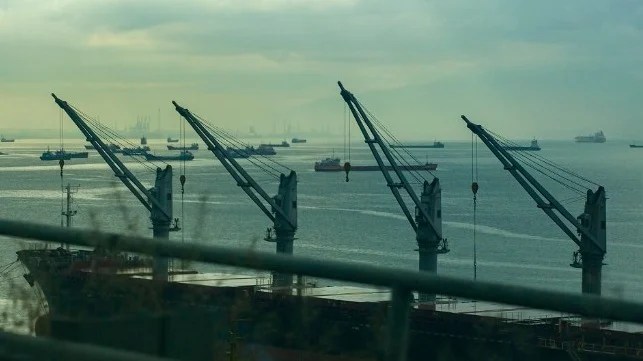
Still, those crises do take tangible form…
Q3 is a traditional peak season in the world of shipping, but not this year. Global inflation, weakened consumer demand and excess cargo carrying capacity are pushing the market down…
With a gloomy economic outlook and vague alarms from central banks, it seems recession could be just around the corner.
Are there any indications from the shipping market when global recession is on its way? This is a question not only of interest to the commercial and technical players in the maritime industry, but also to financiers and policy makers.
The last recession triggered by economic factors was the Great Recession from December 2007 to June 2009. Goods loaded worldwide for seaborne trade fell by nearly five percent in 2009 compared to 2008, from about 8.23 billion tons to 7.82, according to UNCTAD’s Handbook of Statistics 2021.
Is a depressed shipping market a contributor to global recession, or does global recession lead the shipping market down? It is a chicken and egg question. But can the Great Recession’s impact to shipping market provide some useful reference to the current situation? Shipping indexes may shed some light.
…
How is the shipping market now? In May 2022, bulker earnings started to drop. Tankers were at a short break in an upward rise. Container freight rates were flat and just about to begin sliding. As of September 2022, only tankers’ earnings are still climbing.
The bulk shipping market’s underperformance will probably continue and will not turn before Christmas, unless there are significant changes – for example, if an easing of COVID restrictions in China pushes up its industrial demand (particularly for iron ore). Demand for oil and gas from the West will help send tanker rates continue soaring. Container shipping is expected to decline in the short term.
During the past months, a black cloud has appeared on the global shipping market’s horizon. The downward trend of shipping indexes brings a sense of foreboding. As to the question, “is a global recession imminent?” Most likely, say signals from these two shipping indexes…
“Do Shipping Indexes Hint at Global Recession?,” from @Mar_Ex. (TotH to friend PH.)
See also: “China lockdowns accelerate supply chain diversion and box shipping review,” and more generally, “An often-overlooked economic measure is signaling serious trouble ahead” and “Three Harbingers Point to a U.S. Recession.”
* John Stuart Mill
###
As we batten the hatches, we might we might spare a thought for Henry George; he died on this date in 1897. A writer, politician and political economist, George is best remembered for Progress and Poverty, published in 1879, which treats inequality and the cyclic nature of industrialized economies, and proposes the use of a land value tax (AKA a “single tax” on real estate) as a remedy– an economic philosophy known as Georgism, the main tenet of which is that, while individuals should own what they create, everything found in nature, most importantly the value of land, belongs equally to all mankind.
George’s ideas were widely-discussed in his time and into the early 20th century, and admired by thinkers like Alfred Russel Wallace, Jose Marti, and William Jennings Bryan; Franklin D. Roosevelt sang his praises, as did George Bernard Shaw. But with the rise of neoclassical economics, George’s star began to recede. Still, more modern thinkers like Albert Einstein and martin Luther King were fans.
In a sequence that mimicked George’s arc of influence, it was George’s work that inspired Elizabeth Magie to create The Landlord’s Game in 1904 to demonstrate his theories; ironically, it was Magie’s board game that became in the 1930s (as recently noted here and here) the basis for Monopoly.
In 1977, Joseph Stiglitz showed that under certain conditions, spending by the government on public goods will increase aggregate land rents/returns by the same amount. Stiglitz’s findings were dubbed “the Henry George Theorem,” as they illustrate a situation in which Henry George’s “single tax” is not only efficient, it is the only tax necessary to finance public expenditures.

You must be logged in to post a comment.