Posts Tagged ‘recession’
“Economic problems have no sharp edges. They shade off imperceptibly into politics, sociology, and ethics. Indeed, it is hardly an exaggeration to say that the ultimate answer to every economic problem lies in some other field.”*…

The number of households that live above the poverty line but are barely scraping by is ticking higher…
Over time, higher costs and sluggish wage growth have left more Americans financially vulnerable, with many known as “ALICEs.”
Nearly 40 million families, or 29% of the population, fall in the category of ALICE — Asset Limited, Income Constrained, Employed — according to United Way’s United for ALICE program, which first coined the term to refer to households earning above the poverty line but less than what’s needed to get by.
That figure doesn’t include the 37.9 million Americans [individuals, as opposed to families as measured above] who live in poverty, comprising 11.5% of the total population, according to data from the U.S. Census Bureau.
“ALICE is the nation’s child-care workers, home health aides and cashiers heralded during the pandemic — those working low-wage jobs, with little or no savings and one emergency from poverty,” said Stephanie Hoopes, national director at United for ALICE…
Read on for an explanation of how high inflation and higher interest rates have aggravated what was already a problem: “29% of households have jobs but struggle to cover basic needs,” from @CNBC.
Apposite: “Millions of Americans are about to lose internet access, and Congress is to blame.”
(Image above: source)
***
As we knit a safety net, we might recall that, on this date in 2020, as a product of the COVID-19 recession, the U.S. unemployment rate to hit 14.9 percent, its worst rate since the Great Depression. Federal legislators enacted six major bills, centered on the American Rescue Plan and costing about $5.3 trillion, to help manage the pandemic and mitigate the economic burden on families and businesses. Those programs have now expired.

“It’s the economy, stupid”*…

It’s no secret that economic conditions have political impacts; still the stark, almost mechanical character of that impact can still be surprising– and can raise the question of motive. Consider on the findings of a recent study by analysts at Sveriges Riksbank, Sweden’s central bank…
Using a novel regional database covering over 200 elections in several European countries,
this paper provides new empirical evidence on the political consequences of fiscal consoli-
dations. To identify exogenous reductions in regional public spending, we use a Bartik-type
instrument that combines regional sensitivities to changes in national government expendi-
tures with narrative national consolidation episodes. Fiscal consolidations lead to a signifi-
cant increase in extreme parties’ vote share, lower voter turnout, and a rise in political frag-
mentation. We highlight the close relationship between detrimental economic developments
and voters’ support for extreme parties by showing that austerity induces severe economic
costs through lowering GDP, employment, private investment, and wages. Austerity-driven
recessions amplify the political costs of economic downturns considerably by increasing dis-
trust in the political environment.
Here, Adam Tooze:
With a significant data set, this paper argues that post-2008 austerity clearly increased support for far-right parties by deepening recessions and generating social fragmentation. Note that the authors measure support for “extreme” parties, which risks lumping together fascists and socialists through liberal “horseshoe theory” — the most ostensibly objective, empirical social science has a dose of ideology in it! — but this is nonetheless important in confirming the old Keynesian claim that was so starkly forgotten by Eurozone political elites after the financial crisis. The question that arises, then, is why a truth discovered through much pain in the 1930s (slashing demand only deepens economic and social problems) was set aside: was this a case of foolishness or the pursuit of other, narrower [economic self-serving and/or political] interests?
Why do we keep making the same mistakes: “The Political Costs of Austerity,” from @riksbanken and @adam_tooze.
For a sense that there may be some remedial action afoot, at least in the aid available to troubled economies, see “A reboot of the World Bank and IMF tests US influence” (gift article; source of the image above)… though it’s fueled by geopolitical competition for influence, so may simply be trading one problem for another…
And for a contrary view: “The Economic Anxiety Explanation of Fascism Is Wrong” (though the author’s case begins from the assertion that “there just is little to no evidence that economic hardship leads to fascism,” a claim weakened by the paper above; still his larger argument is worth reading).
* James Carville, while he was serving as a strategist to Bill Clinton’s 1992 presidential campaign (which unfolded during a recession)
###
As we wonder if it is, in the end, all about the Benjamins, we might recall that on this date in 1929 Yale economist Irving Fisher wrote in the New York Times that “Stock prices have reached what looks like a permanently high plateau.” Eight days later, on October 24, 1929, the stock market began a four-day implosion on what became known as Black Thursday. This crash cost investors more than World War I and was a main catalyst of the Great Depression.
Fisher’s declaration was in response to Great Britain’s Chancellor of the Exchequer, Philip Snowden, then-recent description of America’s stock market as “a perfect orgy of speculation,” which was quickly followed by U.S. Treasury Secretary Andrew Mellon’s assertion that American investors “acted as if the price of securities would infinitely advance.” Fisher’s prognostication has entered history as the worst stock market prediction of all time.
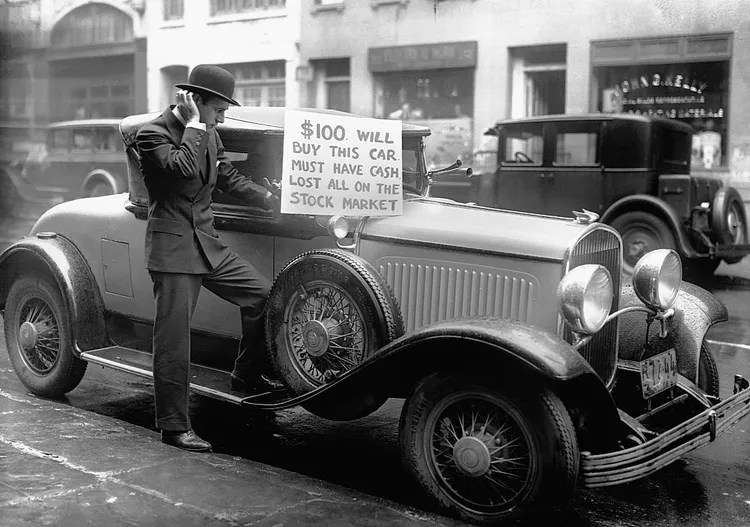
“Things gained through unjust fraud are never secure”*…

Mischief is cyclical—it is bred in good times and uncovered in bad times…
The bad news just keeps coming. Ten months after America’s stock market peaked, its big technology companies have suffered another rout. Hopes that the Federal Reserve might change course have been dashed; interest rates are set to rise by more than previously thought. The bond market is screaming recession. Could things get any worse? The answer is yes. Stock market booms of the sort that crested in January tend to engender fraud. Bad times like those that lie ahead reveal it.
“There is an inverse relationship between interest rates and dishonesty,” says Carson Block, a short-seller. Quite so. A decade of ultra-low borrowing costs has encouraged companies to load up on cheap debt. And debt can hide a lot of misdeeds. They are uncovered when credit dries up. The global financial crisis of 2007-09 exposed fraud and negligence in mortgage lending. The stockmarket bust of the early 2000s unmasked the deceptions of the dotcom bonanza and the book-cooking at Enron, Worldcom and Global Crossing. Those with longer memories in Britain will recall the Polly Peck and Maxwell scandals at the end of the go-go 1980s.
The next downturn seems likely to uncover a similar wave of corporate fraud…
The archetypal sin revealed by recession is accounting fraud. The big scandals play out like tragic dramas: when the plot twist arrives, it seems both surprising and inevitable. No simple formula exists to sort the number-fiddlers from the rest. But the field can be narrowed by searching within the “fraud triangle” of financial pressure, opportunity and rationalization…
As Warren Buffett has noted, “you don’t find out who’s been swimming naked until the tide goes out.” Read on for more from @TheEconomist, “A sleuth’s guide to the coming wave of corporate fraud” (a gift article: no paywall).
* Sophocles
###
As we contemplate criminality, we might recall that it was on this date in 1997 that MCI and Worldcom announced what was then the largest merger in history, valued at $37 Billion, creating the second largest telecom company in the U.S. (after ATT).
Worldcom, the acquirer, completed the deal in 1998, then continued to grow via acquisition. MCI Worldcom (as then it was) filed for bankruptcy in 2002 (the Dot Com Bust) after an accounting scandal (as referenced above), in which several executives, including CEO Bernard Ebbers, were convicted of a scheme to inflate the company’s assets… which were ultimately acquired by Verizon.

“The malady of commercial crisis is not, in essence, a matter of the purse but of the mind”*…
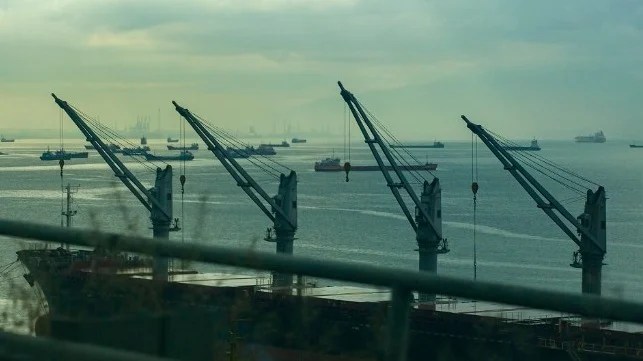
Still, those crises do take tangible form…
Q3 is a traditional peak season in the world of shipping, but not this year. Global inflation, weakened consumer demand and excess cargo carrying capacity are pushing the market down…
With a gloomy economic outlook and vague alarms from central banks, it seems recession could be just around the corner.
Are there any indications from the shipping market when global recession is on its way? This is a question not only of interest to the commercial and technical players in the maritime industry, but also to financiers and policy makers.
The last recession triggered by economic factors was the Great Recession from December 2007 to June 2009. Goods loaded worldwide for seaborne trade fell by nearly five percent in 2009 compared to 2008, from about 8.23 billion tons to 7.82, according to UNCTAD’s Handbook of Statistics 2021.
Is a depressed shipping market a contributor to global recession, or does global recession lead the shipping market down? It is a chicken and egg question. But can the Great Recession’s impact to shipping market provide some useful reference to the current situation? Shipping indexes may shed some light.
…
How is the shipping market now? In May 2022, bulker earnings started to drop. Tankers were at a short break in an upward rise. Container freight rates were flat and just about to begin sliding. As of September 2022, only tankers’ earnings are still climbing.
The bulk shipping market’s underperformance will probably continue and will not turn before Christmas, unless there are significant changes – for example, if an easing of COVID restrictions in China pushes up its industrial demand (particularly for iron ore). Demand for oil and gas from the West will help send tanker rates continue soaring. Container shipping is expected to decline in the short term.
During the past months, a black cloud has appeared on the global shipping market’s horizon. The downward trend of shipping indexes brings a sense of foreboding. As to the question, “is a global recession imminent?” Most likely, say signals from these two shipping indexes…
“Do Shipping Indexes Hint at Global Recession?,” from @Mar_Ex. (TotH to friend PH.)
See also: “China lockdowns accelerate supply chain diversion and box shipping review,” and more generally, “An often-overlooked economic measure is signaling serious trouble ahead” and “Three Harbingers Point to a U.S. Recession.”
* John Stuart Mill
###
As we batten the hatches, we might we might spare a thought for Henry George; he died on this date in 1897. A writer, politician and political economist, George is best remembered for Progress and Poverty, published in 1879, which treats inequality and the cyclic nature of industrialized economies, and proposes the use of a land value tax (AKA a “single tax” on real estate) as a remedy– an economic philosophy known as Georgism, the main tenet of which is that, while individuals should own what they create, everything found in nature, most importantly the value of land, belongs equally to all mankind.
George’s ideas were widely-discussed in his time and into the early 20th century, and admired by thinkers like Alfred Russel Wallace, Jose Marti, and William Jennings Bryan; Franklin D. Roosevelt sang his praises, as did George Bernard Shaw. But with the rise of neoclassical economics, George’s star began to recede. Still, more modern thinkers like Albert Einstein and martin Luther King were fans.
In a sequence that mimicked George’s arc of influence, it was George’s work that inspired Elizabeth Magie to create The Landlord’s Game in 1904 to demonstrate his theories; ironically, it was Magie’s board game that became in the 1930s (as recently noted here and here) the basis for Monopoly.
In 1977, Joseph Stiglitz showed that under certain conditions, spending by the government on public goods will increase aggregate land rents/returns by the same amount. Stiglitz’s findings were dubbed “the Henry George Theorem,” as they illustrate a situation in which Henry George’s “single tax” is not only efficient, it is the only tax necessary to finance public expenditures.

“It’s a recession when your neighbor loses his job; it’s a depression when you lose your own”*…

The “R word,” unpacked…
It’s being whispered and murmured about. The president is facing questions about it. Business leaders and investors are already bracing for it. The specter of recession is once again rearing its monstrous head.
It’s feasible that the economy could chug along without any bumps or crashes. But boom-and-bust cycles remain a seemingly inescapable feature of capitalist economies. Some countries have done well avoiding busts. Starting in 1991, Australia had a run of almost 29 years without a recession, the longest stretch of economic growth of any nation in modern history. That ended in 2020, when the pandemic led to a big contraction — and Australia (briefly) succumbed to the beast.
While Australia had zero recessions between 1991 and 2020, the United States had two, a mild one in 2001, amid the dotcom crash and the 9/11 terrorist attacks; and a catastrophic one known as the Great Recession, between 2007 and 2009. Since 1854, the first year for which we have official economic data, the United States has experienced 35 recessions.
The National Bureau of Economic Research’s Business Cycle Dating Committee is the official body that keeps track of recessions in the U.S. The committee has traditionally defined recessions as “a significant decline in economic activity that is spread across the economy and that lasts more than a few months.”…
Recessions– what they are, what they aren’t, and how they happen: “Fear The Vibe Shift: Are We Entering A Recession?,” from Greg Rosalsky (@elliswonk) at Planet Money (@planetmoney).
And for a dive into the vibe in question, see Derek Thompson‘s (@DKThomp) examination of why many Americans believe that they’re personally doing well, even as they feel that the country and the economy are going to hell: “Everything Is Terrible, but I’m Fine.”
See also: “There are 2 very different kinds of recessions—and the U.S. is likely headed for something totally different than 2008” in @FortuneMagazine (source of the image above), and “A recession in America by 2024 looks likely– It should be mild—but fear its consequences” in @TheEconomist.
* Harry S. Truman
###
As we batten the hatches, we might send carefully-considered birthday greetings to Robert Aumann; he was born on this date in 1930. An economist and mathematician, he is best known for his contributions to game theory, especially for his work on repeated games (situations in which players encounter the same situation over and over again). He developed the concept of correlated equilibrium in game theory, which is a type of equilibrium in non-cooperative games (like most of those in our economy), a more flexible version than the classical Nash equilibrium.
For these and related contributions to game theory, he shared the 2005 Nobel Prize in Economics.

You must be logged in to post a comment.