Posts Tagged ‘austerity’
“A greenback, greenback dollar bill / Just a little piece of paper, coated with chlorophyll”*…

Americans are increasingly going cashless. Still, as Marcus Lu illustrates, there’s rather a lot of currency in circulation– almost $2.3 Trillion (of which about a third, an estimated $950 Billion [and here] is outside the U.S.)…
Every year, the U.S. Federal Reserve submits a print order for U.S. currency to the Treasury Department’s Bureau of Engraving and Printing (BEP). The BEP will then print billions of notes in various denominations, from $1 bills to $100 bills.
In this graphic, we’ve used the latest Federal Reserve data to visualize the approximate number of bills for each denomination globally, as of Dec. 31, 2022…
“Visualizing All of the U.S. Currency in Circulation” from @VisualCap.
* Ray Charles, “Greenbacks”
###
As we concede that cash is still king, we might send penurious birthday greetings to Kenneth Rogoff; he was born on this date in 1953. An economist who teaches at Harvard and has served as the Chief Economist of the International Monetary Fund, he has been a vocal champion of austerity… thus in conflict with Nobel Laueate and former chief economist of the World Bank Joseph Stiglitz (and radically less consequentially, with your correspondent).
While Rogoff completed his education (at Princeton and MIT), he dropped out of high school at 16 to concentrate on chess (at which time he met Bobby Fischer, who was impressed by Rogoff’s “self-assured style and his knowing exactly what he wanted over the chessboard”). Two years later he returned to school but continued to play competitively. Indeed, In 2012 he drew a blitz game with the world’s highest rated player Magnus Carlsen.

“It’s the economy, stupid”*…

It’s no secret that economic conditions have political impacts; still the stark, almost mechanical character of that impact can still be surprising– and can raise the question of motive. Consider on the findings of a recent study by analysts at Sveriges Riksbank, Sweden’s central bank…
Using a novel regional database covering over 200 elections in several European countries,
this paper provides new empirical evidence on the political consequences of fiscal consoli-
dations. To identify exogenous reductions in regional public spending, we use a Bartik-type
instrument that combines regional sensitivities to changes in national government expendi-
tures with narrative national consolidation episodes. Fiscal consolidations lead to a signifi-
cant increase in extreme parties’ vote share, lower voter turnout, and a rise in political frag-
mentation. We highlight the close relationship between detrimental economic developments
and voters’ support for extreme parties by showing that austerity induces severe economic
costs through lowering GDP, employment, private investment, and wages. Austerity-driven
recessions amplify the political costs of economic downturns considerably by increasing dis-
trust in the political environment.
Here, Adam Tooze:
With a significant data set, this paper argues that post-2008 austerity clearly increased support for far-right parties by deepening recessions and generating social fragmentation. Note that the authors measure support for “extreme” parties, which risks lumping together fascists and socialists through liberal “horseshoe theory” — the most ostensibly objective, empirical social science has a dose of ideology in it! — but this is nonetheless important in confirming the old Keynesian claim that was so starkly forgotten by Eurozone political elites after the financial crisis. The question that arises, then, is why a truth discovered through much pain in the 1930s (slashing demand only deepens economic and social problems) was set aside: was this a case of foolishness or the pursuit of other, narrower [economic self-serving and/or political] interests?
Why do we keep making the same mistakes: “The Political Costs of Austerity,” from @riksbanken and @adam_tooze.
For a sense that there may be some remedial action afoot, at least in the aid available to troubled economies, see “A reboot of the World Bank and IMF tests US influence” (gift article; source of the image above)… though it’s fueled by geopolitical competition for influence, so may simply be trading one problem for another…
And for a contrary view: “The Economic Anxiety Explanation of Fascism Is Wrong” (though the author’s case begins from the assertion that “there just is little to no evidence that economic hardship leads to fascism,” a claim weakened by the paper above; still his larger argument is worth reading).
* James Carville, while he was serving as a strategist to Bill Clinton’s 1992 presidential campaign (which unfolded during a recession)
###
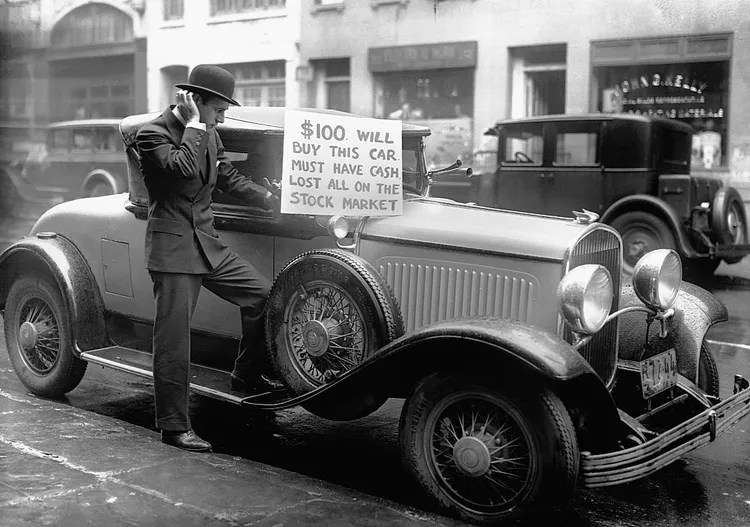
As we wonder if it is, in the end, all about the Benjamins, we might recall that on this date in 1929 Yale economist Irving Fisher wrote in the New York Times that “Stock prices have reached what looks like a permanently high plateau.” Eight days later, on October 24, 1929, the stock market began a four-day implosion on what became known as Black Thursday. This crash cost investors more than World War I and was a main catalyst of the Great Depression.
Fisher’s declaration was in response to Great Britain’s Chancellor of the Exchequer, Philip Snowden, then-recent description of America’s stock market as “a perfect orgy of speculation,” which was quickly followed by U.S. Treasury Secretary Andrew Mellon’s assertion that American investors “acted as if the price of securities would infinitely advance.” Fisher’s prognostication has entered history as the worst stock market prediction of all time.
You must be logged in to post a comment.