Posts Tagged ‘American Dream’
“Fire made us human, fossil fuels made us modern, but now we need a new fire that makes us safe, secure, healthy and durable”*…

A number of entrenched interests have been playing a long game. There’s (all too appropriately) a good bit of attention trained on efforts like The Federalist Society‘s attempts to remake the legal and judicial landscape and The Heritage Foundation‘s “Project 2025” plan to reshape the federal government along right-wing lines. Both reflect the careful cultivation, over decades, first of sympathetic “scholarship” and opinion, then of political action.
But as Kate Yoder of Grist explains, there’s another– longer, deeper– program at work: from the family car to the dream kitchen, fossil fuel companies have sold a vision of prosperity that depended on their own products. Over a century of evidence shows how they have done it…
What does going on a date have to do with fossil fuels? Everything, according to the petroleum industry.
One advertisement from the pipeline company Energy Transfer follows two people getting ready for a date, the man primping with hair gel, the woman applying lipstick, before meeting at a bar. “That connection was brought to you by petroleum products,” the narrator says. “But what if we lived in a world without oil and natural gas?”
The story rewinds to the beginning, except this time, the woman looks bewildered as her phone with the dating app evaporates in her hands. She gets lipstick all over her cheek when the car she’s riding in hits the pavement without its tires. As his hair gel disappears, the man looks into the mirror, baffled. When they sit down across from each other, makeup, hair dye, and glasses fade away. In the game playing on a TV in the bar, a football disintegrates a second before the kicker swings his leg at empty air.
The commercial, which has racked up 7.4 million views since it appeared four years ago, taps into the fact that fossil fuels have become embedded in American life (what’s more American than football?). Oil and gas not only influence how people get around town, but also where they live, how they dress, and how they cook food in their kitchens. This all feels so ordinary that most people don’t notice how pervasive petroleum is, powering our lives while hiding in plain sight. Though it might seem inevitable that we live this way, a Grist investigation found that this idea of what’s “normal” was shaped by decades of advertising, public relations propaganda, and broader efforts to sway American culture, from radio programs to Hollywood films.
“Our dependence on oil didn’t just happen,” said Robert Brulle, an environmental sociologist at Brown University.
This campaign started about a century ago, when companies began strategizing how to create long-term demand for fossil fuels and the products that ran on them. Billboards showcased happy families on the road in their cars, films showed stylish women cooking over the flame of a gas stove, and magazines featured men pushing their gas-powered mowers across soon-to-be perfectly manicured lawns. The message was often left unsaid: The American way of life runs on fossil fuels.
There’s a well-documented history showing that Exxon and other oil giants understood the dangers of global warming by the 1970s based on their own research and still spent decades publicly downplaying, or outright denying, the science. But the story of how oil and gas companies coaxed Americans into accepting — even desiring — a life built on fossil fuels has largely escaped attention, buried in the pages of obscure trade journals.
In the 1940s and 1950s, the oil industry spent millions of dollars a year on campaigns to “educate” the public about the wonders of petroleum and how it advanced the “American way.” The natural gas industry promoted all-gas “dream kitchens” and paraded them in front of the editors of Better Homes and Gardens, Good Housekeeping, and The Ladies’ Home Journal. They sold a vision of the American Dream that required their products — a cultural legacy that has been devastating for efforts to rein in climate change and shift to a cleaner future.
This history offers an explanation for why Americans have had such a strong reaction to the idea of banning polluting gas ranges (“they can pry it from my cold dead hands”) or requiring more sales of electric vehicles over gas-powered cars. Is this debate really just about technology, or about what the burning of fossil fuels represents — freedom and a sense of identity? President Donald Trump’s Make America Great Again agenda is deeply nostalgic for what oil once promised: economic might, a higher standard of living, the chance to rise above your station and maybe make a fortune. In his inauguration speech last year, Trump promised a return to these ideals. “We will be a rich nation again, and it is that liquid gold under our feet that will help to do it,” he said.
As the world enters an “age of electricity” powered increasingly by solar, wind, and other low-carbon energy sources, the United States often appears to be stuck in the past. The Trump administration has prolonged the life of coal plants and opened up new areas to oil drilling, while paying companies billions of dollars to stop offshore wind projects. The explanation, when it’s offered, often returns to the same theme. Earlier this year, when the Trump administration scrapped Biden-era rules to cut emissions from cars, along with the Environmental Protection Agency’s authority to regulate climate change, it touted the effort as “restoring the American Dream.” White House spokesperson Taylor Rogers summed up the sentiment this summer: “President Trump was given a mandate to roll back the radical climate policies that are burning a hole through taxpayers’ wallets and jeopardizing the American Dream for future generations.”
The words echo what the oil industry has been telling Americans for a century: Without fossil fuels, there is no “good life,” only sacrifice…
Read on for the remarkable tale: “The hidden history of how Big Oil invented the American Dream,” from @grist.org.
See also: “How Big Oil Shaped America’s Parks.”
###
As we look behind the curtain, we might that it was on this date in 1895 that George Selden was granted the first patent for a gasoline-powered automobile. In the patent, which Seldon had filed several years earlier, on May 8, 1879 (eight years before the public introduction of the Benz Patent Motorwagen in Europe, built in 1886 and widely considered the first automobile), he described not only the engine but also a complete automobile incorporating such features as a clutch, compressed air self-starter, and steering system (No. 549,160). He maintained that it was the combination of these elements, together with his engine, made the road-engine patentable. Selden’s day job was as a patent attorney, so he knew to delay the issue of the patent by sending amendments and other communications every two years. Meanwhile, others did the hard work of developing the automobile, and his patent became more valuable. Years of legal wrangling for profits followed.

“An imbalance between rich and poor is the oldest and most fatal ailment of all republics”*…

Plutarch’s warning is one to take seriously–as then, now. So, how is the American Dream doing?…
In late 20th-century music, the elusiveness of the American Dream is a recurring theme. From Stevie Wonder’s ode to a boy “born in hard time Mississippi” in 1973 to Bruce Springsteen’s anthems to the working class in factory-shuttered towns in the 1980s, frustration with people’s inability to outgrow their circumstances is rife. The timing of the peak of that genre is no coincidence: whereas nearly all American children born in 1940 could still expect to do better than their parents, only two in five could by 1984…
… A new study by Raj Chetty, of Harvard University, and colleagues provides fresh data on how America’s landscape of opportunity has shifted sharply over the past decades. Although at the national level there have been only small declines in mobility, the places and groups that have become more (or less) likely to enable children to rise up have changed a lot. The most striking finding is that, compared with the past, a child’s race is now less relevant for predicting their future and their socioeconomic class more so.
The greatest drops in mobility have been not in the places evoked in song, but on the coasts and the Great Plains, which historically provided pathways up (see maps). “Fifteen years ago, the American Dream was alive and well for white children born to low-income parents in much of the North-east and West Coast,” says Benjamin Goldman of Cornell University, one of the co-authors. “Now those areas have outcomes on par with Appalachia, the rustbelt and parts of the South-east.”
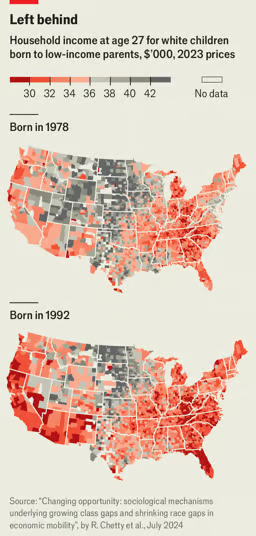
The fact that white children have become more likely to remain in poverty than before, whereas for black children the reverse is true, raises many questions. The finding comes from tracing the trajectories of 57m children born in America between 1978 and 1992 and looking at their outcomes by the age of 27. “This is really the first look with modern big data into how opportunity can change within a place over time,” says Mr Goldman. For children born into high-income families, household income increased for all races between birth cohorts. Yet among those from low-income families, earnings rose for black children and fell for white children.
A black child born to poor parents in 1992 earned $1,400 a year more than one born in 1978. A similar white child earned $2,000 less than one born in 1978. But on average, a poor white child still earned $9,500 more than a poor black child.
This pattern has played out in virtually every county, though with big regional differences. As a result, the earnings gap between rich and poor white children (the “class gap”) grew by 27%, whereas the earnings gap between poor white and poor black children (the “race gap”) fell by 28%…
… None of this means that race is no longer relevant for Americans’ chances in life. Although the reversal of the direction of travel is striking, a young black American born in 1992 to poor parents was still four percentage points more likely to remain in poverty than a poor white peer, down from a 15 percentage-point gap for those born in 1978. And while the near doubling in rates of mortality among young, lower-income white Americans is deeply alarming, mortality rates for their black counterparts have increased too, and they are still (a bit) more likely to die young…
… Convergence has not yet brought equality. Despite improvements across America for poor black children, there is still no county where their outcomes match those of poor white ones. Yet the decline of the white working class is steep, and bound to cause grief. Telling a young white man with lower life outcomes than previous generations that he is still doing better than the average black peer is about as useful as telling a young black man that he’s doing well “for a black man”.
Another possible misconception is that social mobility is a zero-sum game: that poor white children are doing worse because poor black children are doing better. The authors tackle this by showing how in places where black children have done well, white children’s outcomes have remained stable; and in places where white children have done particularly poorly, their black peers have also not thrived.
In his previous work Mr Chetty demonstrated [see here for a summary of his 2018 study] just how much a child’s chances of outperforming their parents depended on their race and where they grew up. One of the questions the authors were left with was how “sticky” these effects would be over time: could opportunities for the next cohorts of children change within these same places, or were they fixed? The new study’s most hopeful finding is that, far from being fixed, opportunities within a place can change significantly and rapidly. Neither history nor place is destiny…
… Americans love a rags-to-riches story. In his acceptance speech [at the Republican Convention], Mr Vance pledged to “make this country a place where every dream…will be possible once again”. In his bestselling book “Hillbilly Elegy” he writes that the assumption “that only a truly extraordinary person could have made it to where I am today…I think that theory is a load of bullshit.”
But the story of Mr. Vance, who grew up in a poor part of the rustbelt, rose to be a venture capitalist and now, at 39, is a potential American president, remains extraordinarily rare. While there has been a reshuffling of opportunities for Americans trying to escape the lowest rung, there has been no progress at all for routes into the upper class. For the vast majority of poor black children, who continue to have a 3% chance of rising from the bottom to the top quintile, and poor white children, whose chances have fallen from 14% to 12%, that door remains firmly shut…
“Class, race and the chances of outgrowing poverty in America,” a big-data analysis– a gift article from @TheEconomist.
* Plutarch
###
As we optimize opportunity, we might send mortgaged birthday greetings to Charles Darrow; he was born on this date in 1889. He designed (in 1933) and patented (in 1935) the board game Monopoly. He later sold his patent to Parker Brothers, which credits him as its creator.
In fact, the history of Monopoly is much longer. It can be traced back to 1903, when American anti-monopolist Lizzie Magie created a game called The Landlord’s Game that she hoped would explain the single-tax theory of Henry George. It was intended as an educational tool to illustrate the negative consequences of concentrating land in private monopolies.
After losing his job at a sales company following the Stock Market Crash of 1929, Darrow worked at various odd jobs. Seeing his neighbors and acquaintances play a board game in which the object was to buy and sell property, he decided to publish his own version of the game.
In fact, Darrow and his friends were just a few of many people in the American Midwest and East Coast who had been playing a game of buying and trading property– all based on Magie’s original… but most having morphed as warnings of that sort too often do) into the opposite of Magie’s intent– a celebration of accumulation. The game was used by college professors and their students, and another variant, called The Fascinating Game of Finance, was published in the Midwest in 1932. From there the game traveled back east, where it had remained popular in Pennsylvania, and became popular with a group of Quakers in Atlantic City. Darrow was taught to play the game by Charles Todd, who had played it in Atlantic City, where it had been customized with that city’s street and property names– to wit Monopoly‘s nomenclature.

“Not every business cycle has a financial crisis. Frequently they do.”*…
Your correspondent is headed away on his annual pilgrimage to the land of banked dunes and deep-fried delights. Regular service will resume on or around August 27. Vacations can be a time for retrospection. In that spirit, an invitation to think about the last ten years…

2008 was a big year: Senator Barack Obama was elected president of the United States, “Satoshi Nakamoto” published “Bitcoin: A Peer-to-Peer Electronic Cash System,” SpaceX became the first private, commercial company to put an object into earth orbit, China wowed the world with its host ceremonies for the Summer Olympic Games… But of course, 2008 was also the start of the Great Recession… which was bad. Really bad:
Total U.S. household net worth dropped by $11.1 trillion in 2008.
The median income for 25-to-34-year-olds in America, $34,000, hasn’t budged since 1977, adjusted for inflation.
Median household wealth collapsed.
2007: $126k
2016: $97kThe number of Americans worried about the economy multiplied nearly sixfold.
2007: 16 percent
2008: 86 percentIn 2016, the median wealth of a family headed by someone born in the 1980s was 34 percent below the level of earlier generations at the same 2007: age.
Mutual funds lost a third of their value: -38 percent.
The market value of all publicly traded companies was cut in half.
October 2007: $63 trillion
March 2009: $28.6 trillionFrom 2005 to 2009, the median value of stocks and mutual funds owned by whites dropped by 9 percent.
The median value of holdings for African-Americans dropped by 71 percent (probably because of pressure to sell when prices were low).
Between 2007 and 2013, wages declined for the bottom 70 percent of all workers.
The retirement savings of black families fell by 35 percent from 2007 to 2010.
In a 2016 survey by the Fed, 28 percentof working-age adults said they had no retirement savings whatsoever.
The racial wealth gap, already large, ballooned.
Whites: $171k
Hispanics: $20.7k
African-Americans: $17.6kIn terms of household wealth, every group suffered — but some more than others.
Hispanics: -66 percent
Asian-Americans: -54 percent
African-Americans: -53 percent
Whites: -16 percentConsumer credit-card debt at the end of 2017 was over $1 trillion (about 30% higher than in 2008).
Millennials have taken on at least 300 percent more student-loan debt than their parents’ generation.
The unemployed took many more weeks to find work.
May 2008: 7.9
June 2010: 25.2In a December 2017 poll by YouGov, 38 percent of those surveyed said they didn’t know when they’d be debt-free. 30 percent of respondents thought they’d never be out of debt.
63 percent of Americans say they don’t have enough money in savings to cover a $500 health-care expense.
In 2017, women had nearly 500,000 fewer babies than in 2007, although there were 7 percent more women of prime childbearing age.
The suicide rate rose 4 percent from 1999 to 2010: 4,750 additional deaths.
24 million adult millennials, or 32 percent, still live at home.
79 million Americans live in a “shared household” with at least one extra, nonfamily resident.
More college grads moved in with their parents.
2005: 19 percent
2016: 28 percentAs of 2017, only 34.2 percent of homes have recovered their value from before the recession. (Still below 2008 value.)
From 2000 to 2015, homeownership declined in 90% of all U.S. metropolitan areas.
[source]
Frank Rich explores the lasting impact of that crash:
…the collapse of Lehman Brothers kicked off the Great Recession that proved to be a more lasting existential threat to America than the terrorist attack of seven Septembers earlier. The shadow it would cast is so dark that a decade later, even our current run of ostensible prosperity and peace does not mitigate the one conviction that still unites all Americans: Everything in the country is broken. Not just Washington, which failed to prevent the financial catastrophe and has done little to protect us from the next, but also race relations, health care, education, institutional religion, law enforcement, the physical infrastructure, the news media, the bedrock virtues of civility and community. Nearly everything has turned to crap, it seems, except Peak TV (for those who can afford it)…
Read the full essay: “In 2008, America Stopped Believing in the American Dream.”
Then consider Steve Bannon’s take on the same event:
The legacy of the financial crisis: Donald Trump. The legacy of the financial crisis is Donald J. Trump. And I can give you the specific moment: When they put Lehman in bankruptcy, and the geniuses didn’t understand that it was inextricably linked to the commercial paper market. Hank Paulson, Treasury secretary, and Ben Bernanke, the head of the Federal Reserve, they went to see Bush three days later. They told him, ‘We need a trillion dollars in cash, and we need it by five o’clock.’”
And in a profile of courage, President Bush says, “Not my problem. You gotta go to Capitol Hill.” They go up to Capitol Hill, they put everybody in a room. They make them all put their BlackBerrys outside, and they walk in, and Bernanke, who’s not an alarmist, says, “If we don’t have a trillion dollars by today, the American financial system will melt down in 72 hours. The world financial system will melt down in two weeks, and there will be global anarchy.”
And by the way, this was completely brought on by the elites of the country and Wall Street. When I got to Harvard Business School in 1983, a bunch of professors were coming up with a radical idea that’s had a horrible negative consequence on this country and to the fabric of our society: the maximization of shareholder value; this was preached as High Church theology. The whole thing of the financialization of Wall Street, of looking at people as pure commodities and of outsourcing and globalization, came from the business schools and the financial community that had these radical ideas, and nobody kept them in check…
I think you’re starting to see the deindustrialization of the country. We stopped investing in the country. Domestic investment’s all going over to China. We deindustrialized Western Europe. Brexit and 2016 are inextricably linked, okay?
Workers know this. It’s the labor vote in the midland counties that drove Brexit. This is what’s so obvious the Democratic Party misses. Donald Trump’s president because of working-class Democrats. The Trump movement is made up of people like my father, the Marty Bannons. My whole household was working-class Democrats. These are adamant Trump supporters because they understand Trump supports working-class people…
While the prescribed remedies may be wildly different as between the progressive writer and the Nativist provocateur, the diagnosis is eerily similar. Read Bannon’s interview in full at “Steve Bannon on How 2008 Planted the Seed for the Trump Presidency.”
More perspectives on 2008 at “Ten Years After the Crash, We Are Still Living in the World It Brutally Remade.”
And lest we think too parochially, consider this argument that the Georgian War (Russia’s engagement in Georgia) in 2008 was (another) product of the same currents that yielded the financial crisis: “The Turning Point of 2008“… which, in turn, helped spur the growth of Russia’s use of criminal hackers: “It’s our time to serve the Motherland.”
* Kenneth Arrow
###
As we make our way down memory lane, we might recall that it was on this date in 1945 that George Orwell’s allegory, Animal Farm– A Fairy Story, was published. (The U.S. edition, published in 1946, dropped the sub-title.) While it has never disappeared from conversation about politics and governance, Animal Farm is enjoying a renaissance in these increasingly Nativist times. But while Orwell rings only too relevant these days, we might do well to keep in mind his friendly competitor (and one-time school master), Aldous Huxley, and Huxley’s Brave New World:
In his classic 1985 book Amusing Ourselves to Death, Neil Postman wrote of the difference between George Orwell’s and Aldous Huxley’s visions of fascism.
“Orwell feared those who would deprive us of information,” wrote Postman. “Huxley feared those who would give us so much that we would be reduced to passivity and egoism. Orwell feared that the truth would be concealed from us. Huxley feared the truth would be drowned in a sea of irrelevance.”
More at “Amusing Ourselves to Trump.”
For a nifty cartoon version of the Orwell-Huxley distinction, see here.
And for a further exploration of this modern day Scylla and Charybdis, see “Orwell feared that what we fear will ruin us. Huxley feared that what we desire will ruin us.”

First edition cover
You must be logged in to post a comment.