Posts Tagged ‘board games’
“An imbalance between rich and poor is the oldest and most fatal ailment of all republics”*…

Plutarch’s warning is one to take seriously–as then, now. So, how is the American Dream doing?…
In late 20th-century music, the elusiveness of the American Dream is a recurring theme. From Stevie Wonder’s ode to a boy “born in hard time Mississippi” in 1973 to Bruce Springsteen’s anthems to the working class in factory-shuttered towns in the 1980s, frustration with people’s inability to outgrow their circumstances is rife. The timing of the peak of that genre is no coincidence: whereas nearly all American children born in 1940 could still expect to do better than their parents, only two in five could by 1984…
… A new study by Raj Chetty, of Harvard University, and colleagues provides fresh data on how America’s landscape of opportunity has shifted sharply over the past decades. Although at the national level there have been only small declines in mobility, the places and groups that have become more (or less) likely to enable children to rise up have changed a lot. The most striking finding is that, compared with the past, a child’s race is now less relevant for predicting their future and their socioeconomic class more so.
The greatest drops in mobility have been not in the places evoked in song, but on the coasts and the Great Plains, which historically provided pathways up (see maps). “Fifteen years ago, the American Dream was alive and well for white children born to low-income parents in much of the North-east and West Coast,” says Benjamin Goldman of Cornell University, one of the co-authors. “Now those areas have outcomes on par with Appalachia, the rustbelt and parts of the South-east.”
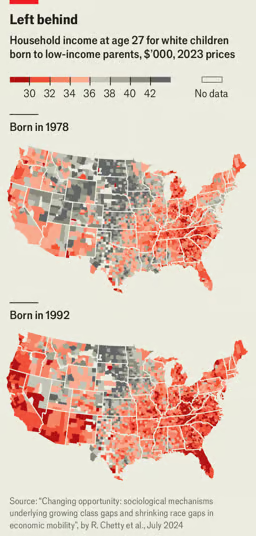
The fact that white children have become more likely to remain in poverty than before, whereas for black children the reverse is true, raises many questions. The finding comes from tracing the trajectories of 57m children born in America between 1978 and 1992 and looking at their outcomes by the age of 27. “This is really the first look with modern big data into how opportunity can change within a place over time,” says Mr Goldman. For children born into high-income families, household income increased for all races between birth cohorts. Yet among those from low-income families, earnings rose for black children and fell for white children.
A black child born to poor parents in 1992 earned $1,400 a year more than one born in 1978. A similar white child earned $2,000 less than one born in 1978. But on average, a poor white child still earned $9,500 more than a poor black child.
This pattern has played out in virtually every county, though with big regional differences. As a result, the earnings gap between rich and poor white children (the “class gap”) grew by 27%, whereas the earnings gap between poor white and poor black children (the “race gap”) fell by 28%…
… None of this means that race is no longer relevant for Americans’ chances in life. Although the reversal of the direction of travel is striking, a young black American born in 1992 to poor parents was still four percentage points more likely to remain in poverty than a poor white peer, down from a 15 percentage-point gap for those born in 1978. And while the near doubling in rates of mortality among young, lower-income white Americans is deeply alarming, mortality rates for their black counterparts have increased too, and they are still (a bit) more likely to die young…
… Convergence has not yet brought equality. Despite improvements across America for poor black children, there is still no county where their outcomes match those of poor white ones. Yet the decline of the white working class is steep, and bound to cause grief. Telling a young white man with lower life outcomes than previous generations that he is still doing better than the average black peer is about as useful as telling a young black man that he’s doing well “for a black man”.
Another possible misconception is that social mobility is a zero-sum game: that poor white children are doing worse because poor black children are doing better. The authors tackle this by showing how in places where black children have done well, white children’s outcomes have remained stable; and in places where white children have done particularly poorly, their black peers have also not thrived.
In his previous work Mr Chetty demonstrated [see here for a summary of his 2018 study] just how much a child’s chances of outperforming their parents depended on their race and where they grew up. One of the questions the authors were left with was how “sticky” these effects would be over time: could opportunities for the next cohorts of children change within these same places, or were they fixed? The new study’s most hopeful finding is that, far from being fixed, opportunities within a place can change significantly and rapidly. Neither history nor place is destiny…
… Americans love a rags-to-riches story. In his acceptance speech [at the Republican Convention], Mr Vance pledged to “make this country a place where every dream…will be possible once again”. In his bestselling book “Hillbilly Elegy” he writes that the assumption “that only a truly extraordinary person could have made it to where I am today…I think that theory is a load of bullshit.”
But the story of Mr. Vance, who grew up in a poor part of the rustbelt, rose to be a venture capitalist and now, at 39, is a potential American president, remains extraordinarily rare. While there has been a reshuffling of opportunities for Americans trying to escape the lowest rung, there has been no progress at all for routes into the upper class. For the vast majority of poor black children, who continue to have a 3% chance of rising from the bottom to the top quintile, and poor white children, whose chances have fallen from 14% to 12%, that door remains firmly shut…
“Class, race and the chances of outgrowing poverty in America,” a big-data analysis– a gift article from @TheEconomist.
* Plutarch
###
As we optimize opportunity, we might send mortgaged birthday greetings to Charles Darrow; he was born on this date in 1889. He designed (in 1933) and patented (in 1935) the board game Monopoly. He later sold his patent to Parker Brothers, which credits him as its creator.
In fact, the history of Monopoly is much longer. It can be traced back to 1903, when American anti-monopolist Lizzie Magie created a game called The Landlord’s Game that she hoped would explain the single-tax theory of Henry George. It was intended as an educational tool to illustrate the negative consequences of concentrating land in private monopolies.
After losing his job at a sales company following the Stock Market Crash of 1929, Darrow worked at various odd jobs. Seeing his neighbors and acquaintances play a board game in which the object was to buy and sell property, he decided to publish his own version of the game.
In fact, Darrow and his friends were just a few of many people in the American Midwest and East Coast who had been playing a game of buying and trading property– all based on Magie’s original… but most having morphed as warnings of that sort too often do) into the opposite of Magie’s intent– a celebration of accumulation. The game was used by college professors and their students, and another variant, called The Fascinating Game of Finance, was published in the Midwest in 1932. From there the game traveled back east, where it had remained popular in Pennsylvania, and became popular with a group of Quakers in Atlantic City. Darrow was taught to play the game by Charles Todd, who had played it in Atlantic City, where it had been customized with that city’s street and property names– to wit Monopoly‘s nomenclature.

“Man’s most serious activity is play”*…

Until the mid-20th century, the “playing fields” on board games tended to be composed of squares; then hexagons emerged. Jon-Paul Dyson explains why…
A board game begins with the board. But how is that board divided up? Often the simplest unit of division is a square. Consider the 64 squares of a chess board, or the 92 squares on a Stratego board. In each case, players take control of a square which exists in relation to other spaces around it, especially if they share adjoining borders. The design of these game boards affords or encourages certain types of movement, usually horizontally or vertically (in four directions) or in some cases diagonally in eight directions (as with the bishop in chess).
And yet there exists a problem with this sort of layout in any game that allows freedom of movement, because the connection between these squares is uneven. Although squares share a long border horizontally and vertically, they do not share such a border on the diagonal connections. In a game like chess, where you physically pick up a piece to move it, this is not much of an issue. But as simulation board games began to develop after World War II, this proved more problematic. Many of these games involved sliding pieces (or cardboard tiles that were frustrating to pick up) from square to square, like army units occupying territory. For these situations, hexagonal spaces that provided equal movement in six directions, produced a better solution.
As is true throughout the history of innovation, whenever there is a problem, it usually turns out that multiple people arrive at similar inventive solutions. That was the case with the development of the hex as a basic unit of division in board games.
Piet Hein [see here], a Danish polymath, who was a quantum physicist as well as a designer, poet, and puzzle and game inventor, came up with the idea in 1942 for a game in which players competed to create connected lines across a game board made up of hexagonal spaces. Thus he might be credited as the father of hex. Yet in the late 1940s, American mathematician John Nash (the subject of the movie A Beautiful Mind) independently invented a similar game at Princeton that also used hex tiles [though we should note that it was a variation on the Shannon switching game, created by Claude Shannon sometime before 1951]. In 1952, Parker Brothers released a version of the game which they called Hex.
This was a time of post-war prosperity when people increasingly had the discretionary income to buy board games, but it was also a period when the United States and the Soviet Union, allies during the war, had become bitter rivals locked in a Cold War. Rather than downsizing after the victory over Germany and Japan, the American military complex shifted from fighting the Axis powers to planning for a major conflict with the Soviet Union and engaging in a series of smaller wars such as that fought in Korea. To help plan American strategy, the Army Air Force and the Douglas Aircraft Company created the Rand Corporation, a think tank that made significant contributions to American policy and computing.
One of the projects the Rand Corporation focused on was modeling conflict through the use of war games. To that end Alexander Mood, a staff member at the Rand Corporation, introduced a honeycombed, hex-shaped board that allowed pieces to move in six directions rather than just four. John Nash was at the Rand Corporation and, in a 1952 paper he coauthored entitled “Some War Games,” he and coauthor R. M. Thrall described using this hex-based system for ground and air games.
It was another game creator, however, who took this development and made the most significant contribution to the development of hex-based games: Charles S. Roberts. Roberts was an army veteran who in 1954 published Tactics, a military simulation board game that is often credited as the first modern wargame. Roberts then founded the game company Avalon Hill, and his games and their innovative simulation of battlefield odds drew the attention of the Rand Corporation because his Combat Results Table for determining the outcome of battles mirrored systems they had developed. The Rand Corporation invited Roberts to visit, and supposedly while he was there he noticed their use of hex-based boards.
Recognizing the superiority of a hex-based system for simulating movement, Roberts began using it in game design in 1961. That year was the centennial of the American Civil War, and so there was a demand for historical simulations. Roberts redesigned his recently released game Gettysburg with the new hex pattern. The Strong owns copies of Gettysburg belonging to Roberts, both in the older square format and in the revised hex version. He also used it for the Avalon Hill game Chancellorsville, another Civil War simulation. Soon the hex system became commonplace in a high proportion of wargames, as well as in more mainstream games such as the 1969 release Psyche-Paths.
Since then, hex board layouts have been used in a wide variety of games. Settlers of Catan is perhaps the most famous example, but plenty of others exist including the spaces in the game Hero Scape. Even video games will often use the hex layout, not only in wargames but in titles such as in Sid Meier’s Civilization V…
“Hex Marks the Spot,” from @jpdysonplay and @museumofplay.
* George Santayana
###
As we make our moves, we might send playful birthday greetings to Seymour Papert; he was born on this date in 1928. Trained as a mathematician, Papert was a pioneer of computer science, and in particular, artificial intelligence. He created the Epistemology and Learning Research Group at the MIT Architecture Machine Group (which later became the MIT Media Lab); he directed MIT’s Artificial Intelligence Laboratory; he authored the hugely-influential LOGO computer language; and he was a principal of the One Laptop Per Child Program. Called by Marvin Minsky “the greatest living mathematics educator,” Papert won a Guggenheim fellowship (1980), a Marconi International fellowship (1981), the Software Publishers Association Lifetime Achievement Award (1994), and the Smithsonian Award (1997).
A champion of fun and games in learning, Papert was the brain behind Lego Mindstorms.

“Our people are good people; our people are kind people. Pray God some day kind people won’t all be poor”*…

For a singular image of the Great Depression and the roughness of those years, it’s hard to do much better than Dorothea Lange’s 1936 photograph of Florence Owens Thompson, two of her children tucking their faces over her shoulders, a baby in her lap.
Where that image comes from, there are many, many more: around 175,000 surviving portraits of America between 1935 and 1945 taken by the photographers of the government’s Farm Security Administration. The Library of Congress, which houses the collection, has, remarkably, digitized all the negatives and tagged the records with loads of data, such as who took the picture and where it was taken.
Now, thanks to a new project known as Photogrammar from Yale University, viewers will have a much easier time exploring the photographs. There’s a map that displays the images by county and another that shows where each picture was taken and by which photographer. There’s also an interactive that allows viewers to sort the photos by theme (e.g. “war” or “religion”) and then browse from there. Other tools are still in the works…

Agricultural workers bound for upstate New York in time for the harvest
More at “Seeing the Great Depression.”
* John Steinbeck, The Grapes of Wrath
###
As we go West, we might recall that it was on this date in 1935 that Parker Brothers purchased the patent for “The Landlord’s Game” from Elizabeth Magie, a Quaker political activist who had used the theories of the economist Henry George to create the game to illustrate the way in which monopolies impoverish (“bankrupt”) the many while concentrating extraordinary wealth in one or few. Parker Brothers had released a copy– Charles Darrow’s “Monopoly”– which was (to put it politely) closely modeled on “The Landlord’s Game”; when Darrow’s version became a hit in 1933, Parker Brothers bought “The Landlord’s Game” as insurance against a intellectual property suit– and subsequently paid Ms. Magie $500 for her patent to avoid a (completely justified) claim from her that “Monopoly” was, in effect, stolen. It is estimated that over a billion people have played “Monopoly” over the years.

“The Landlord’s Game” board, from Magie’s original patent application
“I think it’s wrong that only one company makes the game Monopoly”*…

The game Monopoly was created in the early 1930s as “The Landlord Game” by a Quaker anxious to illuminate the dangers of unbridled acquisitiveness. But by 1935, when it was acquired by Parker Bros., it had been copied, re-titled, and remade into the paean to aspirational capitalism that’s been a huge success ever since.
But times have changed; the methods of wealth accumulation have morphed… and now there is a new set of rules to reflect this new reality.
It would be hard to simplify capitalism further than Monopoly. The game attempts to express the ruthlessness of raw capitalism by declaring that whoever has the most money at the “end” is the winner. While it’s true our culture proclaims the rich as our greatest heroes, the method of financial gain in Monopoly is not a system that allows for any creativity. Roll the dice, buy a property, pay rent, pass go, and collect $200. Repeat.
Simple models have long been used to help understand complex ideas. With a few small changes Monopoly can be a space where we can play at being in control of the economic system. All it takes is a few new rules.
Rule Change #1: The Banker
In the original rules the role of the banker is simply a chore–the board game equivalent of taking out the trash. But in real life the banker is no passive entity. The banker is the center of the universe.
The Libor scandal, the UBS money laundering scandal, the SAC Capital scandal, FINRA suing Wells Fargo and Bank of America, TD Bank paying to settle charges of a ponzi scheme, Galleon Group’s insider trading scandal. This list could go on. The point is that banking is
exciting work!The role of the banker is special. The banker should have no piece on the Monopoly board, but this person is in charge of the bank’s money. The success of the banker is judged the same as any other player: Whoever accumulates the most wealth is the winner. Of course, as in life, the banker has some advantages (like control of all the money)…
Read the rest of the new rules at “Rethinking the game of Monopoly“… then roll the dice.
Playing this version of Monopoly won’t help you understand the details of a banking scandal. But you’ll have experience with a simplified model of the financial system that generates regular “scandals.” A game where arguing and backstabbing are part of the rules and the winner is hard to determine. This simple model recreates the same results found in the real world.
* Stephen Wright
###
As we wonder why no one’s done time, we might recall that it was on this date in 1882 that the San Francisco Stock and Bond Exchange was formed; it later merged with with Los Angeles Oil Exchange to become the Pacific Stock Exchange. In 1999 it became the first stock exchange in the U.S. to demutualize, and in 2003, closed its trading floors and went to electronic transactions. The PSX, as it was known, merged into the New York Stock Exchange in 2006.

The San Francisco home of the Pacific Stock Exchange from 1930 to 2003
“And now that I have some wood, I will begin the erection of my settlement”*…

Family game nights, game nights in bars, game nights with friends– game nights are back! And Board Games for Me can help…
It is a great time to enjoy board games. Great publishers are turning out a wide variety or high-quality games. Crowd-funding sites, such as Kickstarter, are allowing independent designers to create unique and interesting games. Internet video series, such as TableTop, are demonstrating how fun board games can be to a huge audience.
This rise in popularity leads to one frustration, finding games that fit what you are looking for can be difficult. Few people have the time to wade through the flood of games that are available to find something you will enjoy. Board Games for Me aims to make things easier for you by allowing you to easily search through several games and find ones that are the perfect fit for you. We want you to spend your time playing games, not searching for what you want to play next.
So, give it a try. You can have results back in less than a minute. What are you waiting for? Get out there and play more games!
* Sheldon Cooper, playing Settlers of Catan in Episode 100 of Big Bang Theory
###
As we roll the dice, we might recall that it was on this date in 1991 that Pamela Smart was convicted Coral Gables, Florida of conspiring to murder her husband Greg. A 24-year-old part-time heavy metal radio DJ (she hosted “Metal Madness”, as “Maiden of Metal” on local station WVFS), Pam had seduced 15-year-old Billy Flynn, then threatened him with an end to her sexual favors if he failed to help her get rid of Greg. Flynn obliged, with the help of three friends. All five conspirators were quickly arrested, tried, and convicted.
Flynn, who is serving a 30 years, has apologized and asked for a reduction in sentence. Smart, who is serving a life sentence without the possibility of parole, continues to maintain her innocence.
One can only wonder if regular game nights might have prevented this tragedy.

Pamela Smart taking the oath at her trial
You must be logged in to post a comment.