Posts Tagged ‘technics’
“Men have become the tools of their tools”*…

Visionary philosopher Bernard Stiegler argued that it’s not our technology that makes humans special; rather, it’s our relationship with that technology. Bryan Norton explains…
It has become almost impossible to separate the effects of digital technologies from our everyday experiences. Reality is parsed through glowing screens, unending data feeds, biometric feedback loops, digital protheses and expanding networks that link our virtual selves to satellite arrays in geostationary orbit. Wristwatches interpret our physical condition by counting steps and heartbeats. Phones track how we spend our time online, map the geographic location of the places we visit and record our histories in digital archives. Social media platforms forge alliances and create new political possibilities. And vast wireless networks – connecting satellites, drones and ‘smart’ weapons – determine how the wars of our era are being waged. Our experiences of the world are soaked with digital technologies.
But for the French philosopher Bernard Stiegler, one of the earliest and foremost theorists of our digital age, understanding the world requires us to move beyond the standard view of technology. Stiegler believed that technology is not just about the effects of digital tools and the ways that they impact our lives. It is not just about how devices are created and wielded by powerful organisations, nation-states or individuals. Our relationship with technology is about something deeper and more fundamental. It is about technics.
According to Stiegler, technics – the making and use of technology, in the broadest sense – is what makes us human. Our unique way of existing in the world, as distinct from other species, is defined by the experiences and knowledge our tools make possible, whether that is a state-of-the-art brain-computer interface such as Neuralink, or a prehistoric flint axe used to clear a forest. But don’t be mistaken: ‘technics’ is not simply another word for ‘technology’. As Martin Heidegger wrote in his essay ‘The Question Concerning Technology’ (1954), which used the German term Technik instead of Technologie in the original title: the ‘essence of technology is by no means anything technological.’ This aligns with the history of the word: the etymology of ‘technics’ leads us back to something like the ancient Greek term for art – technē. The essence of technology, then, is not found in a device, such as the one you are using to read this essay. It is an open-ended creative process, a relationship with our tools and the world.
This is Stiegler’s legacy. Throughout his life, he took this idea of technics, first explored while he was imprisoned for armed robbery, further than anyone else. But his ideas have often been overlooked and misunderstood, even before he died in 2020. Today, they are more necessary than ever. How else can we learn to disentangle the effects of digital technologies from our everyday experiences? How else can we begin to grasp the history of our strange reality?…
[Norton unspools Stiegler’s remarkable life and the development of his thought…]
… Technology, for better or worse, affects every aspect of our lives. Our very sense of who we are is shaped and reshaped by the tools we have at our disposal. The problem, for Stiegler, is that when we pay too much attention to our tools, rather than how they are developed and deployed, we fail to understand our reality. We become trapped, merely describing the technological world on its own terms and making it even harder to untangle the effects of digital technologies and our everyday experiences. By encouraging us to pay closer attention to this world-making capacity, with its potential to harm and heal, Stiegler is showing us what else is possible. There are other ways of living, of being, of evolving. It is technics, not technology, that will give the future its new face…
Eminently worth reading in full: “Our tools shape our selves,” from @br_norton in @aeonmag.
Compare and contrast: Kevin Kelly‘s What Technology Wants
* Henry David Thoreau
###
As we own up, we might send phenomenological birthday greetings to Immanuel Kant; he was born on this date in 1724. One of the central figures of modern philosophy, Kant is remembered primarily for his efforts to unite reason with experience (e.g., Critique of Pure Reason [Kritik der reinen Vernunft], 1781), and for his work on ethics (e.g., Metaphysics of Morals [Die Metaphysik der Sitten], 1797) and aesthetics (e.g., Critique of Judgment [Kritik der Urteilskraft], 1790).
But Kant made important contributions to mathematics and astronomy. For example: his argument that mathematical truths are a form of synthetic a priori knowledge was cited by Einstein as an important early influence on his work. And his description of the Milky Way as a lens-shaped collection of stars that represented only one of many “island universes,” was later shown to be accurate by Herschel.
Act so as to treat humanity, whether in your own person or in that of another, at all times also as an end, and not only as a means.

“Why has our age surrendered so easily to the controllers, the manipulators, the conditioners of an authoritarian technics?”*…

Half a century ago, Lewis Mumford developed a concept that explains why we trade autonomy for convenience…
… Surveying the state of the high-tech life, it is tempting to ponder how it got so bad, while simultaneously forgetting what it was that initially convinced one to hastily click “I agree” on the terms of service. Before certain social media platforms became foul-smelling swamps of conspiratorial misinformation, many of us joined them for what seemed like good reasons; before sighing at the speed with which their batteries die, smartphone owners were once awed by these devices: before grumbling that there was nothing worth watching, viewers were astounded by how much streaming content was available at one’s fingertips. Overwhelmed by the way today’s tech seems to be burying us in the bad, it’s easy to forget the extent to which tech won us over by offering us a share in the good — or to be more precise, in “the goods.”
Nearly 50 years ago, long before smartphones and social media, the social critic Lewis Mumford put a name to the way that complex technological systems offer a share in their benefits in exchange for compliance. He called it a “bribe.” With this label, Mumford sought to acknowledge the genuine plentitude that technological systems make available to many people, while emphasizing that this is not an offer of a gift but of a deal. Surrender to the power of complex technological systems — allow them to oversee, track, quantify, guide, manipulate, grade, nudge, and surveil you — and the system will offer you back an appealing share in its spoils. What is good for the growth of the technological system is presented as also being good for the individual, and as proof of this, here is something new and shiny. Sure, that shiny new thing is keeping tabs on you (and feeding all of that information back to the larger technological system), but it also lets you do things you genuinely could not do before. For a bribe to be accepted it needs to promise something truly enticing, and Mumford, in his essay “Authoritarian and Democratic Technics,” acknowledged that “the bargain we are being asked to ratify takes the form of a magnificent bribe.” The danger, however, was that “once one opts for the system no further choice remains.”
For Mumford, the bribe was not primarily about getting people into the habit of buying new gadgets and machines. Rather it was about incorporating people into a world that complex technological systems were remaking in their own image. Anticipating resistance, the bribe meets people not with the boot heel, but with the gift subscription.
The bribe is a discomforting concept. It asks us to consider the ways the things we purchase wind up buying us off, it asks us to see how taking that first bribe makes it easier to take the next one, and, even as it pushes us to reflect on our own complicity, it reminds us of the ways technological systems eliminate their alternatives. Writing about the bribe decades ago, Mumford was trying to sound the alarm, as he put it: “This is not a prediction of what will happen, but a warning against what may happen.” As with all of his glum predictions, it was one that Mumford hoped to be proven wrong about. Yet as one scrolls between reviews of the latest smartphone, revelations about the latest misdeeds of some massive tech company, and commentary about the way we have become so reliant on these systems that we cannot seriously speak about simply turning them off — it seems clear that what Mumford warned “may happen” has indeed happened…
Eminently worth reading in full: “The Magnificent Bribe,” by Zachary Loeb in @_reallifemag.
As to (some of) the modern implications of that bargain, see also Shoshana Zuboff‘s: “You Are the Object of a Secret Extraction Operation.”
As we move into the third decade of the 21st century, surveillance capitalism is the dominant economic institution of our time. In the absence of countervailing law, this system successfully mediates nearly every aspect of human engagement with digital information. The promise of the surveillance dividend now draws surveillance economics into the “normal” economy, from insurance, retail, banking and finance to agriculture, automobiles, education, health care and more. Today all apps and software, no matter how benign they appear, are designed to maximize data collection.
Historically, great concentrations of corporate power were associated with economic harms. But when human data are the raw material and predictions of human behavior are the product, then the harms are social rather than economic. The difficulty is that these novel harms are typically understood as separate, even unrelated, problems, which makes them impossible to solve. Instead, each new stage of harm creates the conditions for the next stage…
And resonantly: “AI-tocracy” a working paper from NBER that links the development of artificial intelligence with the interests of autocracies: from the abstract:
Can frontier innovation be sustained under autocracy? We argue that innovation and autocracy can be mutually reinforcing when: (i) the new technology bolsters the autocrat’s power; and (ii) the autocrat’s demand for the technology stimulates further innovation in applications beyond those benefiting it directly. We test for such a mutually reinforcing relationship in the context of facial recognition AI in China. To do so, we gather comprehensive data on AI firms and government procurement contracts, as well as on social unrest across China during the last decade. We first show that autocrats benefit from AI: local unrest leads to greater government procurement of facial recognition AI, and increased AI procurement suppresses subsequent unrest. We then show that AI innovation benefits from autocrats’ suppression of unrest: the contracted AI firms innovate more both for the government and commercial markets. Taken together, these results suggest the possibility of sustained AI innovation under the Chinese regime: AI innovation entrenches the regime, and the regime’s investment in AI for political control stimulates further frontier innovation.
(And, Anne Applebaum warns, “The Bad Guys Are Winning.”)
* “Why has our age surrendered so easily to the controllers, the manipulators, the conditioners of an authoritarian technics? The answer to this question is both paradoxical and ironic. Present day technics differs from that of the overtly brutal, half-baked authoritarian systems of the past in one highly favorable particular: it has accepted the basic principle of democracy, that every member of society should have a share in its goods. By progressively fulfilling this part of the democratic promise, our system has achieved a hold over the whole community that threatens to wipe out every other vestige of democracy.
The bargain we are being asked to ratify takes the form of a magnificent bribe. Under the democratic-authoritarian social contract, each member of the community may claim every material advantage, every intellectual and emotional stimulus he may desire, in quantities hardly available hitherto even for a restricted minority: food, housing, swift transportation, instantaneous communication, medical care, entertainment, education. But on one condition: that one must not merely ask for nothing that the system does not provide, but likewise agree to take everything offered, duly processed and fabricated, homogenized and equalized, in the precise quantities that the system, rather than the person, requires. Once one opts for the system no further choice remains. In a word, if one surrenders one’s life at source, authoritarian technics will give back as much of it as can be mechanically graded, quantitatively multiplied, collectively manipulated and magnified.”
– Lewis Mumford in “Authoritarian and Democratic Technics,” via @LMSacasas
###
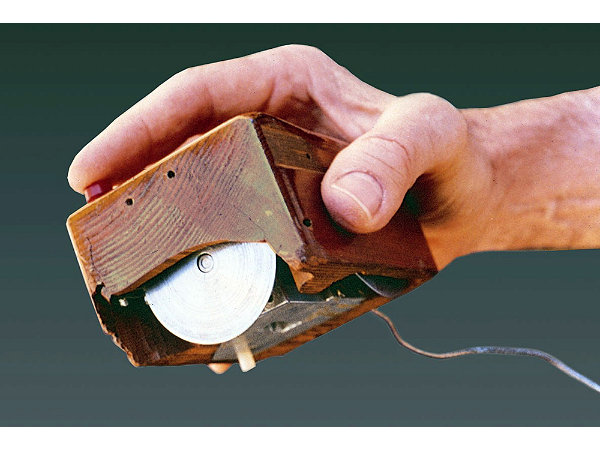
As we untangle user agreements, we might recall that it was on this date in 1970 that Douglas Engelbart (see here, here, and here) was granted a patent (US No. 3,541,541) on the “X-Y Position Indicator for a Display System,” the world’s first prototype computer mouse– a wooden block containing the tracking apparatus, with a single button attached.

You must be logged in to post a comment.