Posts Tagged ‘city’
“All the cities of the world are going to expand. We need to have a better understanding of what makes good urban habitat for home sapiens.”*…

“When did our vision of the future become so constrained, tired, and even dystopic?” Julien Crockett talks with Bruno Carvalho, the author of The Invention of the Future: A History of Cities in the Modern World, about the history of city planning and how urban design intertwines with a society’s prognostications and projections…
Cities have long been places of possibility—places where it seemed that we could break from the past and create an entirely new future. As Bruno Carvalho observes in his new book, The Invention of the Future: A History of Cities in the Modern World, this mindset is a key feature of what it means to be “modern”—a sensibility toward the present and the future as it relates to the past.
Yet, as Carvalho’s wide-ranging history details, a break from the past does not assume a positive vision of the future. In fact, Carvalho begins his book with the question “Where did the future go?”—the title of a debate between the venture capitalist Peter Thiel and anthropologist David Graeber. Both imagine that the only cities of tomorrow are on Mars. When did our vision of the future become so constrained, tired, and even dystopic?
Carvalho’s book returns to a recurring paradox we have faced since the Enlightenment: the better our capacity for creation and prediction, the more limited our ability to imagine a new future. He marvels, though, that “we know some of what is coming: urbanization and climate change, life and death. Between all that, there is a lot of space for reinvention.”
In our conversation, we look to the past to help us think through what reinvention might look like and discuss what it means to plan for a radically different future. We also discuss the legacies of Silicon Valley, the construction of New York City, urban futures moving from the West across the Pacific, and whether Carvalho is optimistic about what’s to come…
Eminently worth reading and pondering: “Where Did the Future Go?” from @lareviewofbooks.bsky.social.
* Jan Gehl
###
As we undertake to understand the urban, we might recall that it was on this date in 455 that the Vandals entered Rome, which they plundered for the next two weeks. It was, as sackings went (this was Rome’s third, of four altogether), relatively “light”: while the Vandals (who had destroyed all of Rome’s aqueducts on their approach) looted Roman treasure and sold many Romans into slavery, their leader Genseric acceded to the pleas of Pope Leo that the Vandals refrain from the wholesale slaughter of Rome’s population and the destruction of the Eternal City’s historic buildings.

“The braid is always stronger than the strand”*…

From Grace Ebert, a novel look at the world’s densest “city”…
At its height in the 1990s, Kowloon Walled City in Hong Kong housed about 50,000 people. Its population is unremarkable for small cities, but what set Kowloon apart from others of its size was its density. Spanning only 2.6 hectares, the tiny enclave contained [the equivalent of] 1,255,000 people per square kilometer, making it the densest city in the world. For context, New York City boasts about 11,300 per square kilometer, while Manila, the most highly concentrated municipality today, tops out at about 42,000.
Kowloon was built as a small military fort around the turn of the 20th century. When the Chinese and English governments abandoned it after World War II, the area attracted refugees and people in search of affordable housing. With no single architect, the urban center continued to grow as people stacked buildings on top of one another and tucked new structures in between existing ones to accommodate the growing population without expanding beyond the original fort’s border.
With only a small pocket of community space at the center, Kowloon quickly morphed into a labyrinth of shops, services, and apartments connected by narrow stairs and passageways through the buildings. Rather than navigate the city through alleys and streets, residents traversed the structures using slim corridors that always seemed to morph, an experience that caused many to refer to Kowloon as “a living organism.”
The city devolved into a slum with crime and poor living conditions and was razed in 1994. Before demolition, though, a team of Japanese researchers meticulously documented the architectural marvel, which had become a sort of cyberpunk icon that even inspired a gritty arcade as tribute.
For a now out-of-print book titled Kowloon City: An Illustrated Guide, artist Hitomi Terasawa drew a meticulous cross-sectioned rendering of the urban phenomenon to preserve its memory. The massive panorama peers into the compact neighborhood, glimpsing narrow dance halls, laundry dangling from balconies, and entire factories tucked inside cramped quarters.
Thanks to psychologist Greg Jensen, we now have a stunning high-resolution scan of Terasawa’s illustration complete with annotations and diagramming. It’s worth viewing the full panorama in its entirety to zoom in on all the details of this infamous city [and here, animated]. And, for photos of Kowloon and its inhabitants, check out this incredibly informative video detailing its history…
A real-life human hive: “A Rare Cross-Section Illustration Reveals the Infamous Happenings of Kowloon Walled City,” from @Colossal.
* Ryan Graudin, The Walled City
###
As we pack it in, we might we might send the simplest of birthday greetings to a writer, philosopher, and naturalist who might not have gravitated naturally to Kowloon City, Henry David Thoreau; he was born on this date in 1817. From 1845 to 1847, Thoreau lived in a small cabin on the banks of Walden Pond, a small lake near Concord, Massachusetts. Striving to “simplify, simplify,” he strictly limited his expenditures, his possessions, and his contact with others, intending “to live deliberately, to front only the essential facts of life, and see if I could not learn what it had to teach.”
Thoreau became a pillar of New England Transcendentalism, embracing and exemplifying the movement’s belief in the universality of creation and the primacy of personal insight and experience. Perhaps best remembered for his advocacy of simple, principled living, his writings on the relationship between humans and the environment also helped define the nature essay.

“This City is what it is because our citizens are what they are”*…
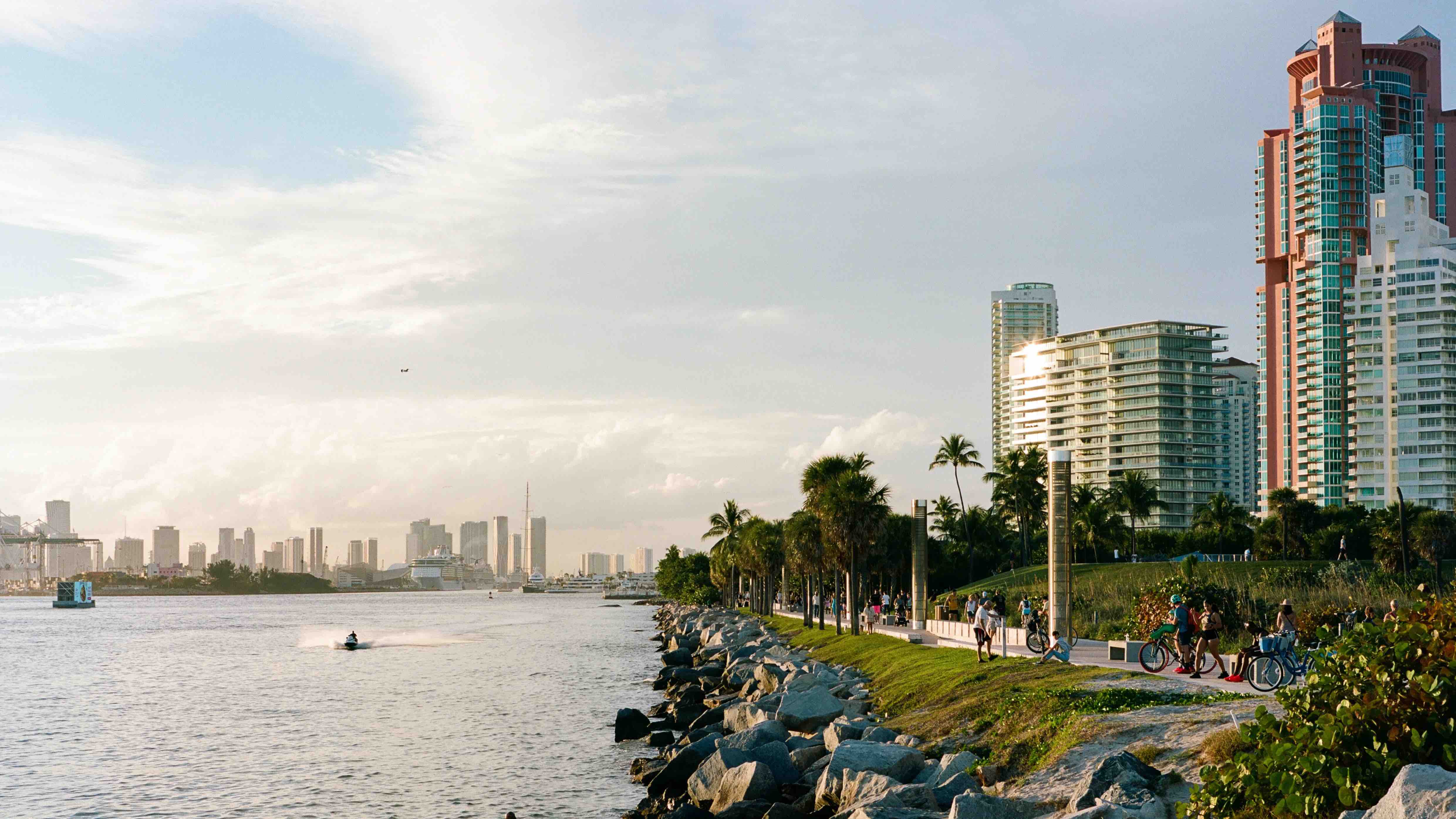
Joel Stein on the ascendance of Miami…
The last time Miami was relevant, it wasn’t important. In the 1980s, Miami provided nothing more than drugs, clubs, pastel blazers, jai alai gambling and, most notably, a hit TV show about all four.
But now Miami is the most important city in America. Not because Miami stopped being a frivolous, regulation-free, climate-doomed tax haven dominated by hot microcelebrities. It became the most important city in America because the country became a frivolous, regulation-free, climate-doomed tax haven dominated by hot microcelebrities…
How a refuge for the retired, divorced, bankrupt, and unemployed has evolved into a “paradise of freedom”: “How Miami became the most important city in America,” from @thejoelstein in @FinancialTimes. (A “gifted” article, so should be free of the paywall.)
An apposite look at ascendant cities worldwide, but especially in Africa: “Africa’s rising cities” (also “gifted”).
* Plato
###
As we investigate epicenters, we might recall that it was on this date in 1986 that figure skater Debi Thomas, a Stanford undergraduate, became the first African American to win the Women’s Singles event in the U.S. National Figure Skating Championship competition. She went on to win a gold medal in the World Championships later that year, and then (after battling Achilles tendinitis in both ankles) to earn a Bronze in the 1988 Olympics.
Thomas then attended medical school at Northwestern, and has since practiced as a surgeon.

You must be logged in to post a comment.