Posts Tagged ‘Transcendentalism’
“The braid is always stronger than the strand”*…

From Grace Ebert, a novel look at the world’s densest “city”…
At its height in the 1990s, Kowloon Walled City in Hong Kong housed about 50,000 people. Its population is unremarkable for small cities, but what set Kowloon apart from others of its size was its density. Spanning only 2.6 hectares, the tiny enclave contained [the equivalent of] 1,255,000 people per square kilometer, making it the densest city in the world. For context, New York City boasts about 11,300 per square kilometer, while Manila, the most highly concentrated municipality today, tops out at about 42,000.
Kowloon was built as a small military fort around the turn of the 20th century. When the Chinese and English governments abandoned it after World War II, the area attracted refugees and people in search of affordable housing. With no single architect, the urban center continued to grow as people stacked buildings on top of one another and tucked new structures in between existing ones to accommodate the growing population without expanding beyond the original fort’s border.
With only a small pocket of community space at the center, Kowloon quickly morphed into a labyrinth of shops, services, and apartments connected by narrow stairs and passageways through the buildings. Rather than navigate the city through alleys and streets, residents traversed the structures using slim corridors that always seemed to morph, an experience that caused many to refer to Kowloon as “a living organism.”
The city devolved into a slum with crime and poor living conditions and was razed in 1994. Before demolition, though, a team of Japanese researchers meticulously documented the architectural marvel, which had become a sort of cyberpunk icon that even inspired a gritty arcade as tribute.
For a now out-of-print book titled Kowloon City: An Illustrated Guide, artist Hitomi Terasawa drew a meticulous cross-sectioned rendering of the urban phenomenon to preserve its memory. The massive panorama peers into the compact neighborhood, glimpsing narrow dance halls, laundry dangling from balconies, and entire factories tucked inside cramped quarters.
Thanks to psychologist Greg Jensen, we now have a stunning high-resolution scan of Terasawa’s illustration complete with annotations and diagramming. It’s worth viewing the full panorama in its entirety to zoom in on all the details of this infamous city [and here, animated]. And, for photos of Kowloon and its inhabitants, check out this incredibly informative video detailing its history…
A real-life human hive: “A Rare Cross-Section Illustration Reveals the Infamous Happenings of Kowloon Walled City,” from @Colossal.
* Ryan Graudin, The Walled City
###
As we pack it in, we might we might send the simplest of birthday greetings to a writer, philosopher, and naturalist who might not have gravitated naturally to Kowloon City, Henry David Thoreau; he was born on this date in 1817. From 1845 to 1847, Thoreau lived in a small cabin on the banks of Walden Pond, a small lake near Concord, Massachusetts. Striving to “simplify, simplify,” he strictly limited his expenditures, his possessions, and his contact with others, intending “to live deliberately, to front only the essential facts of life, and see if I could not learn what it had to teach.”
Thoreau became a pillar of New England Transcendentalism, embracing and exemplifying the movement’s belief in the universality of creation and the primacy of personal insight and experience. Perhaps best remembered for his advocacy of simple, principled living, his writings on the relationship between humans and the environment also helped define the nature essay.

“The daily hummingbird assaults existence with improbability”*…

Zito Madu‘s lovely meditation on– and appreciation of– the hummingbird…
… Hummingbirds are wondrous creatures. As Katherine Rundell wrote in her 2022 essay “Consider the Hummingbird”:
There is nothing I admire more than evolution. But it’s difficult, more than with any other living thing, to imagine hummingbirds beginning as archaebacteria among primordial murk, painstakingly working over millions of years to grow bright wings. They seem as if they were made in an instant, a spark of genius from an extravagant god.
They are the smallest living birds in the world. There are 366 known species of hummingbirds, with the smallest being the bee hummingbird that measures at two inches, and the largest being the giant hummingbird, which is 9.1 inches long. Most live in the tropics, largely in Central and South America, but there are around seventeen species in the United States. They have long needle-like beaks, can fly forward, backward, up, down, and in zigzags. They flap their wings faster than any other bird, up to fifty times per second, they have the largest heart-to-body-size rate in an animal, and that heart has typically 500 to 1200 beats per minute, according to The Hummingbird Handbook (2021) by John Shewey. When in a state of deep rest, and to conserve energy, the hummingbird can slow down its heart rate to only fifty beats per minute, and drop its metabolism by 95 percent.
In 2022, a study was published by Yale scientists on the range of colors in the plumage of hummingbirds, which “exceeds the known diversity of colors found in the plumages of all other bird species combined, increasing the total of known bird-visible plumage colors by 56 percent.”…
“Hummingbirds are Wondrous,” from @_Zeets in @Plough.
* Ursula K. Le Guin, No Time to Spare: Thinking About What Matters
###
As we appreciate abundance, we might send bucolic birthday greetings to Ralph Waldo Emerson; he was born on this date in 1803. An essayist, lecturer, philosopher, abolitionist, and poet, he articulated the philosophy of Transcendentalism in his 1836 essay “Nature.”
A mentor and friend of Henry David Thoreau, a fellow Transcendentalist, and remains among the linchpins of the American romantic movement.

“How do I know what I think until I see what I say?”*…
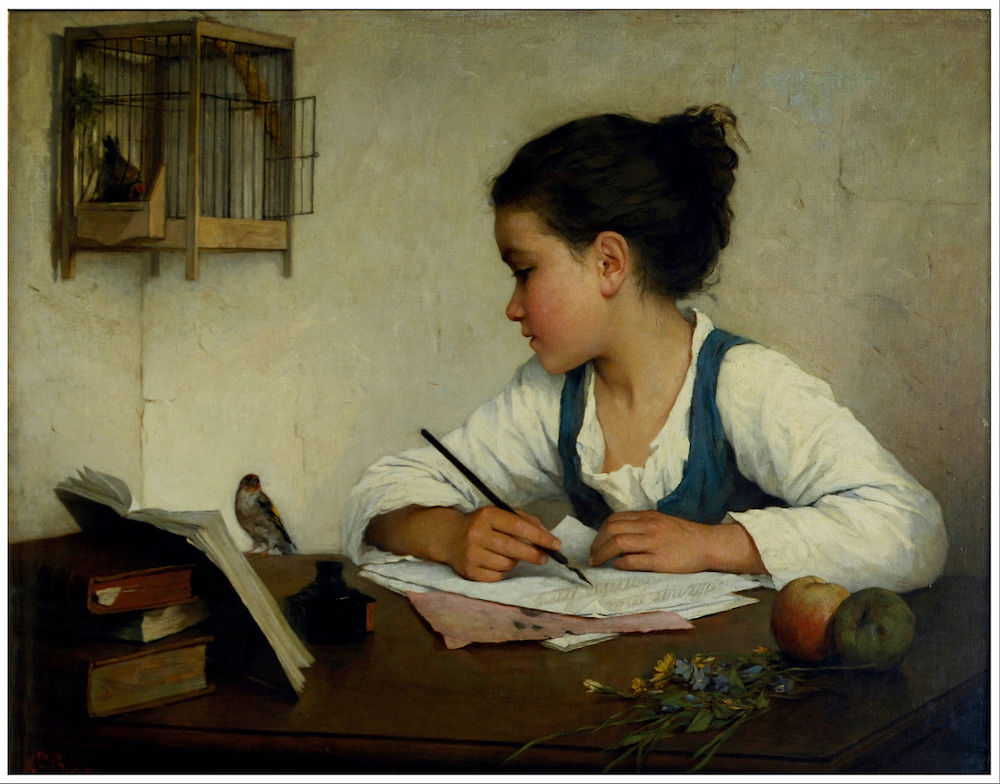
Montaigne would be amused…
The first quarter of the twenty-first century has been an uneasy time of rupture and anxiety, filled with historic challenges and opportunities. In that close to twenty-five-year span, the United States witnessed the ominous opening shot of September 11, followed by the seemingly unending Afghanistan and Iraq wars, the effort to control HIV/AIDS, the 2008 recession, the election of the first African American president, the legalization of same-sex marriage, the contentious reign of Donald Trump, the stepped-up restriction of immigrants, the #MeToo movement, Black Lives Matter, and the coronavirus pandemic, just to name a few major events. Intriguingly, the essay has blossomed during this time, in what many would deem an exceptionally good period for literary nonfiction—if not a golden one, then at least a silver: I think we can agree that there has been a remarkable outpouring of new and older voices responding to this perplexing moment in a form uniquely amenable to the processing of uncertainty.
When the century began, essays were considered box office poison; editors would sometimes disguise collections of the stuff by packaging them as theme-driven memoirs. All that has changed: a generation of younger readers has embraced the essay form and made their favorite authors into best sellers. We could speculate on the reasons for this growing popularity—the hunger for humane, authentic voices trying to get at least a partial grip on the truth in the face of so much political mendacity and information overload; the convenient, bite-size nature of essays that require no excessive time commitment; the rise of identity politics and its promotion of eloquent spokespersons. Rather than trying to figure out why it’s happening, what’s important is to chart the high points of this resurgence, and to account for the range of styles, subgenres, experimental approaches, and moral positions that characterize the contemporary American essay…
Read “The Silver Age of Essays,” an excerpt from Phillip Lopate‘s introduction to a new collection, The Contemporary American Essay; via @parisreview.
* E. M. Forster
###
As we praise perceptive prose, we might recall that it was on this date in 1854 that Ticknor & Fields published transcendentalist Henry David Thoreau’s reflection on simple living in natural surroundings, Walden; or, Life in the Woods... essentially a long essay.

“In wonder all philosophy began, in wonder it ends”*…

Samuel Taylor Coleridge (1772-1834) stands tall in the cultural pantheon for his poetry. It’s less well known that in his own lifetime, and in the decades following his death, this canonical poet had an equal reputation as a philosopher. His published works containing much of his philosophical prose span from The Statesman’s Manual (1816), which set out his theory of imagination and symbolism; Biographia Literaria (1817), one of the great and founding works of literary criticism; The Friend (1818), which includes his philosophical ‘Essays on the Principles of Method’; Aids to Reflection(1825), where he expounds his religious philosophy of transcendence; and On the Constitution of the Church and the State (1829), which presents his political philosophy.
The effect of those last two books was so impressive that John Stuart Mill named Coleridge as one of the two great British philosophers of the age – the other being Jeremy Bentham, Coleridge’s polar opposite. His thinking was also at the root of the Broad Church Anglican movement, a major influence on F D Maurice’s Christian socialism, and the main source for American Transcendentalism. Ralph Waldo Emerson visited Coleridge in 1832, and John Dewey, the leading pragmatist philosopher, called Coleridge’s Aids to Reflection ‘my first Bible’.
Yet philosophical fortunes change. The almost-total eclipse of British idealism by the rise of analytic philosophy saw a general decline in Coleridge’s philosophical stock. His philosophy languished while his verse rose. Coleridge’s poetry resonated with the psychedelia of the 1960s and a general cultural shift that emphasised the value of the imagination and a more holistic view of the human place within nature. Today, Coleridge is far more often remembered as a poet than a philosopher. But his philosophy was spectacular in its originality and syntheses…
Though largely remembered only as a poet, Coleridge’s theory of ideas was spectacular in its originality and bold reach; Peter Cheyne explains: “Coleridge the philosopher.”
For other literary philosophers, see “On Exploring Philosophy in Fiction and Autobiography: A Reading List.”
[image above: source]
* Samuel Taylor Coleridge, Aids to Reflection
###
As we muse on meaning, we might spare a thought for one of Coleridge’s philosophical beneficiaries, Ralph Waldo Emerson; he died on this date in 1882. The essayist (“Nature,” “Self-Reliance,” et al.), lecturer, and poet who led the Transcendentalist movement of the mid-19th century, he was one of the linchpins of the American romantic movement, and friend and mentor to Henry David Thoreau.

“And then the water ran out, and they fell back, realizing too late that their prosperity was borrowed, and there would be no more coming”*…

Remnants of the ancient city of Cahokia, in what’s now southern Illinois
Not far from my grandmother’s house is a ghost city. At Angel Mounds on the Ohio river about eight miles southeast of Evansville, there are a few visible earthworks and a reconstructed wattle-and-daub barrier. There is almost nothing left of the people who build these mounds; in a final insulting erasure, the site is now named after the white settler family who most recently farmed the land.
There are traces of other dead villages along the Ohio and Mississippi rivers, mounds scattered from present-day Indiana to Arkansas and Alabama. In southern Illinois, a few miles from the Missouri border, hidden among empty corn and soy fields, is the center of that dead civilization’s gravity: the lost city of Cahokia.
Cahokia was larger than London, centrally planned, the Manhattan of its day. Most people there would have come from somewhere else. There were defensive foundations, playing fields, and a magnificent temple. There would have been sacred ceremonies and salacious gossip. It must have been a very exciting place to live.
And then, relatively abruptly, it ceased to exist. We know of the city only because of the physical traces left behind. Few stories of Cahokia have survived; it disappeared from oral tradition, as if whatever happened to it is best forgotten. The archaeological record shows traces of the desperation and bloodshed that almost always accompany great upheavals: skeletons with bound hands, pits full of strangled young women.
The North American Drought Atlas, a historical record of climate conditions pieced together from the rings of old trees, provides a hint of what might have happened. The tenth century CE, when the Cahokia civilization would have developed, marked a distinct shift in the regional climate from persistent drought to rainier conditions more suitable for agriculture, centralization, and civilization.
But the good times were not to last…
Some people say “the climate has changed before,” as though that should be reassuring. It’s not: “Lost Cities and Climate Change.”
See also: “A Quarter of Humanity Faces Looming Water Crises” and “What kind of climate change coverage do you read in the news? It depends on whether you live in a rich country or a poor one.”
* “Thanks to the centrifugal pump, places like Nebraska, Kansas, Oklahoma, and Texas had thrown on the garments of fertility for a century, pretending to greenery and growth as they mined glacial water from ten-thousand-year-old aquifers. They’d played dress-up-in-green and pretended it could last forever. They’d pumped up the Ice Age and spread it across the land, and for a while they’d turned their dry lands lush. Cotton, wheat, corn, soybeans — vast green acreages, all because someone could get a pump going. Those places had dreamed of being different from what they were. They’d had aspirations. And then the water ran out, and they fell back, realizing too late that their prosperity was borrowed, and there would be no more coming.”
― The Water Knife (a powerful novel)
###
As we face facts, we might recall that it was on this date in 1854 that Ticknor & Fields published transcendentalist Henry David Thoreau’s reflection on simple living in natural surroundings, Walden; or, Life in the Woods.
You must be logged in to post a comment.