Posts Tagged ‘artifical intelligence’
“It takes something more than intelligence to act intelligently”*…
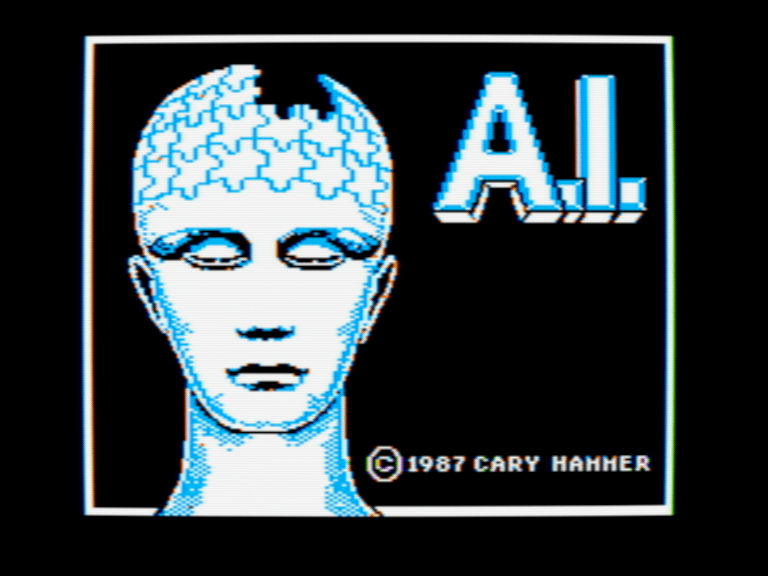
It can feel, as we’re awash in the wave of “news” and “dialogue” about AI that dominates discourse these days, as though artificial intelligence sprang onto the scene with more development up its sleeve but, Athena-like, essentially fully grown.
Writing on the Internet Archive’s blog, Jason Scott introduces a new collection at the Archive that reminds us that AI’s had a childhood (e.g., ELIZA) and an adolescence (e.g., work by and inspired by Seymour Papert), and that we can learn from it…
Long before the current kerfuffle about LLMs, Generative AI Artwork, and asking your tax preparation chatbot for a cookie recipe, the concept of artificial intelligence and synthetic life was a pervasive theme in creative and engineering works. We have the ground-breaking appearance of Rossum’s Universal Robots [and here] (or Tik-Tok, the Royal Army of Oz), through countless science-fiction properties and incredibly positive futurist home-making advertisements, and into the inevitable portrayal of dark and dystopian empires providing humans with nothing but a clear and present ending to their story arc. Artificial Intelligence has been riding along with humanity’s storytelling and expressiveness for many generations – and, one might argue, it is this ever-present influence and inspiration that has driven a lot of the modern phrasing and design in our most contemporary toys and tools wearing the vestments of consciousness.
The motivations are clear: our endless curiosity of the nature of our minds and humanity, the twists and turns that come when the synthetic mirror-images of people betray unintended consequences, and the fact that human beings look amazing when rendered in chrome.
But before we get swept up too much into the echoes of the past and see patterns of AI-like entities into the distant generations (golems, anyone?) let us instead zoom into a very specific family of projects and products that are presented at the Internet Archive for the research, education, and enjoyment of all: The newly-minted Vintage Artificial Intelligence collection.
Dating roughly from the 1970s through the 1990s, these emulated software packages have come from many sources, and with many motivations, but have been curated together for a very subtle and occasionally imperceptible theme: the adventure of experiencing a machine that thinks.
To be clear, and without taking too much time for a press conference announcing so or claiming such for a future IPO, none of the programs in this collection come within a solar system of thinking in any actual sense. They are, instead, portrayals on microcomputers and game consoles of the idea of thinking machines, the experience of creating autonomous or semi-autonomous virtual entities, and playing games with the illusion of a contemplative and improvisational opponent…
Eminently worth reading in full. The early days of AI: “Vintage Artificial Intelligence: Before It Got Awkward,” from @textfiles.com and @archive.org.
Given that the original users of/audiences for most those vintage programs presumably skewed young (in keeping with the demographics of recreational pc use), it’s fascinating to note, in the results of a recent Pew survey, that “for the first time, a majority of adults under 30 (55%) now say they’re more concerned than excited about AI,” a rate on par with adults 65+ and (for the time) higher than that level of concern adults 30-49 (51%) or adults 50-64 (47%). As to why…
Even in 2021, job loss was one of the top reasons behind Americans’ concern about AI. Today, Americans largely – and increasingly – think AI-related job loss is on the horizon.
In our new survey, 71% of adults think AI will lead to fewer jobs in the United States over the next two decades, up from 64% in 2024. Few (5%) say AI will lead to more jobs. One-in-ten say it won’t make much difference, and a slightly larger share are unsure…
… Adults under 30 are most likely to think AI will be bad for society – and for them. They largely think it will make connection and creativity harder to come by. And though most say they use chatbots, they’re just as likely to say these tools hurt their own creativity as help it… – source
* Fyodor Dostoevsky
###
As we reminisce, we might recall that it was on this date in 1833 that The Sun began publication in New York City. It was the first successful penny daily newspaper in the United States; and for a time, the most successful newspaper in the U.S.
[The Sun was] popular with the city’s less affluent, working classes. Its publisher, Benjamin H. Day, emphasized local events, police court reports, and sports in his four-page morning newspaper. Advertisements, notably help-wanted ads, were plentiful. By 1834, the Sun had the largest circulation in the United States. Its rising popularity was attributed to its readers’ passion for the Sun‘s sensational and sometimes fabricated stories [c.f., for example, here] and the paper’s exaggerated coverage of sundry scandals. Its success was also the result of the efforts of the city’s ubiquitous newsboys, who the innovative Day had hired to hawk the paper. The Sun added a Saturday edition in 1836. A number of weekly and semiweekly titles were also published, such as the Weekly Sun (1851-69), which shares the same masthead as the Sun with “Weekly” appearing in the title ornament.
The paper’s true glory days began in 1868 when Charles A. Dana, former managing editor of the New York Tribune, became part owner and editor. Dana endeavored to apply the art of literary craftsmanship to the news. Under him, the Sun became known as “the newspaperman’s newspaper,” featuring editorials, society news, and human-interest stories. A Sunday edition was added in 1875 and, later, a Saturday supplement appeared, offering book notices, essays, and fictional sketches by Bret Harte, Henry James, and other well-known writers. In the 1880s, the paper’s size increased to eight pages and in 1887 the Evening Sun hit the streets in two editions: Wall Street and Night
On September 21, 1897, in response to a letter from eight-year-old reader Virginia O’Hanlon (“Papa says ‘If you see it in The Sun it’s so.’ Please tell me the truth, is there a Santa Claus?”), the paper published “Yes, Virginia, there is a Santa Claus.” This opinion piece by veteran newspaperman Francis P. Church, insisting that Santa Claus “exists as certainly as love and generosity and devotion exist,” caused an immediate sensation. It became one of the most famous editorials in newspaper publishing history; the Sun would reprint this editorial annually until 1949… – source

“The economic system is, in effect, a mere function of social organization”*…

The AI race is, of course, afoot. But while most headlines focus on the new capabilities and benchmarks achieved by competing developers, Jeremy Shapiro reminds us that the winners in this race won’t necessarily be the most objectively capable, but rather the players who most effectively integrate the technology into their organizations, economies, and societies…
Artificial intelligence has rapidly become a central arena of geopolitical competition. The United States government frames AI as a strategic asset on par with energy or defense and seeks to press its apparent lead in developing the technology. The European Union lags in platform power but seeks influence over AI through regulation, labor protections, and rule-setting. China is racing to catch up and to deploy AI at scale, combining heavy state investment with administrative control and surveillance.
Each of these rivals fears falling behind. Losing the AI race is widely understood to mean slower growth, military disadvantage, technological dependence, and diminished global influence. As a result, governments are pouring money into chips, data centers, and national AI champions, while tightening export controls and treating compute capacity as a strategic resource. But this familiar race narrative obscures a deeper danger. AI is not just another general-purpose technology. It is a force capable of reshaping the very meaning of work, income, and social status. The states that lose control of these social effects may find that technological leadership offers little geopolitical advantage.
History suggests that societies unable to absorb disruptive economic change become politically volatile, strategically erratic, and ultimately weaker competitors. The central question, then, is not only who builds the most powerful AI systems, but who can integrate them into society without triggering a societal backlash or an institutional breakdown.
Karl Polanyi’s The Great Transformation, published in 1944, explains why the capacity to “socially embed” new market forces determines national strength. By “embeddedness,” Polanyi meant that markets have historically been subordinate to social and political institutions, rather than governing them. The nineteenthcentury idea of what he called a “self-regulating market” was historically novel precisely because it sought to “disembed” the economy from society and organize social life around price and competition rather than social obligation. As Polanyi put it in his most succinct formulation, “instead of economy being embedded in social relations, social relations are embedded in the economic system.”
Writing in the shadow of the Great Depression, Polanyi argued that the attempt in the nineteenth century to create a self-regulating market society that treated labor, land, and money as commodities generated social dislocation so severe that it provoked authoritarian backlash and geopolitical collapse. Stable orders, he insisted, required markets to be re-embedded in social and political institutions. Where they were not, societies sought protection by other means, which often translated into support for fascist or communist regimes that promised to tame the market. Today, it often means electing populist leaders who promise to break the entire existing order, both domestic and international.
Polanyi insisted that the idea of a “self-adjusting market implied a stark utopia” because such a system could not exist “for any length of time without annihilating the human and natural substance of society.” The interwar gold standard, for example, disciplined states in the name of efficiency, but it did so by transmitting economic shocks directly into social life. When democratic governments proved unable to shield their populations, they either abandoned the liberal economic order or turned authoritarian (or both)…
[Shapiro considers the history of the 20th century, in particular the rise of Nazi Gernmany, sketches the state of play in the AI arena, considers the challenge of embedding the changes that AI will bring in The U.S., Europe, and China, then teases out the ways in which the “industrial revolution” is different from it predecessors (in particular, the mobility of capital, the services (as opposed to manufacturing)-heavy character of employment today, and the accelerating pace of tech deelopment. He concludes…]
… Geopolitical competition in the AI age will not take place solely in clean rooms or data centers. It will also involve the less visible realm of social institutions: labor markets, communities, social protections, and political legitimacy. Polanyi teaches us that markets are powerful only when societies can bear them. When they cannot, markets provoke their own undoing and often in rather spectacular fashion.
The West’s success in the Cold War owed much to its ability to reconcile capitalism with social protection. If the AI age is another “great transformation,” the same lesson applies. Chips matter. Data matters. But the ultimate source of power may be the capacity to re-embed technological change in society without sacrificing cohesion.
That is not a liberal-progressive distraction from geopolitical competition. It is its hidden core.
“The Next Great Transformation,” from @jyshapiro.bsky.social and @open-society.bsky.social.
For a complementary perspective (with special focus on the interaction between labor and the supply side of the economy) pair with: “Brave New World- a third industrial divide?” from @thunen.bsky.social in @phenomenalworld.bsky.social.
And see also: “AI and the Futures of Work,” from Johannes Kleske (@jkleske.bsky.social). A response to dramatic predictions of AI’s impact– most recently, Matt Shumer‘s viral “Something Big Is Happening“: it’s a possible future, Kleske suggests. but only one possibe future– and one that, while plausible, isn’t likely (at least outside the rarified atmsphere of coding, in which Shumer operates). In a way that echoes Shapiro’s piece above, Kleske suggests that individuals need to better understand the technology in order to retain/regain some agency, and societies need the same kind of rekindled resistance to act clearly and with purpose in re-embedding AI, and markets, in society. Not the other way around… Resonant with the thinking of Tim O’Reilly and Mike Loukides featured here before: “The best way to predict the future is to invent it“; and with Ted Chiang‘s “ChatGPT Is a Blurry JPEG of the Web” and “Will A.I. Become the New McKinsey?” And then there’s the ever-illuminating Rusty Foster (riffing on Gideon Lewis-Kraus‘ recent New Yorker piece): “A. I. Isn’t People.”
For a look at a high-value, trust-based use case for AI that seems to avoid the objections to AGI (and speak to Shapiro’s points), see “The Middle Game: Routers at the Edge,” from Byrne Hobart.
But back to AGI… as Nicholas Carr observes, we might understand Bosrtrom’s “paperclip maximizer” “not as a thought experiment but as a fable. It’s not really about AIs making paperclips. It’s about people making AIs. Look around. Are we not madly harvesting the world’s resources in a monomaniacal attempt to optimize artificial intelligence? Are we not trapped in an “AI maximizer” scenario?”
###
As we digest development, we might recall that it was on this date in 1962 that an early precondition for the revolution underway was first achieved: telephone and television signals were first relayed in space via the communications satellite Echo 1– basically a big metallic balloon that simply bounced radio signals off its surface. Simple, but effective.
Forty thousand pounds (18,144 kg) of air was required to inflate the sphere on the ground; so it was inflated in space. While in orbit it only required several pounds of gas to keep it inflated.
Fun fact: the Echo 1 was built for NASA by Gilmore Schjeldahl, a Minnesota inventor probably better remembered as the creator of the plastic-lined airsickness bag.

“The best way to predict the future is to invent it”*…

Dario Amodei, the CEO of AI purveyor Anthropic, has recently published a long (nearly 20,000 word) essay on the risks of artificial intelligence that he fears: Will AI become autonomous (and if so, to what ends)? Will AI be used for destructive pursposes (e.g., war or terrorism)? Will AI allow one or a small number of “actors” (corporations or states) to seize power? Will AI cause economic disruption (mass unemployment, radically-concentrated wealth, disruption in capital flows)? Will AI indirect effects (on our societies and individual lives) be destabilizing? (Perhaps tellingly, he doesn’t explore the prospect of an economic crash on the back of an AI bubble, should one burst– but that might be considered an “indirect effect,” as AI development would likely continue, but in fewer hands [consolidation] and on the heels of destabilizing financial turbulence.)
The essay is worth reading. At the same time, as Matt Levine suggests, we might wonder why pieces like this come not from AI nay-sayers, but from those rushing to build it…
… in fact there seems to be a surprisingly strong positive correlation between noisily worrying about AI and being good at building AI. Probably the three most famous AI worriers in the world are Sam Altman, Dario Amodei, and Elon Musk, who are also the chief executive officers of three of the biggest AI labs; they take time out from their busy schedules of warning about the risks of AI to raise money to build AI faster. And they seem to hire a lot of their best researchers from, you know, worrying-about-AI forums on the internet. You could have different models here too. “Worrying about AI demonstrates the curiosity and epistemic humility and care that make a good AI researcher,” maybe. Or “performatively worrying about AI is actually a perverse form of optimism about the power and imminence of AI, and we want those sorts of optimists.” I don’t know. It’s just a strange little empirical fact about modern workplace culture that I find delightful, though I suppose I’ll regret saying this when the robots enslave us.
Anyway if you run an AI lab and are trying to recruit the best researchers, you might promise them obvious perks like “the smartest colleagues” and “the most access to chips” and “$50 million,” but if you are creative you might promise the less obvious perks like “the most opportunities to raise red flags.” They love that…
– source
In any case, precaution and prudence in the pursuit of AI advances seems wise. But perhaps even more, Tim O’Reilly and Mike Loukides suggest, we’d profit from some disciplined foresight:
The market is betting that AI is an unprecedented technology breakthrough, valuing Sam Altman and Jensen Huang like demigods already astride the world. The slow progress of enterprise AI adoption from pilot to production, however, still suggests at least the possibility of a less earthshaking future. Which is right?
At O’Reilly, we don’t believe in predicting the future. But we do believe you can see signs of the future in the present. Every day, news items land, and if you read them with a kind of soft focus, they slowly add up. Trends are vectors with both a magnitude and a direction, and by watching a series of data points light up those vectors, you can see possible futures taking shape…
For AI in 2026 and beyond, we see two fundamentally different scenarios that have been competing for attention. Nearly every debate about AI, whether about jobs, about investment, about regulation, or about the shape of the economy to come, is really an argument about which of these scenarios is correct…
[Tim and Mike explore an “AGI is an economic singularity” scenario (see also here, here, and Amodei’s essay, linked above), then an “AI is a normal technology” future (see also here); they enumerate signs and indicators to track; then consider 10 “what if” questions in order to explore the implications of the scenarios, honing in one “robust” implications for each– answers that are smart whichever way the future breaks. They conclude…]
The future isn’t something that happens to us; it’s something we create. The most robust strategy of all is to stop asking “What will happen?” and start asking “What future do we want to build?”
As Alan Kay once said, “The best way to predict the future is to invent it.” Don’t wait for the AI future to happen to you. Do what you can to shape it. Build the future you want to live in…
Read in full– the essay is filled with deep insight. Taking the long view: “What If? AI in 2026 and Beyond,” from @timoreilly.bsky.social and @mikeloukides.hachyderm.io.ap.brid.gy.
[Image above: source]
* Alan Kay
###
As we pave our own paths, we might send world-changing birthday greetings to a man who personified Alan’s injunction, Doug Engelbart; he was born on this date in 1925. An engineer and inventor who was a computing and internet pioneer, Doug is best remembered for his seminal work on human-computer interface issues, and for “the Mother of All Demos” in 1968, at which he demonstrated for the first time the computer mouse, hypertext, networked computers, and the earliest versions of graphical user interfaces… that’s to say, computing as we know it, and all that computing enables.
“[They] would think that the truth is nothing but the shadows cast by the artifacts.”*…

How do AI models “understand” and represent reality? Is the inside of a vision model at all like a language model? As Ben Brubaker reports, researchers argue that as the models grow more powerful, they may be converging toward a singular “Platonic” way to represent the world…
Read a story about dogs, and you may remember it the next time you see one bounding through a park. That’s only possible because you have a unified concept of “dog” that isn’t tied to words or images alone. Bulldog or border collie, barking or getting its belly rubbed, a dog can be many things while still remaining a dog.
Artificial intelligence systems aren’t always so lucky. These systems learn by ingesting vast troves of data in a process called training. Often, that data is all of the same type — text for language models, images for computer vision systems, and more exotic kinds of data for systems designed to predict the odor of molecules or the structure of proteins. So to what extent do language models and vision models have a shared understanding of dogs?
Researchers investigate such questions by peering inside AI systems and studying how they represent scenes and sentences. A growing body of research has found that different AI models can develop similar representations, even if they’re trained using different datasets or entirely different data types. What’s more, a few studies have suggested that those representations are growing more similar as models grow more capable. In a 2024 paper, four AI researchers at the Massachusetts Institute of Technology argued that these hints of convergence are no fluke. Their idea, dubbed the Platonic representation hypothesis, has inspired a lively debate among researchers and a slew of follow-up work.
The team’s hypothesis gets its name from a 2,400-year-old allegory by the Greek philosopher Plato. In it, prisoners trapped inside a cave perceive the world only through shadows cast by outside objects. Plato maintained that we’re all like those unfortunate prisoners. The objects we encounter in everyday life, in his view, are pale shadows of ideal “forms” that reside in some transcendent realm beyond the reach of the senses.
The Platonic representation hypothesis is less abstract. In this version of the metaphor, what’s outside the cave is the real world, and it casts machine-readable shadows in the form of streams of data. AI models are the prisoners. The MIT team’s claim is that very different models, exposed only to the data streams, are beginning to converge on a shared “Platonic representation” of the world behind the data.
“Why do the language model and the vision model align? Because they’re both shadows of the same world,” said Phillip Isola, the senior author of the paper.
Not everyone is convinced. One of the main points of contention involves which representations to focus on. You can’t inspect a language model’s internal representation of every conceivable sentence, or a vision model’s representation of every image. So how do you decide which ones are, well, representative? Where do you look for the representations, and how do you compare them across very different models? It’s unlikely that researchers will reach a consensus on the Platonic representation hypothesis anytime soon, but that doesn’t bother Isola.
“Half the community says this is obvious, and the other half says this is obviously wrong,” he said. “We were happy with that response.”…
Read on: “Distinct AI Models Seem To Converge On How They Encode Reality,” from @quantamagazine.bsky.social.
Bracket with: “AGI is here (and I feel fine),” from Robin Sloan and “We Need to Talk About How We Talk About ‘AI’,” from Emily Bender and Nanna Inie.
* from Socrates “Allegory of the Cave,” in Plato’s Republic (Book VII)
###
As we interrogate ideas and Ideas, we might recall that it was on this date that the fictional HAL 9000 computer became operational, according to Arthur C. Clarke’s 2001: A Space Odyssey., in which the artificially-intelligent computer states: “I am a HAL 9000 computer, Production Number 3. I became operational at the HAL Plant in Urbana, Illinois, on January 12, 1997.” (Kubrik’s 1968 movie adaptation put his birthdate in 1992.)

“The historian of science may be tempted to exclaim that when paradigms change, the world itself changes with them”*…

What we now call AI has gone through a series of paradigm shifts, and there appears to be no end in sight. Ashlee Vance shares an anecdote that suggests that AI might itself be an agent (perhaps the agent) of a broader paradigm shift (or shifts)…
AI madness is upon many of us, and it can take different forms. In August 2024, for example, I stumbled upon a post from a 20-year-old who had built a nuclear fusor [see here] in his home with a bunch of mail-ordered parts. More to the point, he’d done this while under the tutelage of Anthropic’s Claude AI service…
… The guy who built the fusor in question, Hudhayfa Nazoordeen, better known as HudZah on the internet, was a math student on his summer break from the University of Waterloo. I reached out and asked to see his experiment in person partly because it seemed weird and interesting and partly because it seemed to say something about AI technology and how some people are going to be in for a very uncomfortable time in short order.
A couple days after the fusor posts hit X, I showed up at Nazoordeen’s front door, a typical Victorian in San Francisco’s Lower Haight neighborhood. Nazoordeen, a tall, skinny dude with lots of energy and the gesticulations to match, had been crashing there for the summer with a bunch of his university friends as they tried to soak in the start-up and AI lifestyle. Decades ago, these same kids might have yearned to catch Jerry Garcia and The Dead playing their first gigs or to happen upon an Acid Test. This Waterloo set, though, had a different agenda. They were turned on and LLMed up.
Like many of the Victorian-style homes in the city, this one had a long hallway that stretched from the front door to the kitchen with bedrooms jutting off on both sides. The wooden flooring had been blackened in the center from years of foot traffic, but that was not the first thing anyone would notice. Instead, they’d see the mass of electrical cables that were 10-, 25- and sometimes 50-feet long and coming out of each room and leading to somewhere else in the house.
One of the cables powered a series of mind-reading experiments. Someone in the house, Nazoordeen said, had built his own electroencephalogram (EEG) device for measuring brain activity and had been testing it out on houseguests for weeks. Most of the cables, though, were there to feed GPU clusters, the computing systems filled with graphics chips (often designed by Nvidia) that have powered the recent AI boom. You’d follow a cable from one room to another and end up in front of a black box on the floor. All across San Francisco, I imagined, twenty-somethings were gathered around similar GPU altars to try out their ideas…
Vance tells HudZah’s story, recounts the building of his fusor, explains Claude’s (sometimes reluctant) role, and raises the all-too-legitimate safety questions the experiment raises… though in fairness, one might note that the web is rife with instuctions for building a fusor, e.g., here, here, and here, some of which encuraged HudZah.
But in the end, the takeaway for Vance was not the product, but the process…
I must admit, though, that the thing that scared me most about HudZah was that he seemed to be living in a different technological universe than I was. If the previous generation were digital natives, HudZah was an AI native.
HudZah enjoys reading the old-fashioned way, but he now finds that he gets more out of the experience by reading alongside an AI. He puts PDFs of books into Claude or ChatGPT and then queries the books as he moves through the text. He uses Granola to listen in on meetings so that he can query an AI after the chats as well. His friend built Globe Explorer, which can instantly break down, say, the history of rockets, as if you had a professional researcher at your disposal. And, of course, HudZah has all manner of AI tools for coding and interacting with his computer via voice.
It’s not that I don’t use these things. I do. It’s more that I was watching HudZah navigate his laptop with an AI fluency that felt alarming to me. He was using his computer in a much, much different way than I’d seen someone use their computer before, and it made me feel old and alarmed by the number of new tools at our disposal and how HudZah intuitively knew how to tame them.
It also excited me. Just spending a couple of hours with HudZah left me convinced that we’re on the verge of someone, somewhere creating a new type of computer with AI built into its core. I believe that laptops and PCs will give way to a more novel device rather soon.
I’m not sure that people know what’s coming for them. You’re either with the AIs now and really learning how to use them or you’re getting left behind in a profound way. Obviously, these situations follow every major technology transition, but I’m a very tech-forward person, and there were things HudZah could accomplish on his machine that gave off alien vibes to me. So, er, like, good luck if you’re not paying attention to this stuff.
After doing his AI and fusor show for me, HudZah gave me a tour of the house. Most of his roommates had already bailed out and returned to Canada. He was left to clean up the mess, which included piles of beer cans and bottles of booze in the backyard from a last hurrah.
The AI housemates had also left some gold panning equipment in a bathtub. At some point during the summer, they had decided to grab “a shit ton of sand from a nearby creek” and work it over in their communal bathroom for fun.
I’m honestly not sure what the takeaway there was exactly other than that something profound happened to the Bay Area brain in 1849, and it’s still doing its thing…
Goodbye, Digital Natives; hello, AI Natives: “A Young Man Used AI to Build A Nuclear Fusor and Now I Must Weep,” from @ashleevance. Eminently worth reading in full.
And for a look at one attempt to understand what may be the emerging new pardigm(s) of which AI may be a motive part, see Benjamin Bratton‘s explantion of the work he and his collegues are doing at a new institute at UCSD: “Antikythera.” See his recent Long Now Foundation talk on this same subject here.
On the other hand: “The Future Is Too Easy” (gift article) by David Roth in the always-illuminating Defector.
(Image above: source)
###
As we ponder progress, we might spare a thought for Johannes Gutenberg; he died on this date in 1416. A craftsman and inventor, he invented the movable-type printing press. (Though movable type was already in use in East Asia, Gutenberg’s invention of the printing press enabled a much faster rate of printing.)
The printing press spread across the world and led to an information revolution and the unprecedented mass-spread of literature throughout Europe. It was a profound enabler of the arts and the sciences of the Renaissance, of the Reformation (and Counter-Reformation), and of humanist movements… which is to say that it contributed to a series of pardigm shifts.

You must be logged in to post a comment.