Posts Tagged ‘scenario planning’
“The unpredictable and the predetermined unfold together to make everything the way it is.”*…
Thinking– worrying– about the future occupies more and more of our mindshare. How do we ready ourselves for the impacts of the playing out of the myriad uncertainties we face? Your correspondent’s approach-of-choice has been scenario planning (see, e.g., here and here), a method of thinking through and making sense of those unknowns. But as we do that, we have to think against the backdrop of “pre-determined elements”– forces that are going to accrue no matter how the uncertainties resolve, no matter which scenario unfolds.
Old friend and colleague Art Kleiner has dropped a thoughtful– and provocative– reminder of just how important understanding pre-determined elements is…
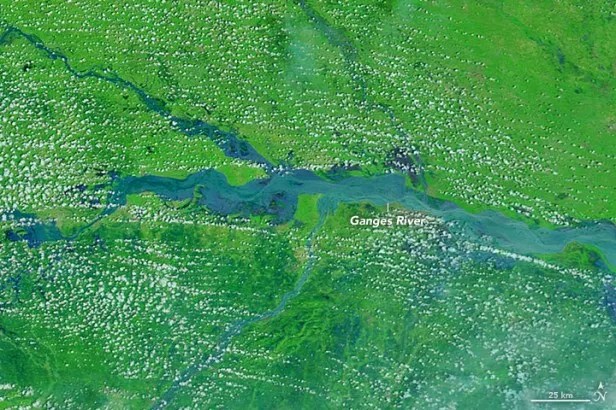
Pierre Wack, the scenario pioneer who built Royal Dutch Shell’s celebrated foresight practice, sometimes explained his methods by talking about the Ganges river in northern India. If there are heavy monsoon rains over the Himalayan headwaters, you can tell with certainty that there will be a flood five days later at Allahabad, which is 650 miles downstream. Five days after that, he said, the floods would reach Benares.
“Now the people down here in Benares don’t know that this flood is on its way,” he said, “but I do. Because I’ve seen it! This is not fortune telling. This is not crystal-ball gazing. This is merely describing future implications of something that has already happened.”…
… Most of us, peering ahead, fix on anxieties and uncertainties that may or may not happen: elections, technologies, and potential crises. We imagine what might happen, and get into the habit of thinking that our fate depends on this contingency. For instance, we pin our hopes on a particular candidate getting into office.
An alternative [your correspondent would suggest: “a critical complement”] is to look at the predetermined elements in our world as the playing field. When we recognize the true certainties, we can leap ahead to framing our choices and modulating our expectations. For example: We know it will take a long time to mitigate the effects of the climate crisis, so we invest accordingly in renewable energy. We also know our efforts to manage artificial intelligence need to happen practically overnight, so we work to rapidly build the necessary skills.
There are two kinds of predetermined elements. The first-order trends are basic and happening now. They follow directly from events that already took place — children already born, tons of carbon already in the air, debts already incurred. The second-order ones arise from the combination of first-order forces. Their effects are less predictable, but we can’t avoid the pressures they will place on us.
Taken together, they tell us the world of the 2030s will be markedly different from today and from most predictions being made today. For system leaders, a good list of predetermined elements gives you a start on developing scenarios that help you move to a creative orientation: creating the future you want.
I do a lot of work with scenarios, particularly at New York University’s Interactive Telecommunications Program, where I teach a graduate-level course on the future of media and technology. Here is my list of predetermined elements facing us today…
[Art shares a meaty– and bracing– list of both first- and second-order “pre-determineds.” He concludes…]
… The persistence of the ordinary. Against all the above sits the most underrated predetermined element of all: most people, most days, will live recognizable lives. The school, the clinic, the shop, and the family table endure because institutions change far more slowly than the forces acting on them. This is not complacency; it is the buffer that keeps the surprises survivable — and the reason that system leadership is generally local.
It’s as if we’re all driving down a treacherous highway. We notice the accidents and cars being towed off the shoulder, and the road rage as cars cut each other off. We don’t pay attention to all the drivers who stay in lane, leaving enough space between themselves and the car in front of them. Many of those drivers have experienced past accidents; they don’t want any more. If there were more of them, the road wouldn’t be nearly so scary. Uncertain: the prevailing attitudes and what it takes to bring people to a more system-oriented perspective...
[He then turns to the implications of his insight…]
… The discipline of scenario thinking is a discipline of attention. It tells us where to pay attention. Which predetermined elements affect us most? Which opportunities should we focus on? And which changes do we care about most urgently?
It is humbling and steadying at once: humbling because so much of the future is already decided, steadying because so much of it depends on what we do together.
The predetermined elements provide a working map. The first-order forces — the aging, the warming, the sun, the grid, the genome, the debt — are the ground on which the next decade must be built. The second-order combinations — cities, pressures, robots, possible relief — are where our work takes place…
Art’s conclusion is worth underling: first-order predetermineds are the terrain on which we will have to build our future; second order-pre-determineds are (a large part of) the agenda of issues we’ll have to address as we do; uncertainties are the unpredictable “weather” in which we’ll have to do that– guided throughout by our values and the hope that powers them. As Dennis Gabor said: “The future cannot be predicted, but futures can be invented.”
We already know much of what’s coming in the 2030s: “The Futures We Can’t Avoid.” Eminently worth reading in full.
* Tom Stoppard
###
As we buckle up, we might recall that it was on this date in 1927 that “The Cyclone,” a wooden roller coaster in Luna Park at Coney Island, opened to the public. It wasn’t the first roller coaster at Coney Island; but with total track length of 2,640 feet, a maximum height of 75 feet, and cars that reached 60 miles per hour on a ride, The Cyclone became a signature attraction. Operating still, it was declared a New York City designated landmark in 1988 and was placed on the National Register of Historic Places in 1991.

“The present is pregnant with the future”*…

The estimable Tim O’Reilly uses scenario planning to create an insightful look at AI, our futures, and the choices that will define them…
We all read it in the daily news. The New York Times reports that economists who once dismissed the AI job threat are now taking it seriously. In February, Jack Dorsey cut 40% of Block’s workforce, telling shareholders that “intelligence tools have changed what it means to build and run a company.” Block’s stock rose 20%. Salesforce has shed thousands of customer support workers, saying AI was already doing half the work. And a Stanford study found that software developers aged 22 to 25 saw employment drop nearly 20% from its peak, while developers over 26 were doing fine.
But how are we to square this news with a Vanguard study that found that the 100 occupations most exposed to AI were actually outperforming the rest of the labor market in both job growth and wages, and a rigorous NBER study of 25,000 Danish workers that found zero measurable effect of AI on earnings or hours?
Other studies could contribute to either side of the argument. For example, PwC’s 2025 Global AI Jobs Barometer, analyzing close to a billion job ads across six continents, found that workers with AI skills earn a 56% wage premium, and that productivity growth has nearly quadrupled in the industries most exposed to AI.
This is exactly the kind of contradictory, uncertain landscape that scenario planning was designed for. Scenario planning doesn’t ask you to predict what the future will be. It asks you to imagine divergent possible futures and to develop a strategy that improves your odds of success across all of them. I’ve used it many times at O’Reilly and have written about it before with COVID and climate change as illustrative examples. The argument between those who say AI will cause mass unemployment and those who insist technology always creates more jobs than it destroys is a debate that will only be resolved by time. Both sides have evidence. Both are probably right at some level. And both framings are not terribly helpful for anyone trying to figure out what to do next…
[O’Reilly explains the scenario approach, then applies it to our future with AI (see the image above), astutely assessing the conflicting signals that we’ve experiencing; he explores the “robust strategy” for our uncertian future (strategic choices that make sense regardless of which future unfolds); then he concludes…
… I’ll return to the theme that I sounded in my book WTF? What’s the Future and Why It’s Up To Us.
Every time a company uses AI to do what it was already doing with fewer people, it is making a choice for the lower half of the scenario grid. Every time a company uses AI to do something that wasn’t previously possible, to serve a customer who wasn’t previously served, to solve a problem that wasn’t previously solvable, it is making a choice for the upper half. These choices compound, for good or ill. An economy that uses AI primarily for efficiency will slowly hollow itself out.
Looking at the news from the future, both sets of signals are present. The question is which will dominate. AI will give us both the Augmentation Economy and the Displacement Crisis, in different measures in different places, depending on the choices we make.
Scenario planning teaches us that we don’t have to predict which future we’ll get. We do have to prepare for a very uncertain future. But the robust strategy, the one that works across every quadrant, is to focus on doing more, not just doing the same with less, and to find ways that human taste still matters in what is created. As long as there is unmet demand, as long as there are problems we haven’t solved and people we haven’t served, AI will augment human work rather than replacing it. It’s only when we stop looking for new things to do that the machines come for the jobs…
Eminently worth reading in full. Indeed, speaking as a long-time scenario planner, your correspondent can only wish that everyone who wields “scenarios” applies the approach as appropriately, adriotly, and acutely as Tim has: “Scenario Planning for AI and the ‘Jobless Future‘,” from @timoreilly.bsky.social.
* Voltaire
###
As we take the long view, we might send formative birthday greetings to Mark Pinsker; he was born on this date in 1923. A mathematician, he made impoprtant contributions to the fields of information theory, probability theory, coding theory, ergodic theory, mathematical statistics, and communication networks. This work, which helped lay the foundation for AI-as-we-know-it, earned him the IEEE Claude E. Shannon Award in 1978, and the IEEE Richard W. Hamming Medal in 1996, among other honors.

“The best way to predict the future is to invent it”*…

Dario Amodei, the CEO of AI purveyor Anthropic, has recently published a long (nearly 20,000 word) essay on the risks of artificial intelligence that he fears: Will AI become autonomous (and if so, to what ends)? Will AI be used for destructive pursposes (e.g., war or terrorism)? Will AI allow one or a small number of “actors” (corporations or states) to seize power? Will AI cause economic disruption (mass unemployment, radically-concentrated wealth, disruption in capital flows)? Will AI indirect effects (on our societies and individual lives) be destabilizing? (Perhaps tellingly, he doesn’t explore the prospect of an economic crash on the back of an AI bubble, should one burst– but that might be considered an “indirect effect,” as AI development would likely continue, but in fewer hands [consolidation] and on the heels of destabilizing financial turbulence.)
The essay is worth reading. At the same time, as Matt Levine suggests, we might wonder why pieces like this come not from AI nay-sayers, but from those rushing to build it…
… in fact there seems to be a surprisingly strong positive correlation between noisily worrying about AI and being good at building AI. Probably the three most famous AI worriers in the world are Sam Altman, Dario Amodei, and Elon Musk, who are also the chief executive officers of three of the biggest AI labs; they take time out from their busy schedules of warning about the risks of AI to raise money to build AI faster. And they seem to hire a lot of their best researchers from, you know, worrying-about-AI forums on the internet. You could have different models here too. “Worrying about AI demonstrates the curiosity and epistemic humility and care that make a good AI researcher,” maybe. Or “performatively worrying about AI is actually a perverse form of optimism about the power and imminence of AI, and we want those sorts of optimists.” I don’t know. It’s just a strange little empirical fact about modern workplace culture that I find delightful, though I suppose I’ll regret saying this when the robots enslave us.
Anyway if you run an AI lab and are trying to recruit the best researchers, you might promise them obvious perks like “the smartest colleagues” and “the most access to chips” and “$50 million,” but if you are creative you might promise the less obvious perks like “the most opportunities to raise red flags.” They love that…
– source
In any case, precaution and prudence in the pursuit of AI advances seems wise. But perhaps even more, Tim O’Reilly and Mike Loukides suggest, we’d profit from some disciplined foresight:
The market is betting that AI is an unprecedented technology breakthrough, valuing Sam Altman and Jensen Huang like demigods already astride the world. The slow progress of enterprise AI adoption from pilot to production, however, still suggests at least the possibility of a less earthshaking future. Which is right?
At O’Reilly, we don’t believe in predicting the future. But we do believe you can see signs of the future in the present. Every day, news items land, and if you read them with a kind of soft focus, they slowly add up. Trends are vectors with both a magnitude and a direction, and by watching a series of data points light up those vectors, you can see possible futures taking shape…
For AI in 2026 and beyond, we see two fundamentally different scenarios that have been competing for attention. Nearly every debate about AI, whether about jobs, about investment, about regulation, or about the shape of the economy to come, is really an argument about which of these scenarios is correct…
[Tim and Mike explore an “AGI is an economic singularity” scenario (see also here, here, and Amodei’s essay, linked above), then an “AI is a normal technology” future (see also here); they enumerate signs and indicators to track; then consider 10 “what if” questions in order to explore the implications of the scenarios, honing in one “robust” implications for each– answers that are smart whichever way the future breaks. They conclude…]
The future isn’t something that happens to us; it’s something we create. The most robust strategy of all is to stop asking “What will happen?” and start asking “What future do we want to build?”
As Alan Kay once said, “The best way to predict the future is to invent it.” Don’t wait for the AI future to happen to you. Do what you can to shape it. Build the future you want to live in…
Read in full– the essay is filled with deep insight. Taking the long view: “What If? AI in 2026 and Beyond,” from @timoreilly.bsky.social and @mikeloukides.hachyderm.io.ap.brid.gy.
[Image above: source]
* Alan Kay
###
As we pave our own paths, we might send world-changing birthday greetings to a man who personified Alan’s injunction, Doug Engelbart; he was born on this date in 1925. An engineer and inventor who was a computing and internet pioneer, Doug is best remembered for his seminal work on human-computer interface issues, and for “the Mother of All Demos” in 1968, at which he demonstrated for the first time the computer mouse, hypertext, networked computers, and the earliest versions of graphical user interfaces… that’s to say, computing as we know it, and all that computing enables.
You must be logged in to post a comment.