“The unpredictable and the predetermined unfold together to make everything the way it is.”*…
Thinking– worrying– about the future occupies more and more of our mindshare. How do we ready ourselves for the impacts of the playing out of the myriad uncertainties we face? Your correspondent’s approach-of-choice has been scenario planning (see, e.g., here and here), a method of thinking through and making sense of those unknowns. But as we do that, we have to think against the backdrop of “pre-determined elements”– forces that are going to accrue no matter how the uncertainties resolve, no matter which scenario unfolds.
Old friend and colleague Art Kleiner has dropped a thoughtful– and provocative– reminder of just how important understanding pre-determined elements is…
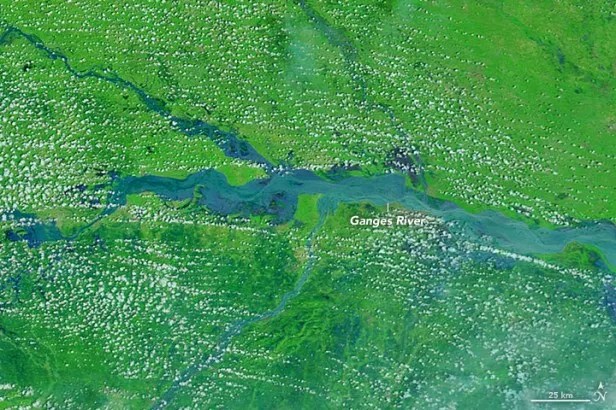
Pierre Wack, the scenario pioneer who built Royal Dutch Shell’s celebrated foresight practice, sometimes explained his methods by talking about the Ganges river in northern India. If there are heavy monsoon rains over the Himalayan headwaters, you can tell with certainty that there will be a flood five days later at Allahabad, which is 650 miles downstream. Five days after that, he said, the floods would reach Benares.
“Now the people down here in Benares don’t know that this flood is on its way,” he said, “but I do. Because I’ve seen it! This is not fortune telling. This is not crystal-ball gazing. This is merely describing future implications of something that has already happened.”…
… Most of us, peering ahead, fix on anxieties and uncertainties that may or may not happen: elections, technologies, and potential crises. We imagine what might happen, and get into the habit of thinking that our fate depends on this contingency. For instance, we pin our hopes on a particular candidate getting into office.
An alternative [your correspondent would suggest: “a critical complement”] is to look at the predetermined elements in our world as the playing field. When we recognize the true certainties, we can leap ahead to framing our choices and modulating our expectations. For example: We know it will take a long time to mitigate the effects of the climate crisis, so we invest accordingly in renewable energy. We also know our efforts to manage artificial intelligence need to happen practically overnight, so we work to rapidly build the necessary skills.
There are two kinds of predetermined elements. The first-order trends are basic and happening now. They follow directly from events that already took place — children already born, tons of carbon already in the air, debts already incurred. The second-order ones arise from the combination of first-order forces. Their effects are less predictable, but we can’t avoid the pressures they will place on us.
Taken together, they tell us the world of the 2030s will be markedly different from today and from most predictions being made today. For system leaders, a good list of predetermined elements gives you a start on developing scenarios that help you move to a creative orientation: creating the future you want.
I do a lot of work with scenarios, particularly at New York University’s Interactive Telecommunications Program, where I teach a graduate-level course on the future of media and technology. Here is my list of predetermined elements facing us today…
[Art shares a meaty– and bracing– list of both first- and second-order “pre-determineds.” He concludes…]
… The persistence of the ordinary. Against all the above sits the most underrated predetermined element of all: most people, most days, will live recognizable lives. The school, the clinic, the shop, and the family table endure because institutions change far more slowly than the forces acting on them. This is not complacency; it is the buffer that keeps the surprises survivable — and the reason that system leadership is generally local.
It’s as if we’re all driving down a treacherous highway. We notice the accidents and cars being towed off the shoulder, and the road rage as cars cut each other off. We don’t pay attention to all the drivers who stay in lane, leaving enough space between themselves and the car in front of them. Many of those drivers have experienced past accidents; they don’t want any more. If there were more of them, the road wouldn’t be nearly so scary. Uncertain: the prevailing attitudes and what it takes to bring people to a more system-oriented perspective...
[He then turns to the implications of his insight…]
… The discipline of scenario thinking is a discipline of attention. It tells us where to pay attention. Which predetermined elements affect us most? Which opportunities should we focus on? And which changes do we care about most urgently?
It is humbling and steadying at once: humbling because so much of the future is already decided, steadying because so much of it depends on what we do together.
The predetermined elements provide a working map. The first-order forces — the aging, the warming, the sun, the grid, the genome, the debt — are the ground on which the next decade must be built. The second-order combinations — cities, pressures, robots, possible relief — are where our work takes place…
Art’s conclusion is worth underling: first-order predetermineds are the terrain on which we will have to build our future; second order-pre-determineds are (a large part of) the agenda of issues we’ll have to address as we do; uncertainties are the unpredictable “weather” in which we’ll have to do that– guided throughout by our values and the hope that powers them. As Dennis Gabor said: “The future cannot be predicted, but futures can be invented.”
We already know much of what’s coming in the 2030s: “The Futures We Can’t Avoid.” Eminently worth reading in full.
* Tom Stoppard
###
As we buckle up, we might recall that it was on this date in 1927 that “The Cyclone,” a wooden roller coaster in Luna Park at Coney Island, opened to the public. It wasn’t the first roller coaster at Coney Island; but with total track length of 2,640 feet, a maximum height of 75 feet, and cars that reached 60 miles per hour on a ride, The Cyclone became a signature attraction. Operating still, it was declared a New York City designated landmark in 1988 and was placed on the National Register of Historic Places in 1991.

You must be logged in to post a comment.