Posts Tagged ‘wildfires’
“I can think of no other edifice constructed by man as altruistic as a lighthouse. They were built only to serve.”*…
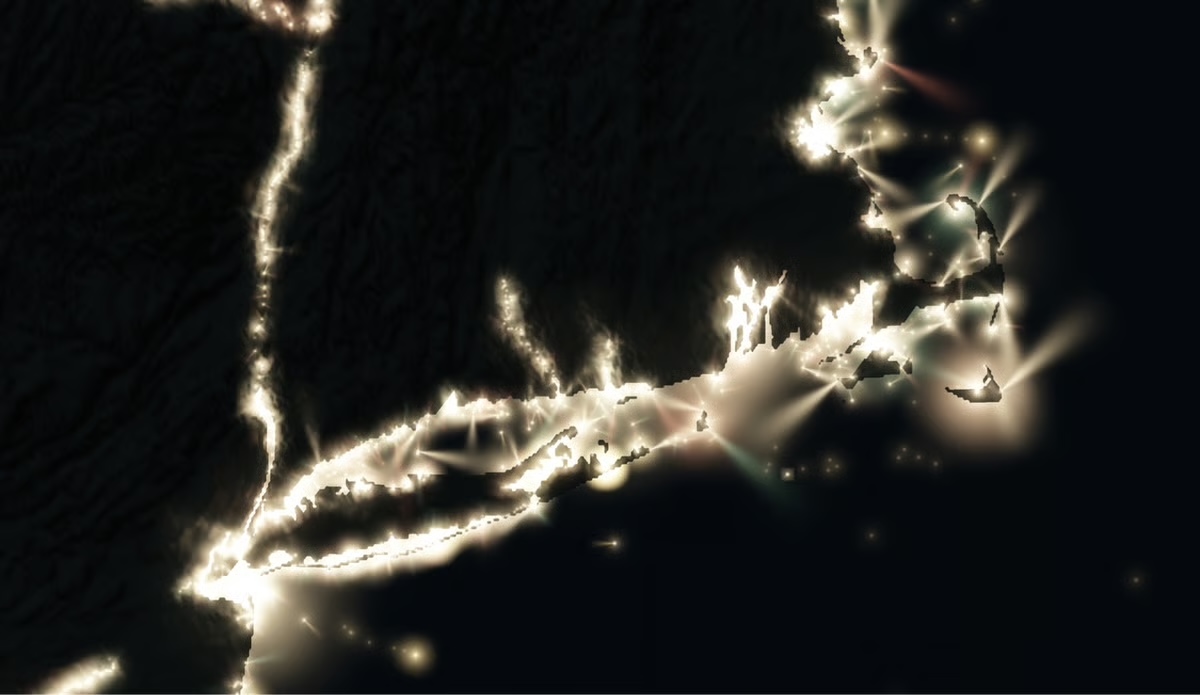
Aaron Becker‘s Mapped.Earth is an extraordinary resource…
mapped.earth is maps and geography as a way to see the planet — by Aaron Becker. The Earth rendered as data: winds, currents, terrain, borders, populations, the shapes underneath the numbers. The through-line is wonder plus clarity — here is a way of looking at the world you haven’t seen before, and here is what it means…
The living globe — a real-time 3D Earth: live winds and ocean currents from the latest forecast cycles, active fires, population as terrain, and a Time Machine that scrubs eight decades of climate history.
Map films — short, narrated films built from geographic data: unfamiliar projections, seasonal winds, shipping lanes, the way a country’s people are actually arranged on its land.
Field notes — writing that backs the maps: where the data comes from, why a projection was chosen, what the pattern means.
And now (as illustrated above), the lighthouses of the world: every charted maritime navigational light on the planet, sweeping to its actual reach, on its actual arc, and on its real cycle.
Via Jason Kottke, who recorded this short video sampler:
“Lighthouses of the World,” from @aaronjbecker.bsky.social (via @kottke.org)
* George Bernard Shaw
###
As we illuminate, many will recall that this is the anniversary of the outbreak, on this date in 1871, of the Great Chicago Fire, famously blamed on Mrs. Kate O’Leary’s cow kicking over a lamp. (Though in 1997 the Chicago City Council looked into the evidence, both new and old, and passed a resolution exonerating Mrs. O’Leary and her cow.)
What many fewer remember is that on that date 37 separate fires broke out in the Great Lakes region, three were massive: the Great Chicago fire killed 300; the Great Michigan fire, 300-500.
But the Wisconsin Peshtigo fire—history’s deadliest—killed least 1,200– though data gathered from mass graves, both those already exhumed and those still being discovered, suggest that the death toll of the blaze was most likely greater than that of the 1889 Johnstown flood death toll of 2,200 people or more. The fire razed 1.2 million acres– and destroyed the Peshtigo Lighthouse, a key navigational aid in the Great Lakes region.

“I’d rather fight 100 structure fires than a wildfire. With a structure fire you know where your flames are, but in the woods it can move anywhere; it can come right up behind you.”*…

The devastation in the Los Angeles area is just the latest reminder that wildfires are a massive problem that continues to grow. Caleb X. Cunningham, Grant J. Williamson, and David M. J. S. Bowman put the threat into alarming perspective…
Climate change is exacerbating wildfire conditions, but evidence is lacking for global trends in extreme fire activity itself. Here we identify energetically extreme wildfire events by calculating daily clusters of summed fire radiative power using 21 years of satellite data, revealing that the frequency of extreme events (≥99.99th percentile) increased by 2.2-fold from 2003 to 2023, with the last 7 years including the 6 most extreme. Although the total area burned on Earth may be declining, our study highlights that fire behaviour is worsening in several regions—particularly the boreal and temperate conifer biomes—with substantial implications for carbon storage and human exposure to wildfire disasters…
An unlocked article from Nature Ecology & Evolution: “Increasing frequency and intensity of the most extreme wildfires on earth.”
Looking forward: “Five Climate Realism Insights on California’s Wildfires.”
Apposite: “Climate Change, Disaster Risk, and Homeowner’s Insurance,” from the Congressional Budget Office.
And very practically: “Wildfire Prep.”
* Tom Watson
###
As we contemplate conflagration, we might recall that on this date in 1949, after two days in which a few flakes fell, Los Angeles “enjoyed” a real snow fall (the first that anyone can recall).

You must be logged in to post a comment.