Posts Tagged ‘globe’
“I can think of no other edifice constructed by man as altruistic as a lighthouse. They were built only to serve.”*…
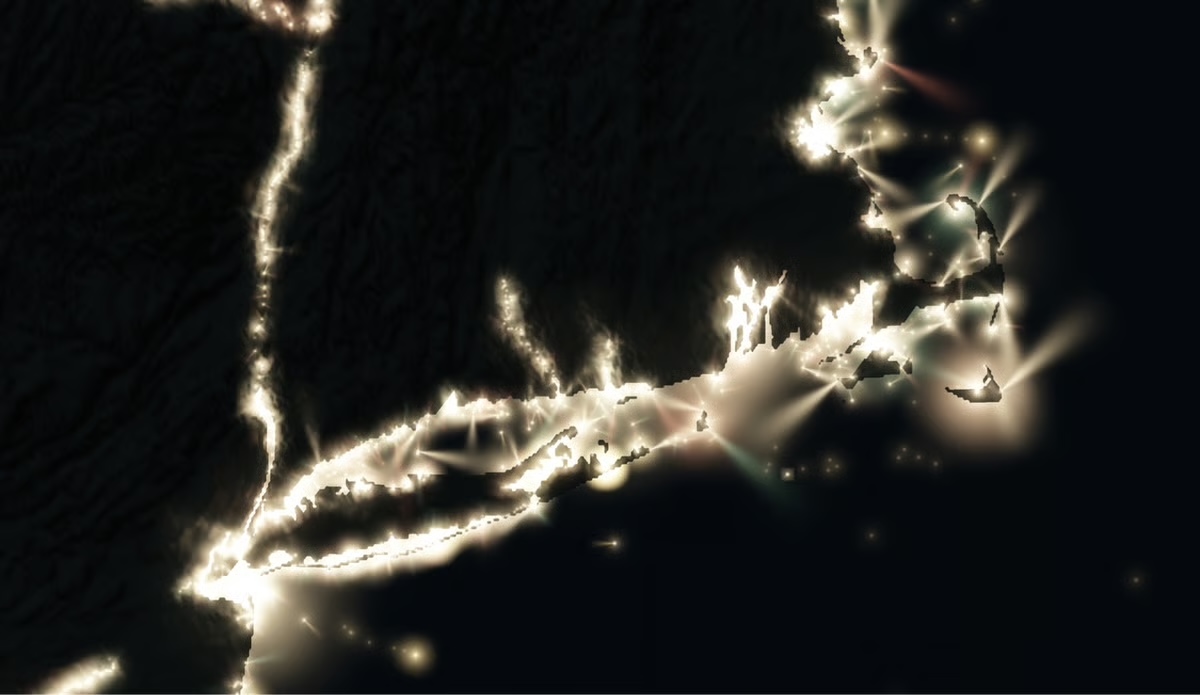
Aaron Becker‘s Mapped.Earth is an extraordinary resource…
mapped.earth is maps and geography as a way to see the planet — by Aaron Becker. The Earth rendered as data: winds, currents, terrain, borders, populations, the shapes underneath the numbers. The through-line is wonder plus clarity — here is a way of looking at the world you haven’t seen before, and here is what it means…
The living globe — a real-time 3D Earth: live winds and ocean currents from the latest forecast cycles, active fires, population as terrain, and a Time Machine that scrubs eight decades of climate history.
Map films — short, narrated films built from geographic data: unfamiliar projections, seasonal winds, shipping lanes, the way a country’s people are actually arranged on its land.
Field notes — writing that backs the maps: where the data comes from, why a projection was chosen, what the pattern means.
And now (as illustrated above), the lighthouses of the world: every charted maritime navigational light on the planet, sweeping to its actual reach, on its actual arc, and on its real cycle.
Via Jason Kottke, who recorded this short video sampler:
“Lighthouses of the World,” from @aaronjbecker.bsky.social (via @kottke.org)
* George Bernard Shaw
###
As we illuminate, many will recall that this is the anniversary of the outbreak, on this date in 1871, of the Great Chicago Fire, famously blamed on Mrs. Kate O’Leary’s cow kicking over a lamp. (Though in 1997 the Chicago City Council looked into the evidence, both new and old, and passed a resolution exonerating Mrs. O’Leary and her cow.)
What many fewer remember is that on that date 37 separate fires broke out in the Great Lakes region, three were massive: the Great Chicago fire killed 300; the Great Michigan fire, 300-500.
But the Wisconsin Peshtigo fire—history’s deadliest—killed least 1,200– though data gathered from mass graves, both those already exhumed and those still being discovered, suggest that the death toll of the blaze was most likely greater than that of the 1889 Johnstown flood death toll of 2,200 people or more. The fire razed 1.2 million acres– and destroyed the Peshtigo Lighthouse, a key navigational aid in the Great Lakes region.

“I wisely started with a map”*…

From Daniel O’Donohue, 29 print-ready folding globe templates (the one above is “Earth Today”; there are also globes of the sun, the moon, the planets, and lots of different “views” of Earth) — every one free to download, print, and fold, and every one customizable into other shapes or create your own, with your own pinned places. via the custom globe builder…
… This project started with a simple observation: we look at maps on screens all day, but almost nobody gets to hold a planet. A paper globe is the cheapest possible spacecraft — print a sheet, cut along the lines, fold, glue, and you are turning the actual shape of the world over in your hands.
Nothing here is decoration. Every globe is built from openly licensed scientific data — NASA satellite imagery, USGS planetary mosaics, Natural Earth cartography, NOAA ocean data, the Smithsonian’s volcano inventory — rendered through real map projections into print-quality PDFs. Each globe credits its source, and the source is always one click away.
The fold shapes are the classics of mathematical cartography: icosahedra, dodecahedra, gores like a 17th-century globemaker would cut, even the Airocean projection that unfolds the world onto twenty triangles with barely any distortion.
The curated globes are free — print as many as you like. When you want a globe that is yours alone — your places pinned, your countries highlighted, your choice of shape — the builder is where it happens…
Getting our minds– and out hands– around the places we are: “Folding Globes.”
Harmonic: “24 Times,” from Gysin-Vanetti: “A collection of twentyfour variations on the theme “clock” created for HeK… Each of these clocks shows time in a distinct form. The result is a sequence of numbers, letters or punctuation marks animated in different ways….”
* J. R. R. Tolkien
###
As we orient ourselves, we might spare a thought for William John McGee (or “WJ McGee, without the periods, as he referred to himself); he died on this date in 1912. An inventor, geologist, anthropologist, and ethnologist, he is remembered for his pioneering studies documenting the occurrence of waves of invasions and recessions of ice sheets in North America (thus establishing the complexity of the Great Ice Age). But he worked in a number of governmental and organizational capacities that contributed to teh development of geography as a discipline: e.g., as a director in the U.S. Geological Survey, and as a founder and president of the National Geographic Society. While on the staff of the Bureau of Soils, in 1918, he organized the landmark Conference of Governors on Conservation of Natural Resources, for whihc he has been called the “chief theorist of the conservation movement.”

“The world is a globe — the farther you sail, the closer to home you are”*…

A good globe is a thing of beauty and a source of wonder, perhaps none more than those made by Peter Bellerby, founder of artisan globemakers Bellerby & Co. Globemakers, one of only two handmade globemaking companies in the world. In an excerpt from his book, The Globemakers: The Curious Story of an Ancient Craft, he explains how it’s done…
The simplest way to make a globe is to construct a sphere and paint it. The earliest globes would have been made of wood or metal, with the celestial or terrestrial map painted directly on by hand. Later, in the sixteenth century, hollow globes were made of thin sheets of metal which were then hand-painted. Mapping doesn’t lend itself to painting and lettering by hand, and cartography was in its infancy, so early painted globes were necessarily very inaccurate.
Later makers pasted blank gores onto the sphere to create a more forgiving canvas for the hand-painted map and lettering. These are called manuscript globes. The invention of the printing press meant that maps could be printed as gores. A silversmith or skilled engraver would etch a reverse map on copper plates before printing using a process known as intaglio, from the Italian word for ‘carving.’ In intaglio printing the etched plate is coated with ink, then wiped to leave ink only in the incised depressions, before being run through an etching press, in which dampened paper picks up the ink to create the printed image. Copper is a soft metal, so the plates lose their clarity relatively quickly; smaller print runs were therefore common. The effect, though, is very satisfying, with an intense character to the image. The globemaker then pasted the printed gores onto the globe and finally the painter would add color.
It was at this point that the globemaking craft became assimilated with the printing and publishing industry. Globes were after all now printed just like books, and since this time each edition has been referred to as a ‘publication.’ And as in book publishing, copying the map from a rival’s globe is plagiarism.
The golden age of the printed and then hand-painted globe coincided with the age of European expansion, reaching its peak at the beginning of the seventeenth century. In this period, as astronomical, geographical and cartographical knowledge developed apace, globemakers too were inspired to experiment and refine their art. In turn, the proliferation of printing presses made it possible over time to produce more globes at a less than exorbitant cost so they became more affordable to a greater number of people.
Nevertheless, the acquisition or commission of a globe was still the preserve of the aristocracy and the affluent merchant class. Because of the delicate and time-consuming nature of the work, a budding globemaker probably would have required considerable financial backing. Globes therefore were prized symbols of status and prestige.
Studying these venerable antique globes, it was striking to see how little the methods of manufacture had changed from the mid-sixteenth century until the twentieth century, albeit there is always a mystery about the exact construction and methods because so much is hidden under the surface – it was only in the last century that the rot set in. I knew that I had high aspirations but did not want to simply reproduce some sort of cheap faux-antique facsimile. Instead, my ambition was to produce a handmade globe that felt classic yet at the same time unusual, relevant and contemporary…
Read on for a fascinating unpacking of the ingenuity and skill involved: “On the Artisanal Craft of Making a Globe,” from @globemakers in @lithub.
* Terry Pratchett
###
As we spin the sphere, we might send cartographical birthday greetings to Dimitrie Cantemir; he was born on this date in 1673. A Moldavian prince, statesman, and man of letters, he led a storied life as a statesman (twice serving as voivode of Moldavia), but also distinguished himself as a philosopher, historian, composer, musicologist, linguist, ethnographer, and geographer.
To that lattermost distinction, Cantemir’s c. 1714 manuscript map of Moldova (as the region which Moldavia centered was also known) was the first real map of the country, containing geographical detail as well as administrative information. Printed in 1737 in the Netherlands, it formed the basis of most European maps of the country for decades.

“Everybody wants to save the Earth; nobody wants to help Mom do the dishes”*…

Adam Smith once famously observed…
How selfish soever man may be supposed, there are evidently some principles in his nature, which interest him in the fortune of others, and render their happiness necessary to him, though he derives nothing from it except the pleasure of seeing it.
– Theory of Moral Sentiments, 1759
He is a member of a stream of observers of the human condition, stretching back to the ancient Greeks, who believe that an innate goodness is at work in us all. But is it so?
Behavioral economists have revolutionized the standard view of human nature. No longer are people presumed to be purely selfish, only acting in their own interest. Hundreds of experiments appear to show that most people are pro-social, preferring to sacrifice their own success in order to benefit others. That’s altruism.
If the interpretations of these experiments are true, then we have to rip up the textbooks for both economics and evolutionary biology! Economic and evolutionary models assume that individuals only act unselfishly when they stand to benefit some way. Yet humans appear to be unique in the animal kingdom as experiments suggest they willingly sacrifice their own success on behalf of strangers they will never meet. These results have led researchers to look for the evolutionary precursors of such exceptional altruism by also running these kinds of experiments with non-human primates.
But are these altruism experiments really evidence of humans being special? Our new study says probably not…
Read more– and draw your own conclusion– at “Does behavioral economics show people are altruistic or just confused?”
[TotH to Mark Stahlman]
* P.J. O’Rourke
###
As we calculate the angles, we might spare a thought for Johannes Schöner; this is both his birthday (1477) and the anniversary of his death (1547). A priest, astronomer, astrologer, geographer, cosmographer, cartographer, mathematician, globe and scientific instrument maker, and editor and publisher of scientific texts, he is probably best remembered today (and was renowned in his own tine) as a pioneering maker of globes. In 1515 he created one of the earliest surviving globes produced following the discovery of new lands by Christopher Columbus. It was the first to show the name “America” that had been suggested by Waldseemüller– and tantalizingly, it depicts a passage around South America before it was recorded as having been discovered by Magellan. In his roles as professor and academic publisher, he played a significant part in the events that led up to the publishing of Copernicus’ epoch-making “De revolutionibus” in Nürnberg in 1543.

“This world is but a canvas to our imagination”*…

The 1603 Sphaera stellifera globe by Willem Janszoon Blaeu showcases cutting-edge seventeenth-century astronomy in three dimensions. Designed by printmaker Jan Saenredam, it is also stunningly beautiful. It features highly accurate observations of the Northern Hemisphere, and pictures the newly discovered constellations of the Southern sky, offering them as heavenly proof of the success of the Dutch colonial enterprise…
Read more– and find a version that you can zoom and turn online– at “Spin a 3-D Representation of a Beautiful 17th-Century Celestial Globe.”
* Henry David Thoreau
###
As we locate ourselves, we might recall that it was on this date in 1790 that the Aztec Calendar Stone (or Sun Stone or Stone of the Five Eras), which had been buried by Spanish conquistadors at El Zocalo in Mexico City, was rediscovered during repairs to the Cathedral there. Perhaps the most famous work of Aztec sculpture, it depicts the five eras (the Five Suns) of Aztec civilization; and, while it is called “calendar stone,” it appears to have been used as a ceremonial basin or ritual altar.

You must be logged in to post a comment.