Posts Tagged ‘snow’
“Everything will be okay in the end. If it’s not okay, it’s not the end.”*…
These are harrowing times. Finally, an answer…
The “Make Everything OK” button is a website containing nothing but a single button. Press it, and after a moment of processing, you’re informed: “Everything is OK now. If everything is still not OK, try checking your settings of perception of objective reality.”…
Try it yourself at make-everything-ok.com. Via the always illuminating @boingboing.net.
* John Lennon (and others)
###
As we press and press again, we might recall that on this date in 1949, after two days in which a few flakes fell, Los Angeles “enjoyed” a real snow fall (the first that anyone can recall).

“I’d rather fight 100 structure fires than a wildfire. With a structure fire you know where your flames are, but in the woods it can move anywhere; it can come right up behind you.”*…

The devastation in the Los Angeles area is just the latest reminder that wildfires are a massive problem that continues to grow. Caleb X. Cunningham, Grant J. Williamson, and David M. J. S. Bowman put the threat into alarming perspective…
Climate change is exacerbating wildfire conditions, but evidence is lacking for global trends in extreme fire activity itself. Here we identify energetically extreme wildfire events by calculating daily clusters of summed fire radiative power using 21 years of satellite data, revealing that the frequency of extreme events (≥99.99th percentile) increased by 2.2-fold from 2003 to 2023, with the last 7 years including the 6 most extreme. Although the total area burned on Earth may be declining, our study highlights that fire behaviour is worsening in several regions—particularly the boreal and temperate conifer biomes—with substantial implications for carbon storage and human exposure to wildfire disasters…
An unlocked article from Nature Ecology & Evolution: “Increasing frequency and intensity of the most extreme wildfires on earth.”
Looking forward: “Five Climate Realism Insights on California’s Wildfires.”
Apposite: “Climate Change, Disaster Risk, and Homeowner’s Insurance,” from the Congressional Budget Office.
And very practically: “Wildfire Prep.”
* Tom Watson
###
As we contemplate conflagration, we might recall that on this date in 1949, after two days in which a few flakes fell, Los Angeles “enjoyed” a real snow fall (the first that anyone can recall).
“It was impossible to tame, like leeches”*…

Or maybe just not worth it…
If you’re like me, one of the few remaining artifacts of the pre-Internet age that you’re able to regularly revel in is the mail order catalog. I particularly love the desk toys highlighted they show off—often, some of the most luxurious are vintage weather prediction devices. Today’s tedium is about the Victorian “Tempest Prognosticator,” a vintage weather forecast device you’re not likely to see as a desk toy any time soon—because maintaining one also means taking care of a dozen leeches…
George Merryweather, a member of Whitby, North Yorkshire’s then-thriving intellectual scene, masterminded the “Tempest Prognosticator” as a years-long hobby that culminated in its public display in 1851.
As a physician, Merryweather would already have been quite familiar with leeches, but in his essays, Merryweather said he was inspired by a poem, which spoke of how the common “medicinal leech” tends to move up in a jar of rainwater as a storm nears, then settle to the bottom in clear conditions…
To harness this instinct, Merryweather placed 12 leeches in their own jars of rainwater, arranged in a circle to keep each other company. Atop each jar, he rigged a piece of whale bone to a chain that, when yanked, would hit a bell he had placed in the center. As leeches rose to the top of their jars in advance of a storm, they would come into contact with the bone and sound the bell. The more bells that sounded, the more likely there was to be a storm, and the more intense it was likely to be…
At the time, consensus among the leech-invested appears to have emerged that these behaviors were due to the creatures’ innate ability to sense electromagnetic energy gathering in advance of a storm. Merryweather himself was a major proponent of this belief, dedicating a significant portion of his essays to reiterating Michael Faraday’s contemporary work on electromagnetism.
Unfortunately for him, we now know this acknowledgement was likely both unnecessary and uncalled-for. Leeches’ faculties for weather prediction turn out to actually be pretty patchy, and their “instincts” for this are far simpler than it seemed to him at the time. Leeches “breathe” through their body walls by absorbing the dissolved oxygen in the water they inhabit. When atmospheric pressure drops, a fractional amount less oxygen remains dissolved, and they move toward the surface, where the water is more oxygen-rich.
In effect, the “Tempest Prognosticator” was one of the world’s most elaborate barometers…
More of the remarkable story– and what it can teach us– at “The Leech Machine,” from Nathan Lawrence (@NathanBLawrence) in @ShortFormErnie‘s wonderful @readtedium.
* Daniel Handler (Lemony Snicket), Who Could That Be at This Hour?
###
As we consult the Almanac, we might recall that on this date in 1949, after two days in which a few flakes fell, Los Angeles “enjoyed” a real snow fall.
“Nothing that is not there and the nothing that is”*…
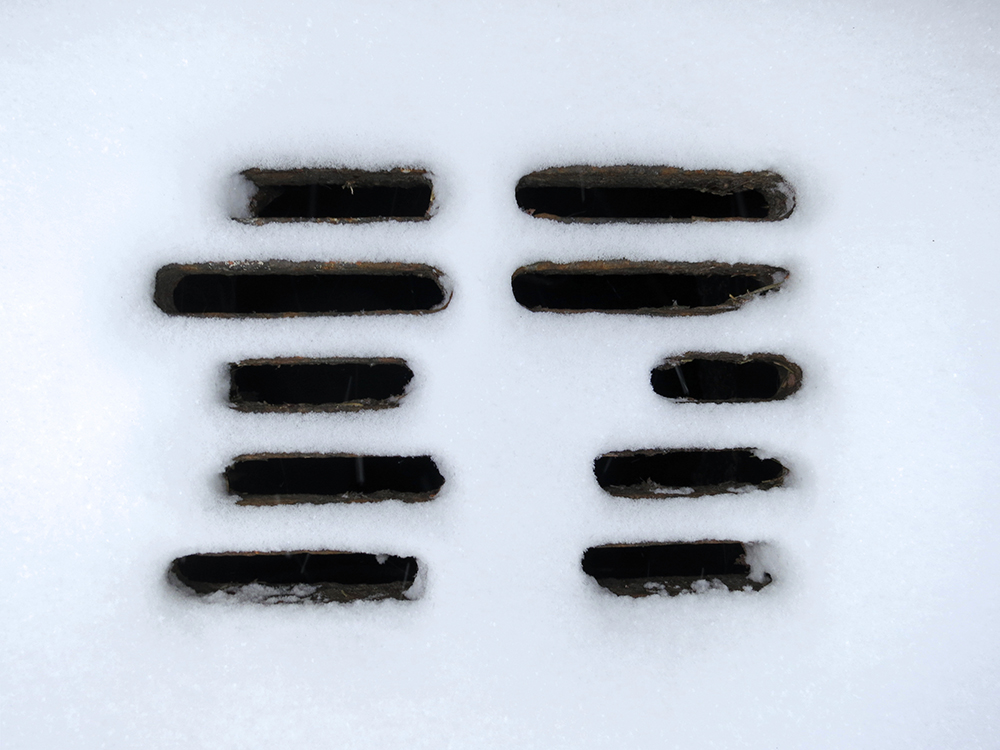
While wandering around a snowy New York City this past December, the artist Jan Baracz began to notice patterns forming in the grates of storm drains. “They reminded me of the I Ching hexagrams and ideographic language systems,” he writes. “They also reminded me of when I lived in Japan and researched how water patterns (from vapor to ice) are represented in kanji. It was a time when I had given my apophenia free rein. I was transfixed by logograms and language characters built upon symbolic origins. I thought these snow glyphs may be a perfect set of images to reflect this intense time in which we seek signs and project meaning onto the physical world that surrounds us.”…
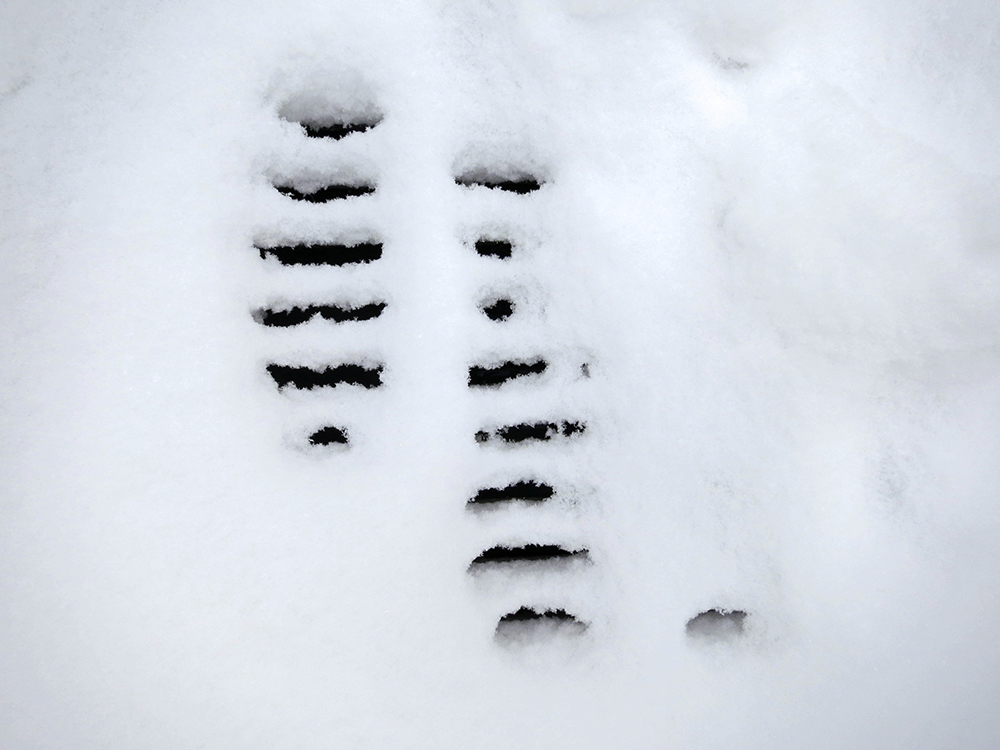
More of Jan Baracz‘s portentous photos at: “Snow Oracles.”
See also Vivian Wu‘s marvelous “Snowflake Generator.”
*”For the listener, who listens in the snow, / And, nothing himself, beholds /
Nothing that is not there and the nothing that is.” – Wallace Stevens, “The Snow Man”
###
As we search for signs, we might note that today is National Weatherperson Day, honoring individuals in the fields of meteorology, weather forecasting, and broadcast meteorology, as well as volunteer storm spotters and observers.
It is celebrated on this date in honor of the man credited with being America’s first (scientific) weather observer, John Jeffries (born on this date in 1744), who began making and recording daily weather observations in Boston in 1774.
Jeffries sided with the Crown in the unpleasantness that soon followed with the British, so fled to Nova Scotia in 1776, and from there to London, where his observations continued. In 1785, Jeffries and inventor/aeronaut Jean-Pierre Blanchard crossed the English Channel in a balloon, becoming the first human beings to cross the Channel by air; Jeffries measured the temperature throughout the voyage.

“Pray don’t talk to me about the weather, Mr. Worthing”*…

If you’re planning to relocate but want to live somewhere with a near-exact temperature profile, where should you go?
That depends: Folks in San Francisco might choose San Luis Obispo 200 miles south, or Portugal’s Cabo Carvoeiro 5,600 miles east, as these locales have 99 percent similar monthly temperatures. Chicagoans could go to Ottawa or Dalian, China, whereas New Yorkers will feel at home in Dover, Maryland; Milford, Delaware; or Makhachkala, Russia.
That’s according to an engrossing map tool from Codeminders that compares places with equivalent climates…
More at “A Guide to Finding Cities With Nearly Identical Temperatures“– and try it for yourself here.
* “Pray don’t talk to me about the weather, Mr. Worthing. Whenever people talk to me about the weather, I always feel quite certain that they mean something else. And that makes me quite nervous.”
– Oscar Wilde, The Importance of Being Earnest
###
As we ponder the differential impacts of climate change, we might recall that it was on this date in 1900 that a massive storm spread record snows from Kansas to New York State. Snowfall totals ranged up to 17.5 inches at Springfield IL and 43 inches at Rochester NY, with up to 60 inches in the Adirondack Mountains of New York State.

Central Park, after the storm
You must be logged in to post a comment.