Posts Tagged ‘nutrition’
“The earth is bountiful, and where her bounty fails, nitrogen drawn from the air will refertilize her womb.”*…
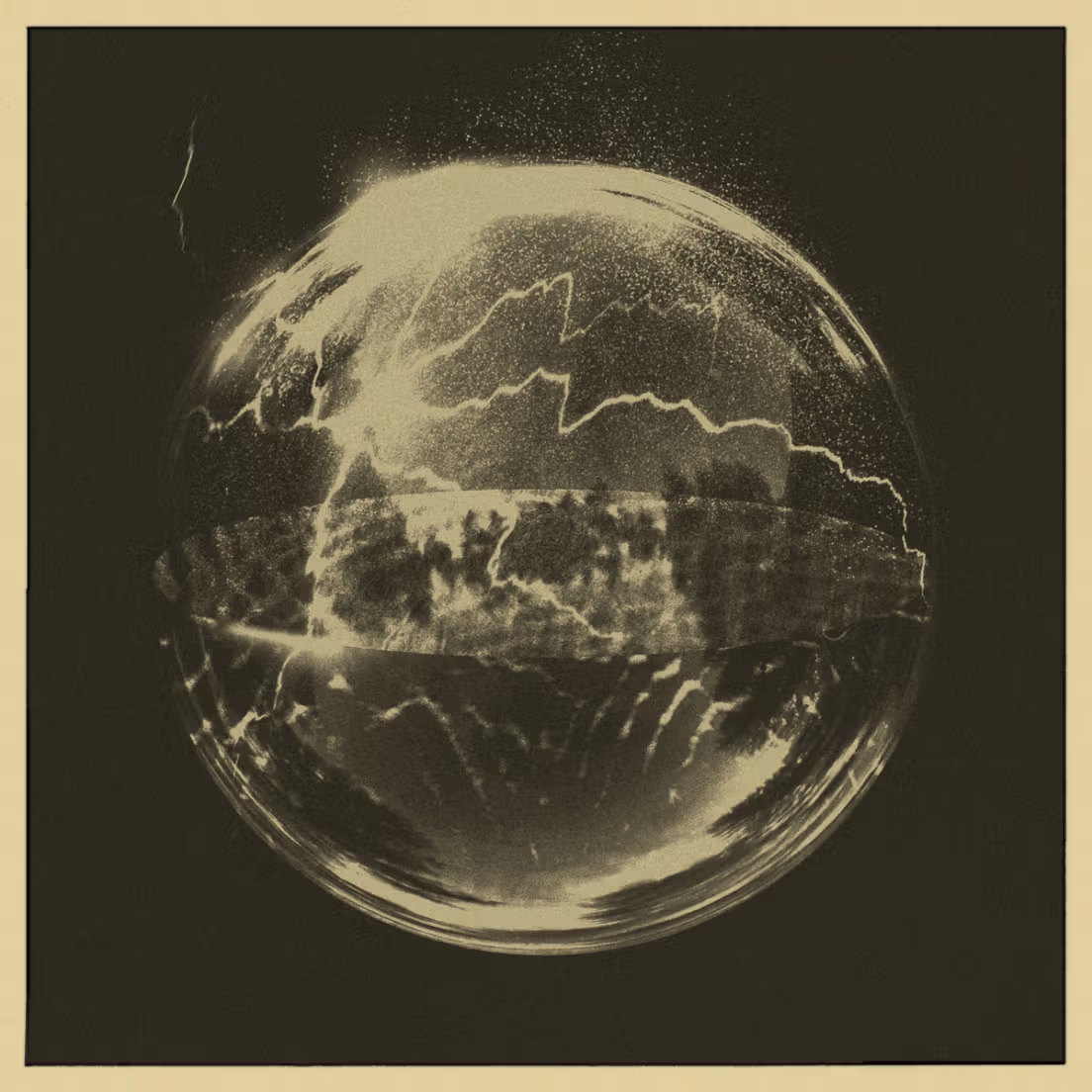
As the Iran War continues to unfold, there is understandably a great deal of concern about energy prices (and the prices of things that depend on energy). We might forget that the Middle East is also crucial to the world’s fertilizer supply– though not for long, as farmers (along with everyone else in the food chain, all the way down to all of us eaters) are beginning to feel the pain.
But, as Diana Kruzman reports, even as fertilizer trade concerns are growing, a revolutionary sourcing alternative has emerged– one that could make a huge positive difference if it proves out at scale…
The world has an almost insatiable demand for nitrogen. Crops need it to grow, but although it makes up 78 percent of our atmosphere, plants can’t just pull it in from the air the way they do with oxygen. Instead, they rely on bacteria in the soil to convert it into nitrate, a form they can use; in the case of agriculture, think of fertilizer spread by humans. Leaving aside organic options like cow manure, most farmers use ammonia produced mainly from natural gas using a technique called the Haber-Bosch process, which was invented in 1909. [See also here.]
Haber-Bosch is expensive and energy-intensive, responsible for up to two percent of the world’s annual greenhouse gas emissions. It’s also spurred a global nitrogen pollution crisis; as much as two-thirds of nitrogen fertilizer applied to crops is never used, and the excess escapes into the soil, air, and water, raising the cancer risk in nearby communities and contributing to climate change.
Researchers have been trying to find an alternative way to get nitrogen to plants for decades — turning to everything from microbes to human urine. But so far, these scientific advancements haven’t translated into much practical change for farmers, who for the most part still rely on ammonia (which, granted, is getting greener, but is increasingly vulnerable to global price shocks).
That could soon change with the growth in popularity of a new technology known as plasma activated water, or PAW. Around the U.S., scientists and startups are experimenting with this high-tech solution, which uses electricity to pull nitrogen from the air, mix it with water, and create fertilizer straight on the farm. The concept, on the surface, seems suspiciously rosy — on-demand nitrogen, in a form plants can use, at just the cost of electricity (and the initial price of the machine used to make it). But early adopters have told Offrange that it genuinely works…
… PAW uses electricity to transform air into plasma — the fourth state of matter (besides gases, solids, and liquids), which typically forms at high temperatures. When the plasma comes into contact with water, it encourages chemical reactions that form nitrates — the type of nitrogen that plants need. Though this process was actually invented in 1903, even before Haber-Bosch, it required so much energy that it never achieved widespread use.
But in recent years, those energy needs have gone down thanks to the development of “cold plasma” technology, which operates at less than 60 degrees Fahrenheit. It’s also used for medical sterilization and food safety, and over the last decade researchers have worked to develop new ways to apply it for agricultural production…
More at: “Pulling Nitrogen From the Air” from @dkruzman.bsky.social.
* Nikola Tesla (who, around 1900, imagined and experimented with something like the Birkeland–Eyde-based plasma process described above)
###
As we count on creativity, we might send healthy birthday greetings to a man who explained one of the central ways in which we depend on the food that we eat, William Cumming Rose; he was born on this date in 1887. A biochemist, he researched amino acids, discovered threonine, and established the importance of the nine essential amino acids in human nutrition (that’s to say, the amino acids that our bodies cannot synthesize and that we must consume in our food). He received the National Medal of Science in 1966.

“Where’s the beef?”*…

There’s been some consternation over the FDA’s new food pyramid, with nutritionists arguing that, while the emphasis on “whole foods” (as opposed to processed) is a plus, the guidance overstresses satured-fat-rich foods and under-recommends gut-healthy fermented foods, and beans and grains (see also here).
There could be material economic costs as well. The Federal goverment already spends over $72 Billion subsidizing livestock— not counting the reduced cost grazing permits offered ranchers on Federal land. And as ranch and farm land ownership has become more and more concentrated in fewer and fwer hands, the benifits are flowing to fewer, wealthier “ranchers” (like Bill Gates, Warren Buffett, Jeff Bezos, a clutch of large corporations, and foreign investors).
Then there are the environmental implications. Oliver Milman ponders the potential scale of that impact if the new pyramid is followed…
The Trump administration’s new dietary guidelines urging Americans to eat far more meat and dairy products will, if followed, come at a major cost to the planet via huge swathes of habitat razed for farmland and millions of tons of extra planet-heating emissions.
A new inverted food pyramid recently released by Donald Trump’s health department emphasizes pictures of steak, poultry, ground beef and whole milk, alongside fruits and vegetables, as the most important foods to eat.
The new guidelines are designed to nearly double the amount of protein currently consumed by Americans. “Protein and healthy fats are essential and were wrongly discouraged in prior dietary guidelines,” said Robert F Kennedy Jr, the US health secretary. “We are ending the war on saturated fats.”
But a surge in meat-eating by Americans would involve flattening vast tracts of ecosystems such as forests to make way for the hefty environmental hoofprint of raised livestock, emitting large quantities of greenhouse gases in the process, experts have warned.
Even a 25% increase in the amount of protein consumed in this way in the US would require about 100m acres of additional agricultural land each year, an area about the size of California, and add hundreds of millions of tons of extra pollution to an already overheating planet, according to an estimate by the World Resources Institute (WRI), a non-profit research body.
“We are seeing millions of acres of forest cut down and agricultural expansion is the lead driver of that – adding 100m acres to that to feed the US means additional pressure on the world’s remaining ecosystems,” said Richard Waite, the director of agriculture initiatives at WRI.
“It’s already hard to feed the global population while reducing emissions and stopping deforestation, and a shift in this direction would make the challenge even harder. We need to reduce the impact of our food systems urgently and the US is an important piece of the puzzle in doing that.”
While many Americans will simply ignore the guidelines, the new framework will probably influence institutions such as schools and federal workplaces. The average American already eats about 144kg (317lb) of meat and seafood a year, second globally only to Portugal, and ingests more protein than previous federal government guidelines recommended.
Any further increase will be felt in places such as the Amazon rainforest, which is already being felled at a rapid rate for cattle ranches and to grow livestock feed.
Red meat, in particular, has an outsized impact upon the planet – beef requires 20 times more land and emits 20 times more greenhouse gas emissions per gram of protein than common plant proteins, such as beans. The raising of cows, pigs, lamb and other animals for slaughter is also associated with significant localized air and water pollution.
“To the extent that people follow these guidelines and eat more animal protein foods, particularly beef and dairy, they will negatively impact our environment, since the production of these foods emits way more greenhouse gases than vegetable protein foods, or even other animal foods,” said Diego Rose, a director of nutrition at Tulane University.
Choosing beef over beans and lentils is “a big choice we make that has real consequences”, said Waite. “If people want more protein there are ways to do that via eating plant-based foods without the environmental impacts. We can have our protein and our forests, too.”
Animal agriculture is responsible for about a fifth of global emissions, with little progress made in recent years to reduce its impact as more of the world starts to demand meat products. Worldwide consumption of pork, beef, poultry and meat is projected to reach over 500m tonnes by 2050 –double what it was in 2000.
In the US, much of this meat-eating is concentrated in a relatively small group of avid carnivores – just 12% of Americans consume nearly half of the country’s beef, a 2024 study found. But plant-based options, including “fake meat” burgers, have suffered a slump in sales in recent years amid a resurgent trend in meat-eating, fueled by online “meatfluencers” and a broader desire to consume more protein.
The environmental problems associated with the meat industry were previously highlighted by Kennedy himself, when he was a campaigner on green issues. At one point, Kennedy even said the pork industry was an even bigger threat to the US than Osama bin Laden, the terrorist mastermind.
“The factory meat industry has polluted thousands of miles of America’s rivers, killed billions of fish, pushed tens of thousands of family farmers off their land, sickened and killed thousands of US citizens, and treated millions of farm animals with unspeakable and unnecessary cruelty,” Kennedy wrote in 2004.
However, since becoming Trump’s health secretary, Kennedy has sought to elevate meat-eating, dismissing an independent scientific committee’s advice to emphasize plant-based proteins to instead favor meat.
“The Trump administration will no longer weaponize federal food policy to destroy the livelihoods of hard-working American ranchers and protein producers under the radical dogma of the Green New Scam,” a spokesperson for the Department of Health and Human Services said in response to questions about the knock-on environmental impacts of the new guidelines.
“Americans already eat a lot of meat, so this promotion of more meat and things like beef tallow is puzzling to me,” said Benjamin Goldstein, a researcher at the University of Michigan who has studied the huge emissions associated with meat-eating by city-dwellers in the US.
“We needed to be addressing climate change two decades ago and we are still not doing enough now. If we are adding more greenhouse gases to impose unnecessary ideas of protein intake, that’s going to destabilize the climate further. It’s going to have a big impact.”…
Even 25% increase in meat and dairy consumption would require 100m more acres of agricultural land: “Huge amounts of extra land needed for RFK Jr’s meat-heavy diet guidelines,” from @olliemilman.bsky.social in @theguardian.com.
* Wendy’s advertising tagline (from 1984)
###
As we deconstruct diet, we might send bibulous birthday greetings to William Claude Dukenfield; he was born on this date in 1880. Better known by his stage name, W.C. Fields, an actor, comedian, juggler, and writer, became a vaudeville headliner, “the world’s greatest juggler” [which he may have been], then transitioned to Broadway (e.g., the Ziegfeld Follies revue and Poppy, wherein he perfected his persona as a colorful small-time con man) and began appearing in silent films. In the 1930s, Fields wrote and starred in a series of successful short films for (his golf buddy) Mack Sennett, then appeared in 13 feature films for Paramount. An illness sidelined him in the late 30s, but he roared back in the early 40s with Universal classics like My Little Chickadee, The Bank Dick, and Never Give a Sucker an Even Break.
Now widely regarded one of the comic geniuses of the 20th century, the Surrealists loved Fields’ absurdism and anarchistic pranks. Max Ernst painted a Project for a Monument to W. C. Fields (1957), and René Magritte made an Homage to Mack Sennett (1934).
The Firesign Theatre titled the second track of their 1968 album Waiting for the Electrician or Someone Like Him “W. C. Fields Forever,” a riff on the Beatles song “Strawberry Fields Forever.”
“I personally stay away from natural foods. At my age I need all the preservatives I can get.”
– W. C. Fields

“It’s not a bug, it’s a feature”*…

Anna Marija Helt reports that, as global warming challenges tradtional agriculture, scientists are looking to “probiotics” for crops as a new green revolution in agriculture…
Potatoes contain something about which most people are entirely unaware: endophytes, which means “within plants.” Endophytes can also be found in other vegetables, fruits, and grains. In fact, all plants harbor endophytes in the form of bacteria, fungi, and other microbes.
Endophytes eat plant-derived nutrients but typically don’t cause disease. Instead, they bolster plant growth, disease resistance, antioxidant status, or tolerance to stressors such as drought, heat, and cold. Endophytes enable plants to respond quickly to such stressors by expanding their genetic repertoire, according to a review by ecologist Christine Hawkes and colleagues. To improve crop health and sustainability, Hawkes studies how plants, their fungal residents, and such stressors interact.
Given climate-related drought and temperature extremes, declining soil quality, and a decrease in arable land, endophytes, argue Pankaj Trivedi, Chakradhar Mattupalli, Kellye Eversole, and Jan E. Leach, might undergird a sustainable “green revolution” to improve agricultural productivity while lessening reliance on environmentally damaging and health-threatening agricultural chemicals. Endophytes can have an impact, says plant biotechnologist Julissa Ek-Ramos, on “climate change, recovering the soil, and having more healthy food to eat.”…
… “It’s really amazing how strongly these endophytes can combat the fungal pathogens of crops,” [microbiologist Sharon] Doty says. And she notes regarding their growth-promoting effects, “It works in maize, in rice, in tomatoes, in bell peppers, and strawberries.” Her team has also isolated endophytes from sweet potatoes that improve the rooting of poplars, a promising biofuels crop.
Endophytes confer additional traits useful for a changing planet. For example, those from geothermal habitats can confer heat tolerance, based on studies led by geneticist Regina Redman. And crop physiologist K. M. Manasa demonstrated salt-tolerance in rice plants inoculated with an endophyte from seaside plants. Rice is salt-sensitive and one of the world’s main food crops. But increasing soil salinity is impacting a fifth of farmable land globally due to climate change and human water and land use practices…
Nitrogen is often the most limiting soil nutrient for crops, something nineteenth-century farmers recognized. Agronomist and Nobel Prize nominee Johanna Döbereiner discovered nitrogen-fixing endophytes in non-legume plants in the twentieth century that, like rhizobia, might reduce the need for financially and environmentally costly synthetic fertilizers. Many of the endophytes Doty has characterized over twenty-five years fix nitrogen and promote growth in lab, greenhouse, and field trials but have a much broader host range than rhizobia, extending from farm lands to forests…
… Developing real-world endophyte applications is a complicated challenge, but a necessary one given the need for more productive and sustainable agriculture. In the meantime, skeptical farmers are getting onboard.
“There’s a lot of conversations going on between researchers and farmers,” says Friesen, to “move the needle on our understanding of these processes that are so important for soil health but also plant health and the stability and security of our food supply.”…
More at “Better Farming Through Endophytes,” from @ahelt.bsky.social in @jstordaily.bsky.social.
###
As we muse on microbes, we might send healthy birthday greetings to John Boyd Orr (1st Baron Boyd-Orr); he was born on this date in 1880. A teacher, medical doctor, biologist, nutritional physiologist, politician, businessman, and farmer, he was awarded the Nobel Peace Prize in 1949 for his scientific research into nutrition and for his work as the first Director-General of the United Nations Food and Agriculture Organization.

“The call is coming from inside the house”*…

As the old proverb goes, “we become what we hate.” In this post, two examples of groups adopting practices they had decried in their enemies.
First, from the fetid ocean of political finance: it’s been pretty obvious for some time that the Trump Administration and the Republican party at large have embraced the doctrine of “honest graft” (and here and here and…). What is perhaps less obvious is the extent to which that impulse has affected (infected?) their approach to campaign finance per se (and here).
But, as Stanford professor Adam Bonica demonstrates, greed is an equal opportunity vice…
The digital deluge is a familiar annoyance for anyone on a Democratic fundraising list. It’s a relentless cacophony of bizarre texts and emails, each one more urgent than the last, promising that your immediate $15 donation is the only thing standing between democracy and the abyss.
The main rationale offered for this fundraising frenzy is that it’s a necessary evil—that the tactics, while unpleasant, are brutally effective at raising the money needed to win. But an analysis of the official FEC filings tells a very different story. The fundraising model is not a brutally effective tool for the party; it is a financial vortex that consumes the vast majority of every dollar it raises.
We all have that one obscure skill we’ve inadvertently maxed out. Mine happens to be navigating the labyrinth of campaign finance data. So, after documenting the spam tactics in a previous article, I told myself I’d just take a quick look to see who was behind them and where the money was going.
That “quick look” immediately pulled me in. The illusion of a sprawling grassroots movement, with its dozens of different PAC names, quickly gave way to a much simpler and more alarming reality. It only required pulling on a single thread—tracing who a few of the most aggressive PACs were paying—to watch their entire manufactured world unravel. What emerged was not a diverse network of activists, but a concentrated ecosystem built to serve the firm at its center: Mothership Strategies.
To understand Mothership’s central role, one must understand its origins. The firm was founded in 2014 by senior alumni of the Democratic Congressional Campaign Committee (DCCC): its former digital director, Greg Berlin, and deputy digital director, Charles Starnes. During their tenure at the DCCC, they helped pioneer the fundraising model that now dominates Democratic inboxes—a high-volume strategy that relies on emotionally charged, often hyperbolic appeals to compel immediate donations. This model, sometimes called “churn and burn,” prioritizes short-term revenue over long-term donor relationships.
After leaving the DCCC, Berlin and Starnes effectively privatized this playbook, building a business around the party’s most aggressive tactics and turning an internal strategy into a fundraising powerhouse for the Democratic Party—or so it might seem on the surface.
They became the operational heart of a sprawling nexus of interconnected political action committees, many of which they helped create and which now serve as their primary clients. These are not a diverse collection of grassroots groups; they are a tightly integrated network that functions primarily to funnel funds to Mothership. Their names are likely familiar from the very texts and emails that flood inboxes: Progressive Turnout Project, Stop Republicans, and End Citizens United to name a few.
The relationship between the firm and this network is cemented by blatant self-dealing. The most glaring example is End Citizens United. In 2015, just one year after founding their consulting firm, Mothership principals Greg Berlin and Charles Starnes also co-founded this PAC. It quickly became one of their largest and most reliable clients, a perfect circle of revenue generation that blurs the line between vendor and client.
The core defense of these aggressive fundraising tactics rests on a single claim: they are brutally effective. The FEC data proves this is a fallacy. An examination of the money flowing through the Mothership network reveals a system designed not for political impact, but for enriching the consultants who operate it.
To understand the scale of this operation, consider the total amount raised. Since 2018, this core network of Mothership-linked PACs has raised approximately $678 million from individual donors. (This number excludes money raised by the firm’s other clients, like candidate campaigns, focusing specifically on the interconnected PACs at the heart of this system.) Of that total fundraising haul, $159 million was paid directly to Mothership Strategies for consulting fees, accounting for the majority of the $282 million Mothership has been paid by all its clients combined…
… After subtracting these massive operational costs—the payments to Mothership, the fees for texting services, the cost of digital ads and list rentals—the final sum delivered to candidates and committees is vanishingly small. My analysis of the network’s FEC disbursements reveals that, at most, $11 million of the $678 million raised from individuals has made its way to candidates, campaigns, or the national party committees.
But here’s the number that should end all debate:
This represents a fundraising efficiency rate of just 1.6 percent.
Here’s what that number means: for every dollar a grandmother in Iowa donates believing she’s saving democracy, 98 cents goes to consultants and operational costs. Just pennies reach actual campaigns…
For all of the details, and an explanation of why the Party looks the other way: “The Mothership Vortex: An Investigation Into the Firm at the Heart of the Democratic Spam Machine,” from @adambonica.bsky.social.
Second, consider the case of Texas, a state that used to hate lawsuits, the nanny state, and the film industry. As Christopher Hooks reports, it’s learned from the Golden State to embrace all three as a means of cultural influence. After unpacking the state government’s turnabout from tort reform to encouaging rise of private enforcement of laws through fines and lawsuits and it’s shift from it’s prior rejection of government nutritional and health guidelines, Hooks looks at Texas’ new push to become a seat of film and television production…
… Beneath the long-standing contempt for California and its tyranny was, apparently, a fair bit of envy. On no issue was this more obvious than the expensive package of film incentives the Lege passed this year—$300 million to refund movie and TV productions for money spent in the state.
Most lawmakers who supported the package doubtless did so because of a general positive feeling about the arts, or just because Matthew McConaughey came to the Capitol to lobby for it. But implicit in the way some lawmakers talk about the baleful influence of the California-centered movie industry—currently in a state of near collapse because of AI and the streaming revolution—is a belief that it represents a malign channel of cultural control and coercion by liberal Hollywood elites. In writing the incentives, Texas lawmakers seemed to be asking: What if we had that power instead?
Texas is likely to attract many additional TV and film shoots with this new money. Some productions will come specifically to take advantage of the bill’s Texas Heritage Project funding, a pot of money set aside and controlled by the governor’s appointees to fund projects that promote “family values” and portray “Texas and Texans in a positive fashion.” A cynic might blink twice and wonder if the governor just gave himself a propaganda fund.
The subtext of the bill is probably more important. The state has already in the recent past revoked film incentives from a movie, 2010’s Machete, because state officials disapproved of its message. Future films made here will likely aim to avoid the watchful eye of state lawmakers. The Legislature seems to be embodying the favorite idea of a profoundly influential Californian, Andrew Breitbart, who reminded conservatives at every possible opportunity that “politics is downstream from culture.” It’s perhaps true, but it’s also the kind of thing you think up when you’ve lived in Santa Monica for too long.
After ten years of a governor who has vowed to keep West Coast ways from our pleasant shores, the state is awash in tech exiles. Big money and a strong executive dominate the Legislature more than ever before. Republicans in the House have turned into granola-eating health food obsessives while trial lawyers are on the ascent. The lieutenant governor spends his days entertaining movie stars. Close your eyes, and you can almost imagine you’re U-Hauling down the 405…
Becoming your enemy: “Right-Wing Lawmakers Are Trying to California Your Texas,” from @hooks.bsky.social in @texasmonthly.bsky.social.
Yet another bizzaro flip: “Welcome to the age of Hard Tech” from @taylorlorenz.bsky.social.
* from When a Stranger Calls
###
As we try to appreciate the ironies, we might recall that it was on this date in 2008, that a tour bus belonging to the Dave Matthews Band dumped an estimated 800 pounds (360 kg) of human waste from the bus’s blackwater tank through (grated surface of) the Kinzie Street Bridge in Chicago onto an open-top passenger sightseeing boat sailing in the Chicago River below. Roughly two-thirds of the 120 passengers aboard the tour boat were soaked.
More here.

“Beans, Beans, the Musical Fruit”*…

Then remarkable Umberto Eco on his candidate for the most important innovation of the last millennium. After considering the stern mounted rudder, the horse shoe, the yoke, the improved plough, crop rotation, gunpowder, and other candidates, he nominates a humble but central development…
… But what I really want to talk about is beans, and not just beans but also peas and lentils. All these fruits of the earth are rich in vegetable proteins, as anyone who goes on a low-meat diet knows, for the nutritionist will be sure to insist that a nice dish of lentils or split peas has the nutritional value of a thick, juicy steak. Now the poor, in those remote Middle Ages, did not eat meat, unless they managed to raise a few chickens or engaged in poaching (the game of the forest was the property of the lords). And as I mentioned earlier, this poor diet begat a population that was ill nourished, thin, sickly, short and incapable of tending the fields. So when, in the 10th century, the cultivation of legumes began to spread, it had a profound effect on Europe. Working people were able to eat more protein; as a result, they became more robust, lived longer, created more children and repopulated a continent.
We believe that the inventions and the discoveries that have changed our lives depend on complex machines. But the fact is, we are still here — I mean we Europeans, but also those descendants of the Pilgrim Fathers and the Spanish conquistadors — because of beans. Without beans, the European population would not have doubled within a few centuries, today we would not number in the hundreds of millions and some of us, including even readers of this article, would not exist. Some philosophers say that this would be better, but I am not sure everyone agrees.
And what about the non-Europeans? I am unfamiliar with the history of beans on other continents, but surely even without European beans, the history of those continents would have been different, just as the commercial history of Europe would have been different without Chinese silk and Indian spices.
Above all, it seems to me that this story of beans is of some significance for us today. In the first place, it tells us that ecological problems must be taken seriously. Secondly, we have all known for a long time that if the West ate unmilled brown rice, husks and all (delicious, by the way), we would consume less food, and better food.
But who thinks of such things? Everyone will say that the greatest invention of the millennium is television or the microchip. But it would be a good thing if we learned to learn something from the Dark Ages too…
What innovation was most instrumental in creating the modern world? “Best Invention: How the Bean Saved Civilization” (gift link) from the April 18, 1999 edition of @nytimes.com.
(Image above: source)
* children’s playground saying
###
As we lionize legumes, we might note that today is National Buffet Day, a celebration of an occasion to heap one’s plate with beans (or whatever).

You must be logged in to post a comment.