Posts Tagged ‘buffet’
“Too much of a good thing can be wonderful”*…
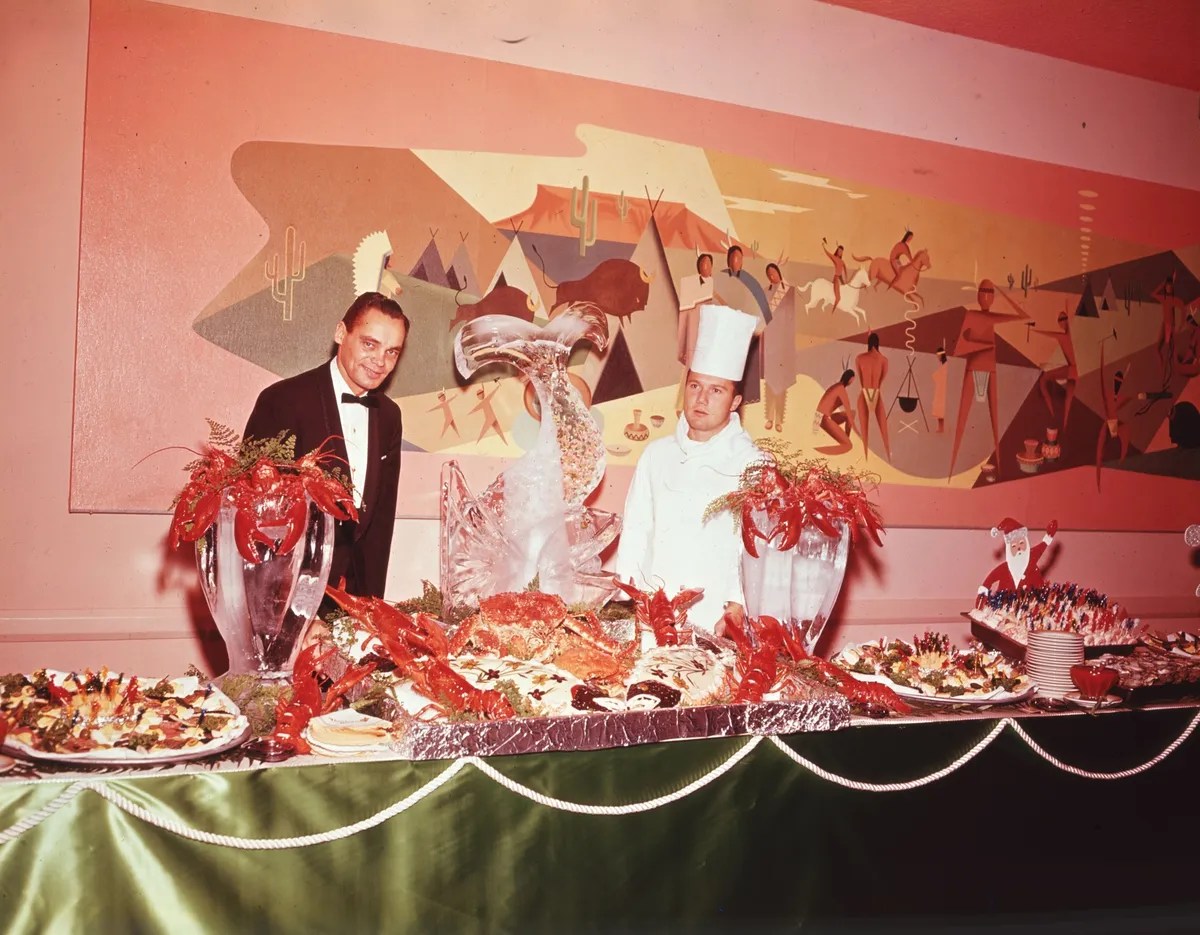
On the rise and fall of the Las Vegas casino buffet…
… With the May 31 closure of the MGM Grand Buffet, the Strip is down to about half a dozen all-you-can-eat buffets. It was once home to more than 10 times that many.
Excluding the sushi bar, the MGM Grand’s $44 Sunday mimosa brunch might have looked about like it did when the resort opened in 1993. It offered crispy brisket at the carving station, biscuits, scrambled eggs and sauteed vegetables. Most of the meats had a tub of gravy next to them, either dark brown or as beige as the decor. The anachronistic vibe at the 535-seat establishmentstood in contrast with more expensive buffets at nearby Caesars Palace and Wynn, overflowing with luxury offerings like turmeric grilled baby octopus, Peking duck and lobster toasts garnished with caviar.
“Young people complain that it looks old,” says Shaunell Samano, the MGM Grand Buffet’s assistant general manager. She has a job lined up at the nearby Luxor. All five of the servers hustling the floor had worked there since the resort’s opening. Most of the staff had been prepping the buffet for at least 26 years. Samano recalled guests even visiting twice a day, including retired boxer Evander Holyfield and his wife a few years ago.
The vanishing old-school Vegas buffet comes as Americans rethink their relationship to food and travel. A 2025 Cornell University study found that the proliferation of GLP-1 drugs is driving down demand for the kinds of indulgent foods available at all-you-can-eat buffets, and several studies show that gastronomic experiences are fundamental to choosing a vacation destination. Still, a 2025 Pew Research Center study indicated that even if consumers are more health-conscious than ever, taste and affordability remain the most important factors in deciding what to eat.
All-you-can-eat buffets may be receding from their spiritual home of Las Vegas, but the country isn’t abandoning them yet.
Golden Corral Chief Executive Officer Lance Trenary told Bloomberg Intelligence in November that his company’s restaurants were averaging the same number of meals served as they were pre-pandemic. The all-you-can-eat Korean BBQ and hot-pot chain KPOT had three locations in 2020; it plans to have more than 150 open by the end of the calendar year. Yelp’s 2026 Trends forecast cited a 252% increase in searches for “all you can eat buffet.”
“Customers like buffets,” says Eric Chiang, a University of Nevada at Las Vegas economics professor who loves using buffets as a way to explain economics. “It’s a flat price with no risk involved and no surprise at the end,” he says.
The novelty of all-you-can-eat dining is rooted in contradictory American lifestyles: One diner sees freedom and abundance, while another sees waste and gluttony. They’re rare restaurants where, at least for an hour or two, anyone can eat like royalty…
… the all-you-can-eat buffet is inextricably linked to the glamorous excesses of Las Vegas, where famed promoter Herb McDonald hired Norwegian chef Arne Hansen Rom in 1946 to tailor the European smorgasbord to the tastes of the Western Yankee. The Midnight Chuckwagon, later known as the Buckaroo Buffet, lured gamblers at the El Rancho hotel and its previous incarnation, the Thunderbird. Along with a lounge act came unlimited food ranging from deviled eggs to shrimp cocktail to Rom’s specialty: barbecue spareribs. The all-you-can-eat buffet evolved into a signature loss leader for resorts competing to attract a new wave of Las Vegas tourists: families and international travelers.
When John Curtas recalls his first visit to a Las Vegas buffet as a 10-year-old in the early 1960s, the veteran Las Vegas food critic remembers a haunch of beef that looked 12 feet tall manned by a chef wielding a carving knife like a scimitar. Beside the beef sat piles of shrimp, whole-cooked turkeys, potato salad and cowboy beans. It cost just $1, and he could return for more without embarrassment.
“Buffets gave you such a dazzle factor and eye candy,” Curtas says. “But they also gave a lot of perceived value for people and for families.”…
More on the social psychology and economics of buffets: “The Quintessential Old-School Las Vegas Buffet Bids Farewell” gift link from @bloomberg.com.
* Mae West
###
As we go back for seconds, we might spare a thought for Edwin Traisman; he died on this date in 2007. A food scientist, he is best remembered for helping to create Cheez Whiz for Kraft, then for perfecting the method used by McDonalds standardize their french fries (by freezing partially-cooked fries for transport and storage). But relevantly to the piece above, he also helped initiate research on E. coli 0157:H7, which was at the time (1987) a little known pathogen.

“…my age is as a lusty winter, / Frosty, but kindly…”*…

Aging is tough; Catherine Hiller offers a guide…
For some people, being old just comes naturally. They’ve acted old for years, and they know just what to do. They are the lucky ones—the “old souls,” if you will. For many others, being old just seems weird. They think, Really? How did I get here? What do I wear? How do I navigate this new geography?
This guide is expressly written for those who are bewildered by the face in the mirror and somehow think that 70 qualifies as middle-aged. These people need gentle guidance so that they, too, can enjoy the special perks of being old, beyond the senior discounts. This guide aims to help newcomers fit in with their cohort and enjoy their well-earned privileges.
At 79, I know something about old age, and I’ve compiled the following guidelines hoping they will empower you to enjoy your entitlements…
Read on for such useful tips as…
… Your health is vital to you, so it must be important to others as well. People want to hear about your ailments, even the minor ones, as well as all the cures you’ve ever tried. Your every test result is intriguing to your family and friends, so you should discuss the details. Oddly, the health problems of others are of little interest to you, unless they mirror your own…
… Everything really was better when you were young. Your mind tells you that every generation feels this way (including the Athenians in the Golden Age, 400 years BC), but your heart tells you that this time, you are actually right! You came of age in the Summer of Love, which lasted about a decade. There was joy in the air, and a sense of personal and social freedom. Humankind would progress. Everything would be better! Be sure to talk to your children and grandchildren constantly about what it was like when you were young, and how very much worse things are today.
Embrace your inner curmudgeon! You have every right to be cranky, because many things are difficult, and the news is always appalling. At this point, you’ve had many disappointments, and likely some physical problems as well. There’s no need to mute your general displeasure. Being old is the time to express it fully, forcefully and funnily. (At least you assume your tirades are amusing.)…
… Your clothing choices will be determined entirely by comfort. In this, you and other old people are in the fashion vanguard. Remember the “little old ladies in tennis shoes”? Well, who wears sneakers now? Only everyone, all the time! Celebrate your preference for flowing clothes in neutral colors. Turns out some of you have been “coastal grandmothers” long before it was a thing. For years you’ve been wearing pants with elastic waistbands or drawstrings, predating and predicting pandemic dressing, when everyone wore sweatpants. Turns out old people are the true fashionistas!…
More pearls at: “How to Be Old,” from @oldstermag.bsky.social.
* Shakespeare, As You Like It, Act II, Scene 3
###
As we muse on maturity, we might note that today is National Buffet Day, an annual celebration of an occasion for the senescent to practice most of the advice Hiller gives in the piece featured above.
“Beans, Beans, the Musical Fruit”*…

Then remarkable Umberto Eco on his candidate for the most important innovation of the last millennium. After considering the stern mounted rudder, the horse shoe, the yoke, the improved plough, crop rotation, gunpowder, and other candidates, he nominates a humble but central development…
… But what I really want to talk about is beans, and not just beans but also peas and lentils. All these fruits of the earth are rich in vegetable proteins, as anyone who goes on a low-meat diet knows, for the nutritionist will be sure to insist that a nice dish of lentils or split peas has the nutritional value of a thick, juicy steak. Now the poor, in those remote Middle Ages, did not eat meat, unless they managed to raise a few chickens or engaged in poaching (the game of the forest was the property of the lords). And as I mentioned earlier, this poor diet begat a population that was ill nourished, thin, sickly, short and incapable of tending the fields. So when, in the 10th century, the cultivation of legumes began to spread, it had a profound effect on Europe. Working people were able to eat more protein; as a result, they became more robust, lived longer, created more children and repopulated a continent.
We believe that the inventions and the discoveries that have changed our lives depend on complex machines. But the fact is, we are still here — I mean we Europeans, but also those descendants of the Pilgrim Fathers and the Spanish conquistadors — because of beans. Without beans, the European population would not have doubled within a few centuries, today we would not number in the hundreds of millions and some of us, including even readers of this article, would not exist. Some philosophers say that this would be better, but I am not sure everyone agrees.
And what about the non-Europeans? I am unfamiliar with the history of beans on other continents, but surely even without European beans, the history of those continents would have been different, just as the commercial history of Europe would have been different without Chinese silk and Indian spices.
Above all, it seems to me that this story of beans is of some significance for us today. In the first place, it tells us that ecological problems must be taken seriously. Secondly, we have all known for a long time that if the West ate unmilled brown rice, husks and all (delicious, by the way), we would consume less food, and better food.
But who thinks of such things? Everyone will say that the greatest invention of the millennium is television or the microchip. But it would be a good thing if we learned to learn something from the Dark Ages too…
What innovation was most instrumental in creating the modern world? “Best Invention: How the Bean Saved Civilization” (gift link) from the April 18, 1999 edition of @nytimes.com.
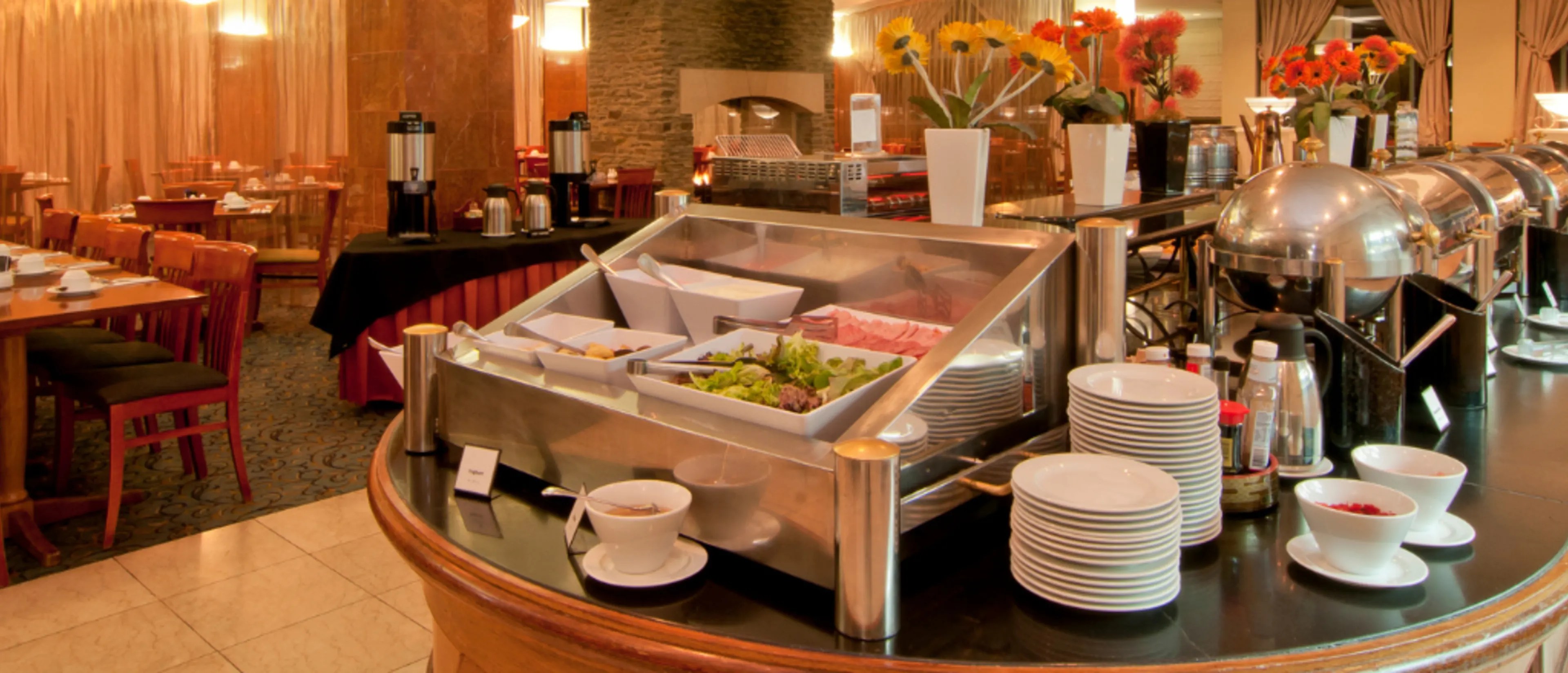
(Image above: source)
* children’s playground saying
###
As we lionize legumes, we might note that today is National Buffet Day, a celebration of an occasion to heap one’s plate with beans (or whatever).
“Food is an important part of a balanced diet”*…

In your quest to eat right, are you an a nutritionist or an essentialist?
Nutrition science began with the chemical description of proteins, fats and carbohydrates in the 19th century. The field didn’t seem to hold much medical import; the research was mostly aimed at cheaply feeding poor and institutionalised people well enough to keep them from rioting. Germ theory, on the other hand, was new and revolutionary medical science, and microbiologists such as Louis Pasteur were demonstrating that one disease after another, from cholera to malaria to leprosy, was caused by microbes. But at the turn of the 20th century, nutrition science suddenly arrived as a major part of our understanding of human health…
In 1911, the Polish chemist Casimir Funk announced that he’d isolated the beriberi-preventing chemical, which he thought to be a molecule containing an amine group, and named it ‘vitamine’ – a vital amine. The next year, Funk published an ambitious paper and book arguing that not only beriberi but three other human diseases – scurvy, pellagra and rickets – were each caused by a lack of a particular vitamin. Within a few months, the English researcher Frederick Hopkins published the results of a series of experiments in which he fed animals diets based on pure proteins, carbohydrates and fats, after which they developed various ailments. He posited that the simplified diets lacked some ‘accessory food factors’ important for health. Those factors and many others were discovered over the next three decades, and researchers showed how these vitamins were critical to the function of practically every part of the body. Ten of those scientists, including Eijkman and Hopkins, won Nobel prizes. At the same time that physicists laid out the theories of general relativity and quantum mechanics, describing fundamental laws that governed the Universe on its smallest and largest scales, chemists discovered the laws that seemed to govern the science of nutrition.
[… which, over the last 100 years, has exploded…]
[Gyorgy Scrinis, a professor of food politics and policy at the University of Melbourne] argues that the field of nutrition science is under the sway of an ideology he dubbed ‘nutritionism’, a mode of thinking about food that makes a number of erroneous assumptions: it reduces foods to quantified collections of nutrients, pulls foods out of the context of diets and lifestyles, presumes that biomarkers such as body-mass index are accurate indicators of health, overestimates scientists’ understanding of the relationship between nutrients and health, and falls for corporations’ claims that the nutrients they sprinkle into heavily processed junk foods make them healthful. These errors lead us toward food that is processed to optimise its palatability, convenience and nutrient profile, drawing us away from the whole foods that Scrinis says we should be eating. He says the history of margarine provides a tour of the perils of nutritionism: it was first adopted as a cheaper alternative to butter, then promoted as a health food when saturated fat became a nutritional bugbear, later castigated as a nutritional villain riddled with trans fats, and recently reformulated without trans fats, using new processes such as interesterification. That has succeeded in making margarine look better, according to nutritionism’s current trends, but is another kind of ultra-processing that’s likely to diminish the quality of food….
While Scrinis cites the growing body of scientific research implicating modern food processing, he also supports his critique of nutritionism with appeals to intuition. ‘This idea that ultra-processed foods are degraded – we’ve always known this,’ he says. ‘Our senses tell us whole foods are wholesome. People know this intuitively. The best foods in terms of cuisine are made from whole foods, not McDonald’s. It’s common sense.’
Even as nutritionism pushes us to believe that the latest nutrition research reveals something important about food, we also hold on to a conflicting concept: the idea that natural foods are better for us in ways that don’t always show up in scientific studies – that whole foods contain an inherent essence that is despoiled by our harsh modern processing techniques. ‘It’s a general attitude that you can break foods down that is the problem,’ says Scrinis. ‘It’s showing no respect for the food itself.’ This idea of respecting food reveals an underlying perspective that is essentialist, which, in philosophy, is the Platonic view that certain eternal and universal characteristics are essential to identity. Science is usually thought of as the antithesis of our atavistic intuitions, yet nutrition science has contained an essentialist view of nutrition for almost a century.
…
Most of us carry both ideologies, essentialism and nutritionism, in our minds, pulling us in different directions, complicating how we make decisions about what to eat. This tension is also visible in nutrition. Many government public health agencies give precise recommendations, based on a century of hard research, for the amounts of every nutrient we need to keep us healthy. They also insist that whole foods, especially fruits and vegetables, are the best ways to get those nutrients. But if you accept the nutrient recommendations, why assume that whole foods are a better way of getting those nutrients than, say, a powdered mix that is objectively superior in terms of cost, convenience and greenhouse emissions? What’s more, powdered mixes make it far easier for people to know exactly what they’re eating, which addresses one problem that constantly vexes nutritionists.
This kind of reflexive preference for natural foods can sometimes blind us to the implications of science. Even as research piles up implicating, for instance, excessive sugar as a particular problem in modern diets, most nutrition authorities refuse to endorse artificial sweeteners as a way to decrease our sugar consumption. ‘I’ve spent a lot of time with artificial sweeteners, and I cannot find any solid evidence there’s anything wrong with including them in your diet,’ says Tamar Haspel, a Washington Post columnist who has been writing about nutrition for more than 20 years. She says there’s some evidence that low-calorie sweeteners help some people lose weight, but you won’t hear that from nutrition authorities, who consistently minimise the positives while focusing on potential downsides that have not been well-established by research, such as worries that they cause cancer or scramble the gut microbiome. Why the determined opposition? ‘Because artificial sweeteners check lots of the boxes of the things that wholesome eaters avoid. It’s a chemical that’s manufactured in a plant. It’s created by the big companies that are selling the rest of the food in our diet, a lot of which is junk.’ Haspel says that nutritionists’ attitude to low-calorie sweeteners is ‘puritanical, it’s holier-than-thou, and it’s breathtakingly condescending’. The puritanical response reflects the purity of essentialism: foods that are not ‘natural’ are not welcome in the diets of right-thinking, healthy-eating people…
Our arguments over food are so polarised because they are not only about evidence: they are about values. Our choice of what we put inside us physically represents what we want inside ourselves spiritually, and that varies so much from person to person. Hearn uses food, much of it from a blender, to hack his body and keep him well-fuelled between business meetings. Scrinis looks forward to spending time in his kitchen, tinkering with new varieties of sourdough packed with sprouted grains and seeds. Haspel lives in Cape Cod, where she grows oysters, raises chickens, and hunts deer for venison – and also drinks diet soda and uses sucralose in her smoothies and oatmeal, to help keep her weight down.
Nutritionism and essentialism provide comfortingly clear perspectives about what makes food healthful. But an open-minded look at the evidence suggests that many of the most hotly debated questions about nutrition are impossible to answer with the information we have, maybe with the information we will ever have in the foreseeable future. If we isolate nutrients and eat them in different forms than they naturally come in, how will they affect us? Can processed foods be made in ways to approach or even surpass the healthfulness of natural whole foods?…
Human bodies are so fascinating in part because they are so variable and malleable. Beyond some important universals, such as the vitamins discovered a century ago, different people’s bodies work differently, because of their genes, behaviours and environments. The food we eat today changes the way our bodies work tomorrow, making yesterday’s guidance out of date. There are too many variables and too few ways to control them…
Maybe the reason that diet is so difficult to optimise is that there is no optimal diet. We are enormously flexible omnivores who can live healthily on varied diets, like our hunter-gatherer ancestors or modern people filling shopping carts at globally sourced supermarkets, yet we can also live on specialised diets, like traditional Inuits who mostly ate a small range of Arctic animals or subsistence farmers who ate little besides a few grains they grew. Aaron Carroll, a physician in Indiana and a columnist at The New York Times, argues that people spend far too much time worrying about eating the wrong things. ‘The “dangers” from these things are so very small that, if they bring you enough happiness, that likely outweighs the downsides,’ he said in 2018. ‘So much of our food discussions are moralising and fear-inducing. Food isn’t poison, and this is pretty much the healthiest people have even been in the history of mankind. Food isn’t killing us.’
Food is a vehicle for ideologies such as nutritionism and essentialism, for deeply held desires such as connecting with nature and engineering a better future. We argue so passionately about food because we are not just looking for health – we’re looking for meaning. Maybe, if meals help provide a sense of meaning for your life, that is the healthiest thing you can hope for.
Vitamins or whole foods? high-fat or low-fat? sugar or sweetener?… Will we ever get a clear idea about what we should eat? “The Food Wars,” from Amos Zeeberg (@settostun)
[image above: source]
* Fran Lebowitz
###
As we scale the food pyramid, we might send birthday greetings in oyster sauce to Joyce Chen; she was born on this date in 1917. A chef, restauranteur, author, television personality, and entrepreneur, she parlayed a successful Cambridge, MA restaurant (where she’s credited with creating the “all you can eat Chinese buffet” to perk up slow Tuesdays and Wednesdays) into a collection of restaurants, a cooking school, a series of cookbooks, and a PBS series (shot on the same set as Julia Child’s show). She is credited with popularizing northern-style Chinese cuisine in America. Chen was honored in 2014 (along with Julia Child) as one of the five chefs featured on a series of U.S. postage stamps.

“If we were capable of thinking of everything, we would still be living in Eden, rent-free with all-you-can-eat buffets and infinitely better daytime TV programming”*…

Few things epitomize America more than the all-you-can-eat buffet.
For a small fee, you’re granted unencumbered access to a wonderland of gluttony. It is a place where saucy meatballs and egg rolls share the same plate without prejudice, where a tub of chocolate pudding finds a home on the salad bar, where variety and quantity reign supreme.
“The buffet is a celebration of excess,” says Chef Matthew Britt, an assistant professor at the Johnson & Wales College of Culinary Arts. “It exists for those who want it all.”
But one has to wonder: How does an industry that encourages its customers to maximize consumption stay in business?
To find out, we spoke with industry experts, chefs, and buffet owners. As it turns out, it’s harder to “beat” the buffet than you might think…
Is it possible to out-eat the price you pay for a buffet? How do these places make money? The dollars and cents behind the meat and potatoes: “The economics of all-you-can-eat buffets.”
* Dean Koontz
###
As we pile it high, we might recall that it was on this date in 1883 that A. Ashwell, of Herne Hill in South London, received a patent for the “vacant/engaged” door bolt for lavatory doors… presumably a relief to the folks who had been using the public restrooms that had been introduced in London in 1852.

You must be logged in to post a comment.