Posts Tagged ‘Edwin Traisman’
“Too much of a good thing can be wonderful”*…
On the rise and fall of the Las Vegas casino buffet…
… With the May 31 closure of the MGM Grand Buffet, the Strip is down to about half a dozen all-you-can-eat buffets. It was once home to more than 10 times that many.
Excluding the sushi bar, the MGM Grand’s $44 Sunday mimosa brunch might have looked about like it did when the resort opened in 1993. It offered crispy brisket at the carving station, biscuits, scrambled eggs and sauteed vegetables. Most of the meats had a tub of gravy next to them, either dark brown or as beige as the decor. The anachronistic vibe at the 535-seat establishmentstood in contrast with more expensive buffets at nearby Caesars Palace and Wynn, overflowing with luxury offerings like turmeric grilled baby octopus, Peking duck and lobster toasts garnished with caviar.
“Young people complain that it looks old,” says Shaunell Samano, the MGM Grand Buffet’s assistant general manager. She has a job lined up at the nearby Luxor. All five of the servers hustling the floor had worked there since the resort’s opening. Most of the staff had been prepping the buffet for at least 26 years. Samano recalled guests even visiting twice a day, including retired boxer Evander Holyfield and his wife a few years ago.
The vanishing old-school Vegas buffet comes as Americans rethink their relationship to food and travel. A 2025 Cornell University study found that the proliferation of GLP-1 drugs is driving down demand for the kinds of indulgent foods available at all-you-can-eat buffets, and several studies show that gastronomic experiences are fundamental to choosing a vacation destination. Still, a 2025 Pew Research Center study indicated that even if consumers are more health-conscious than ever, taste and affordability remain the most important factors in deciding what to eat.
All-you-can-eat buffets may be receding from their spiritual home of Las Vegas, but the country isn’t abandoning them yet.
Golden Corral Chief Executive Officer Lance Trenary told Bloomberg Intelligence in November that his company’s restaurants were averaging the same number of meals served as they were pre-pandemic. The all-you-can-eat Korean BBQ and hot-pot chain KPOT had three locations in 2020; it plans to have more than 150 open by the end of the calendar year. Yelp’s 2026 Trends forecast cited a 252% increase in searches for “all you can eat buffet.”
“Customers like buffets,” says Eric Chiang, a University of Nevada at Las Vegas economics professor who loves using buffets as a way to explain economics. “It’s a flat price with no risk involved and no surprise at the end,” he says.
The novelty of all-you-can-eat dining is rooted in contradictory American lifestyles: One diner sees freedom and abundance, while another sees waste and gluttony. They’re rare restaurants where, at least for an hour or two, anyone can eat like royalty…
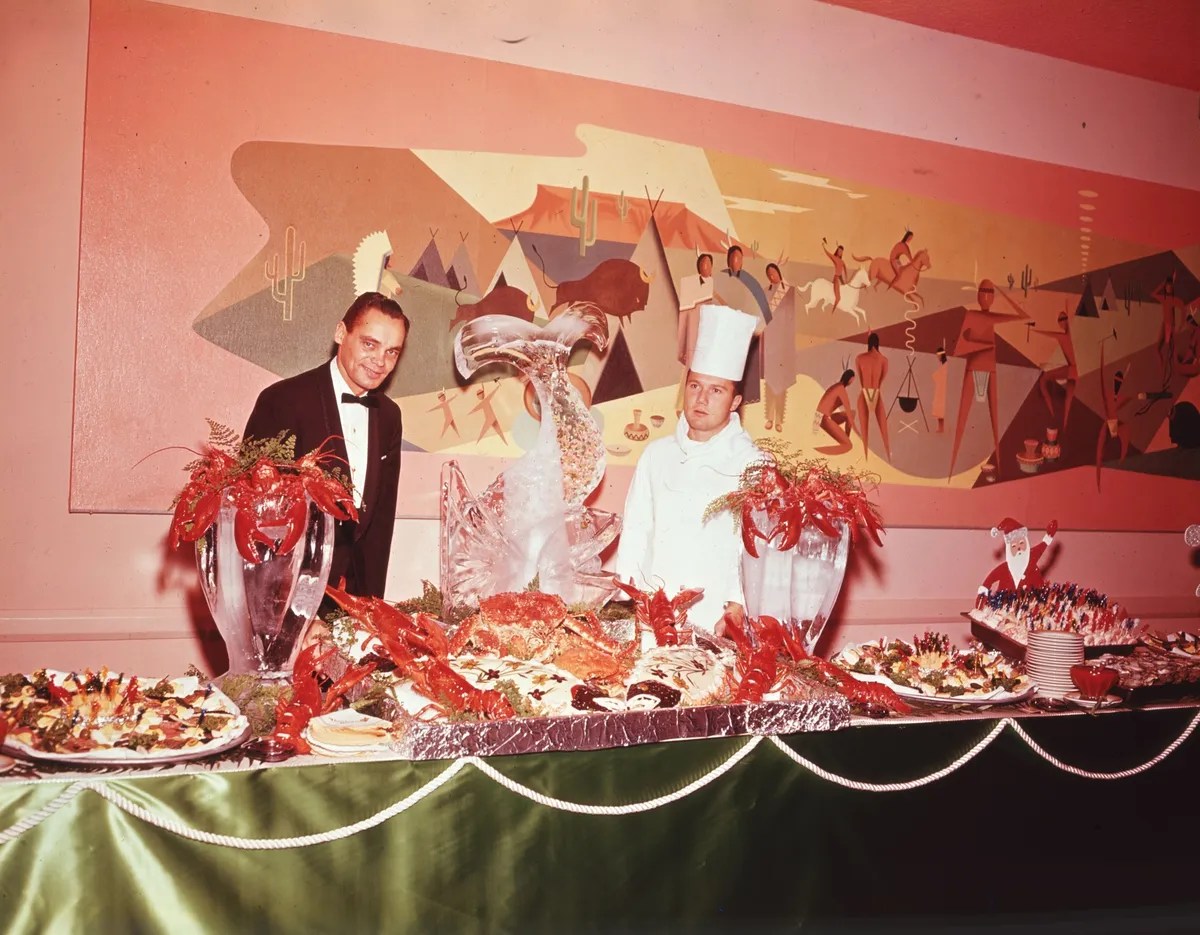
… the all-you-can-eat buffet is inextricably linked to the glamorous excesses of Las Vegas, where famed promoter Herb McDonald hired Norwegian chef Arne Hansen Rom in 1946 to tailor the European smorgasbord to the tastes of the Western Yankee. The Midnight Chuckwagon, later known as the Buckaroo Buffet, lured gamblers at the El Rancho hotel and its previous incarnation, the Thunderbird. Along with a lounge act came unlimited food ranging from deviled eggs to shrimp cocktail to Rom’s specialty: barbecue spareribs. The all-you-can-eat buffet evolved into a signature loss leader for resorts competing to attract a new wave of Las Vegas tourists: families and international travelers.
When John Curtas recalls his first visit to a Las Vegas buffet as a 10-year-old in the early 1960s, the veteran Las Vegas food critic remembers a haunch of beef that looked 12 feet tall manned by a chef wielding a carving knife like a scimitar. Beside the beef sat piles of shrimp, whole-cooked turkeys, potato salad and cowboy beans. It cost just $1, and he could return for more without embarrassment.
“Buffets gave you such a dazzle factor and eye candy,” Curtas says. “But they also gave a lot of perceived value for people and for families.”…
More on the social psychology and economics of buffets: “The Quintessential Old-School Las Vegas Buffet Bids Farewell” gift link from @bloomberg.com.
* Mae West
###
As we go back for seconds, we might spare a thought for Edwin Traisman; he died on this date in 2007. A food scientist, he is best remembered for helping to create Cheez Whiz for Kraft, then for perfecting the method used by McDonalds standardize their french fries (by freezing partially-cooked fries for transport and storage). But relevantly to the piece above, he also helped initiate research on E. coli 0157:H7, which was at the time (1987) a little known pathogen.

“Tell me what you eat, and I will tell you who you are”*…

Fuchsia Dunlop in praise of the multifaceted, deliciously-diverse Chinese cuisine…
If you visit a Shaoxing wine factory, you may walk past a stack of crumbly bricks made of some rough, pale, porous material. You’ll probably assume it’s debris left behind by negligent builders. But these bricks, this stuff, so unprepossessing to the eye, is one of the most important Chinese ingredients. You won’t see it in your bowl; you won’t smell or taste it directly; yet it’s an invisible presence in almost every Chinese meal. It is not merely an ingredient, but a pre-ingredient, the progenitor of some of the most vital components of Chinese edible culture. Like a genie, it brings Chinese food and drink to life.
The bricks are made of what is known as qu—which sounds like “choo,” but with a lovely softness—a sort of coral reef teeming with desiccated microorganisms, enzymes, moulds and yeasts that will spring into action in the presence of water, ready to unleash themselves on all kinds of foods, especially those that are starchy. The Japanese, who learned about qu from China, call it koji ; it’s sometimes translated into English as “ferment.” When awakened, all these microorganisms will magically transform cooked beans, rice and other cereals, unravelling their tight-knit starches into simple sugars, then fermenting the sugars into alcohol, meanwhile spinning off a whole aurora of intriguing flavors. It is qu that converts soybeans into soy sauce and jiang. Qu is the catalyst for fermenting alcoholic drinks from rice, millet and other cereals, as well as grain vinegars. It’s no exaggeration to say that qu is one of the keys to what makes Chinese food Chinese…
More kitchen secrets in this excerpt from her new book, Invitation to a Banquet: The Story of Chinese Food “The Marvels of Qu: What Makes Chinese Food and Drink Unique,” in @lithub.
* Jean Anthelme Brillat-Savarin
###
As we investigate identity, we might send tasty birthday greetings to Edwin Traisman; he was born on this date in 1915. A food scientist, he developed the process for freezing McDonald’s french fries that allowed for their standardization, developed Cheez Whiz for Kraft Foods, and researched E. coli.

You must be logged in to post a comment.