Posts Tagged ‘Las Vegas’
“Too much of a good thing can be wonderful”*…
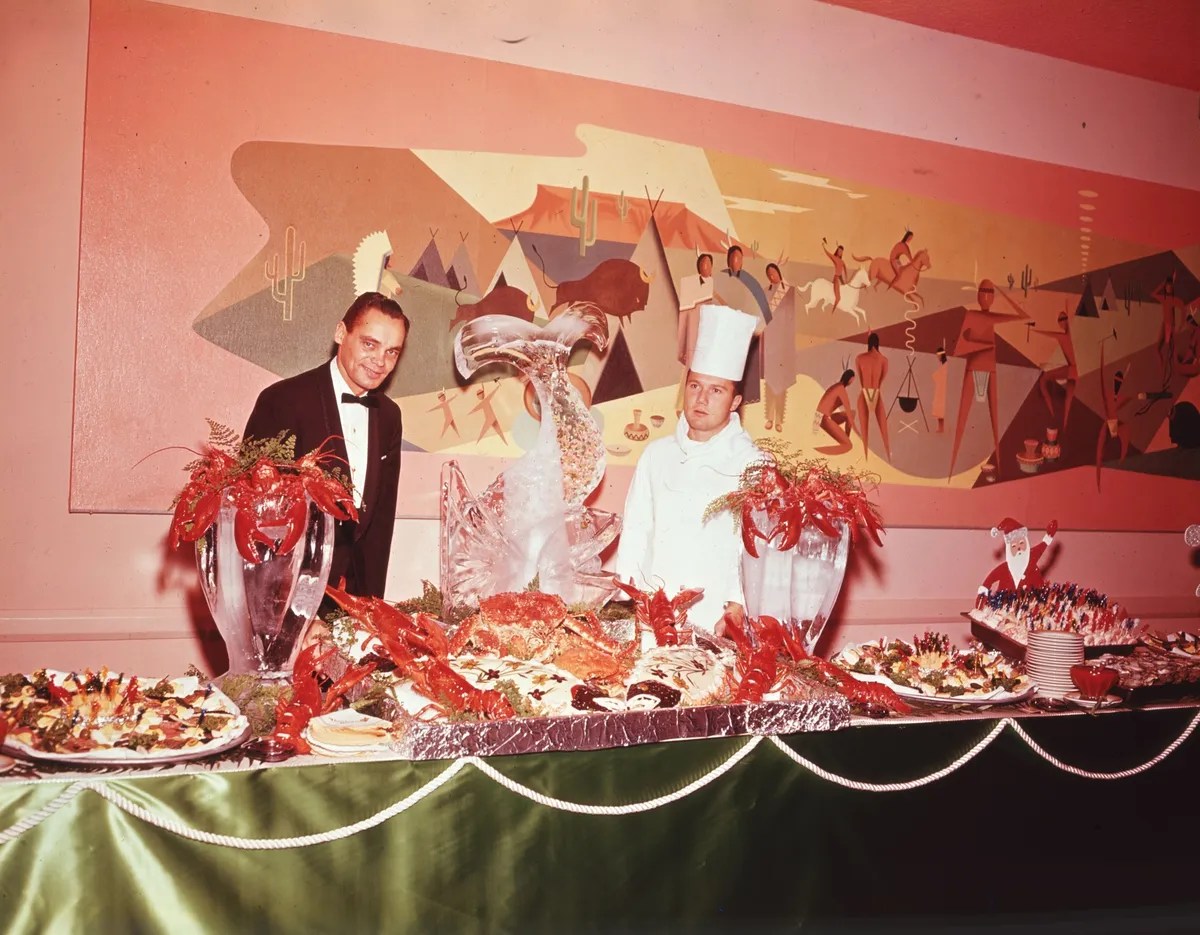
On the rise and fall of the Las Vegas casino buffet…
… With the May 31 closure of the MGM Grand Buffet, the Strip is down to about half a dozen all-you-can-eat buffets. It was once home to more than 10 times that many.
Excluding the sushi bar, the MGM Grand’s $44 Sunday mimosa brunch might have looked about like it did when the resort opened in 1993. It offered crispy brisket at the carving station, biscuits, scrambled eggs and sauteed vegetables. Most of the meats had a tub of gravy next to them, either dark brown or as beige as the decor. The anachronistic vibe at the 535-seat establishmentstood in contrast with more expensive buffets at nearby Caesars Palace and Wynn, overflowing with luxury offerings like turmeric grilled baby octopus, Peking duck and lobster toasts garnished with caviar.
“Young people complain that it looks old,” says Shaunell Samano, the MGM Grand Buffet’s assistant general manager. She has a job lined up at the nearby Luxor. All five of the servers hustling the floor had worked there since the resort’s opening. Most of the staff had been prepping the buffet for at least 26 years. Samano recalled guests even visiting twice a day, including retired boxer Evander Holyfield and his wife a few years ago.
The vanishing old-school Vegas buffet comes as Americans rethink their relationship to food and travel. A 2025 Cornell University study found that the proliferation of GLP-1 drugs is driving down demand for the kinds of indulgent foods available at all-you-can-eat buffets, and several studies show that gastronomic experiences are fundamental to choosing a vacation destination. Still, a 2025 Pew Research Center study indicated that even if consumers are more health-conscious than ever, taste and affordability remain the most important factors in deciding what to eat.
All-you-can-eat buffets may be receding from their spiritual home of Las Vegas, but the country isn’t abandoning them yet.
Golden Corral Chief Executive Officer Lance Trenary told Bloomberg Intelligence in November that his company’s restaurants were averaging the same number of meals served as they were pre-pandemic. The all-you-can-eat Korean BBQ and hot-pot chain KPOT had three locations in 2020; it plans to have more than 150 open by the end of the calendar year. Yelp’s 2026 Trends forecast cited a 252% increase in searches for “all you can eat buffet.”
“Customers like buffets,” says Eric Chiang, a University of Nevada at Las Vegas economics professor who loves using buffets as a way to explain economics. “It’s a flat price with no risk involved and no surprise at the end,” he says.
The novelty of all-you-can-eat dining is rooted in contradictory American lifestyles: One diner sees freedom and abundance, while another sees waste and gluttony. They’re rare restaurants where, at least for an hour or two, anyone can eat like royalty…
… the all-you-can-eat buffet is inextricably linked to the glamorous excesses of Las Vegas, where famed promoter Herb McDonald hired Norwegian chef Arne Hansen Rom in 1946 to tailor the European smorgasbord to the tastes of the Western Yankee. The Midnight Chuckwagon, later known as the Buckaroo Buffet, lured gamblers at the El Rancho hotel and its previous incarnation, the Thunderbird. Along with a lounge act came unlimited food ranging from deviled eggs to shrimp cocktail to Rom’s specialty: barbecue spareribs. The all-you-can-eat buffet evolved into a signature loss leader for resorts competing to attract a new wave of Las Vegas tourists: families and international travelers.
When John Curtas recalls his first visit to a Las Vegas buffet as a 10-year-old in the early 1960s, the veteran Las Vegas food critic remembers a haunch of beef that looked 12 feet tall manned by a chef wielding a carving knife like a scimitar. Beside the beef sat piles of shrimp, whole-cooked turkeys, potato salad and cowboy beans. It cost just $1, and he could return for more without embarrassment.
“Buffets gave you such a dazzle factor and eye candy,” Curtas says. “But they also gave a lot of perceived value for people and for families.”…
More on the social psychology and economics of buffets: “The Quintessential Old-School Las Vegas Buffet Bids Farewell” gift link from @bloomberg.com.
* Mae West
###
As we go back for seconds, we might spare a thought for Edwin Traisman; he died on this date in 2007. A food scientist, he is best remembered for helping to create Cheez Whiz for Kraft, then for perfecting the method used by McDonalds standardize their french fries (by freezing partially-cooked fries for transport and storage). But relevantly to the piece above, he also helped initiate research on E. coli 0157:H7, which was at the time (1987) a little known pathogen.

“Las Vegas: a savage journey to the heart of the American dream”*…

Isaac Ariail Reed muses on Las Vegas and what it can tell us about ourselves…
It comes buzzing into my mind like a hazy half dream, the kind that arrives when you’ve had too much espresso and need to close your eyes in the dark of your hotel room for a moment. I’m in two places at once: One is the Neon Museum in Las Vegas, where I am wandering around the sandy two-acre lot amid the retired signs of dynamited casinos, hotels, and other businesses on the Strip, listening to old Elvis live shows on my headphones; the other is the recently opened poker room in the Venetian Casino, where I find myself sitting next to Walter Benjamin, the German Jewish intellectual who once saw, with a clarity that remains difficult to reckon with today, the end of an epoch.
As Benjamin wrote in 1928, in his sprawling and unfinished magnum opus The Arcades Project, “if, sometime in the mid-nineties, we had asked for a prediction, surely it would have been: the decline of a culture.” He meant the 1890s, the European fin-de-siècle and the coming descent into fascism, but I could say the same thing about the 1990s today. Benjamin was writing about the arcades, those iron-and-glass canopied commercial passageways that he took as emblematic of Paris when it was the epicenter of the glory and fragility of nineteenth-century bourgeois culture. What Benjamin saw in the persistence of the remaining arcades in early-twentieth-century Paris (after the urban-renewal efforts of Baron Haussmann leveled many) is what I see in the persistently glitzy architecture and tightly time-constrained nightly shows of Las Vegas today: a culture attempting to grasp its own passing…
…
… What I did not quite realize viscerally before this year, though, is something that the great art critic Dave Hickey was always on about. Las Vegas, despite its similarities to Macau, is in its history, culture, and politics deeply American. Hence, de Tocqueville: “Those who live in the midst of democratic fluctuations have always before their eyes the image of chance; and they end by liking all undertakings in which chance plays a part.” In Hickey’s 1997 classic, Air Guitar, he wrote, “America…is a very poor lens through which to view Las Vegas, while Las Vegas is a wonderful lens through which to view America.” He continued:
What is hidden elsewhere exists here in quotidian visibility. So when you fly out of Las Vegas to, say, Milwaukee, the absences imposed by repression are like holes in your vision. They become breathtakingly perceptible, and, as a consequence, there is no better place than Las Vegas for a traveler to feel at home. The town has a quick, feral glamour that is hard to localize—and it arises, I think, out of the suppression of social differences rather than their exacerbation. The whole city floats on a sleek frisson of anxiety and promise that those of us addicted to such distraction must otherwise induce by motion or medication.
Hickey was luminously perspicacious in his ability to recognize, amid the vast and disturbing inequalities of Las Vegas, the horizontality of its cultural politics, which are not so much lowbrow as they are open to weirdness and conformity in equal measure such that the sheer humanity of the equally but differently weird (or conformist) is suddenly public and undeniable. Hickey also argued that there was something about the American experiment wrapped up in his “home in the neon.” The secret of Vegas is that there are no secrets, he explained, and, furthermore, “there are only two rules: (1) Post the odds, and (2) Treat everybody the same. Just as one might in a democracy (What a concept!)” Hickey thus found in Liberace’s rhinestones the key to a democratic politics of honest fakery as a defense against the subtle tyranny—recently become much less subtle—of a politics of authenticity and its handmaiden, the deep hatred of art, freedom, and changing your mind dressed up as love of family, morality, nation, and the supposed liberty of guns and tariffs. The emphasis, for Hickey, is on the honest and the different human commmunities of desire that are the root of pluralism in aesthetics: Liberace’s rhinestones is not a real diamond, but union wages, sexual freedom, and aesthetic ambition are honestly held commitments. In Hickey’s version of Las Vegas, no one asks who is a “real” American, because the reality of the USA is not something that has to be performed into existence by duplicitous electoral promises and unpaid contractors; it’s right there in the posted gambling odds, the midnight steak and eggs, and the civilizational ambition of the Hoover Dam.
This, then, is the problem we have inherited from Hickey: Can the bare and brutal honest fakery of Las Vegas, and the deeply American, weirdly libertarian, outsider-art-loving union democracy that Hickey found inside that honest fakery sustain itself as part of a free society? Or will the crushing inequality, insane techno-oligarchy, and battling moralisms of toxic masculinity and therapeutic bureaucracy be, in the end, too much for Vegas and thus too much for the United States as well?…
…
… There was in Hickey’s writing a deep suspicion of both the aesthetics and the politics of authenticity, and that suspicion, one might hazard, is the connection between Las Vegas and the kernel of freedom held in common that has, on occasion, here and there, made itself present in American life, and which has sustained American intellectuals as distinct as John Dewey and Joan Didion. What, then, does Las Vegas do for us when it reminds us that libido is a fact of life and building a culture on its suppression is a little like taking a political stand against gravity? Here I found my way to a different kind of theorizing, once I realized that far from any simulacrum, Las Vegas is in fact the place where American modernity articulates the eternal problems of being human.
On the one hand, Las Vegas is the culmination of the historically specific phenomenon of the American modern, bringing together the technological sublime, movable capital, representative democracy, and libertarian culture in the first postindustrial metropolis. Yet on the other hand, Vegas is about the inescapable aspects of human existence from time immemorial: desire as multiple, the importance of creature comforts to a sense of well-being, the philosophy of uncertainty and the problem of fate, embodiment as both wonderful and unbearable, and the irrepressible need to create new art and build new buildings. In this regard, we can say that Vegas is the place where the American project’s complex and conflictual relationship to the more immovable aspects of human life together was thrown into stark relief.
And then there are the binaries. In Vegas, it becomes quite clear that the towering economic power that drives American politics has, in the end, cultural sources and cultural consequences. The USA is about sin and salvation, filth and cleanliness, God and the Devil, believer and atheist, winners and losers. All societies have such binaries. The sociologist Émile Durkheim mapped them all as versions of sacred versus profane, while the anthropologist Claude Lévi-Strauss used them to read stories as clues to the structure of the mind itself. But in the United States, with its Calvinist inheritance and infamously strict racial hierarchy, the binaries have a special importance. They have always resisted middle grounds and gray areas, preferring the intense clash of purified poles to ambiguous endings and existential despair. This is why American movies are melodramatic to the point of absurdity and why the harshness of the American moral climate, when combined with the filth of American politics, created a political culture that can be unbearably self-righteous. Vegas puts on display the harsh feel and gleaming strangeness, bordering on surreality, of the American binaries, but it also breaks them down, which is the deep effect of its honest fakery. Vegas is not there to make you feel your job back home is unavoidable. It is there to make you ask whether the difference between good and evil is really what your pastor says it is.
For a long time, it sure looked as though Hickey was right to find a home in Las Vegas, and to find his version of America there too, because of the way Vegas both displayed the binaries and embraced the gray areas in between. It happens in two steps. First, the town cuts through pretense. One night in Vegas will remind you that in America, the most famous cultural critic in the world, past or present, is about as important as the current special-teams coach of the Pittsburgh Steelers (and probably less). Second, it liberates you from the defensiveness that constantly infects the American intellectual trying to justify his existence. Why? Because Vegas is an intellectual’s paradise in so far as it is the place that knows, better than anywhere else in the United States, that we are all creatures addicted to symbols, entranced by our illusions, and in need of a lucky roll. In Vegas, as Dean Martin and Katy Perry have both attested, the desirous body, the strategic mind, and the neon sign are bound together in a cosmic swirl, and the result is the Frankenstein’s monster of American modernity. What could be more intellectual than that?
Back when American modernity was more than the latest tweet from the Department of Homeland Security, its intellectuals navigated the harsh binaries of American culture via innovation in thinking and generosity of spirit, making some kind of room, some of the time, for the next immigrant culture to arrive and do the two most American things of all: make a buck and do whatever you want with religion and culture. This is the spirit we have lost; we increasingly just want to double down on the same binaries that every other preacher in this godforsaken land does, calling endlessly for the return of the cultural artifacts of an earlier era. But the two great philosophies of culture to emerge in America—pragmatism and jazz—are, among many other things, attempts to solve the problem of the excluded middle between the purest Good and the worst Evil, and to find in the very confrontation of contradiction an improvised way for humans to live together a little better tomorrow than they did yesterday. This is the American promise: that beyond the binaries lies not transcendent meaning or nihilism but a little bit of democracy, a little bit of freedom, and a whole lot of practicality.
But navigating the binaries to subvert and reinvent them takes energy, and it is that energy one still finds in Las Vegas. Even if in enervated form, it is there, and this is the part of the city—the Strip, yes, but also the Arts District and downtown—that some foreign visitors grasp intuitively and immediately and others will never, ever understand: Vegas as the intensity of American hustle. On that winter-vacation visit, I was set straight about it by my bartender. I had just had a quite unpleasant interaction at the craps table with an overstimulated and sleep-deficient fellow in town for the rodeo. His truculent attitude had turned very dark, even threatening, in response to my friendly overtures. I was getting ready to bitch about it to the young man from Los Angeles who had just served my whiskey and had all the signs of being a safe political harbor. He cut me off right away: “Shit, I’m glad they’re here. Otherwise, we’d have no money to make these two weeks in December.”
There, in that moment, I saw the tiniest glimpse of possibility for a new, but nonetheless recognizable, American culture, and I realized everything I was, in my academic bubble, missing. Vegas is much cheaper to live in than LA; for the first time in its history all major casinos on the Strip are unionized; my bartender, like me and the poker pros, was hustling most weeks of the year but was also going to take a real vacation with his girlfriend; I might be able to write and teach, but who cares about my opinions on the cultural politics of the rodeo? And that’s the deal that Las Vegas has offered: Make the wages fair and the housing affordable, post the damn odds, and let people make their own judgments about what kind of clothes, art, sex, and sports they want. That’s the project, if we want our country back in a new and better form. But the artists in Vegas are here to tell you: The odds are very long…
What does it mean to “think Las Vegas”? “Mourning and Melancholia in Las Vegas,” from @hedgehogreview.bsky.social. Eminently worth reading in full.
Pair with “Lost Vegas,” from @lukewinkie.bsky.social in @slate.com: “Everyone inside America’s most flailing destination city has a theory for what’s wrong. Now I have my own.”
* Hunter S. Thompson
###
As we check the odds, we might recall that it was on this date in 1997 that Las Vegas strip fixture The Aladdin hotel and casino closed. The site of Elvis and Priscilla Presley’s wedding in 1967, its final show was a preformance by Mötley Crüe.
The building was demolished the following March (in front of 20,000 spectators, 1,000 of whom paid $250 each to watch the implosion from inside a “ringside” tent). In 2000 a new Aladdin resort, three times larger than the original, opened on the site, but quickly went broke. It was purchased out of bankruptcy to become “The Planet Hollywood Resort and Casino.”

“He who controls the spice controls the universe”*

Spices were among the first engines of globalization, not in the modern sense of a world engulfed by ever-larger corporations but in the ways that we began to become aware, desirous even, of cultures other than our own. Such desire, unchecked, once led to colonialism. After Dutch merchants nearly tripled the price of black pepper, the British countered in 1600 by founding the East India Company, a precursor to modern multinationals and the first step toward the Raj. In the following decades, the Dutch sought a monopoly on cloves, which once had grown nowhere but the tropical islands of Ternate and Tidore in what is today Indonesia, and then in 1652 introduced the scorched-earth policy known as extirpation, felling and burning tens of thousands of clove trees. This was both an ecological disaster and horribly effective: For more than a century, the Dutch kept supplies low and prices high, until a Frenchman (surnamed, in one of history’s inside jokes, Poivre, or “pepper”) arranged a commando operation to smuggle out a few clove-tree seedlings. Among their ultimate destinations were Zanzibar and Pemba, off the coast of East Africa, which until the mid-20th century dominated the world’s clove market.
The craving for spices still brings the risk of exploitation, both economically, as farmers in the developing world see only a sliver of the profits, and in the form of cultural appropriation. In the West, we’re prone to taking what isn’t ours and acting as if we discovered it, conveniently forgetting its history and context. Or else we reduce it to caricature, cooing over turmeric-stained golden lattes while invoking the mystic wisdom of the East. At the same time, a world without borrowing and learning from our neighbors would be pallid and parochial — a world, in effect, without spice…
From turmeric in Nicaragua to cardamom in Guatemala, nonnative ingredients are redefining trade routes and making unexpected connections across lands: “How Spices Have Made, and Unmade, Empires.”
* Frank Herbert, Dune
###
As we go deep on dash, we might recall that this is National Buffet Day. The concept of the buffet arose in mid 17th century France, when gentleman callers would arrive unexpectedly at the homes of ladies they wanted to woo. It was popularized in 18th century France and quickly spread throughout Europe. The all-you-can-eat buffet made its restaurant debut in 1946, when it was introduced by Vegas hotel manager Herb MacDonald. By the mid-1960s, virtually every casino in Las Vegas sported its own variation. Today, of course, buffets are regularly available not only in any/every Vegas casino, but also in thousands of Indian and Chinese restaurants and ubiquitous chains of “family restaurants.”

“I can understand that a man might go to the gambling table – when he sees that all that lies between himself and death is his last crown”*…

Wheel of Fortune, Las Vegas, 1988
Thirty years ago, gambling in the US was limited to three destinations: Reno, Las Vegas, and Atlantic City. Jay Wolke photographed the ordinary people who played, lived and worked in the rapidly expanding cities. Wolke was fascinated by the intersections of people, artifice, architecture and landscape in the US’s three gambling cities…

Girl in car, Trump Plaza, Atlantic City, 1989

Fortune Hunter, Las Vegas, 1988
See more at “Same dream another time: under the skin of 80s Vegas – in pictures” and at Wolke’s site.
* Honoré de Balzac, The Wild Ass’s Skin
###
As we consider the odds, we might recall that it was on this date in 2000 that Cynthia Jay-Brennan won $34,959,458.56 on a Megabucks slot machine at the Desert Inn in Las Vegas, the world’s largest payout; it was a one in 7 million chance. A cocktail waitress at another casino, she had been a Desert Inn regular; on this occasion, she had “invested” $27 in the machine that paid off so handsomely.
Sadly. Jay-Brennan has become synonymous with the “Jackpot Jinx”: a few weeks after her huge haul, she and her sister were driving to a casino out of town when they were hit by a drunk driver, paralyzing her and killing her sister.

“A city that was to forge out of steel and blood-red neon its own peculiar wilderness”*…

A woman and her work
Las Vegas– and the world– lost two icons of neon sign design on April 19th: Betty Willis, seen above with the iconic “Welcome” sign that she designed, and Brian “Buzz” Leming, creator of many of the Strip’s most memorable marquees, passed away within hours of each other.

Leming’s “Hacienda Horse and Rider”
Willis and Leming both worked at the Western Sign Company, where they struck up a friendship. Many of their creations are preserved in the Neon Museum’s outdoor “Boneyard,” where it stores its relics.

The Neon Museum’s Boneyard
More at “Two Designers of Las Vegas’s Iconic Neon Signs Died on the Same Day.”
* Nelson Algren (writing about Chicago, though it’s surely apropos of Las Vegas as well)
###
As we switch on the lights, we might send forbearing birthday wishes to Marcus Aurelius Antoninus Augustus; he was born on this date in 121. The last of the Five Good Emperors, Marcus Aurelius is also considered one of the most important Stoic philosophers; his Meditations, written on campaign before he became emperor, is still a central text on the philosophy of service and duty.

You must be logged in to post a comment.