Posts Tagged ‘McDonalds’
“Too much of a good thing can be wonderful”*…
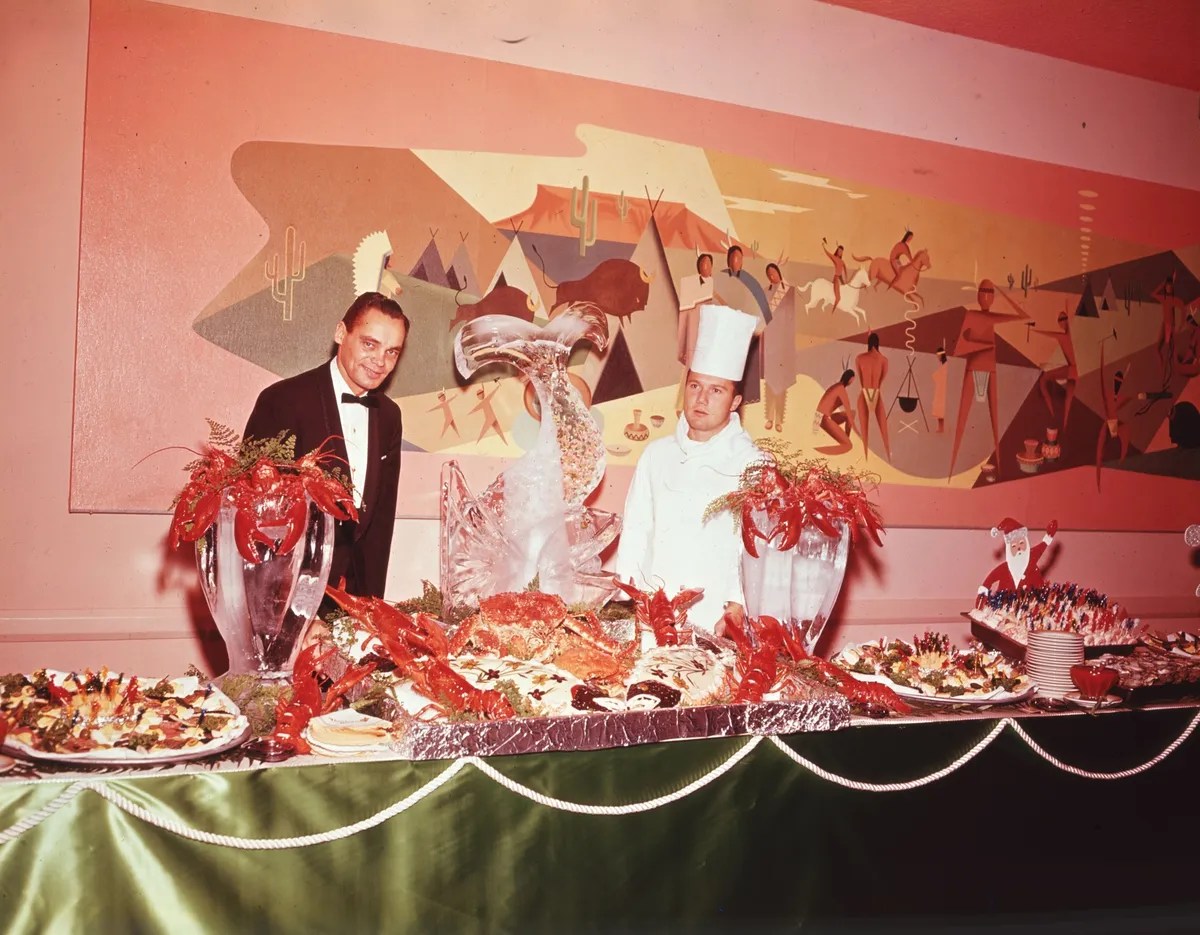
On the rise and fall of the Las Vegas casino buffet…
… With the May 31 closure of the MGM Grand Buffet, the Strip is down to about half a dozen all-you-can-eat buffets. It was once home to more than 10 times that many.
Excluding the sushi bar, the MGM Grand’s $44 Sunday mimosa brunch might have looked about like it did when the resort opened in 1993. It offered crispy brisket at the carving station, biscuits, scrambled eggs and sauteed vegetables. Most of the meats had a tub of gravy next to them, either dark brown or as beige as the decor. The anachronistic vibe at the 535-seat establishmentstood in contrast with more expensive buffets at nearby Caesars Palace and Wynn, overflowing with luxury offerings like turmeric grilled baby octopus, Peking duck and lobster toasts garnished with caviar.
“Young people complain that it looks old,” says Shaunell Samano, the MGM Grand Buffet’s assistant general manager. She has a job lined up at the nearby Luxor. All five of the servers hustling the floor had worked there since the resort’s opening. Most of the staff had been prepping the buffet for at least 26 years. Samano recalled guests even visiting twice a day, including retired boxer Evander Holyfield and his wife a few years ago.
The vanishing old-school Vegas buffet comes as Americans rethink their relationship to food and travel. A 2025 Cornell University study found that the proliferation of GLP-1 drugs is driving down demand for the kinds of indulgent foods available at all-you-can-eat buffets, and several studies show that gastronomic experiences are fundamental to choosing a vacation destination. Still, a 2025 Pew Research Center study indicated that even if consumers are more health-conscious than ever, taste and affordability remain the most important factors in deciding what to eat.
All-you-can-eat buffets may be receding from their spiritual home of Las Vegas, but the country isn’t abandoning them yet.
Golden Corral Chief Executive Officer Lance Trenary told Bloomberg Intelligence in November that his company’s restaurants were averaging the same number of meals served as they were pre-pandemic. The all-you-can-eat Korean BBQ and hot-pot chain KPOT had three locations in 2020; it plans to have more than 150 open by the end of the calendar year. Yelp’s 2026 Trends forecast cited a 252% increase in searches for “all you can eat buffet.”
“Customers like buffets,” says Eric Chiang, a University of Nevada at Las Vegas economics professor who loves using buffets as a way to explain economics. “It’s a flat price with no risk involved and no surprise at the end,” he says.
The novelty of all-you-can-eat dining is rooted in contradictory American lifestyles: One diner sees freedom and abundance, while another sees waste and gluttony. They’re rare restaurants where, at least for an hour or two, anyone can eat like royalty…
… the all-you-can-eat buffet is inextricably linked to the glamorous excesses of Las Vegas, where famed promoter Herb McDonald hired Norwegian chef Arne Hansen Rom in 1946 to tailor the European smorgasbord to the tastes of the Western Yankee. The Midnight Chuckwagon, later known as the Buckaroo Buffet, lured gamblers at the El Rancho hotel and its previous incarnation, the Thunderbird. Along with a lounge act came unlimited food ranging from deviled eggs to shrimp cocktail to Rom’s specialty: barbecue spareribs. The all-you-can-eat buffet evolved into a signature loss leader for resorts competing to attract a new wave of Las Vegas tourists: families and international travelers.
When John Curtas recalls his first visit to a Las Vegas buffet as a 10-year-old in the early 1960s, the veteran Las Vegas food critic remembers a haunch of beef that looked 12 feet tall manned by a chef wielding a carving knife like a scimitar. Beside the beef sat piles of shrimp, whole-cooked turkeys, potato salad and cowboy beans. It cost just $1, and he could return for more without embarrassment.
“Buffets gave you such a dazzle factor and eye candy,” Curtas says. “But they also gave a lot of perceived value for people and for families.”…
More on the social psychology and economics of buffets: “The Quintessential Old-School Las Vegas Buffet Bids Farewell” gift link from @bloomberg.com.
* Mae West
###
As we go back for seconds, we might spare a thought for Edwin Traisman; he died on this date in 2007. A food scientist, he is best remembered for helping to create Cheez Whiz for Kraft, then for perfecting the method used by McDonalds standardize their french fries (by freezing partially-cooked fries for transport and storage). But relevantly to the piece above, he also helped initiate research on E. coli 0157:H7, which was at the time (1987) a little known pathogen.

“Are you green and growing or ripe and rotting?”*…

From our old friend (see, e.g., here and here) Flowing Data‘s Nathan Yau…
I read that there are more golf courses than there are McDonald’s locations in the United States, which seemed surprising. There are about 16,000 golf courses and 13,000 McDonald’s locations. How could this be? Obviously, there are a lot of McDonald’s locations, but where are all these golf courses? Some maps made it clear.
[The yellow circles in the map above show] the distribution of McDonald’s locations across the conterminous United States. As you might expect, they concentrate around cities.
An area in East Los Angeles has 110 locations within a 10-mile radius, which makes it the most dense area. This makes sense because McDonald’s was founded in southern California. The second most is an area just outside Chicago with 88 locations. This also makes sense, because McDonald’s headquarters are in Chicago.
At first glance, [the distribution of] golf courses [the green circles in the map above] looks similar to the McDonald’s one. There is a higher concentration around cities, but golf courses are more widespread, especially in the Midwest.
This makes more sense now. You can have a golf course in an area where there aren’t that many people, because people will travel to play golf. Few people are going to travel specifically for McDonald’s.
…
The high number of golf courses along the Florida coast and in the northeast jump out to me, someone who has never played a round of golf. I also noticed it’s fairly common for smaller golf courses to sit next to each other, whereas you’re not going to see neighboring McDonald’s restaurants, which seems to contribute to the higher totals for the former…
Amazing but true: “McDonald’s Locations vs. Golf Courses,” from @flowingdata.
* Ray Kroc (founder of McDonalds-as-we-know-it)
###
As we get down with data, we might recall that it was on this date in 1945 that Byron Nelson teed off in the first round of the 1945 Miami International Four Ball Tournament. For five months– from that swing through August 4– he was untouchable: Nelson won that tournament and his next 10, a record 11 events in a row, and shot 50 consecutive rounds under par.

“The way we eat has changed more in the last 50 years than in the previous 10,000″*…

And that change is coming for China… Even as trade tension tighten between China and the U.S., foreign investment in China drops, and talk of decoupling grows (see, e.g., here and here), one sector of American business is doubling down on the Chinese market…
There’s been no shortage of tough news for China’s economy as some of the world’s biggest brands consider or take action to shift manufacturing to friendlier shores at a time of unease about security controls, protectionism and wobbly relations between Beijing and Washington.
Count Adidas, Apple and Samsung among those looking elsewhere.
But as a tumultuous 2023 for the Chinese economy comes to a close, there has been at least one bright spot for Beijing when it comes to foreign investment: American fast-food chains have decided a market of 1.4 billion people is simply too delicious to pass up.
KFC China’s parent company opened its 10,000th restaurant in China this month and aims to have stores within reach of half of China’s population by 2026. McDonald’s is planning to open 3,500 new stores in China over the next four years. And Starbucks invested $220 million in a manufacturing and distribution facility in eastern China, its biggest project outside the U.S.
This is surely not what Chinese President Xi Jinping had in mind as he made the case to American CEOs about the upside of China’s “super-large market” last month while he was in San Francisco for a summit of world leaders. The investments in fast food and other consumer goods, while Washington is curbing exports of computer chips and other advanced technology, don’t fit into China’s own blueprint for modernizing its economy…
Unlike manufacturing plants, fast-food franchises are relatively easy to set up and break down and don’t have to worry about IP security/theft. So, even as trade policy hardens and manufacturing/tech companies lean away, “American fast-food companies find China’s 1.4 billion population too delicious to resist,” from @BusinessInsider.
###
As we supersize that, we might spare a thought for Fred Turner; he died on this date in 2013. One of the first employees hired by McDonald’s entrepreneur Ray Kroc, Turner rose quickly through the ranks, and succeeded Kroc as CEO in 1977.
Turner founded Hamburger University in 1961 and was a co-founder of Ronald McDonald House Charities.

“Every pizza is a personal pizza if you try hard and believe in yourself”*…

The fateful experiment happened in 1962. Sam Panopoulos, a restaurant owner, was not afraid of taking chances. He had left Greece at the age of 20 to start a new life in Canada and went on to run a successful restaurant in downtown Chatham, Ontario. He was also known for his mischievous sense of humour. His fateful culinary creation combined both elements of his personality. While he was making a pizza, he cracked open a can of sliced pineapple – and did the unthinkable.
Sixty years on, the Hawaiian pizza, a standard mozzarella-and-tomato base topped with pineapple and ham or bacon, has become a contender for the most controversial dish ever made. Unlike other joyfully divisive foods (Marmite, anyone?) it’s not enough simply to love or hate it. In an era defined by a propensity for polarisation, the debate over the merits (or failings) of pineapple on pizza has become a global pastime. Profiles on dating apps tease potential matches with the prospect of a food fight. “Do you like pineapple on pizza?” is simultaneously an icebreaker and a dealbreaker. Public figures have taken sides: Paris Hilton loves it; Gordon Ramsay is very angry about it.
The pineapple-pizza debate has become so pervasive that in 2019 the American government launched “The War on Pineapple”, a public-information campaign that illustrated how people can be manipulated through online posts about divisive issues [see here]. Why does the Hawaiian pizza provoke such strong opinions? Panopoulos added pineapple, he said, only “for the fun of it”. When the controversy over his creation went viral in 2017 he emerged from retirement to wring his hands. “What’s going on with everybody?” he asked…
A thorough examination of how pineapple broke the internet– Will Coldwell (@will_coldwell) explains why Hawaiian pizza is the polarizing issue of our times.
* Bill Murray
###
As we keep it simple, we might recall that it was on the date in 1985 that the McDonald’s #1 Store Museum opened in Des Plaines, Illinois. A replica of the former McDonald’s restaurant there, opened by Ray Kroc in April 1955, the company usually refers to it as The Original McDonald’s, although it is not the first McDonald’s restaurant but the ninth: the first was opened by Richard and Maurice McDonald in San Bernardino, California in 1940, and the oldest McDonald’s still in operation is the third one built, in Downey, California, which opened in 1953.
Still, the Des Plaines restaurant marked the beginning of future CEO Kroc’s involvement with the firm. It was the first opened under the aegis of his franchising company McDonald’s Systems, Inc., which became McDonald’s Corporation after Kroc purchased the McDonald brothers’ stake in the firm.
But lest the corporation seem sentimental, the museum was completely demolished as of January 2019. A new, modern McDonald’s was built across the street– at which there are a half-dozen glass-enclosed exhibits arrayed around the tables. These include red and white tiles from the original restaurant, and string ties worn by employees from the 1950s to the early 1970s.

You must be logged in to post a comment.