Posts Tagged ‘casino’
“Too much of a good thing can be wonderful”*…
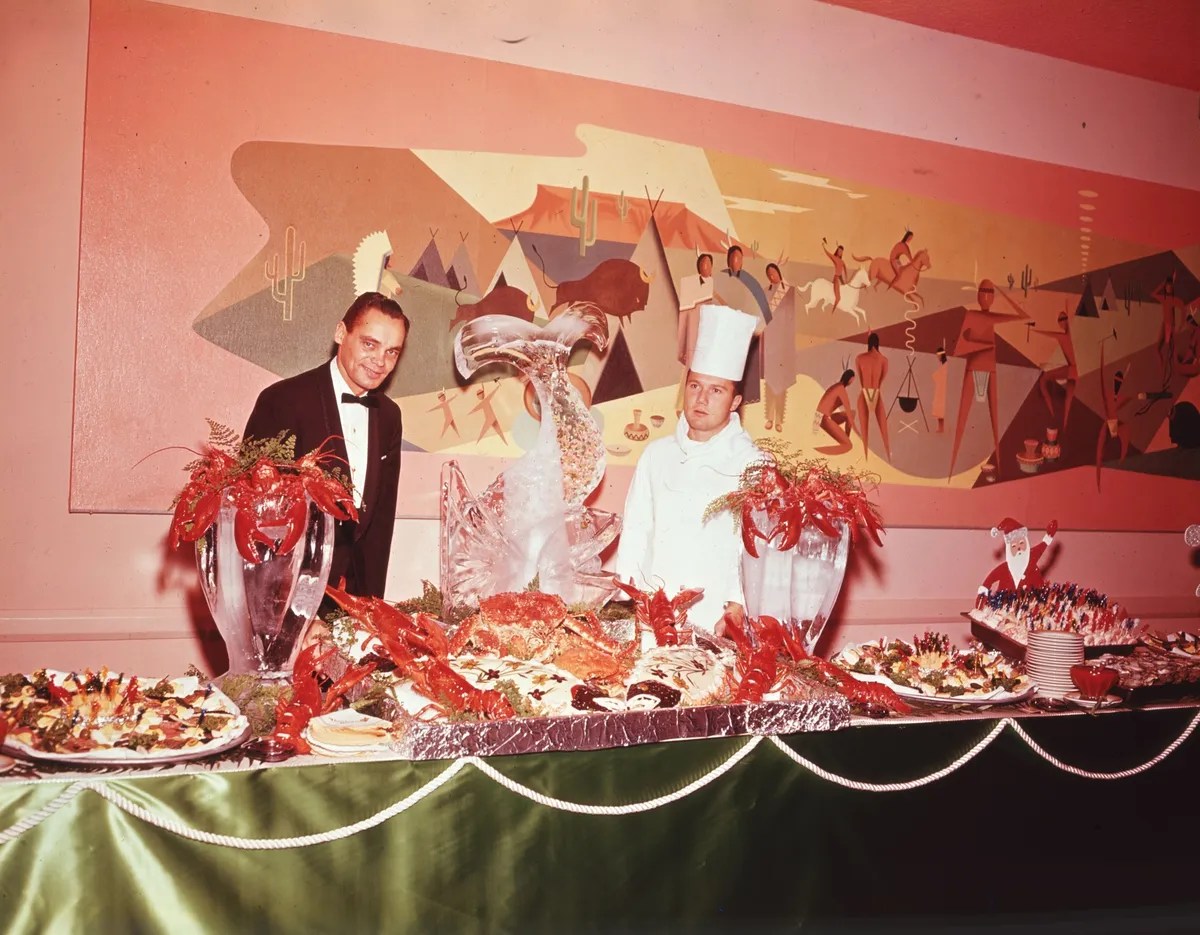
On the rise and fall of the Las Vegas casino buffet…
… With the May 31 closure of the MGM Grand Buffet, the Strip is down to about half a dozen all-you-can-eat buffets. It was once home to more than 10 times that many.
Excluding the sushi bar, the MGM Grand’s $44 Sunday mimosa brunch might have looked about like it did when the resort opened in 1993. It offered crispy brisket at the carving station, biscuits, scrambled eggs and sauteed vegetables. Most of the meats had a tub of gravy next to them, either dark brown or as beige as the decor. The anachronistic vibe at the 535-seat establishmentstood in contrast with more expensive buffets at nearby Caesars Palace and Wynn, overflowing with luxury offerings like turmeric grilled baby octopus, Peking duck and lobster toasts garnished with caviar.
“Young people complain that it looks old,” says Shaunell Samano, the MGM Grand Buffet’s assistant general manager. She has a job lined up at the nearby Luxor. All five of the servers hustling the floor had worked there since the resort’s opening. Most of the staff had been prepping the buffet for at least 26 years. Samano recalled guests even visiting twice a day, including retired boxer Evander Holyfield and his wife a few years ago.
The vanishing old-school Vegas buffet comes as Americans rethink their relationship to food and travel. A 2025 Cornell University study found that the proliferation of GLP-1 drugs is driving down demand for the kinds of indulgent foods available at all-you-can-eat buffets, and several studies show that gastronomic experiences are fundamental to choosing a vacation destination. Still, a 2025 Pew Research Center study indicated that even if consumers are more health-conscious than ever, taste and affordability remain the most important factors in deciding what to eat.
All-you-can-eat buffets may be receding from their spiritual home of Las Vegas, but the country isn’t abandoning them yet.
Golden Corral Chief Executive Officer Lance Trenary told Bloomberg Intelligence in November that his company’s restaurants were averaging the same number of meals served as they were pre-pandemic. The all-you-can-eat Korean BBQ and hot-pot chain KPOT had three locations in 2020; it plans to have more than 150 open by the end of the calendar year. Yelp’s 2026 Trends forecast cited a 252% increase in searches for “all you can eat buffet.”
“Customers like buffets,” says Eric Chiang, a University of Nevada at Las Vegas economics professor who loves using buffets as a way to explain economics. “It’s a flat price with no risk involved and no surprise at the end,” he says.
The novelty of all-you-can-eat dining is rooted in contradictory American lifestyles: One diner sees freedom and abundance, while another sees waste and gluttony. They’re rare restaurants where, at least for an hour or two, anyone can eat like royalty…
… the all-you-can-eat buffet is inextricably linked to the glamorous excesses of Las Vegas, where famed promoter Herb McDonald hired Norwegian chef Arne Hansen Rom in 1946 to tailor the European smorgasbord to the tastes of the Western Yankee. The Midnight Chuckwagon, later known as the Buckaroo Buffet, lured gamblers at the El Rancho hotel and its previous incarnation, the Thunderbird. Along with a lounge act came unlimited food ranging from deviled eggs to shrimp cocktail to Rom’s specialty: barbecue spareribs. The all-you-can-eat buffet evolved into a signature loss leader for resorts competing to attract a new wave of Las Vegas tourists: families and international travelers.
When John Curtas recalls his first visit to a Las Vegas buffet as a 10-year-old in the early 1960s, the veteran Las Vegas food critic remembers a haunch of beef that looked 12 feet tall manned by a chef wielding a carving knife like a scimitar. Beside the beef sat piles of shrimp, whole-cooked turkeys, potato salad and cowboy beans. It cost just $1, and he could return for more without embarrassment.
“Buffets gave you such a dazzle factor and eye candy,” Curtas says. “But they also gave a lot of perceived value for people and for families.”…
More on the social psychology and economics of buffets: “The Quintessential Old-School Las Vegas Buffet Bids Farewell” gift link from @bloomberg.com.
* Mae West
###
As we go back for seconds, we might spare a thought for Edwin Traisman; he died on this date in 2007. A food scientist, he is best remembered for helping to create Cheez Whiz for Kraft, then for perfecting the method used by McDonalds standardize their french fries (by freezing partially-cooked fries for transport and storage). But relevantly to the piece above, he also helped initiate research on E. coli 0157:H7, which was at the time (1987) a little known pathogen.

“There is a sociology of horses, as well as a psychology”*…

Clubhouse Mezzanine
On a cool and sunny Wednesday afternoon in December 2013, I pulled into a massive parking lot in Inglewood, California. My plan was to photograph Hollywood Park Racetrack before it closed forever. At the time, I was a portrait photographer and had spent many years capturing the subtleties of facial expressions, watching carefully how happiness, sadness, anger, fear, and surprise unfold in the muscles of the face. The work of portraiture is exhilarating but also profoundly exhausting, and I was interested in shifting my attention to buildings, particularly buildings that had been lived in and well worn. I liked the idea of working with less, and also working alone, and I was curious, too. What does a building reveal? How is a building like a face?
Growing up in Los Angeles I had spent many evenings right next door to Hollywood Park. I watched Lakers games, basketball at the summer Olympics, and countless rock concerts at The Forum. Although the neighboring track was enormous — 300 acres, a capacity of 80,000 guests — I had never paid any attention until now…
Photographer Michele Asselin spent the next several days intensively documenting Hollywood Park…
It was almost impossible to stop taking photos, but finally, on December 22, 2013, at 11:00 p.m., my hand was forced. The crowd filed out for the last time as the loudspeakers played “At Last” and “Happy Trails.” Some people were crying, some were singing, some were nonchalant. Those trying to filch a little piece of history — a sign or a doorknob — were stopped by a security guard. When the last person exited the grounds, the gates were locked. The horses were loaded into trailers in the coming weeks and moved across town or to Oklahoma, New Jersey, or Kentucky. The auctioneers sifted through what was left, and then, in 2014, Hollywood Park was razed.
After 15 days of circling the grounds, hauling my equipment from place to place, I was 12 pounds thinner and had hardly seen my kids. I had taken 25,000 photos. It would be a year before I finished sorting through them. I wondered what I had fixed in time. The end of something? Evidence of its existence? The traces of time? I tried to keep in mind what an arborist had once told me — that it’s okay to cut down a struggling tree as long as another is planted in its place. I hope that the same is true of buildings…

Jay Cohen. Bugler.
From Asselin’s introduction to her new book, Clubhouse Turn- The Twilight of Hollywood Park Race Track. For the full intro and more of her photos: “Say Goodbye to Hollywood Park: Photographing the Twilight of a Racetrack” and her website.
* Jane Smiley (Pulitzer Prize-winning novelist and horse owner/breeder)
###
As we place our bets, we might recall that it was on this date in 1931 that the state legislature in Nevada legalized casino gambling in the state. In fact, gambling had been legal in Nevada until 1909 (by which time it was the only state with legal gambling), when an earlier instantiation of the legislature outlawed it.
(Coincidentally, it was on this date in 1942 that Alfred G. Vanderbilt and number of horse racing luminaries established the Thoroughbred Racing Associations of North America.)

“He who controls the spice controls the universe”*

Spices were among the first engines of globalization, not in the modern sense of a world engulfed by ever-larger corporations but in the ways that we began to become aware, desirous even, of cultures other than our own. Such desire, unchecked, once led to colonialism. After Dutch merchants nearly tripled the price of black pepper, the British countered in 1600 by founding the East India Company, a precursor to modern multinationals and the first step toward the Raj. In the following decades, the Dutch sought a monopoly on cloves, which once had grown nowhere but the tropical islands of Ternate and Tidore in what is today Indonesia, and then in 1652 introduced the scorched-earth policy known as extirpation, felling and burning tens of thousands of clove trees. This was both an ecological disaster and horribly effective: For more than a century, the Dutch kept supplies low and prices high, until a Frenchman (surnamed, in one of history’s inside jokes, Poivre, or “pepper”) arranged a commando operation to smuggle out a few clove-tree seedlings. Among their ultimate destinations were Zanzibar and Pemba, off the coast of East Africa, which until the mid-20th century dominated the world’s clove market.
The craving for spices still brings the risk of exploitation, both economically, as farmers in the developing world see only a sliver of the profits, and in the form of cultural appropriation. In the West, we’re prone to taking what isn’t ours and acting as if we discovered it, conveniently forgetting its history and context. Or else we reduce it to caricature, cooing over turmeric-stained golden lattes while invoking the mystic wisdom of the East. At the same time, a world without borrowing and learning from our neighbors would be pallid and parochial — a world, in effect, without spice…
From turmeric in Nicaragua to cardamom in Guatemala, nonnative ingredients are redefining trade routes and making unexpected connections across lands: “How Spices Have Made, and Unmade, Empires.”
* Frank Herbert, Dune
###
As we go deep on dash, we might recall that this is National Buffet Day. The concept of the buffet arose in mid 17th century France, when gentleman callers would arrive unexpectedly at the homes of ladies they wanted to woo. It was popularized in 18th century France and quickly spread throughout Europe. The all-you-can-eat buffet made its restaurant debut in 1946, when it was introduced by Vegas hotel manager Herb MacDonald. By the mid-1960s, virtually every casino in Las Vegas sported its own variation. Today, of course, buffets are regularly available not only in any/every Vegas casino, but also in thousands of Indian and Chinese restaurants and ubiquitous chains of “family restaurants.”

You must be logged in to post a comment.