Posts Tagged ‘sign’
“Make it simple. Make it memorable. Make it inviting to look at. Make it fun to read.”*…
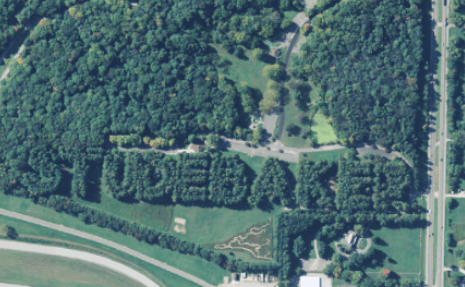
From the annals of advertising…
Planted in 1938, the Studebaker sign in Bendix Woods was once recognized by Guinness World Records as the world’s largest living advertisement. In its prime, it contained 8,000 red and white pine trees. After 75 years with no maintenance, it has thinned out to just 2,000 but is still visible from the air.
Back in 1926, the Studebaker Corporation built what it claimed to be the first closed testing facility for an American car company. The automobile manufacturer, founded in 1852, spent more than one million dollars on the test facility, which included a three-mile circuit with a variety of special test sections including hill climbs, skid pads, snaking curves, and bumpy roads.
Naturally, if you’re going to spend a million dollars on a test circuit, you might as well invest a little more on a giant living sign made out of pine trees that’s only visible from the air, so that’s what Studebaker did…
Initially, the letters were nicely ordered, well defined and maybe even a little skinny. They were easy to read from the air, which is exactly what Studebaker intended. The sign was a salute to the growing aviation industry and a handy publicity stunt that could be seen by overflying aircraft passengers.
Over the years, of course, the pine trees grew and so did the letters. Studebaker, on the other hand, started to wither away. After years of financial problems, the company closed its last remaining production facility in 1966. Studebaker sold the land on which the trees stood to the Bendix Corporation, which donated some of the property for the creation of a county park (hence its current name: Bendix Woods County Park)…
Despite the demise of its namesake company, the Studebaker sign remained. In 1985, it was included in the National Register of Historic Places. Two years later, it first appeared in the Guinness Book of World Records as the world’s “largest living advertisement sign” (a record that no longer seems to exist)…
One of the world’s largest living advertisements is made out of pine trees: the “Studebaker Tree Sign,” from @atlasobscura.
* Advertising pioneer Leo Burnett
###
As we think big, we might recall that today is a momentous one in the histories of two other monumental messages:
On this date in 1631 Mumtaz Mahal, the beloved wife of the fifth Mughal emperor, Shah Jahan, died. He spent the next 17 years building her mausoleum, the Taj Mahal.

And on this date in 1885 the Statue of Liberty— a message of affection and respect from the people of France– arrived in New York Harbor.

“A city that was to forge out of steel and blood-red neon its own peculiar wilderness”*…

A woman and her work
Las Vegas– and the world– lost two icons of neon sign design on April 19th: Betty Willis, seen above with the iconic “Welcome” sign that she designed, and Brian “Buzz” Leming, creator of many of the Strip’s most memorable marquees, passed away within hours of each other.

Leming’s “Hacienda Horse and Rider”
Willis and Leming both worked at the Western Sign Company, where they struck up a friendship. Many of their creations are preserved in the Neon Museum’s outdoor “Boneyard,” where it stores its relics.

The Neon Museum’s Boneyard
More at “Two Designers of Las Vegas’s Iconic Neon Signs Died on the Same Day.”
* Nelson Algren (writing about Chicago, though it’s surely apropos of Las Vegas as well)
###
As we switch on the lights, we might send forbearing birthday wishes to Marcus Aurelius Antoninus Augustus; he was born on this date in 121. The last of the Five Good Emperors, Marcus Aurelius is also considered one of the most important Stoic philosophers; his Meditations, written on campaign before he became emperor, is still a central text on the philosophy of service and duty.

“God made the integers; all the rest is the work of Man”*…

From Alex Bellos: the results of his global online poll to find the world’s favorite number…
The winner? Seven— and it wasn’t even close…
###
As we settle for anything but snake eyes, we might send symbolic birthday greetings to John Pell; he was born on this date in 1611. An English mathematician of accomplishment, he is perhaps best remembered for having introduced the “division sign”– the “obelus”: a short line with dots above and below– into use in English. It was first used in German by Johann Rahn in 1659 in Teutsche Algebra; Pell’s translation brought the symbol to English-speaking mathematicians. But Pell was an important influence on Rahn, and edited his book– so may well have been, many scholars believe, the originator of the symbol for this use. (In any case the symbol wasn’t new to them: the obelus [derived from the word for “roasting spit” in Greek] had already been used to mark passages in writings that were considered dubious, corrupt or spurious…. a use that surely seems only too appropriate to legions of second and third grade math students.)

“Her hat is a creation that will never go out of style; it will just look ridiculous year after year”*…

An opportunity to get in at the very beginning of a fashion trend…
“Le Grand” is a new hat concept: a hybrid between the baseball cap and the top hat! Help us bring a new fashion icon into reality!
* Fred Allen
###
As we cover our crowns, we might recall that it was on this date in 1910 that French chemist, engineer, and inventor Georges Claude switched on the first public display of neon lights– two large (39 foot long), bright red neon tubes– at the Paris Motor Show. Over the next decade, Claude lit much of Paris. Neon came to America in 1923 when Earl Anthony purchased signage from Claude, then transported it to Los Angeles, where Anthony installed it at his Packard dealership… and (literally) stopped traffic.

Claude in his lab, 1913
Times of the Signs…

From Smashing Magazine, culled from over 2,500 entries in 51 categories, the results of their “World Of Signage Photo Contest.”

As we give in to the guides, we might recall that it was on this date in 1888 that the first issue of National Geographic Magazine was published, nine months after its parent, The National Geographic Society, was founded.

You must be logged in to post a comment.