Posts Tagged ‘Statue of Liberty’
“Make it simple. Make it memorable. Make it inviting to look at. Make it fun to read.”*…
From the annals of advertising…
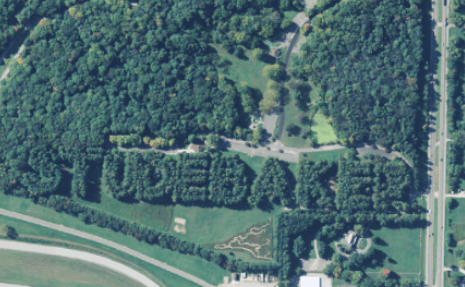
Planted in 1938, the Studebaker sign in Bendix Woods was once recognized by Guinness World Records as the world’s largest living advertisement. In its prime, it contained 8,000 red and white pine trees. After 75 years with no maintenance, it has thinned out to just 2,000 but is still visible from the air.
Back in 1926, the Studebaker Corporation built what it claimed to be the first closed testing facility for an American car company. The automobile manufacturer, founded in 1852, spent more than one million dollars on the test facility, which included a three-mile circuit with a variety of special test sections including hill climbs, skid pads, snaking curves, and bumpy roads.
Naturally, if you’re going to spend a million dollars on a test circuit, you might as well invest a little more on a giant living sign made out of pine trees that’s only visible from the air, so that’s what Studebaker did…
Initially, the letters were nicely ordered, well defined and maybe even a little skinny. They were easy to read from the air, which is exactly what Studebaker intended. The sign was a salute to the growing aviation industry and a handy publicity stunt that could be seen by overflying aircraft passengers.
Over the years, of course, the pine trees grew and so did the letters. Studebaker, on the other hand, started to wither away. After years of financial problems, the company closed its last remaining production facility in 1966. Studebaker sold the land on which the trees stood to the Bendix Corporation, which donated some of the property for the creation of a county park (hence its current name: Bendix Woods County Park)…
Despite the demise of its namesake company, the Studebaker sign remained. In 1985, it was included in the National Register of Historic Places. Two years later, it first appeared in the Guinness Book of World Records as the world’s “largest living advertisement sign” (a record that no longer seems to exist)…
One of the world’s largest living advertisements is made out of pine trees: the “Studebaker Tree Sign,” from @atlasobscura.
* Advertising pioneer Leo Burnett
###
As we think big, we might recall that today is a momentous one in the histories of two other monumental messages:
On this date in 1631 Mumtaz Mahal, the beloved wife of the fifth Mughal emperor, Shah Jahan, died. He spent the next 17 years building her mausoleum, the Taj Mahal.

And on this date in 1885 the Statue of Liberty— a message of affection and respect from the people of France– arrived in New York Harbor.

“You cannot get a grip on blue… blue is sly, slick, it slides into the room sideways, a slippery trickster”*…

Vermeer, Girl with a Pearl Earring, ca. 1665
Michelangelo couldn’t afford ultramarine. His painting The Entombment, the story goes, was left unfinished as the result of his failure to procure the prized pigment. Rafael reserved ultramarine for his final coat, preferring for his base layers a common azurite; Vermeer was less parsimonious in his application and proceeded to mire his family in debt. Ultramarine: the quality of the shade is embodied in its name. This is the superlative blue, the end-all blue, the blue to which all other hues quietly aspire. The name means “beyond the sea”—a dreamy ode to its distant origins, as romantic as it is imprecise…
The whole fascinating story at “True Blue- a brief history of ultramarine.”
* Christopher Moore, Sacré Bleu: A Comedy d’Art
###
As we dip our brushes, we might recall that it was on this date in 1886 that a gift from France was formally received in the U.S.: it was on this date that year that “Liberty Enlightening the World”– a token of friendship from the French to the U.S. better known as the Statue of Liberty– was dedicated by President Grover Cleveland.
Designed by Frédéric Auguste Bartholdi, a French sculptor, it was built by Gustave Eiffel (his Eiffel Tower served as the statue’s armature), who had it shipped from France encased in more than 200 crates, then reassembled it and placed on its pedestal on (what was then known as) Bedloe’s Island, where Cleveland took her in.

Huis Clos, Edition Galactique– avec pop-corn!

Existentialist Star Wars (in French!)
Star Wars with a French Existentialist twist. Almost all the subtitles (except for little things like “Despair!” and “I die!” and a few others) are actually quotes from Jean-Paul Sartre. And obviously this will make no sense if you understand French. If you do know it, hit yourself in the head repeatedly before watching this. And then hit yourself repeatedly when you’re done watching.
More from creator OneMinuteGalactica here (Do be sure to check out “Luke Skywalker- Worst Scout Ever“)
As we steep in ennui, we might recall that it was on this date in 1889 that the Eiffel Tower opened to the public. The spire, now iconic of Paris, was designed by Gustave Eiffel (who also created the armature for France’s largest gift to the U.S., the Statue of Liberty) and served as the entrance arch to the 1889 World’s Fair.

A matter of perspective…
From Darren Rouse‘s Digital Photography School, a 90-year-old example of forced perspective photography:

The picture is of 18,000 men preparing for war in a training camp at Camp Dodge, in Iowa.
A few facts about the image:
* Length from base to Shoulder: 150 feet
* Right Arm: 340 feet
* Length of Torch and flame: 1000 feet
* Total Length: 1490 Feet
* Number of men in body and head of figure: 2,000
* Number of men in right arm: 1,200
* Number of men in torch: 2,800
* Number of men in the flame only: 12,000
* Total men: 18,000
(Thanks SC for the pointer)
As we adjust our focal lengths, we might pause to slip a celebratory tickle to Elmo– it was on this date in 1969 that Sesame Street first aired…

That’s Entertainment!…
As one prepares to add to one’s Netflix queue, it’s helpful to have a little guidance. There’s Rotten Tomatoes, of course; but as wonderful as it is, it requires one to ask after specific films. And then there’s Netflix’s own near-neighbor matching algorithm (“recommended for you”)… but sometimes there’s just no accounting for one’s neighbors’ taste.
Happily, the good folks at Vodkaster, the French cinephile site, have stepped into the breech– and delivered a gift that is, if not quite as momentous as the Statue of Liberty , nonetheless altogether nifty, “The 250 Best Films Map” (… as voted by IMDb users on the 19th of June, 2009; English version here). A taste:

See the full map (and download it in various sizes/resolutions) here.
As we fire up the popcorn maker, we might celebrate two artistic anniversaries: it was on this date in 1910 that the exquisite British comedy team, Stan Laurel and Oliver Hardy, arrived in the U.S. (on tour with an English vaudeville troupe). Then, 31 years to the day later, The Maltese Falcon opened.

![Reblog this post [with Zemanta]](https://i0.wp.com/img.zemanta.com/reblog_e.png?w=700)
You must be logged in to post a comment.