Posts Tagged ‘Studebaker’
“Make it simple. Make it memorable. Make it inviting to look at. Make it fun to read.”*…
From the annals of advertising…
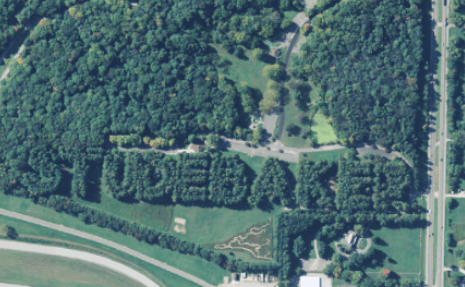
Planted in 1938, the Studebaker sign in Bendix Woods was once recognized by Guinness World Records as the world’s largest living advertisement. In its prime, it contained 8,000 red and white pine trees. After 75 years with no maintenance, it has thinned out to just 2,000 but is still visible from the air.
Back in 1926, the Studebaker Corporation built what it claimed to be the first closed testing facility for an American car company. The automobile manufacturer, founded in 1852, spent more than one million dollars on the test facility, which included a three-mile circuit with a variety of special test sections including hill climbs, skid pads, snaking curves, and bumpy roads.
Naturally, if you’re going to spend a million dollars on a test circuit, you might as well invest a little more on a giant living sign made out of pine trees that’s only visible from the air, so that’s what Studebaker did…
Initially, the letters were nicely ordered, well defined and maybe even a little skinny. They were easy to read from the air, which is exactly what Studebaker intended. The sign was a salute to the growing aviation industry and a handy publicity stunt that could be seen by overflying aircraft passengers.
Over the years, of course, the pine trees grew and so did the letters. Studebaker, on the other hand, started to wither away. After years of financial problems, the company closed its last remaining production facility in 1966. Studebaker sold the land on which the trees stood to the Bendix Corporation, which donated some of the property for the creation of a county park (hence its current name: Bendix Woods County Park)…
Despite the demise of its namesake company, the Studebaker sign remained. In 1985, it was included in the National Register of Historic Places. Two years later, it first appeared in the Guinness Book of World Records as the world’s “largest living advertisement sign” (a record that no longer seems to exist)…
One of the world’s largest living advertisements is made out of pine trees: the “Studebaker Tree Sign,” from @atlasobscura.
* Advertising pioneer Leo Burnett
###
As we think big, we might recall that today is a momentous one in the histories of two other monumental messages:
On this date in 1631 Mumtaz Mahal, the beloved wife of the fifth Mughal emperor, Shah Jahan, died. He spent the next 17 years building her mausoleum, the Taj Mahal.

And on this date in 1885 the Statue of Liberty— a message of affection and respect from the people of France– arrived in New York Harbor.

It’s all there in black and white…

Allister Lee, proprietor of Toronto design house Studio B.I.B. (Black is Beautiful), has committed himself to building the most extensive collection of black markers in the world– and to drawing each one… to scale. He’s acquired 523 unique black markers. So far.
 click the image above, or here, to enlarge
More photos, and an interview with Lee, at Design Milk.
As we try to recall ‘what’s black and white, and red all over,” we might recall that it was on this date in 1961, that industrial designer Raymond Loewy made a dozen sketches of a futuristic sports car at the request of Sherwood Egbert, the recently appointed president of the ailing Studebaker Corporation. Egbert hoped that Loewy, who had a long relationship with the company, could design a new car bold enough to capture the popular imagination and boost the company’s sagging fortunes. Loewy and his team produced a prototype automobile in record time; the Avanti—Italian for “forward”— debuted in April 1962 to rave reviews. The four-passenger car was indeed forward-looking, for it had a steamlined fiberglass body with almost no chrome, and was the first American car to incorporate a disc brake system along with other safety features. A series of problems stalled production of the car, however; and the Studebaker Corporation abruptly discontinued its U.S. manufacture late in 1963.
 preliminary study for the Avanti (more here– source: Library of Congress)
You must be logged in to post a comment.