Posts Tagged ‘nutrition’
“Tell me what you eat and I will tell you what you are”*…

Back in 2016, Nathan Yau of Flowing Data created a fascinating set of animated infographics illustrating how the American diet had changed over the prior several decades. A few years later, he used an even more comprehensive data set to update the picture…
The United States Department of Agriculture keeps track of food availability for over 200 items, which can be used to estimate food consumption at the national level. They have data for 1970 through 2019, so we can for example, see how much beef Americans consume per year on average and how that has changed over four decades.
So that’s what I did.
How long will chicken reign supreme? Who wins between lemon and lime? Is nonfat ice cream really ice cream? Does grapefruit ever make a comeback? Find out in the charts below.
The rankings are broken into six main food groups: proteins [pictured above], vegetables, fruits, dairy, grains, and added fats…
Illuminating: “Seeing How Much [and of what] We Ate Over the Years,” from @flowingdata (where one will find larger, more legible versions of the chart above and its companions).
* Jean Anthelme Brillat-Savarin
###
As we contemplate consumption, we might recall that it was on this date in 1953 that the Cabinet-level Department of Health, Education, and Welfare (HEW) was created under President Eisenhower. Its first Secretary was Oveta Culp Hobby. (In 1979, the Department of Education Organization Act was signed into law, providing for a separate Department of Education. HEW became the Department of Health and Human Services, officially arriving on May 4, 1980.)

“Without debatement further, more or less, / He should the bearers put to sudden death, / Not shriving time allow’d.”*…

“Cell suicide” is inherently self-destructive, and yet it’s an essential and productive process in complex organisms. How did cells evolve a process to end their own lives? As Veronique Greenwood reports, recent research suggests it first arose, first arose billions of years ago… but why?…
It can be hard to tell, at first, when a cell is on the verge of self-destruction.
It appears to be going about its usual business, transcribing genes and making proteins. The powerhouse organelles called mitochondria are dutifully churning out energy. But then a mitochondrion receives a signal, and its typically placid proteins join forces to form a death machine.
They slice through the cell with breathtaking thoroughness. In a matter of hours, all that the cell had built lies in ruins. A few bubbles of membrane are all that remains.
“It’s really amazing how fast, how organized it is,” said Aurora Nedelcu, an evolutionary biologist at the University of New Brunswick who has studied the process in algae.
Apoptosis, as this process is known, seems as unlikely as it is violent. And yet some cells undergo this devastating but predictable series of steps to kill themselves on purpose. When biologists first observed it, they were shocked to find self-induced death among living, striving organisms. And although it turned out that apoptosis is a vital creative force for many multicellular creatures, to a given cell it is utterly ruinous. How could a behavior that results in a cell’s sudden death evolve, let alone persist?…
The story in full: “Cellular Self-Destruction May Be Ancient. But Why?“, from @vero_greenwood in @QuantaMagazine.
* Shakespeare, Hamlet (Act 5, Scene 2)
###
As we appreciate apoptosis, we might send healthy birthday greetings to Lillian Wald; she was born on this date in 1867. A nurse, humanitarian, political reformer, and author, she was instrumental in establishing a nationwide system of nurses in public schools. Known as “the Angel of Henry Street” (for her founding and running of the Henry Street Settlement in New York City), she directed the Henry Street Visiting Nurse Service, while at the same time tirelessly opposing political and social corruption. She helped initiate the revision of child labor laws, improved housing conditions in tenement districts, drove the enactment of pure food laws, championed and improved education for the mentally handicapped, and led the passage of enlightened immigration regulations.

“In the last analysis civilization is based upon the food supply”*…

From the ever-illuminating Information is Beautiful, a look at the global food supply. Click through for a larger version of the diagram above and for illustrations of what’s being over/under consumed, and how much we really need… then ponder the fact that almost one-in-ten people in the world do not get enough to eat.
* Will Durant
###
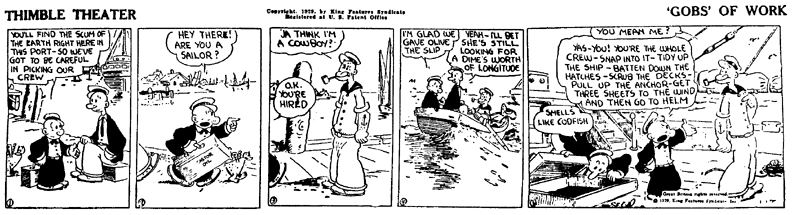
As we pick at our food, we might recall that it was on this date in 1926 that spinach-loving Popeye the Sailor, who made his first appearance in a strip (called “Thimble Theater,” along with Castor Oyle, father of Olive, who “meets” Popeye seven days later).
We might recall Popeye’s wise paraphrase of the old saw “you are what you eat”:
I yam what I yam and tha’s all what I yam.
“If this is coffee, please bring me some tea; but if this is tea, please bring me some coffee.”*…

Which beverage can claim the world title for healthiest drink?…
Do you start your mornings with a potent dose of caffeine from a freshly brewed cup of Joe? Or do you prefer a slightly less caffeinated nudge from a warm and gentle cup of tea?
Whatever your preference, scientists have found that regularly drinking coffee or tea can provide a variety of health benefits. But how do coffee and tea compare in a head-to-head matchup? We took a look at the research, and here’s what we found…
A grudge match, with science as the referee: “Coffee vs. tea smackdown,” (gift article) from @washingtonpost.
* Abraham Lincoln
###
As we parse potables, we might note that today is National Hot Tea Day. The Tea Council of the U.S.A. created the celebration in 2016– the year that the earliest known physical evidence of tea was discovered in the mausoleum of Emperor Jing of Han in Xi’an, indicating that tea, from the genus Camellia, was drunk by Han dynasty emperors, as early as the 2nd century B.C.

“The public health, ecological, and social impacts of fish meal—which were a consequence of its cheapness as a feed ingredient—were largely invisible on the other side of the world”*…

… Those deleterious effects were largely missed in the mid-Twentieth Century, when fish meal became important to the rise of industrial-scale farming, and– as Ashley Braun explains– are still, as fish meal use is again growing…
The dirty yellow powder’s underwhelming appearance belies its influence. Fish meal—an unassuming yet protein-dense powder of dried, cooked, and pulverized fish—has fueled South American oligarchs, fostered slums, reshaped ecosystems, and fed Europe’s agricultural industrialization. Fish meal propelled the global production of meat and eggs, all while spurring public health crises, pollution, and unrest. The precipitous rise and fall of this humble commodity in the mid to late 20th century, writes medical and environmental historian Floor Haalboom, offers lessons for today as fish meal’s star rises again…
How cheap protein fueled the Global North’s agricultural expansion and destabilized the Global South: “Boom and Bust, All at Once: The Fraught Modern History of Fish Meal,” from @ashleybraun in @hakaimagazine. Eminently worth reading in full.
###
As we ponder pulverization, we might recall that it was on this date in 1837 that John Wheeley Lea and William Henry Perrins, a pair of successful Worcester chemists, began manufacturing Worcestershire sauce, a savory flavoring that capitalizes on umami. Their condiment, which was broadly available to the public the following year, faced down scores of imitators to become the dominant brand, which it remains.

You must be logged in to post a comment.