“You can deny, if you like, nearly all abstractions: justice, beauty, truth, goodness, mind, God. You can deny seriousness, but not play”*…
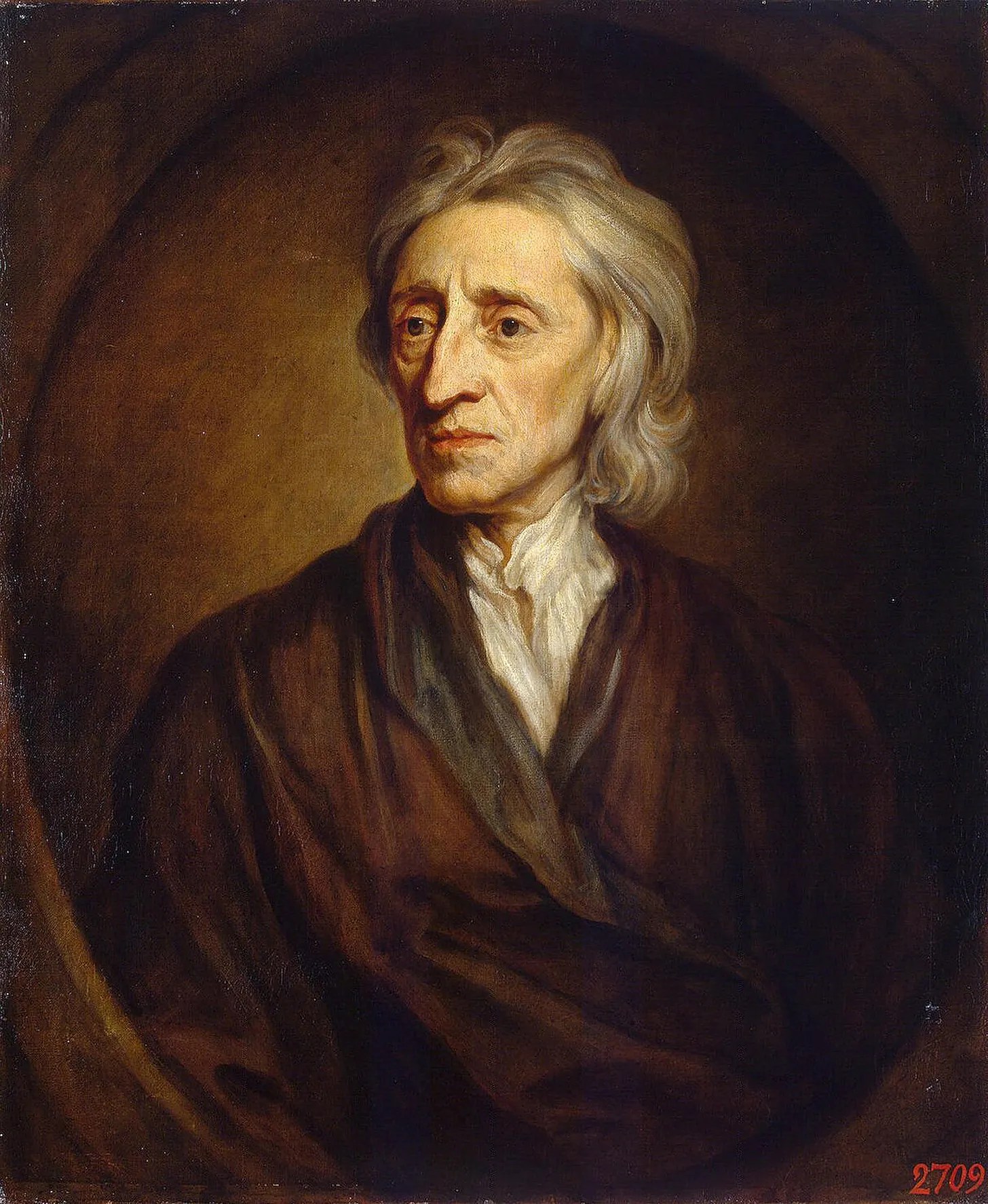
Henry Oliver on John Locke as an exemplar of the importance of play…
One day, when my son was three years old, he stuck his finger into a candle. We were sitting at the table before dinner and he touched the flame without warning. When his sister asked him why he had done it, he told her he just wanted to know what the flame was like. I remembered this when I was reading Locke’s Essay Concerning Human Understanding, in the section when Locke discusses how certainly we can know the world beyond ourselves, and he writes: “he that sees a candle burning, and hath experimented the force of its flame by putting his finger in it, will little doubt that this is something existing without him.” (IV.xi.8) This is how the love of philosophy begins: in a curiosity of the world and a willingness not just to question it, but to test it directly. It illustrates Locke’s larger point about man’s capacity to reason without the use of formal logic. “God has not been so sparing to men to make them barely two-legged creatures, and left it to Aristotle to make them rational.” (IV.xvii.4) We become philosophical as we become interested in knowing the qualities and limits of the world and ourselves. And that begins in childhood.
For the modern, empirical, skeptical mind, Locke’s finger-in-the-flame is akin to the philosopher leaving Plato’s cave. In that experiment, my son became a novice of philosophy. What he learned, he could not communicate. He did not have the language he needed. He was, essentially, at play when he touched that flame. To philosophise, then, requires some play. To be rational requires us to do “irrational” things, like touching a flame.
Play is formal. It might follow the rules of a game, the conventions of the theatre, or the tropes of impersonation—but play is a form of something else. In this way, language is a form of play for our experiences, not the things themselves, but a means of presenting them. Play can be a means of acquiring knowledge that we can express in language, but to begin with it is a means of acquiring impressions, ideas, concepts, feelings, and sensations.
Free play is informal. It is unfamiliar. In its freedom, it is play, just as in their rules the other modes of play are play. Free play might be random (like when children slap paint on paper) or it might be stylized (like free-style swimming) or it might be simply open-ended (as when an invented game keeps changing its content, rules, methods). This is why some play seems both formal and informal, such as when we “play around” with something—an instrument, some materials, an idea—and we are both working at the margin of the known rules and forms and being informal and open-ended.
Over time, play can become practice. The more predictable play becomes, the less playful it is. Children get bored with their imaginary games and begin to expand them: new characters, scenarios, scenes; the old ways of playing are either formalized or discarded. Practice is inherently more boring; it is a form of work. To maintain a good practice, we must, at intervals, allow for some play to revive, reinvent, or reinvigorate the practice. So, the athlete or chess player must know the patterns of their games and must be able to play creatively. So, the thinker or professional must know the accepted knowledge and forms of their discipline and be able to think creatively.
Many modes of life—education, occupations—have to be both work and play, the dynamic development of practices. In ‘Nature: A Fragment’, Goethe says, “we live within her, yet are foreign to her.” So it is with children at play, with students at study. Play is part of the quest for knowledge: we must play both in the sense of removing limits and of pretending. As with children, we must be able to say “this is in the game”, without compromising our sense of the game not being the same as “real life.”
When my son touched that flame, he was playing. When he told his sister that he merely wished to know what the flame was like, that was a similar way of thinking about the world as when they both tell me that something is “in the game.” Occasionally, I hear them saying things that are extraordinary, rude, or that sound like they need help—or that are just downright weird. In response to my puzzlement or offers of help, they explain, off-handedly, “Dad! It’s in the game!” Play is, without them intending it to be, a way of conducting thought experiments with their accumulating knowledge of the world. Touching the candle was a more traditional physical experiment. It was a means of playing that confirmed to my son the existence of the flame, in a way that words and ideas alone never could.
Philosophical play can become abstruse, distant from reality. Locke is hardly a “playful” philosopher, in the colloquial sense. But the plain and clear nature of his prose makes him intellectually exciting because he is always at play, always in the dynamic development of practices and conclusions. He is searching for truth. His insistence on the “plain and clear deductions of words” (IV.viii.11) and his opposition to general and trifling propositions (IV.viii.9) make him substantively and rhetorically compelling. It also brings a repetitive but playful structure to his arguments…
[Oliver considers Locke’s thinking, concluding…]
… Just as my son touched the flame to know the world (and thus to acquire the materials to begin to reason about it), Locke remembered the water and the colours on the bubble (materials he had long ago acquired). The “play” of this way of thinking is all the interplay between mind and reality, idea and experience. What starts as a game of child’s play becomes a practice of reasoning, but in Locke’s hands, the practice is always being played with, always being dynamically tested, refined. New things are always allowed to be “in the game” so long as they enable the pursuit of truth. Locke is not overly formal, following the “rules of philosophy”, but allows the rules of his method to be determined by their ability to enhance his pursuit of truth. Of the metaphysical philosophers who make “trifling” general propositions, he writes:
one may make demonstrations and undoubted propositions in words, and yet thereby advance not one jot in the knowledge of the truth of things: v.g. he that having learnt these following words, with their ordinary mutual relative acceptations annexed to them: v.g. substance, man, animal, form, soul, vegetative, sensitive, rational, may make several undoubted propositions about the soul, without knowing at all what the soul really is: and of this sort, a man may find an infinite number of propositions, reasonings, and conclusions, in books of metaphysics, school-divinity, and some sort of natural philosophy: and, after all, know as little of God, spirits, or bodies, as he did before he set out (IV.viii.9)
This “trifling” is all abstracted play, not based on any experience: it does not base the game on the world. The player is not required to have touched a flame.
Philosophy, as Locke practices it, requires play because there is so little we really know. There are no substances which do not have something in them that “baffles our understandings”, to see ideas and their connections, and to know the proofs of these, requires “single and slow steps, and long poring in the dark”. Our knowledge comes not only short of reality “but even of the extent of our own ideas.” (IV.iii.6) He constantly emphasises that the world cannot be entirely known to us through reason.
…how vain, I say, it is to expect demonstration and certainty in things not capable of it; and refuse assent to very rational propositions, and act contrary to very plain and clear truths, because they cannot be made out so evident, as to surmount every the least (I will not say reason, but) pretence of doubting. He that, in the ordinary affairs of life, would admit of nothing but direct plain demonstration, would be sure of nothing in this world, but of perishing quickly (IV.xi.10)
We must feel the world. We know things through our sensations. To those sensations we must apply reason. We must accept as revealed certain aspects of life and make ourselves more precise in how we discuss those aspects. That is: we find the world through play, and we find the language to describe the world through play, and that play becomes the practice of reasoning.
Some games are high-spirited and dramatic; some are slow and tense; some are hard to see as games, such as when a child sits quietly on the beach and moves the sand around, or re-arranges the pebbles. Locke’s reasoning is often over-determined, persnickety, and can feel like he is attempting to separate out each grain of sand, but in this, as much as in anything else, he has the playful quality of a child who simply wishes to know what it is like to touch the flame, to satisfy himself that the flame does not only exist within the confines of “in the game.”
Frolic is fundamental: “John Locke: The Playful Philosopher.”
Apposite: Richard Feynman (e,g., “Richard Feynman, Spinning Plates and Serious Play“) and Claude Shannon (e.g., “We know the past but cannot control it. We control the future but cannot know it.”)
* Johan Huizinga, in his remarkable Homo Ludens: A Study of the Play Element in Culture (And as for the kinds of games we might play, see James Carse‘s Finite and Infinite Games.)
###
As we celebrate coltish curiosity, we might send lighthearted birthday greetings to Art Clokey; he was born on this date in 1921. An animator, director, producer, screenwriter, and voice actor, he was a pioneer in the popularization of stop-motion clay animation, best known as the creator of the character Gumby (and as the original voice of Gumby’s sidekick, Pokey).

You must be logged in to post a comment.