Posts Tagged ‘Cable’
“I Want My MTV!”*…

You’ve probably seen a variation of this news on social media over the past few days: MTV officially shut down on New Year’s Eve, ending their final broadcast the same way the network started: With the clip “Video Killed the Radio Star” by The Buggles.
But those posts are misinformed. It’s New Year’s Day 2026, and MTV is still around. Granted, today the channel is playing a marathon of “The Big Bang Theory” sitcom repeats, so your interpretation of “MTV is still around” may vary…
– Variety, January 1, 2026
Indeed, the reality shows and network re-runs are still flowing. But the new owners of MTV’s parent, Paramount Global, did end its dedicated, 24/7 music channels (like MTV Music, MTV 80s, MTV 90s) at the close of 2025 across most international markets, effectively ceding the video music turf to YouTube.
So it’s a propitious moment to pause and reflect on the legacy, the impact of MTV…
… MTV, the Music Television that launched a thousand careers and redefined a generation, is finally shutting down [as a music channel]. It’s bittersweet to see it go, but it’s also a perfect moment to reflect on just how profoundly this channel, born in a blaze of sound and vision, altered the landscape of music, media, and even society itself.
It’s hard to imagine now, but before August 1, 1981, music was primarily an auditory experience. You listened to it on the radio, on records, or at concerts. The idea of a 24-hour channel dedicated solely to music videos was revolutionary, a gamble by Warner-Amex Satellite Entertainment. They saw the burgeoning popularity of music videos, then mostly promotional tools for artists, and envisioned a dedicated platform. The very first video ever played, fittingly, was “Video Killed the Radio Star” by The Buggles – a prophetic title if there ever was one.
MTV’s early days were a chaotic, vibrant mix of rock, pop, and new wave, with VJs (video jockeys) becoming household names. It was raw, experimental, and deeply intertwined with the youth culture of the 80s. But what started as a niche cable channel quickly exploded into a global phenomenon, forever altering how we consumed and understood music. So, as we bid adieu, let’s explore ten ways MTV truly changed everything…
Remember them at: “MTV: A Farewell to the Channel That Changed Our World,” from Eric Alper (@thatericalper.com)
* The tag line of MTV’s initial ad campaign (aimed at getting cable viewers to press their cable suppliers to carry MTV)
###
As we recollect rock, we might recall that it was on this date in 1972 that David Bowie released “Changes,” from his 1971 album Hunky Dory. Co-produced by Bowie and Ken Scott, it featured Rick Wakeman on piano and the musicians who would later become known as the Spiders from Mars—Mick Ronson, Trevor Bolder and Mick Woodmansey.

“Badger hates Society, and invitations, and dinner, and all that sort of thing”*…

Americans are now spending more time alone– mostly at home– than ever. It’s changing our personalities, our politics, and even our relationship to reality. While the pandemic certainly enforced some of that isolation; the post-COVID world remains extraordinarily atomized.
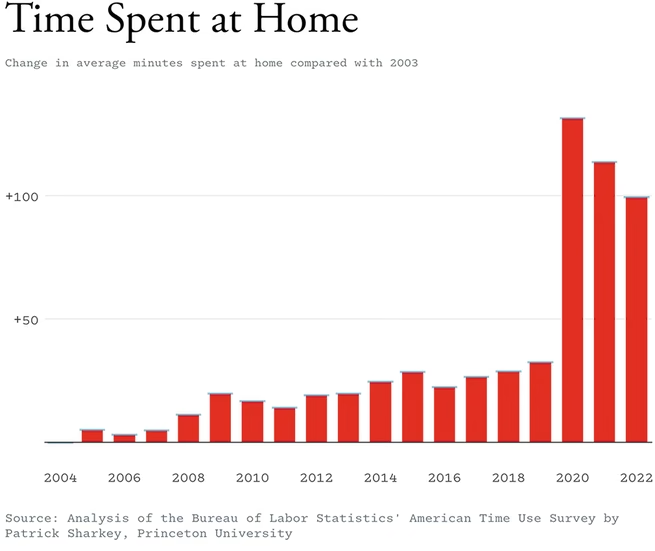

In a bracing essay, Derek Thompson, explores the emergence of this wide-spread isolation, unpacking its drivers, enumerating its considerable (personal and civic) costs, musing on the possible impact of AI, and pondering what might lead to a return to sociability…
… “I have a view that is uncommon among social scientists, which is that moral revolutions are real and they change our culture,” Robert Putnam [author of Bowling Alone] told me. In the early 20th century, a group of liberal Christians, including the pastor Walter Rauschenbusch, urged other Christians to expand their faith from a narrow concern for personal salvation to a public concern for justice. Their movement, which became known as the Social Gospel, was instrumental in passing major political reforms, such as the abolition of child labor. It also encouraged a more communitarian approach to American life, which manifested in an array of entirely secular congregations that met in union halls and community centers and dining rooms. All of this came out of a particular alchemy of writing and thinking and organizing. No one can say precisely how to change a nation’s moral-emotional atmosphere, but what’s certain is that atmospheres do change. Our smallest actions create norms. Our norms create values. Our values drive behavior. And our behaviors cascade.
The anti-social century is the result of one such cascade, of chosen solitude, accelerated by digital-world progress and physical-world regress. But if one cascade brought us into an anti-social century, another can bring about a social century. New norms are possible; they’re being created all the time. Independent bookstores are booming—the American Booksellers Association has reported more than 50 percent growth since 2009—and in cities such as New York City and Washington, D.C., many of them have become miniature theaters, with regular standing-room-only crowds gathered for author readings. More districts and states are banning smartphones in schools, a national experiment that could, optimistically, improve children’s focus and their physical-world relationships. In the past few years, board-game cafés have flowered across the country, and their business is expected to nearly double by 2030. These cafés buck an 80-year trend. Instead of turning a previously social form of entertainment into a private one, they turn a living-room pastime into a destination activity. As sweeping as the social revolution I’ve described might seem, it’s built from the ground up by institutions and decisions that are profoundly within our control: as humble as a café, as small as a new phone locker at school…
On how we spend our time and what that yields: “The Anti-Social Century,” from @dkthomp.bsky.social in @theatlantic.com (gift article).
See also: “You’re Being Alienated From Your Own Attention,” from @chrislhayes.bsky.social (also in @theatlantic.com, also a gift article)
* Kenneth Grahame, The Wind in the Willows
###
As we call a friend, we might recall that it was on this date in 1915 that Alexander Graham Bell placed the first transcontinental phone call, from New York to San Francisco, where the Panama–Pacific International Exposition celebrations were underway and his assistant, his assistant Thomas Augustus Watson stood by. Bell repeated his famous first telephonic words, “Mr. Watson, come here. I want you,” to which Watson this time replied “It will take me five days to get there now!” Bell’s call officially initiated AT&T’s transcontinental service.

And, on ths date 45 years later, in 1959, The first non-stop transcontinental commercial jet trip was made by an American Airlines Boeing 707, from Los Angeles to New York. The sleek silver plane made the flight in airline official time of 4 hours and 3 minutes, half the usual scheduled time for the prop-driven DC- 7Cs then in regular use on that route.

“If you can’t spot the sucker in the first half hour… then you are the sucker”*…

Patrick Redford in the always-enlightening (and entertaining) Defector, on ESPN’s pivot to wagering…
Like an anglerfish lighting its lure, ESPN is attempting to use the shiny bauble of its broadcast rights and import within the sports media world to tempt people onto its gambling platform. The Worldwide Leader signed a 10-year, $2 billion deal with Penn Entertainment one year ago, on the theory that a fusion of ESPN’s brand with Penn’s sportsbook would make for a serious player in the sports gambling world. That theory, which has borne dubious results thus far, depends upon ESPN transforming itself into a gushing firehose of gambling sludge.
To that end, the company broadcast its gambling show ESPN Bet on regular ESPN for the first time this week, shuffling it over from lesser auxiliary ESPNs onto the main channel for the purpose of shoving the words ESPN Bet—also the name of the company’s sportsbook—in front of as many people as possible before football season. I watched both of this week’s episodes, curious what sort of impression the company would try to make. What strategies would it use to turn parlays into paydays? What I saw was an hour-long advertisement that made thin, watery attempts to justify itself as programming, which it is not. The point of ESPN Bet, italicized, is not to make you smarter about sports or give you good picks, but to divert the nascent gambler away from the two biggest sportsbooks in the country and onto ESPN Bet, plain text.
The show is hosted by Tyler Fulghum and Joe Fortenbaugh. It adheres to a very simple pattern: Here is something you can bet on (e.g.: NFL Comeback Player of the Year, the Cincinnati Reds, Israel Adesanya); here are the odds; here is an affirmative or negative case for why to bet or not bet on or against those odds. There are various gimmicky setups that don’t so much disguise this basic loop as they merely vary its cadence…
…
… Something as abstract as LSU and Miami’s making the College Football Playoff four months from now is already banal talk-show fodder on its own; ESPN Bet‘s outlook is even more refracted. The topic is not whether one or both of those teams make the CFP, but rather how correctly those teams’ respective chances of making the CFP are calibrated on this gambling app. The drama, to the extent there is any, is located not in anything that happens on the field or court, but essentially in arbitrage. ESPN Bet is SportsCenter, but about a number instead of a game.
The ostensible point is to make you, the viewer, a more informed gambler so you can make money. There are a number of lies being told here. The most obvious one concerns the topline nature of the operation: Casinos exist to separate you from your money, not to help you take theirs. No matter how spiffy Fortenbaugh’s mustache is—personally, I think he looks cool; Ray Ratto says he looks like “Ronald Colman in a 1953 black-and-white movie” and clearly means this as a bad thing—and how convincing he is about the solidity of the Orioles money line, anyone who is thinking about this rationally has to know there is no algorithmic way to beat the computers. Rather, if there is, it will not be broadcast in public by the very entity that stands to lose money off anybody learning it. There are sharps and there is everyone else, a dissonance that makes ESPN Bet‘s false performance of gambling knowledge all the more icky.
If you are serious about any of this, you know you’re being sold something. The show knows it’s selling you something, and while this is occasionally acknowledged—Fortenbaugh mentioned on Monday where the sharp money was going, which should prompt any viewer to ask what that makes them—the predatory artifice of ESPN Bet is only barely subtext. The specifics are interesting to the extent that they’re pushing a ton of football futures bullshit, as football is the most gambled upon sport in the U.S. But really, all that matters is that Fulghum and Fortenbaugh look you in the eye and say the words “ESPN Bet.” The show is straightforwardly an ad for the app, which ESPN executives have openly talked about on earnings calls.
The incentives are obvious. DraftKings and FanDuel have roughly equal shares of a combined 74.5 percent of the U.S. gambling market. ESPN Bet, meanwhile, controls a paltry 3.2 percent as of the second quarter of the fiscal year, which is down from 4.7 percent in the first quarter. They are getting crushed. ESPN Bet’s competitors are an order of magnitude larger because of first mover advantage, and the only strategic fulcrum ESPN has to utilize is its essentiality as a broadcaster. ESPN’s value proposition is that unlike DraftKings or FanDuel, it operates a vast media apparatus, one that can set itself on a gentle slope, sliding its audience inexorably toward gambling on their phones. An example of that approach’s noxiousness in practice, as Kathryn Xu wrote earlier this year, is the win probability graphic ESPN slaps on baseball broadcasts. But don’t just take our word for it. Here’s Penn CTO Aaron LaBerge on his company’s earnings call last week:
For example, when we have account linking in November, if you place a parlay on ESPN Bet, it’s going to appear in the ESPN app. You have to do no work. It’s going to be seamless. If anyone here has placed a parlay of more than two or three legs, you know that’s a struggle. And so, it’s just going to be like magic for you to actually consume that within ESPN. (source)
“Magic” is offensively lofty rhetoric to use about “consum[ing] that” when the sum total of “that” is losing $15 on a Jalen Williams-centric parlay without having to leave the ESPN appsphere. In the case of something like the Tigers’ birdbrained same game parlays, there is at least baseball (albeit Detroit Tigers baseball) at the core of the experience. Gambling content that is attached, remora-like, to the side of a sports-watching experience is annoying but ultimately ignorable. ESPN Bet is the gambling content shorn of the sports, like if your spam folder was a TV show.
Consider the question of what sort of audience ESPN Bet is even for. Anyone sharp and dedicated enough to actually make money on sports gambling is not getting their picks from two energetic guys on the TV. A viewer rational enough to know this is a sucker’s game will find ESPN Bet equally useless if not outright reprehensible. A viewer who wants to learn something about sports or have fun will find far better options.
What is actually sinister about this show isn’t its adjacency to gambling, but its nihilism. At best this is a show for nobody. Background music hums along behind the hosts throughout the broadcast, an obvious sign that this is intended less as programming you are meant to pay any actual attention to and more as something engineered to run in the background while you wait out an oil change or a connecting flight, a dog whistle audible to the most abject of marks. It is scarcely distinguishable from the commercials that break up its runtime, as it is itself a commercial. The show walks backward, away from the viewer, hoping to draw them into the void…
“‘ESPN Bet’ Is A Black Hole” (gift article) from @redford in @DefectorMedia.
See also: “Sports Betting Is Legal, and Sportswriting Might Never Recover.”
And for a different (and equally astounding/depressing) example of the outsized impact of money on sports see “Ex-Pac-12 Teams Will Face Some of The Worst Travel Distances in Power-Conference History,” from @Neil_Paine.
* Mike McDermott (Matt Damon) in Rounders
###
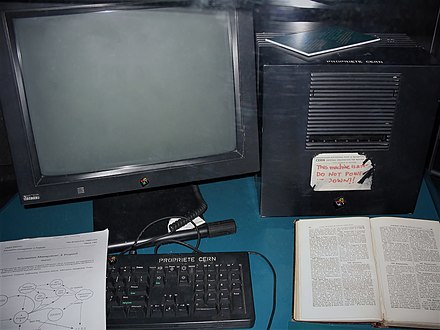
As we look for the line, we might recall that it was on this date in 1991 that the World Wide Web was introduced to the world at large.
In 1989, Tim Berners-Lee (now Sir Tim) proposed the system to his colleagues at CERN. He got a working system implemented by the end of 1990, including a browser called WorldWideWeb (which became the name of the project and of the network) and an HTTP server running at CERN. As part of that development, he defined the first version of the HTTP protocol, the basic URL syntax, and implicitly made HTML the primary document format.
The technology was released outside CERN to other research institutions starting in January 1991, and then– with the publication of this (likely the first public) web page— to the whole Internet 32 years ago today. Within the next two years, there were 50 websites created. (Today, while it is understood that the number of active sites fluctuates, the total is estimated at over 1.5 billion… more than a handful, gambling sites.)
“Ignorance, allied with power, is the most ferocious enemy justice can have”*…

The American author and aphorist William Feather once wrote that being educated means “being able to differentiate between what you know and what you don’t.” As it turns out, this simple ideal is extremely hard to achieve. Although what we know is often perceptible to us, even the broad outlines of what we don’t know are all too often completely invisible. To a great degree, we fail to recognize the frequency and scope of our ignorance.
In 1999, in the Journal of Personality and Social Psychology, my then graduate student Justin Kruger and I published a paper that documented how, in many areas of life, incompetent people do not recognize—scratch that, cannot recognize—just how incompetent they are, a phenomenon that has come to be known as the Dunning-Kruger effect. Logic itself almost demands this lack of self-insight: For poor performers to recognize their ineptitude would require them to possess the very expertise they lack. To know how skilled or unskilled you are at using the rules of grammar, for instance, you must have a good working knowledge of those rules, an impossibility among the incompetent. Poor performers—and we are all poor performers at some things—fail to see the flaws in their thinking or the answers they lack…
The trouble with ignorance is that it feels so much like expertise. A leading researcher on the psychology of human wrongness– David Dunning himself– explains the Dunning-Kruger effect: “We are all confident idiots.”
* James Baldwin
###
As we reconsider our confidence, we might recall that it was on this date in 1996 that the cable channel Fox News debuted.

If a tree falls in a forest and no one is around to hear it…*
Buzzfeed’s intrepid Kate Aurthur dove into a full week’s output from Nielsen, searching for the bottom of the television ratings barrel.
There are many channels in the United States, from the massive (USA, CNN, etc.) to the tiny. So many, in fact, that it does seem possible that at some hours of the day, no one — as in zero humans — is watching them. It’s also possible, of course, that this is where the problems of Nielsen Media Research, which has a monopoly on quantifying ratings, show themselves. If 324 ordinary Joe Shmoes — or 4,000 — did, in fact, watch one of the shows below, but none of those Joe Shmoes is in a Nielsen household, then those viewings do not register. Or, as Nielsen put it when I posed this question to them recently, the shows at the very bottom of the weekly cable list, the ones that get 0.0 total viewers, do not meet “minimum reporting thresholds.”
And yet, it does stand to reason that with hundreds and hundreds of available channels, there could be instances every week when not a single soul is tuning in to certain shows. When there are no longer broadcast networks and cable channels, and everything is digital and on-demand, we can look back at this period and marvel at its ridiculous economics.
I took a random week (Feb. 25-March 3) and delved into what sorts of shows — and cable channels — are members of the Zero Club. I excluded paid programming. And that left 35 shows that got zeros. You did not watch them. I did not watch them either. But here they are…

#1-13
“WPRA Today,” RFD (Feb. 25, 6:30 a.m.). And 12 other shows on RFD.
What does WPRA stand for, you ask? Why, it’s the Women’s Professional Rodeo Association. And there is a show about it. Having not previously known about channel RFD, which bills itself as “Rural America’s Most Important Network,” I am now obsessed with it. (If you are curious what RFD stands for, it’s “Rural Free Delivery,” and as for what that means, it’s so complicated there’s a whole explainer about it on the website.)
RFD focuses on agriculture, equine issues of the day, lifestyle, youth, and livestock auctions. Unfortunately, my cable provider, Time Warner Cable, does not feature RFD — like I needed another reason to hate Time Warner Cable. (Dish and DirecTV customers, I am jealous of you, and I am coming over, k?)
But RFD may want to reconsider their programming mix, because there were 12 other RFD shows that also got zero viewers: FFA Today (Feb. 27, 4 a.m.), Ken McNabb (Feb. 28, 6 a.m.), All Around Performance Horse (Feb. 27, 6 a.m.), Presleys’ Country Jubilee (Feb. 28, 3:30 a.m.), Dennis Reis (Feb. 27, 6:30 a.m.), Julie Goodnight (March 1, 6:30 a.m.), Voices of Agriculture (Feb. 27, 4:30 a.m.), US Dressage (Feb. 27, 3:30 a.m.), Little Britches Rodeo (Feb. 27, 3 a.m.), Ren’s Old Time Music (Feb. 25 and 26, 5:30 a.m.), Chris Cox (Feb. 26, 6 a.m.), and Campfire Café (Feb. 25, 3:30 a.m.). Nielsen families! I call to you to watch these shows! In the middle of the night!
Check out chokes from ESPN, VH-1, Fox, and the rest of the list at “The 35 Least-Watched Shows on TV.”
* after George Berkeley‘s famous thought experiment: “But, say you, surely there is nothing easier than for me to imagine trees, for instance, in a park […] and nobody by to perceive them. […] The objects of sense exist only when they are perceived; the trees therefore are in the garden […] no longer than while there is somebody by to perceive them.” From A Treatise Concerning the Principles of Human Knowledge (1710).
###
As we prepare to dive, we might recall that it was on this date in 1858 that the first U.S. patent for a combination lead pencil and eraser was issued to Hyman L. Lipman, of Philadelphia, Pa. (No. 19,783). Lipman’s design reserved one-fourth of the pencil’s length to hold a piece of prepared india-rubber, glued in at one edge; the balance, conventional graphite “lead.” So, sharpening one end prepared the lead for writing, while sharpening the other exposed a small piece of the eraser.

You must be logged in to post a comment.