Posts Tagged ‘Emile Borel’
“The world of reality has its limits; the world of imagination is boundless”*…
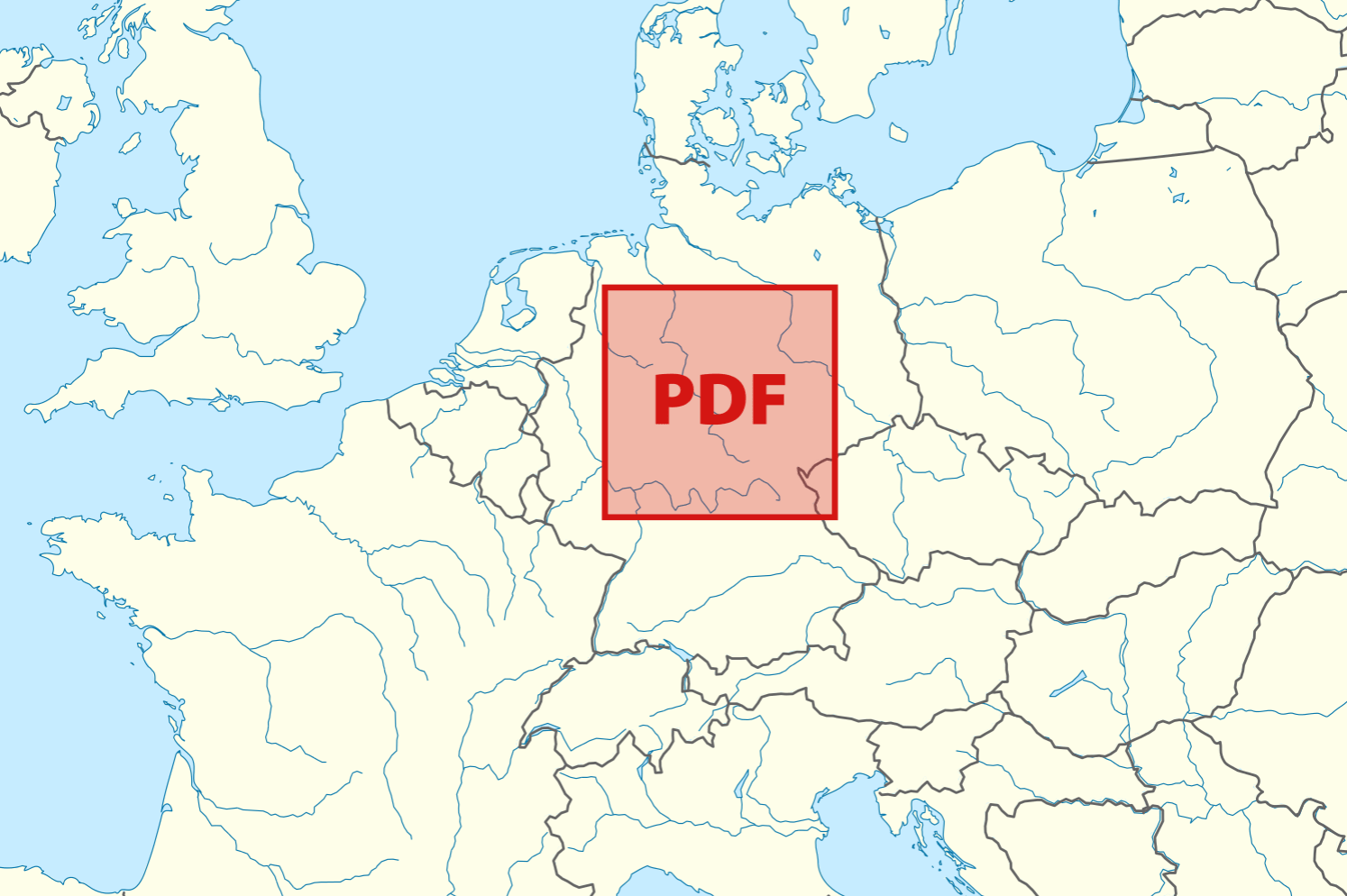
… and the digital world? Maybe, as Rob Beschizza reports, somewhere in between…
Alex set out to debunk the given wisdom that the maximum dimensions of a PDF are 381 km2, which is smaller than Germany. She presents her conclusions in an article titled “Making a PDF that’s larger than Germany,” so you know from the outset she succeeded. It’s a fascinating example of the disalignment of specifications, implementations, and reality. You can make one by hacking the postscript, and while Adobe Acrobat won’t like it, other apps will…
Borges would be delighted…
“On exactitude in PDFs“
Just how big was Alex [Chan] able to make her PDF?…
… unlike Acrobat, the Preview app doesn’t have an upper limit on what we can put in MediaBox. It’s perfectly happy for me to write a width which is a 1 followed by twelve 0s…
If you’re curious, that width is approximately the distance between the Earth and the Moon. I’d have to get my ruler to check, but I’m pretty sure that’s larger than Germany.
I could keep going. And I did. Eventually I ended up with a PDF that Preview claimed is larger than the entire universe – approximately 37 trillion light years square. Admittedly it’s mostly empty space, but so is the universe. If you’d like to play with that PDF, you can get it here.
Please don’t try to print it.
“Making a PDF that’s larger than Germany“
* Jean-Jacques Rousseau
###
As we scale up, we might spare a thought for Émile Borel; he died on this date in 1956. A mathematician (and politician who served as French Minister of the Navy), he is remembered for his foundational work in measure theory and probability. He published a number of research papers on game theory and was the first to define games of strategy.
But Borel may be best remembered for a thought experiment he introduced in one of his books, proposing that a[n immortal] monkey hitting keys at random on a typewriter keyboard will – with absolute certainty – eventually type every book in France’s Bibliothèque Nationale de France. This is now popularly known as the infinite monkey theorem.

“Oops, I did it again”*…

(Roughly) Daily has contemplated game theory a number of times (e.g., here). The Generalist Academy offers a particularly poignant example…
Football [or, as it’s called in the U.S., soccer] has a lot of strange rules – like Ted Lasso, I still don’t understand exactly how the offside rule works. But the basic game is pretty simple: get the ball into your opponent’s goal, and prevent them from getting the ball into your goal. Scoring a goal against your own side is a rare and accidental embarrassment. Usually.
The qualification round for the 1994 Caribbean Cup had some unusual rules. No match could end in a draw; if the teams were tied at the end of regular time, they would go into sudden death extra time. But! Any goal scored in extra time would count as two goals. This was presumably done because this tournament, like many, used goal difference to break ties in the qualifying groups. (Goal difference = total number of goals they’ve scored minus the number of goals they’ve conceded.) So that extra time “golden goal” would give a team an edge in the overall competition. Little did the organisers know that it would also lead to one of the strangest football games ever seen…
A truly remarkable match: “Own-Goal Football,” from @GeneralistAcad.
* Britney Spears (Songwriters: Martin Max / Rami Yacoub)
###
As we work backwards, we might send carefully-calculated birthday greetings to Félix Édouard Justin Émile Borel; he was born on this date in 1871. A mathematician (and politician, who served as French Minister of the Navy), he is remembered for his foundational work in measure theory and probability. He published a number of research papers on game theory and was the first to define games of strategy.
But Borel may be best remembered for a thought experiment he introduced in one of his books, proposing that a monkey hitting keys at random on a typewriter keyboard will – with absolute certainty – eventually type every book in France’s Bibliothèque Nationale de France. This is now popularly known as the infinite monkey theorem.
You must be logged in to post a comment.