Posts Tagged ‘networks’
“Cash is king”*…

“The king is dead, long live the king” Nick Routley on the replacement of cash by digital payment…
As credit cards and digital wallets (e.g. Apple Pay, Paytm, Alipay) see increasing adoption around the world, the share of cash being used in transactions is plummeting.
The chart above looks at cash as a share of transaction value in selected countries at three time periods (2019, 2023, and 2027P). Highlighted in red is cash’s projected drop from 2019 to 2027. This data showing the death of cash comes from WorldPay’s Global Payments Report 2024.
The prominence of cash for use in transactions is dropping in every country measured. This includes countries where cash was preferential method of payment in POS transactions.
One clear example is Nigeria. In 2019, over 90% of transaction value was still in cash payments. That number has now fallen to 55% today. Cash is still the leading payment method in Nigeria and a handful of other nations, but current trends indicate this may not be the case for much longer. For now, cash also remains the leading method of payment in various South American and East Asian countries…
All that is solid melts into air: “Charted: The Death of Cash Transactions Around the World,” from @NickRoutley in @VisualCap.
For more: “What is a cashless society, and what does it mean for businesses?“
And for a consideration of the pros and cons: “Should We Become a Cashless Society?“
Also apposite: “Target said that due to ‘extremely low volumes,’ it would no longer take personal checks.”
* Modern saying, summarizing the position in a recession
###
As we click, we might recall that it was on this date in 2001 THAT The Code Red worm was released onto the Internet. Targeting Microsoft’s IIS web server, Code Red had a significant effect on the Internet via the speed and efficiency of its spread. Much of this was due to the fact that IIS was often enabled by default on many installations of Windows NT and Windows 2000. But Code Red also affected many other systems with web servers, mostly by way of side-effect, exacerbating the overall impact of the worm.
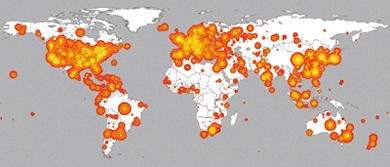
“I don’t have to tell you things are bad. Everybody knows things are bad.”*…

Further to a recent post on “seeing like a system” (and in a fashion, to last Monday’s post on misinformation), a provocative essay by Rohit Krishnan…
We’re living through a phase change that is at the root of a lot of our societal problems. It’s the fact that our information networks have become much more dense.
You exist as a node in a network. Other people are other nodes. They send you information, the edges. You process it, you create your own. Information flows in all directions.
There are all sorts of networks. If you imagine all of us as nodes and the information we receive from each other via edges, then the shape of the network defines the type of information that spreads.
When the type of information is extremely tantalising, one that spreads fast, then the whole network gets taken over with that information. And there’s even a tipping point at which the information breaks containment and spreads through the whole network. Here’s an excellent essay on the subject…
When there are a lot of neighbours to which a node is connected, then various types of information spreads much faster through the network. This is called network density, how many edges are connected on average to each node. And increased density means that there’s many more routes by which information can spread.
This is why cities have much higher rates of “cultural transmission” compared to rural areas. Or why in domains like fashion or ideas or innovation or language or even food, the speed of change and variety is much higher in cities. Because each new unit of culture can transmit from person to person so much faster when there are more people it can connect to.
Ok, this is basics about what a network is. But what happens when the entire world gets interconnected such that we’re all connected to each other much more densely? What would have changed in ourselves? Our culture?
Historically, you used to only have a few sources of news or information. Things that percolated through to your network or things you read in the news. Now information comes from all sides, hungry for your attention. And your “processing power” to make sense of this information hasn’t meaningfully changed.
Imagine seeing the world from this vantage point. A blinding array of data streaming at you, standing as a node. Some from near, some from afar. You take it all in, process it, and build up a sense of the world from it, including a sense of the other people and their beliefs reflecting back, from near and far.
If you do this, as a sentient being, you can’t help but develop a world model. A sense of the world, a sense of what others think of the world, perhaps even another layer or two. Even if you develop it only to help speed up the information processing that you need to do. It will be different in structure for each of you, of course, but part of a shared consensus reality nonetheless. A sense made up of all the information that came your way, including the sense you have of all the sense of information that came other people’s way, which helps them process the information flowing their way. Creating a collective sense of what’s going on, a knowledge of the shared reality in which we live.
We call this our culture…
Culture is the digital biosphere we create for ourselves. Culture is the infosphere we all swim in. If you think of the information that we all swap with each other as water, culture is the ocean made up of it, or a distilled version of the most common or communally known parts of that ocean.
Edward Hall, in his books Silent Language and Beyond Culture, writes about how culture is composed of the communication patterns, behaviours, and symbols that are shared amongst a group. We can think of culture as the common interconnected web that underlay the beliefs that we all hold, which constantly changes and evolves as our beliefs spread.
This is especially salient because part of the culture now is filled with efforts of many to escape it. This isn’t new, of course, and have existed since Thoreau. But there is an increase in it. People try tools for thought and software to recommend things or remember things, or AI to remember everything they read and interacted with, all so that there can be a way to deal with the information avalanche.
While this makes sense for an individual, the fact that this collectively defines the information ecosystem around us also means that the problem is on the supply side. This is why there is the rise of private spaces, especially since Twitter’s demise. Hence the theory that we live in the dark forest era of the internet:
Is our universe an empty forest or a dark one? If it’s a dark forest, then only Earth is foolish enough to ping the heavens and announce its presence. The rest of the universe already knows the real reason why the forest stays dark. It’s only a matter of time before the Earth learns as well.
This is also what the internet is becoming: a dark forest.
In response to the ads, the tracking, the trolling, the hype, and other predatory behaviors, we’re retreating to our dark forests of the internet, and away from the mainstream.
The push to create private spaces, on discord or group chats, to truly express oneself or let mini-ecosystems flourish, they all are needed to make us stop sitting with our face deep inside the information superhighway. It’s to help make the networks you’re in a bit sparser.
And my thesis is that almost everything that we see that pushes against the cultural state we used to recognise, is as a result of this densification of our information networks. Whether it is group chats, private forums, discord, smartphones that are not that smart, yearning for the flip phones from Motorola, various tools for thought, AI software to help you focus, better note taking tools, the angst against media headlines, the disbelief in economic and political institutions, the underlying sense of malaise that seemingly everyone feels, the vibes.
And the way we’re interconnected changes the way we see and process information that comes our way, which changes the culture. The form of the network changes the way the network operates.
In the era of superfast many-to-many communication, the ideas that spread are the ones which can “take over” the entire spectrum. Small ideas grow, wither, die. It’s only the memetic megafauna that survive.
In a sparse network you might have pockets which retain their individuality and survive for longer. Like Galapagos syndrome for ideas. Both good and bad.
Letting your ecosystem interact with the external giant internet might mean it will die out or get outcompeted…
…
… The outcome of having a dense network is insidious but powerful. It means only the narratives which can go viral do go viral. The collective epistemic commons becomes filled with those narratives which outcompete the others and muscle their way to the top. It means that at a time of unprecedented low unemployment, high wages, high standard of living, GDP growth, high stock markets, strong dollar, people in the US still think they’re living in the worst of all possible times. An anti-Panglossian sentiment.
It means that everyone is convinced everyone else is having a bad time. We’re surrounded by vibes about everyone’s life getting worse, wars and famine and pestilence and injustice worldwide. We see gaffes and mistakes made by everyone laid bare instantly.
The denser network makes the impact of the message change. It molds itself to the medium.
At some level of interconnectivity, we all fall prey to the weaknesses of information deluge. Our attention is finite and so is our processing capacity for information. You can have the world do a denial of service attack on your cognition by overwhelming it with bits of information, so you’re stuck in place like a fly in amber. And it does this so easily that we haven’t even recognised when it happens let alone how to prevent it.
That too is why we have so many tools for thought, and ways to capture notes to search them afterwards, and tools for doing work about work, and endless lists and notes and contextual reminders and and and … It’s why we yearn for cultural islanding. It’s why there’s the never-ending “current thing”. We’re all left tilting at the windmill of being a node in a dense network…
Dense networks, dark forests: “Seeing Like a Network,” from @krishnanrohit.
(Image above: source)
* “Howard Beale” (Peter Finch), Network
###
As we deal with density, we might recall that it was on this date in 1974, at 8:01a, that the bar code made its retail debut: the first OPC-coded item, a ten pack of Wrigley’s chewing gum, was canned at the Marsh supermarket in Troy, Ohio by cashier Sharon Buchanan for customer Clyde Dawson.
Bar codes are now, of course, ubiquitous in retail, but are also widely used in healthcare, transport and logistics, mail, parcel, and baggage handling, and ticketing.

“Your values become your destiny”*…

… and that could be an issue for the global order. People’s principles were expected to align as countries got richer; research suggests that instead they’re diverging. What happened?…
In 1981 over 40% of the world’s population lived in extreme poverty. But economic growth was starting to accelerate in developing countries. And Ron Inglehart, a professor at the University of Michigan, was organising a worldwide survey team to test the theory that, as peasant farmers escape poverty, they begin to think and behave differently, as people in the past had done when they joined the middle classes.
They might give a higher priority to education, to widening their children’s knowledge, than their own parents had done. They might give greater weight to their own experience and reasoning, and less to religious books or the authority of kings. And perhaps these new ways, these basic values, would begin to converge around the world. Such matters, Inglehart thought, could be tested by asking questions which revealed underlying values such as “How important is religion in your life?”, “Would you be happy living next to a foreigner?” and “Can you trust most people?”
Forty years later, only 8% of the world’s population is still in extreme poverty; more than half, on some measures, count as middle class. The World Values Survey (WVS), Inglehart’s baby, has become the world’s biggest social-research network. Every five years or so its researchers sally out into the field interviewing, at last count, almost 130,000 people in 90 countries. Yet its latest wave of results, which covers 2017-22, provides only partial endorsement of the idea that basic values tend to converge as people get richer. In significant ways, the differences between how people think in different parts of the world seem to be widening.
The Economist unpacks the data (with loads of helpful graphics), examines the possible causes at work, and looks to the future: “Western values are steadily diverging from the rest of the world’s” @TheEconomist.
* Gandhi
###
As we contemplate culture, we might send carefully-observed birthday greetings to John Scott CBE FRSA FBA FAcSS; he was born on this date in 1949. A sociologist, he is best known for his work on economic and social networks, perhaps especially The Sage Handbook of Social Network Analysis and Conceptualising the Social World.

“Man is not disturbed by events, but by the view he takes of them”*…

From Stripe Partners, a framework for rethinking the way we talk about the AI future…
AI is both a new technology and a new type of technology. It is the first technology that learns and that has the potential to outstrip its makers’ capabilities and develop independently.
As Large Language Models bring to life the realities of AI’s potential to operate at unprecedented, ‘human’ levels of sophistication, projections about its future have gained urgency. The dominant framework being applied to identify AI’s potential futures is 165 years old: Charles Darwin’s theory of evolution.
Darwin’s evolutionary framework is rendered most clearly in Dan Hendycks work for the Center for AI Safety which posits a future where natural selection could cause the most influential future AI agents to have selfish tendencies that might see AI’s favour their own agendas over the safety of humankind.
The choice of Natural Selection as a framework makes sense given AI’s emerging status as a quasi-sentient, highly adaptive technology that can learn and grow. The choice is a response to the limitations inherent in existing models for technological adoption which treat technologies as inert tools that only come to life when used by people.
The risk in applying this lens to AI is that it goes too far in assigning independent agency to AI. Estimates on the timing of the emergence of ‘Artificial General Intelligence’ vary, but spending some time with the current crop of Generative AI platforms confirms the view that AI’s with intelligences that are closer to humans are some way off. In the interim using natural selection as a lens to understand AI positions humans as further out of the developmental loop than is actually the case. Competitive forces whether market or military will shape AI’s development, but these will not be the only forces at play and direct interaction with humans will be the principal driver for AI’s progress in the near term.
A year ago we wrote about the opportunity to reframe the impact of AI on organisations through the lens of Actor Network Theory (ANT). More than a singular theory, ANT describes an approach to studying social and technological systems developed by Bruno Latour, Michel Callon, Madeleine Akrich and John Law in the early 1980s.
ANT posits that the social and natural world is best understood as dynamic networks of humans and nonhuman actors… In our 2023 piece we suggested that ANT, with its focus on framing society and human-technology interactions in terms of dynamic networks where every actor whether human or machine impacts the network, was a useful way of exploring the ways in which AI will impact people, and people will impact AI.
A year on the value of ANT as a framework for exploring AI’s future has become clearer. The critical point when comparing an ANT frame to an evolutionary one is the way in which the ANT framing highlights how AI will progress with and through people’s interactions with it. When viewed as an actor in a network, not a technology in isolation, AI will never be separate from human interventions…
A provocative argument, well worth reading in full: “Why the debate about the future of AI needs less Darwin and more Latour,” from @stripepartners.
Apposite: “Whose risks? Whose benefits?” from Mandy Brown.
* Epictetus
###
As we reframe, we might recall that it was on this date in 1946 that an ancestor of today’s AIs, the ENIAC (Electronic Numerical Integrator And Computer), was first demonstrated in operation. (It was announced to the public the following day.) The first general-purpose computer (Turing-complete, digital, and capable of being programmed and re-programmed to solve different problems), ENIAC was begun in 1943, as part of the U.S’s war effort (as a classified military project known as “Project PX“); it was conceived and designed by John Mauchly and Presper Eckert of the University of Pennsylvania, where it was built. The finished machine, composed of 17,468 electronic vacuum tubes, 7,200 crystal diodes, 1,500 relays, 70,000 resistors, 10,000 capacitors and around 5 million hand-soldered joints, weighed more than 27 tons and occupied a 30 x 50 foot room– in its time the largest single electronic apparatus in the world. ENIAC’s basic clock speed was 100,000 cycles per second (or Hertz). Today’s home computers have clock speeds of 3,500,000,000 cycles per second or more.

“Men, it has been well said, think in herds; it will be seen that they go mad in herds, while they only recover their senses slowly, one by one”*…

You’ve probably heard of the wisdom of crowds. The general idea, popularized by James Surowiecki’s book, is that a large group of non-experts can solve problems collectively better than a single expert. As you can imagine, there are a lot of subtleties and complexities to this idea. Nicky Case helps you understand with a game.
Draw networks, run simulations, and learn in the process…
Spend an extremely-fruitful half hour with “The Wisdom and/or Madness of Crowds.”
[via Flowing Data]
Extraordinary Popular Delusions and the Madness of Crowds
###
As we contemplate connection, we might compose a birthday rhyme for Torquato Tasso, the 16th Century Italian poet; he was born on this date in 1544. Tasso was a giant in his own time– he died in 1595, a few days before the Pope was to crown him “King of the Poets”– but had fallen out the core of the Western Canon by the end of the 19th century. Still, he resonates in the poems (Spencer, Milton, Byron), plays (Goethe), madrigals (Monteverdi), operas (Lully, Vivaldi, Handel, Haydn, Rossini, Dvorak) , and art work (Tintoretto, the Carracci, Guercino, Pietro da Cortona, Domenichino, Van Dyck, Poussin, Claude Lorrain, Tiepolo, Fragonard, Delacroix) that his life and work inspired.

You must be logged in to post a comment.