Posts Tagged ‘servers’
“Cash is king”*…

“The king is dead, long live the king” Nick Routley on the replacement of cash by digital payment…
As credit cards and digital wallets (e.g. Apple Pay, Paytm, Alipay) see increasing adoption around the world, the share of cash being used in transactions is plummeting.
The chart above looks at cash as a share of transaction value in selected countries at three time periods (2019, 2023, and 2027P). Highlighted in red is cash’s projected drop from 2019 to 2027. This data showing the death of cash comes from WorldPay’s Global Payments Report 2024.
The prominence of cash for use in transactions is dropping in every country measured. This includes countries where cash was preferential method of payment in POS transactions.
One clear example is Nigeria. In 2019, over 90% of transaction value was still in cash payments. That number has now fallen to 55% today. Cash is still the leading payment method in Nigeria and a handful of other nations, but current trends indicate this may not be the case for much longer. For now, cash also remains the leading method of payment in various South American and East Asian countries…
All that is solid melts into air: “Charted: The Death of Cash Transactions Around the World,” from @NickRoutley in @VisualCap.
For more: “What is a cashless society, and what does it mean for businesses?“
And for a consideration of the pros and cons: “Should We Become a Cashless Society?“
Also apposite: “Target said that due to ‘extremely low volumes,’ it would no longer take personal checks.”
* Modern saying, summarizing the position in a recession
###
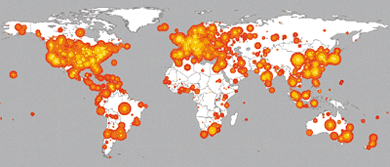
As we click, we might recall that it was on this date in 2001 THAT The Code Red worm was released onto the Internet. Targeting Microsoft’s IIS web server, Code Red had a significant effect on the Internet via the speed and efficiency of its spread. Much of this was due to the fact that IIS was often enabled by default on many installations of Windows NT and Windows 2000. But Code Red also affected many other systems with web servers, mostly by way of side-effect, exacerbating the overall impact of the worm.
“Of course there’s a lot of knowledge in universities: the freshmen bring a little in; the seniors don’t take much away, so knowledge sort of accumulates”*…

Professor Paul Musgrave on the wacky world of university fundraising…
I would like you to buy me a chair. Not just any chair: an endowed chair.
Let me explain.
Universities have strange business models. The legendary University of California president Clark Kerr once quipped that their functions were “To provide sex for the students, sports for the alumni, and parking for the faculty.” These days, the first is laundered for public consumption as “the student experience” and the third is a cost center (yes, many to most professors have to pay, rather a lot, for their parking tags). (The second remains unchanged.)
You can tell that Kerr was president during a time of lavish support because he didn’t include the other function of a university: to provide naming opportunities for donors.
…
Presidents, chancellors, and provosts seek to finagle gifts because the core business of universities—providing credits to students in exchange for tuition—is both volatile and insufficient to meet the boundless ambitions of administrators and faculty alike. (Faculty might protest that their ambitions are quite modest, as they include merely limitless research budgets and infinite releases from course time—but other than that, they ask only for cost of living adjustments as well as regular salary increases.) Trustees expect presidents to bring in new buildings and new chairs; presidents expect trustees to help dun their friends and acquaintances for donations. The incentives even trickle down to deans, directors, and chairs, all of whom live with increasingly austere baseline budgets and a concomitant incentive to find and cultivate donors to expand, or even just support, their operations.
It’s easy, and wrong, for faculty to be cynical about this. First, these operations reflect the gloriously incongruous medieval nature of the university. Higher education in its upper reaches resembles medieval monasteries, and such monasteries provided not just seclusion and sanctity for their initiates but the possibility of the purchase of virtue for the wealthy. So, too, do universities offer grateful alumni and those sentimental about the generation of knowledge opportunities to turn worldly wealth into tax-deductible noblesse oblige.
Second, donors are the customers for the other product of the university: the social proof of good works. Universities offer donors solicitous for the future of the less fortunate opportunities to subsidize tuition, and they offer donors more interested in the benefits of knowledge the opportunity to subsidize research. The reward comes in some combination of the knowledge that such works are being done and the fact that the donor’s name will be associated with it. (Few large university buildings are named the Anonymous Center for Cancer Research.)
…
The bar for giving continues to rise. Nine-figure gifts were once unheard of; nowadays, they are striking but no longer unprecedented. For such a sum you can have a constituent college named for yourself. The next frontier must be the billion, or multi-billion, dollar gift. For that level, of course, the reward would have to be commensurate. Given that Harvard was named for a donor who left some books and a few hundred pounds to his eponymous university, one wonders whether someone in Harvard’s charitable receiving arm hasn’t calculated how much it would cost to become, say, the Zuckerberg-Harvard University. (I would wager that an earnest offer of $10 billion would at least raise the issue.)…
[There follows a price list for endowed/named Chairs at different universities, and an analysis of their economics. The author suggest that a chair for him would run $2.5-3 million…]
Fascinating: “Buy Me a Chair,” from @profmusgrave.
* A. Lawrence Lowell (legal scholar and President of Harvard University from 1909 to 1933)
###
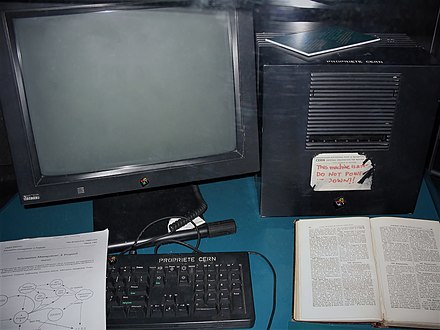
As we dig deep, we might recall that it was on this date in 1991 that the World Wide Web was introduced to the world at large.
In 1989, Tim Berners-Lee (now Sir Tim) proposed the system to his colleagues at CERN. He got a working system implemented by the end of 1990, including a browser called WorldWideWeb (which became the name of the project and of the network) and an HTTP server running at CERN. As part of that development, he defined the first version of the HTTP protocol, the basic URL syntax, and implicitly made HTML the primary document format.
The technology was released outside CERN to other research institutions starting in January 1991, and then– with the publication of this (likely the first public) web page— to the whole Internet 32 years ago today. Within the next two years, there were 50 websites created. (Today, while it is understood that the number of active sites fluctuates, the total is estimated at over 1.5 billion.)
You must be logged in to post a comment.