Posts Tagged ‘interpretation’
“For what man in the natural state or course of thinking did ever conceive it in his power to reduce the notions of all mankind exactly to the same length, and breadth, and height of his own? Yet this is the first humble and civil design of all innovators in the empire of reason.”*…

A “theory of everything” (a Grand Unified Theory on steriods)– a (still hypothetical) coherent theoretical framework of physics containing and explaining all physical principles– is the holy grail of physicists. Natalie Wolchover checks in on the most recent front-runner in the hunt…
Fifty-eight years after it first appeared, string theory remains the most popular candidate for the “theory of everything,” the unified mathematical framework for all matter and forces in the universe. This is much to the chagrin of its rather vocal critics. “String theory is not dead; it’s undead and now walks around like a zombie eating people’s brains,” the former physicist Sabine Hossenfelder said on her popular YouTube channel in 2024.
String theory is a “failure,” the mathematical physicist and blogger Peter Woit often says. His complaint is not that string theory is wrong — it’s that it’s “not even wrong,” as he titled a 2006 book. The theory says that, on scales of billionths of trillionths of trillionths of a centimeter, extra curled-up spatial dimensions reveal themselves and particles resolve into extended objects — strands and loops of energy — rather than points. But this alleged substructure is too small to detect, probably ever. The prediction is untestable.
A further problem is that uncountably many different configurations of dimensions and strings are permitted at those tiny scales; the theory can give rise to a limitless variety of universes. Amid this vast landscape of solutions, no one can hope to find a precise microscopic configuration that undergirds our particular macroscopic world.
These issues are profound indeed. Yet in my experience, the typical high-energy theorist in a prestigious university physics department still thinks string theory has a good chance of being correct, at least in part. The field has become siloed between those who deem it worth studying and those who don’t.
Recently, a new angle of attack has opened up. An approach called bootstrapping has allowed physicists to calculate that, under various starting assumptions about the universe, a key equation from string theory naturally follows. For some experts, these findings support the notion of “string uniqueness,” the idea that it is the only mathematically consistent quantum description of gravity and everything else.
Responding to one bootstrap paper on her YouTube channel, mere weeks after the “undead” comment, Hossenfelder said it was “string theorists do[ing] something sensible for once.” She added, “I’d say this paper strengthens the argument for string theory.”
Not everyone agrees, but the findings are reviving an important question. “This question of ‘Does string theory describe the world?’ has just been so taboo,” said Cliff Cheung, a physicist at the California Institute of Technology and an author of the paper discussed by Hossenfelder. Now, “people are actually thinking about it for the first time in decades.”
Getting wind of this work, I wanted to drill down on the logic and examine how the string hypothesis is faring these days…
And so she does: “Are Strings Still Our Best Hope for a Theory of Everything?” from @nattyover.bsky.social in @quantamagazine.bsky.social. Eminently worth reading in full.
Compare/contrast with: “Where Some See Strings, She Sees a Space-Time Made of Fractals.”
* Jonathan Swift, A Tale of a Tub
###
As we grapple with Godel, we might spare a thought for Hermann Rorschach; he died on this date in 1922. A psychiatrist and psychoanalyst, his education in art helped to spur the development of a set of inkblots that were used experimentally to measure various unconscious parts of the subject’s personality. Rorschach knew the human tendency to project interpretations and feelings onto ambiguous stimuli and believed that the subjective responses of his subjects enabled him to distinguish among them on the basis of their perceptive abilities, intelligence, and emotional characteristics. His method has come to be known as the Rorschach test, iterations of which have continued to be used over the years to help identify personality, psychotic, and neurological disorders.
Perhaps his insight that we humans tend “to project interpretations and feelings onto ambiguous stimuli” can inform our understanding of physicists trying to construct mental/conceptual models of our reality, which they’ve been doing for a very long time, and of the limitations of that quest.

“When truth and reason cannot be heard, then must presumption rule”*…
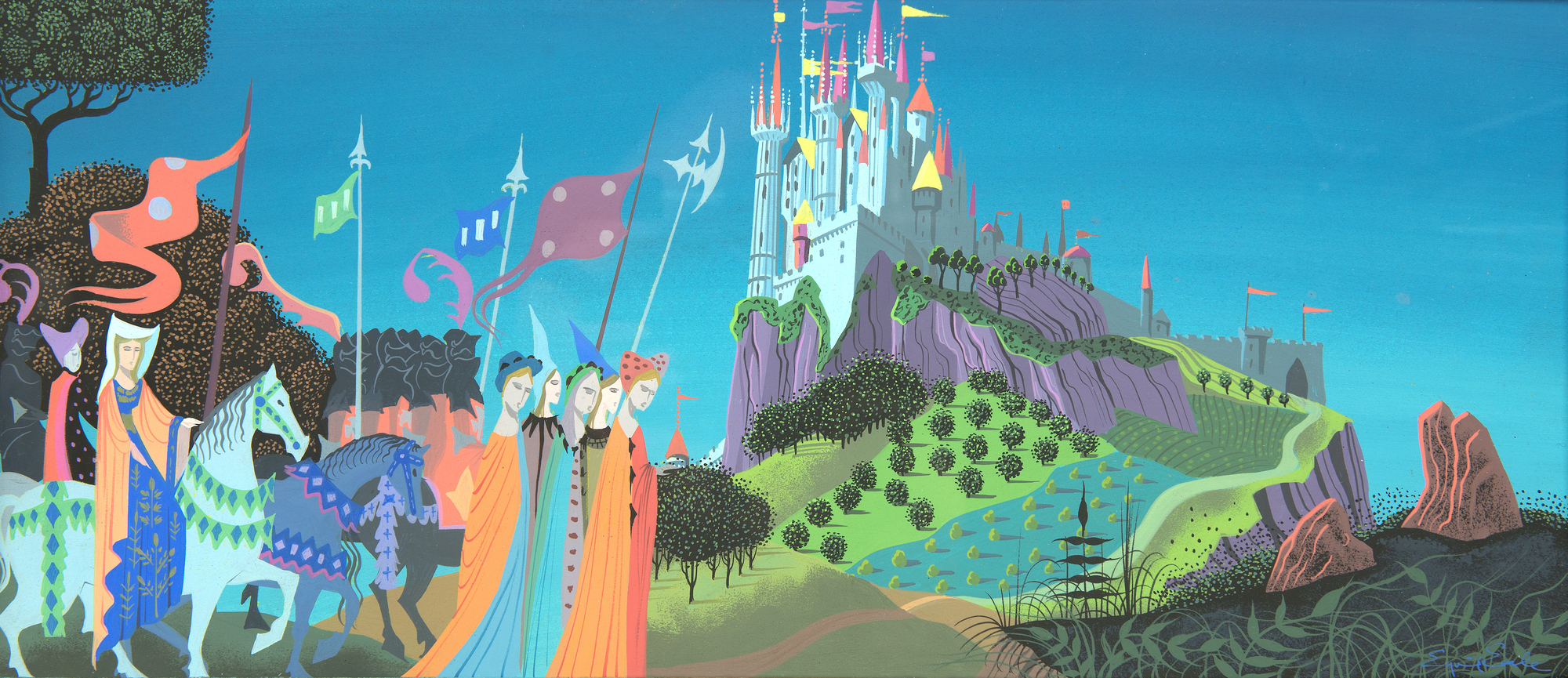
Anne Wallentine considers an exhibition that depicts how people have reimagined the medieval period in the centuries since, and how they have revealed their own interests and ideals with each new interpretation…
To explain why I am standing outside the dinner theater juggernaut Medieval Times in the name of journalism, I would have to go back to the beginning: specifically, to 500 CE, the generally agreed upon start of the Middle Ages, which is a contemporary term for a 1,000-year period (500–1500) in world history. This term is now preferred to the “Dark Ages,” which derived from the assumption that the enlightened learning of Greco-Roman antiquity was extinguished with the collapse of the Roman empire. The retroactive valorizing of past eras — reflected in our names for them — is as constant as our passage into new ones. The Getty Center’s latest exhibition, The Fantasy of the Middle Ages, explores this historical habit by depicting how people have reimagined the medieval period in the centuries since, and how they have revealed their own interests and ideals with each new interpretation…
The fantastical imagery that many of us consider “medieval” today has been invented, at least in part, in the centuries since. While some legends are rooted in the period, like the stories of King Arthur and Camelot, many others were embroidered onto an imagined, “medieval-ish” past through fantasy stories, films, and other forms of popular culture, especially from the 19th century on. Modern medieval tales have become populated with knights, dragons, witches, and fairies — though, as the show explains, only the first two were frequently depicted in the period, and anything magical or mysterious was understood through the lens of religion. The exhibition pairs medieval and later imagery to explore these shifting depictions and the powerful legacy they have left…
Read on: “What Our Fantasies About the European ‘Middle Ages‘ Say About Us,” from @awallintime in @hyperallergic.
* Barbara Tuchman, A Distant Mirror: The Calamitous 14th Century
###
As we ponder the past, we might recall that it was on this date in 1264, in the midst of the War of Saint Sabas (a Crusades-related conflict between Venice/Knights Templar and Genoa/Knights Hospitaller over land in the Kingdom of Jerusalem), that the Genoese tricked the Venetians into sailing east to the Levant, and captured an entire Venetian trade fleet in what’s known as the Battle of Saseno.
Still, the war continued until 1270, when the Peace of Cremona ended the hostilities. In 1288, Genoa finally received their land back.

You must be logged in to post a comment.