Posts Tagged ‘church’
“Here’s the church, here’s the steeple, open the doors, and see all the people”*…

It’s Sunday, and war is raging (again) in the Middle East. This time around, the strains of fundamentalist Christian thought are hard to miss in the justifications of the role of the U.S. in the conflict. The widely-circulated reports of troops being briefed that the war in Iran is meant to hasten the Biblical End Times may or may not be true. But it seems clear that the millennial contingent in Trump’s movement is all in on an apocalypse. (And here.) As the right-wing site Media Matters reports, “Christian media figures have claimed that the Iran war could signal ‘the second coming’ or the ‘End Times’ and said ‘we are watching incredible prophecy in this time come to pass’.”
Tal Lavin has reached back to the work he did for his book Wild Faith to help us understand…
As chaos and violence break out across the Middle East in a war led by the US with Israel as junior partner, I wanted to revisit my research on Christian apocalyptic prophecy… about the evangelical Christians eagerly looking forward to the end of the world—and influencing foreign policy to bring it closer. It’s difficult to conceive of willful courting of disaster for religious reasons, but decades of modern Christian prophecy eagerly foresee mass bloodshed in the Middle East as a prelude to Christ’s triumphant return. Evangelicals of this stripe form a crucial part of Trump’s base and governing coalition…
Eminently worth reading in full: “Yearning for the Apocalypse,” from @swordsjew.bsky.social.
And lest we think that this inveighling is in any way unprecedented, Matthew Avery Sutton, reminds us that there’s a long history of politics using religion (and vice versa). In an excerpt from his new book, Chosen Land: How Christianity Made America and Americans Remade Christianity, he tells the story of Reconstuction, during which churches were mobilized on both sides of the divide-that-never-went-away…
… In the aftermath of the Civil War, federal leaders sought help from Christian groups… as they sought to reassert their power across the entire United States. The US Army had won on the battlefields, and now governing authorities and their protestant collaborators sought to secure the peace. They aimed to reconstruct the nation, to rebuild Americans’ shattered sense of their nation’s exceptional history and manifest destiny, and to reinvigorate their commitment to the United States’ Christian mission. But to succeed, policymakers knew they needed to limit dissent—including religious dissent.
Christian activists played key roles in every part of postwar reconstruction. In the South, Black ministers and White missionaries welcomed the formerly enslaved into the faith and worked with them to establish independent social and political lives. Defeated Southern Whites launched a multi-generation effort to defend their treason by reimagining the causes of the Civil War and God’s role in it. In the West, a series of Indian wars led to the US government’s creation of a comprehensive reservation system, where government-sponsored missionaries sought to Christianize tribes and “civilize” their children. In Utah Territory the US government cracked down on the Church of Jesus Christ of Latter-day Saints and its impressive theocracy, seeking to quell religious dissent.
Across the nation, Reconstruction policies provided new opportunities for church leaders in collaboration with the government to impose their ideas and values on the land and its peoples. Protestant activists believed that they alone had the tools and expertise to integrate Black and Native peoples, former Confederates, and religious dissenters into the body politic, while bringing healing and reconciliation to all Americans on their terms. Rocked by the split over slavery and then the war, they worked to build unity by identifying common threats and enemies and organizing Christians against them. Their actions demonstrated that after the conflict, just as before, the free exercise clause did not apply to all equally. But minority groups constantly challenged the power of mainstream Christian leaders…
… Only about one-third of enslaved Americans considered themselves Christian at the start of the Civil War. But in the Reconstruction era Black church going skyrocketed. And just about all of those who converted chose to attend Black-led churches. The days of Southern Black Christians submitting to second-class treatment in the house of the Lord had ended. In urban areas, African Americans could usually join churches that Black activists had founded before the war. In rural areas, they had fewer options. They sometimes had to settle for makeshift meetings in vacant buildings or arrange outdoor services until they could build rudimentary houses of worship.
Black clergy became some of the strongest advocates for full equality and rights in the postwar South. Seeing Jesus as a liberator, they aimed to make the egalitarianism of the gospel and the Declaration’s line that “all men are created equal” the reality in the United States. Many engaged directly in politics, understanding that while slavery might have ended, securing political equality required vigilance…
… Black ministers’ political engagement made them targets of violence. Members of the Ku Klux Klan, a [Protestant-led] terrorist organization founded by Southern Whites shortly after the war, burned down churches and threatened Black activists. A journalist testified to the US Senate about his interview with a minister. While “he had been preaching on the circuit,” Klansmen dragged the preacher from bed in the middle of the night and “beat him severely.” They “told him that if he returned to the county he would suffer for it.” This was one example of many. As racial violence escalated in the South, serving as a minister proved dangerous…
… Historian, sociologist, and Black activist W.E.B. Du Bois summarized in 1903 the role that churches played in Black life, especially in the postwar South. “The Negro church of today is the social centre of Negro life in the United States,” he wrote, “and the most characteristic expression of African character.” Postwar Black churches, as Du Bois understood, represented the heart of Black efforts to secure social, political, and religious equality. Church leaders had engineered the Christian faith into a tool of liberation, which made them a threat to the White Christians of the South and much of the rest of the United States.
In addition to working to suppress Black political and religious power, many Southern Whites launched a quasi-religious campaign to reshape the memory of the Civil War. Rather than acknowledge their deep investment in slavery, they recast the conflict as a tragic clash between two honorable forces—the North fighting to preserve the Union, and the South struggling to defend local autonomy and states’ rights. The authors of this revisionist account reduced slavery to a secondary issue, incidental to the “real” causes of the war. As a result, by war’s end, many White Southerners felt they had no reason to repent, no moral reckoning to face, and no obligation to embrace Black equality or suffrage. For them, the war had simply preserved the Union and, almost as an afterthought, ended slavery. Nothing more.
Christianity became central to this new Southern narrative. In defeat, White Southerners cast themselves in the role of Christ, imagining their suffering as redemptive. They claimed they had sacrificed for the greater good of the nation, their values—chivalric protection of White women, paternalistic care for those they enslaved, and Christian devotion—positioned them as the rightful moral leaders of the country. In their view, God had chosen them to guide the nation toward righteousness, but first he had humbled and purified them through the bloodshed of war…
Also eminently worth reading in full: How Christianity Was Used By the Powerful and the Marginalized to Shape Post-Civil War America,” from @literaryhub.bsky.social.
We are reminded why our founding fathers– so many of them, Deists— so wisely insisted on freedom of religion and separation of church and state.
Apposite: “The ‘Straight White American Jesus’ podcast covers the history, philosophy, theology, and politics of Christian nationalism” (from Boing Boing)
Also, (under the general heading “things aren’t always what they seem”): “The Iran War’s Most Precious Commodity Isn’t Oil,” (gift article from Bloomberg)
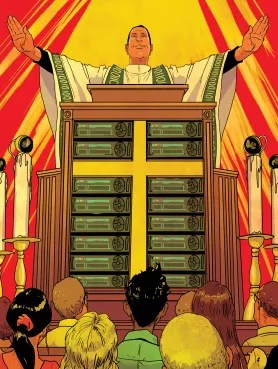
And finally: only vaguely related, but fascinating: “Preached Whales“– (landlocked) Central European pulpits shaped like fish, whales, and boats.
* classic children’s fingerplay rhyme
###
As we celebrate separation, we might recall that it was on this date in 1965 that “Subterranean Homesick Blues” by Bob Dylan was released.
Johnny’s in the basement, mixin’ up the medicine / I’m on the pavement, thinkin’ about the government…
The opening sequence of D. A. Pennebaker‘s Dont Look Back (the apostrophe is absent in the title… and yes, that’s Allen Ginsberg in the background)
“I once wanted to become an atheist, but I gave up – they have no holidays”*…
We used to relate to different spheres of our lives– and they to us– differently: we were consumers in the marketplace; citizens in the civic arena; worshipers in the spiritual; sudents in school; etc. We had expectations and obligations that were different, different in kind, from one to the next. The homogenizing logic of the marketplace is systematically taking over those other spheres… and we’re behaving– and being treated– more and more like consumers across them all. As this Wired article article from 1995 suggests, that’s been underway for a long time.
Case in point:
As of the end of last year, 63% of Americans identified as Christians; down roughly 12% over the last 20 years. As of 2024, 33% said they attended services in person at least monthly, with another 23% saying that they participated in virtual services at least once a month.
So it’s no surprise that churches are goosing their efforts to attract and keep worshipers, cultivating a more “experiential” (even “charismatic“) style– and turning to the same kind of CRM (customer relationship management) tools that Salesforce and others provide commercial ventures.
Alex Ashely reports on a purpose-driven (and purpose-built) vendor that means to enable churchs to “manage” their relationships with their parishioners in a way (and to an extent) that sounds more like Palantir than Salesforce…
On a Sunday morning in a Midwestern megachurch, worshippers step through sliding glass doors into a bustling lobby—unaware they’ve just passed through a gauntlet of biometric surveillance. High-speed cameras snap multiple face “probes” per second, isolating eyes, noses, and mouths before passing the results to a local neural network that distills these images into digital fingerprints. Before people find their seats, they are matched against an on-premises database—tagged with names, membership tiers, and watch-list flags—that’s stored behind the church’s firewall.
Late one afternoon, a woman scrolls on her phone as she walks home from work. Unbeknownst to her, a complex algorithm has stitched together her social profiles, her private health records, and local veteran outreach lists. It flags her for past military service, chronic pain, opioid dependence, and high Christian belief, and then delivers an ad to her Facebook feed: “Struggling with pain? You’re not alone. Join us this Sunday.”
These hypothetical scenes reflect real capabilities increasingly woven into places of worship nationwide, where spiritual care and technology converge in ways few congregants ever realize. Where Big Tech’s rationalist ethos and evangelical spirituality once mixed like oil and holy water, this unlikely amalgam has given birth to an infrastructure already reshaping the theology of trust—and redrawing the contours of community and pastoral power in modern spiritual life. The emerging nerve center of this faith-tech nexus is in Boulder, Colorado, where the spiritual data and technology firm Gloo has its headquarters.
Gloo is constructing a digital infrastructure meant to bring churches into the age of algorithmic insight.
The church is “a highly fragmented market that is one of the largest yet to fully adopt digital technology,” the company said in a statement by email. “While churches have a variety of goals to achieve their mission, they use Gloo to help them connect, engage with, and know their people on a deeper level.”…
… The company refers to itself as “a technology platform for the faith ecosystem.” Either way, this information is integrated into its “State of Your Church” dashboard—an interface for the modern pulpit.
Since its launch in 2013, Gloo has steadily increased its footprint, and it has started to become the connective tissue for the country’s fragmented religious landscape. According to the Hartford Institute for Religion Research, the US is home to around 370,000 distinct congregations. As of early 2025, according to figures provided by the company, Gloo held contracts with more than 100,000 churches and ministry leaders…
… [In March] Gloo… unveiled a strategic investment in Barna Group, the Texas-based research firm whose four decades of surveying more than 2 million people underpin its annual reports on worship, beliefs, and cultural engagement. Barna’s proprietary database—covering every region, age cohort, and denomination—has made it the go-to insight engine for pastors, seminaries, and media tracking the pulse of American faith…
… Barna’s troves of behavioral, spiritual, and cultural data offer granular insight into the behaviors, beliefs, and anxieties of faith communities. While the two organizations frame the collaboration in terms of serving church leaders, the mechanics resemble a data-fusion engine of impressive scale: Barna supplies the psychological texture, and Gloo provides the digital infrastructure to segment, score, and deploy the information…
… Gloo is also now focused on supercharging its services with artificial intelligence and using these insights to transcend market research. At a September 2024 event in Boulder called the AI & the Church Hackathon, Gloo unveiled new AI tools called Data Engine, a content management system with built-in digital-rights safeguards, and Aspen, an early prototype of its “spiritually safe” chatbot, along with the faith-tuned language model powering that chatbot, known internally as CALLM (for “Christian-Aligned Large Language Model”).
[Ashley describes the growth of Gloo (largely through acquisition), the advent and integration of biometric surveillance, and the Salesforce-like growth of third-party apps; he explores several use cases and raises the concerns– privacy and others– that arise in absence of any meaningful regulation or oversight…]
… With guardrails still scarce, though, faith-tech pioneers and church leaders are peering ever more deeply into congregants’ lives. Until meaningful oversight arrives, the faithful remain exposed to a gaze they never fully invited and scarcely understand.
In April, [Intel CEO until he was ousted last year, now Gloo’s executive chair and head of technology Phil] Gelsinger took the stage at a sold-out Missional AI Summit, a flagship event for Christian technologists that this year was organized around the theme “AI Collision: Shaping the Future Together.” Over 500 pastors, engineers, ethicists, and AI developers filled the hall, flashing badges with logos from Google DeepMind, Meta, McKinsey, and Gloo.
“We want to be part of a broader community … so that we’re influential in creating flourishing AI, technology as a force for good, AI that truly embeds the values that we care about,” Gelsinger said at the summit. He likened such tools to pivotal technologies in Christian history: the Roman roads that carried the gospel across the empire, or Martin Luther’s printing press, which shattered monolithic control over scripture. A Gloo spokesperson later confirmed that one of the company’s goals is to shape AI specifically to “contribute to the flourishing of people.”
“We’re going to see AI become just like the internet,” Gelsinger said. “Every single interaction will be infused with AI capabilities.”
He says Gloo is already mining data across the spectrum of human experience to fuel ever more powerful tools.
“With AI, computers adapt to us. We talk to them; they hear us; they see us for the first time,” he said. “And now they are becoming a user interface that fits with humanity.”
Whether these technologies ultimately deepen pastoral care or erode personal privacy may hinge on decisions made today about transparency, consent, and accountability. Yet the pace of adoption already outstrips the development of ethical guardrails. Now, one of the questions lingering in the air is not whether AI, facial recognition, and other emerging technologies can serve the church, but how deeply they can be woven into its nervous system to form a new OS for modern Christianity and moral infrastructure.
“It’s like standing on the beach watching a tsunami in slow motion,” Kriel says.
Gelsinger sees it differently.
“You and I both need to come to the same position, like Isaiah did,” he told the crowd at the Missional AI Summit. “‘Here am I, Lord. Send me.’ Send me, send us, that we can be shaping technology as a force for good, that we could grab this moment in time.”…
Spiritual care and technology are converging across the country, reshaping the theology of trust: “When tech gets religion: How churches use data and AI,” from @technologyreview.com.
* Henny Youngman
###
As we pray for guidance, we might recall that Henry VIII, King of England from 1509 until his death in 1547, known for his six marriages, attempted to have his first marriage (to Catherine of Aragon) annulled. His disagreement with Pope Clement VII over the issue led Henry to initiate the English Reformation, separating the Church of England from papal authority. He appointed himself Supreme Head of the Church of England and dissolved convents and monasteries– for which, on this date in 1535, he was excommunicated by (Clement’s successor) Pope Paul III.

“All the world is made of faith, and trust, and pixie dust”*…

The Gen Z gender divide, especially as it relates to ever-more conservative males and ever-more liberal females, is widely remarked. (E.g., see here [gift article].) Ruth Graham explores that divide in a different dimension– one that may be fueling the political divergence…
… For the first time in modern American history, young men are now more religious than their female peers. They attend services more often and are more likely to identify as religious.
“We’ve never seen it before,” Ryan Burge, an associate professor of political science at Eastern Illinois University, said of the flip.
Among Generation Z Christians, this dynamic is playing out in a stark way: The men are staying in church, while the women are leaving at a remarkable clip.
Church membership has been dropping in the United States for years. But within Gen Z, almost 40 percent of women now describe themselves as religiously unaffiliated, compared with 34 percent of men, according to a survey last year of more than 5,000 Americans by the Survey Center on American Life at the American Enterprise Institute.
In every other age group, men were more likely to be unaffiliated. That tracks with research that has shown that women have been consistently more religious than men, a finding so reliable that some scholars have characterized it as something like a universal human truth.
The men and women of Gen Z are also on divergent trajectories in almost every facet of their lives, including education, sexuality and spirituality.
Young women are still spiritual and seeking, according to surveys of religious life. But they came of age as the #MeToo movement opened a national conversation about sexual harassment and gender-based abuse, which inspired widespread exposures of abuse in church settings under the hashtag #ChurchToo. And the overturning of Roe v. Wade in 2022 compelled many of them to begin paying closer attention to reproductive rights.
Young men have different concerns. They are less educated than their female peers. In major cities, including New York and Washington, they earn less.
At the same time, they place a higher value on traditional family life. Childless young men are likelier than childless young women to say they want to become parents someday, by a margin of 12 percentage points, according to a survey last year by Pew…
… This growing gender divide has the potential to reshape the landscape of not just religion, but also of family life and politics. In a Times/Siena poll of six swing states in August, young men favored former President Donald J. Trump by 13 points, while young women favored Vice President Kamala Harris by 38 points — a 51-point gap far larger than in other generational cohorts.
It is too early to know if this new trend in churchgoing indicates a long-term realignment, said Russell Moore, the editor in chief of Christianity Today.
But he marveled at its strangeness in Christian history.
“I’m not sure what church life looks like with a decreasing presence of women,” he said, pointing out that they historically have been crucial forces in missionary work and volunteering. “We need both spiritual mothers and spiritual fathers.”…
Eminently worth reading in full: “In a First Among Christians, Young Men Are More Religious Than Young Women” (gift article) by @publicroad in @nytimes.
* J.M. Barrie, Peter Pan
###
As we ponder piety, we might spare a thought for Aimee Semple McPherson; she died on this date in 1944. A Pentecostal evangelist and media celebrity in the 1920s and 1930s, she is best known for founding the Los Angeles-based Foursquare Church and for pioneering the use of media to build her following. She broadcast on radio (spiced with popular entertainment and stage techniques) to draw in both audience and revenue for her weekly sermons at Foursquare’s Angelus Temple, an early megachurch. In her time, she was the most well-known (and publicized) Protestant evangelist, surpassing Billy Sunday and other predecessors.
While McPherson certainly undertook her own promotion, her fame was ignited in 1926, when (a la Agatha Christie) she disappeared– in McPherson’s case for five weeks. The evangelist insisted that she had been kidnapped and taken to Mexico; many believed that she had “retreated” into a tryst with a male colleague. Indeed, she was investigated and charged by L.A. authorities with fabricating a hoax. That charge was never proved, though many still believe that she was in fact the architect of her own disappearance. In any event, the turmoil was national news– and supercharged her rise.

“God has no religion”*…

For the last 15 years, the Public Religion Research Institute (PRRI) has done quantitative and qualitative research on religious values in the U.S. A recent study has generated a number of headlines, most focusing on a single issue– a good example: “People say they’re leaving religion due to anti-LGBTQ teachings and sexual abuse“… which is in fact a significant finding, but only one finding in a wide range of other interesting– and important– observations that emerge…
America encompasses a rich diversity of faith traditions, and “religious churning” is very common. In 2023, PRRI surveyed more than 5,600 adults across the United States about their experiences with religion. This report examines how well major faith traditions retain their members, the reasons people disaffiliate, and the reasons people attend religious services. Additionally, this report considers how atheists and agnostics differ from those who say they are “nothing in particular.” Finally, it analyzes the prevalence of charismatic elements as well as prophecy and prosperity theology in American churches and the role of charismatic Christianity in today’s Republican Party…
[Among the major areas explored…]
- “Unaffiliated” is the only major religious category experiencing growth…
- Catholic loss continues to be highest among major religious groups; white Evangelical retention rate has improved since 2016…
- While most disaffiliate because they stop believing, religious teachings on the LGBTQ community and clergy sexual abuse now play a more prominent role…
- The religiously unaffiliated are not a monolith…
- Most unaffiliated Americans are not looking for a religious or spiritual home…
- Church attendance among Americans is down and fewer Americans say religion is important; most Americans who attend religious services do so to feel closer to God…
- Exploring the prevalence of charismatic elements in American churches…
- Prophetic and Prosperity theological beliefs are more common among Republicans and African Americans…
- Religion and the MAGA Movement: The Role of Charismatic Christianity and Prophecy/Prophetic Beliefs in the Republican Party…
The state of faith in the U. S. and what it can tell us about our society: “Religious Change in America” from @PRRIpoll.
Apposite: “Ufologists, Unite!“– Nathaniel Rich‘s review of two books by D.W. Pasulka, a professor of religious studies at the University of North Carolina Wilmington who (to oversimplify only slightly) sees the growing devotion to UFOs/UAPs as a new religious movement… one not considered in the PRRI study.
* Gandhi
###
As we contemplate celestial conviction, we might recall that it was on this date in 1506 that the cornerstone of the current St. Peter’s Basilica was laid. (It was completed in 1626.) Located in Vatican City, an independent microstate enclaved within the city of Rome, it was initially planned in the 15th century by Pope Nicholas V and then Pope Julius II to replace the ageing Old St. Peter’s Basilica, which was built in the fourth century by Roman emperor Constantine the Great.
Designed principally by Donato Bramante, Michelangelo, and Carlo Maderno, with piazza and fittings by Gian Lorenzo Bernini, St. Peter’s is one of the most renowned works of the Italian High Renaissance. It is the largest church in the world (by interior measure). And while it is neither the mother church of the Catholic Church nor the cathedral of the Diocese of Rome (these equivalent titles being held by the Archbasilica of Saint John Lateran in Rome), St. Peter’s is regarded as one of the holiest Catholic shrines. The pope presides at a number of liturgies throughout the year both within the basilica or the adjoining St. Peter’s Square, liturgies that draw audiences numbering from 15,000 to over 80,000 people.

“When demons are required someone will always be found to supply the part”*…

… Interestingly, that role, Professor Martha Rampton explains, has evolved…
Christianity developed in a world with a well-articulated understanding of a multilayered and hierarchical universe that was, above all, animated. Most inhabitants of the ancient world envisioned cosmic energy as alive, meaning that the essence of physicality, spirituality and ethics rested in a host of supernatural sentient beings. Among those beings were demons who dwelt in the space between the earth and the Moon.
In the mid-2nd century, CE Justin Martyr explained the role of demons in Christian thought. The sons of God succumbed to intercourse with human women, and they begot children called the Nephilim (meaning giants). The progenies of the Nephilim were demons. These demons enslaved the human race, sowing wars, adulteries, licentiousness and every kind of evil. All the pagan gods, Justin warned, were, in fact, demons who haunt the earth. The North African bishop Augustine offered a different genealogy. He identified demons as the rebel angels who fought alongside and suffered the same fate as Lucifer (also known as Belial, Beelzebub, the Devil, Satan, and the ‘Day Star’) whom God cast out of heaven after he mounted a failed rebellion.
Both pagan and Christian ideologies envisioned demons in prominent roles but, for pagans, demons could be both good and bad. They resembled deities in that they shared in their immortality, but they were also subject to obnoxious, irrational cravings. Demons were positioned between humans and gods, and could act as guardian angels. Demons were corporeal, though of a material much lighter than, and superior to, the human form; they could move faster than mortals, read thoughts, and slip in and out of spaces impossible for the human body to occupy.
For the Church, all demons were malevolent. Christians saw demons as shape-shifters who copulated promiscuously with human beings, controlled the weather, sickened their victims, flew through the atmosphere, impersonated the dead, predicted the future, and were always to be feared…
Rampton then leads us through the shaping thoughts of Lactantius, Augustine, and others…
… The foundational metaphors of Christianity and paganism differed and conflicted with one another. The importance of place emerged for Christians as they crafted a new identity and a way to express it through ritual. Pagans looked to the natural world for meaning. Christian identity, on the other hand, was manifest in human-made consecrated structures such as churches and shrines. The new place of worship had to be one where demons did not feel welcome. When Christians established consecrated sites (the settings of ritual), they were often competing with pagan holy places that abounded in the world of nature – spots near lakes, beneath trees, at hallowed rocks, and in forests. Although Near Eastern and Mediterranean religions were temple-oriented with a sophisticated concept of enclosed ceremonial, the common person did not, as a rule, enter the hallowed domain, and most popular ritualistic, religious activity took place in the fields or outside the temple precinct – in short, out of doors.
Christians created a new kind of space where demons dared not tread and in which continuity with old rites and the worldview they stored were thwarted. These churches provided a clean slate on which Christians could write in the language of ritual. The building became a symbol for the new religion. It was more than just a different location from those frequented by pagan celebrants and inhabited by their demonic deities. It was a new concept of place particular to Christianity – cleansed of demons, consecrated to that special creator god who does not inhere in his creation (trees, rocks, springs) and should not be worshipped through it. Nothing filled demons with dread and kept them at bay like a sanctified church. The motif of demons fleeing in terror from a consecrating bishop was familiar in late antiquity when the fight against idolatry was a matter of openly confronting pagan cults. In the 3rd century, Gregory the Miracle-Worker prayed at the local temple, and the next morning the temple warden could not induce a lingering demon to enter. Christian structures were fortifications against demons.
…
The distinctive Christian approach to death emerged as a central feature in the competition with pagans for cultural dominance. Despite the radical differences in pagan and Christian notions of mortality, there were also similarities, and these frustrated the new religion in its effort to establish itself as unique.
Necromancy in the ancient world pertained to the practice of calling the dead back to life for the purpose of learning the future. Pagan works portray contact with the dead as ghoulish and repugnant, but, if approached gingerly and undertaken for desirable ends, it was justified. Revivification of the dead was a major feat that required concentrated syncopation with cosmic powers, and such collaboration was realised and made safe through carefully executed rituals. For example, in his novel The Golden Ass, the 2nd-century pagan philosopher Apuleius relates a story of the corpse of Thelyphron, whom the Egyptian prophet Zatchlas temporarily revivifies so that the deceased can solve a mystery regarding his sudden demise…
Many people in late antiquity saw Jesus and his followers as necromancers. This perception brought forth persistent denials from some of the best minds of the Patristic era. In one respect, pagans were right, Jesus had redefined death, and Christians did approach the deceased differently than their polytheistic neighbours. Whereas most pagan cults dreaded, shunned and burned the dead, Christians formed tender and mutually beneficial relationships with the spirits (and, in some cases, the material remains) of those who ceased to exist on a mortal plane. Rather than ostracising the dead beyond the city limits, by the 2nd century, Christians sought out the remains of their loved ones.
The idea that the dead could live again was a central tenet of Christian belief. Following his resurrection, Jesus assured humanity that they could have eternal life. In the Gospel of Matthew, Jesus invests the disciples with the power to emulate his miracles, including resuscitating the dead. In the Gospel of John, Jesus revivifies Lazarus who had been gone for four days.
…
Early Christians bristled when others censured them for necromancy, certainly because the efficacy of the necromantic art rested on demons of the lower air, but also because they sought to distinguish themselves from the many other religions and belief systems in the ancient world. Christian authors worked tirelessly to defend Jesus specifically and Christians generally against accusations of maleficium (malignant magic). Throughout the Early Middle Ages (c500-1000), Christian writers insisted that the power of their holy men and women rested not on demons that lurked between the Moon and the earth, and not on elaborate rites, but on faith, simple Christian rituals, and ultimately on God alone. Elaborate rituals equated to demonism…
Christians walked a tightrope on the issue of revivification. The earliest Christian theologians were univocally in harmony with their pagan neighbours on the evils of using (or trying to use) the deceased either for fortune-telling or to exploit the power of death’s liminal state for nefarious purposes. Dealings with reanimated corpses involved the worst sort of traffic with demons. Yet Jesus and his closest male followers resuscitated the deceased, and all Christians honoured the spirits and bodily remains of departed saints and fostered friendly relationships with these special dead. In the end, through sermons from the pulpit and private correction in the confessional, Christian intellectuals were able to convince converts that Christian resurrection was different from necromancy.
…
Christianity was ultimately successful at establishing itself as the only legitimate religion in the Roman world. However, the struggle for supremacy was protracted and hard fought. The Church was met with the challenge of facing down an ancient, finely-chiseled and much beloved cultural system of which demons and magic were a part. Christianity’s success was due, in part, to the development of a new and thoroughgoing system of rituals responsive to its own worldview…
The history of Christian belief- it took a tremendous effort to distinguish early Christianity from the finely tuned world of pagan beliefs and rituals: “Miracles not magic,” in @aeonmag.
* Margaret Atwood
###
As we go deep on demons, we might recall that it was on this date in 306 that Constantine I (AKA Constantine the Great) was proclaimed Roman emperor by his troops. Nine years later, on this date in 315, the Arch of Constantine was completed near the Colosseum in Rome to commemorate Constantine’s victory over rival emperor Maxentius at the Milvian Bridge.
In the meantime, Constantine had warmed and then converted to Christianity. He played an influential role in the proclamation of the Edict of Milan in 313, which declared tolerance for Christianity in the Roman Empire. And he convened the First Council of Nicaea in 325, which produced the statement of Christian belief known as the Nicene Creed.

You must be logged in to post a comment.