Posts Tagged ‘Gen Z’
“In the last analysis, a pickle is a cucumber with experience”*…
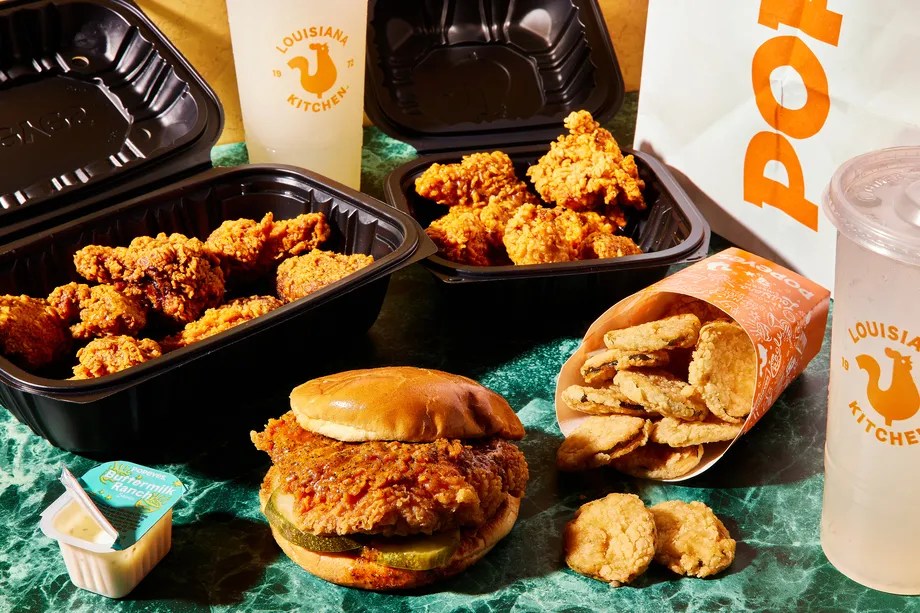
The pickle is Gen Z’s avocado; it’s a passion and a personality. But maybe, Jaya Saxena suggests, that’s missing the point…
In the Top Chef episode “Pickle Me This,” which aired on April 17, host Kristen Kish, in power clashing greens, announces that two teams of chefs must go head to head in creating an all-pickle dinner. The five-course meal was to feature different kinds of pickles in every course — not kimchi or achar necessarily, but instead the cornichons and dill of the European influence. There were charred pickles with cured mackerel, cucumber and celeriac pickle gelee, chef Massimo Piedimonte’s winning fried pickle cannolo, and of course a bread and butter pickle curd with dill ice cream. Individually, each dish sounded great, and judge Tom Colicchio said two of the dishes, including the dessert, were some of the best he’s ever had on the show.
Top Chef contestants often have to create meals utilizing an ingredient that’s in the culinary zeitgeist. Some of those meals are more successful than others. But a successful five-course meal of all things pickles illustrates the strange place in culture the pickle holds now: both cheffy and with diverse-enough flavor profiles to inspire chefs in fierce competition, but obvious and basic enough to also be a little bit of a joke. It’s the food of the moment, both sincerely and ironically.
As Rebecca Jennings wrote in Vox, pickles are Gen Z’s avocado, a viral food that people genuinely enjoy: They “pair well with other contemporary food trends like dirty martinis and canned cocktails, and fit right in with aesthetically pleasing butter boards and “girl dinner” spreads.” But people are also consuming pickles for the meme of it all. There are pickle chips, pickle popcorn, Flamin’ Hot pickle Cheetos, and pickle seltzer. Popeyes recently introduced an entire pickle menu, including pickle lemonade. 21Seeds wants you to make a spicy pickle martini with its tequila, and people are putting pickles in their soda. Sweetgreen has pickle ketchup, and of course Molly Baz has dill pickle mayo. And like any “it” food nowadays, the pickle has moved into fashion and home decor.
Like with any trend, though, it’s kind of exhausting when it’s everywhere. Pickles have become subject to the flavor-ification of actual foods; half the time, pickle-flavored anything is an unsatisfying approximation of the flavor of Central European-style pickled cucumbers — typically a combination of salt, vinegar, and artificial dill which evokes none of the live-culture fizz that hums through the real thing. It’s that complexity we crave, herbs and lactic acid and often spices like coriander.
But for the pickle to be the centerpiece of an entire five-course meal, or for it to be one’s personality to the point that it flavors every snack in one’s house, slightly misses the point of the pickle. A Popeyes meal of fried pickles and pickle glazed wings washed down with a pickle lemonade serves no refreshing alternative to the onslaught of puckering pickle potency. A filthy martini and a bowl of pickle popcorn offers no relief. What makes pickles great on a sandwich or a charcuterie board is usually that the pungent brine and preserving salt make for a great contrast to any creamy, sweet or rich ingredients. Pickles are salt and acid bombs that are delicious on their own, but also enhance every other flavor. It’s why olives are often served with bread and cheese plates have all that cheese. The back and forth is what makes pickles truly shine.
Obviously no one is forcing anyone to only consume pickles, and if that is indeed what your taste buds crave, then congrats on being the moment! But put pickles everywhere and they cease to be a treat, the shining zinging bite to zap you into whatever else you’re eating. Maybe they should stay a sometimes food…
The flavor of the moment: “Is There Too Much Pickle?” from @jayasaxena.com in @eater.bsky.social.
Possibly apposite?: “Will Gen Z’s Pivot to the Republican Party Last?– It’s not only young men who lean conservative. The youngest female voters are also abandoning the Democratic Party.” (gift article)
###
As we test our tastebuds, we might recall that it was on this date in 2009 that 12 year old Catherine Ralston ( a member of Gen Z) was named Easy-Bake “Baker of the Year” for her “Queen of Hearts Strawberry Tart.” The Easy-Bake Oven is, of course, a working toy oven that Kenner introduced in 1963 (more than 16 million Easy-Bake Ovens (in 11 models) had been sold by 1997), and which Hasbro still manufactures.

“All the world is made of faith, and trust, and pixie dust”*…

The Gen Z gender divide, especially as it relates to ever-more conservative males and ever-more liberal females, is widely remarked. (E.g., see here [gift article].) Ruth Graham explores that divide in a different dimension– one that may be fueling the political divergence…
… For the first time in modern American history, young men are now more religious than their female peers. They attend services more often and are more likely to identify as religious.
“We’ve never seen it before,” Ryan Burge, an associate professor of political science at Eastern Illinois University, said of the flip.
Among Generation Z Christians, this dynamic is playing out in a stark way: The men are staying in church, while the women are leaving at a remarkable clip.
Church membership has been dropping in the United States for years. But within Gen Z, almost 40 percent of women now describe themselves as religiously unaffiliated, compared with 34 percent of men, according to a survey last year of more than 5,000 Americans by the Survey Center on American Life at the American Enterprise Institute.
In every other age group, men were more likely to be unaffiliated. That tracks with research that has shown that women have been consistently more religious than men, a finding so reliable that some scholars have characterized it as something like a universal human truth.
The men and women of Gen Z are also on divergent trajectories in almost every facet of their lives, including education, sexuality and spirituality.
Young women are still spiritual and seeking, according to surveys of religious life. But they came of age as the #MeToo movement opened a national conversation about sexual harassment and gender-based abuse, which inspired widespread exposures of abuse in church settings under the hashtag #ChurchToo. And the overturning of Roe v. Wade in 2022 compelled many of them to begin paying closer attention to reproductive rights.
Young men have different concerns. They are less educated than their female peers. In major cities, including New York and Washington, they earn less.
At the same time, they place a higher value on traditional family life. Childless young men are likelier than childless young women to say they want to become parents someday, by a margin of 12 percentage points, according to a survey last year by Pew…
… This growing gender divide has the potential to reshape the landscape of not just religion, but also of family life and politics. In a Times/Siena poll of six swing states in August, young men favored former President Donald J. Trump by 13 points, while young women favored Vice President Kamala Harris by 38 points — a 51-point gap far larger than in other generational cohorts.
It is too early to know if this new trend in churchgoing indicates a long-term realignment, said Russell Moore, the editor in chief of Christianity Today.
But he marveled at its strangeness in Christian history.
“I’m not sure what church life looks like with a decreasing presence of women,” he said, pointing out that they historically have been crucial forces in missionary work and volunteering. “We need both spiritual mothers and spiritual fathers.”…
Eminently worth reading in full: “In a First Among Christians, Young Men Are More Religious Than Young Women” (gift article) by @publicroad in @nytimes.
* J.M. Barrie, Peter Pan
###
As we ponder piety, we might spare a thought for Aimee Semple McPherson; she died on this date in 1944. A Pentecostal evangelist and media celebrity in the 1920s and 1930s, she is best known for founding the Los Angeles-based Foursquare Church and for pioneering the use of media to build her following. She broadcast on radio (spiced with popular entertainment and stage techniques) to draw in both audience and revenue for her weekly sermons at Foursquare’s Angelus Temple, an early megachurch. In her time, she was the most well-known (and publicized) Protestant evangelist, surpassing Billy Sunday and other predecessors.
While McPherson certainly undertook her own promotion, her fame was ignited in 1926, when (a la Agatha Christie) she disappeared– in McPherson’s case for five weeks. The evangelist insisted that she had been kidnapped and taken to Mexico; many believed that she had “retreated” into a tryst with a male colleague. Indeed, she was investigated and charged by L.A. authorities with fabricating a hoax. That charge was never proved, though many still believe that she was in fact the architect of her own disappearance. In any event, the turmoil was national news– and supercharged her rise.

“You see much more of your children after they leave home”*…

… And so, American parents are seeing less of their 18-24 year-old kids. From David Crowther, a graphic reminder that a historic rite of passage for young people and their parents has changed…
As we enter the peak summer months, many students and newly-minted college graduates are taking their first steps into the big bad world of work. In decades gone by, a wave of weddings often followed and young newlyweds shacked up to leave a huge cohort of “empty nesters” behind. That is no longer the case.
In the late 1960s, nearly 40% of 18-24 year-olds lived with their spouse. Last year, just 6% did.
Indeed, data plotted from the Census Bureau (and inspired by reddit user u/theimpossiblesalad) reveals how dramatically the living arrangements of America’s youngest adults have changed in the last 50+ years…

More on how we now live: “Who do Gen Z and Millennials live with in America?” from @ChiefChartmaker in @chartrdaily.
* Lucille Ball
###
As we ruminate on residence, we might recall that it was on this date in 1910 that those epic enactors of the human condition Krazy Kat (and Ignatz Mouse) first appeared in print, in New York Journal (as the “downstairs” strip in George Herriman’s predecessor comic, The Dingbat Family (later, The Family Upstairs). Krazy, Ignatz, and Offisa Pup stepped out on their own in 1913 and ran until 1944– but never actually succeeded financially. It was only the admiration (and support) of publisher William Randolph Hearst that kept those bricks aloft.

You must be logged in to post a comment.